
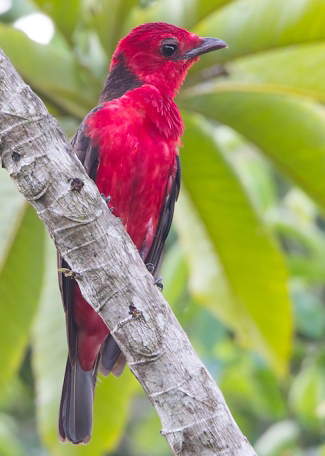
A fabulous male Crimson Fruitcrow by Dubi Shapiro.
- The largest river in the world, inhabited by Grey and Pink River Dolphins and flowing through forest which supports the greatest diversity of life on Earth
- Birds are the most conspicuous forms of life and they include some of
South America's and the world's most spectacular, such as Scarlet, Blue-and-yellow and
Red-and-green Macaws, Channel-billed and Red-billed Toucans, hummingbirds such as Black-eared Fairy
and Crimson Topaz, Pavonine Quetzal, Great, Paradise and Yellow-billed Jacamars, White-plumed Antbird,
Pompadour Cotinga, Capuchinbird, Wire-tailed Manakin and Musician Wren, and
possibly Crimson Fruitcrow, Guianan
Cock-of-the-rock and Guianan Red-cotinga - Mammals are harder to see but they include sloths, tamarins, marmosets and monkeys, notably the red-headed Bald Uakari
- All in some truly wild, almost primeval, terrain which supports 400 species of mammal and 1300 species of bird; 10% of all species known to science in fact.
- In early 2019 an incredible 23 Harpy Eagle nests were located in an area of southern Amazonian rainforest in the state of Mato Grosso in central Brazil, and with the aid of viewing towers some can be viewed at eye level; a possibly very exciting extension to trips to Southern and other parts of Brazil.
- Elsewhere in the huge Amazon region it is possible to visit the Pousada Rio Roosevelt on the fringes of the Madeira-Tapajos interfluvium in southwest Amazonia where Pale-faced Antbird, Black-bellied Gnateater and ten species described to science in 2013 occur; the Madeira-Tapajos interfluvium itself by riverboat in search of Bald and Vulturine Parrots, Golden Parakeet, Fiery-tailed Awlbill, Harlequin and Pale-faced Antbirds, Flame-crested Manakin and Sucunduri Flycatcher; the upper reaches of the Rio Tapajos where there is a floating hotel called Ecolodge da Barra, set up for sport-fishing, and Terra Firme Forest (never flooded), Varzea Forest (seasonally flooded), White Sand Forest and River Islands which together support Dark-winged Trumpeter, Bald Parrot, Pavonine Quetzal, Rufous-necked Puffbird, Pale-faced Antbird, White-tailed Cotinga and, possibly, Rondonia Bushbird; and Amazonia National Park in the Rio Tapajos watershed near Itaituba about halfway between Manaus and Belem in Para state, which supports White-crested Guan, Razor-billed Curassow, Vulturine Parrot, Crimson-bellied Parakeet, Fiery-tailed Awlbill, Blue-cheeked Jacamar, Brown-chested Barbet, Hoffmann’s Woodcreeper, Wing-banded Antbird, Ihering’s Antwren, Pale-faced Bare-eye, Alta Floresta and Variegated Antpittas, Black-necked and Guianan Red-cotingas, White-tailed Cotinga and White-browed Purpletuft, as well as Marbled Wood-quail, Kawall’s Parrot, Santarem Parakeet, Rusty-breasted Nunlet, Black-bellied and Chestnut-belted Gnateaters, Brown-winged Schiffornis and Rose-breasted Chat, with a chance of Crested and Harpy Eagles, Cryptic Forest-falcon, Dark-winged Trumpeter and Golden Parakeet.
- Some tour companies combine a trip to the Manaus region with Cristalino Jungle Lodge in Alta Floresta, southern Amazonia, where nearly 600 species have been recorded, mostly forest birds, including Razor-billed Curassow, Cryptic Forest-falcon, Blue-and-yellow, Red-and-green and Scarlet Macaws, Fiery-tailed Awlbill (a rare hummingbird seemingly restricted to a few scattered sites), Brown-banded Puffbird, Chestnut-belted Gnateater, Pompadour and Spangled Cotingas, Bare-necked Fruitcrow, Amazonian Umbrellabird, White-browed Purpletuft, Musician Wren and Paradise Tanager. More rarely seen birds include Zigzag Heron, Dark-winged Trumpeter and Pavonine Quetzal, and sometimes a Harpy Eagle nest is located, making it easier to see this elusive species. Mammals include Brazilian Tapir and several species of monkey including Azara's Night Monkey.
- A few hours (120 km) by road from Alta Floresta is Rio Azul Jungle Lodge in Para state, one of the best places in the world to see the endemics Bald Parrot and Tapajos Hermit, while the still rising list of over 500 species also includes White-throated Tinamou, Razor-billed Curassow, Zigzag Heron, Crested and Harpy Eagles, Cryptic Forest-falcon, Santarem Parakeet, Pavonine Quetzal, Crimson Topaz, Blue-necked and Bronzy Jacamars, Black-girdled Barbet, Collared Puffbird, Glossy Antshrike, and Flame-crowned and Snow-capped Manakins, as well as Red-throated Piping-guan, Blue-and-yellow, Blue-winged, Red-and-green and Red-bellied Macaws, Paradise Jacamar, Black-fronted Nunbird, Curl-crested and Red-necked Aracaris, Channel-billed and White-throated Toucans, Long-billed Woodcreeper, Bare-eyed, Dot-backed and Xingu Scale-backed Antbirds, Chestnut-belted Gnateater, White-bellied and Zimmer’s Tody-tyrants, Bare-necked Fruitcrow, Spangled Cotinga, Black and Flame-crowned Manakins, Pale-bellied Mourner, Brown-winged Schiffornis, Long-billed Gnatwren, Plush-crested Jay, Dotted and Green-and-gold Tanagers, and White-bellied Dacnis.
Best Birds and other wildlife in the Amazon, Brazil
Birds
Endemics
Widespread Ariel (Channel-billed) Toucan (Amazonia and east) and Ochre-backed Woodpecker (lower Amazon and northeast).
East Amazonia 17 White-crested Guan, Chestnut-headed Chachalaca, Ash-bellied Hermit, Black-winged Trumpeter, Eastern Red-necked Aracari, Varzea Piculet, Santarem Parakeet, Golden Parakeet, Bananal Antbird, Xingu Scale-backed Antbird, Snethlage’s Antpitta, Spix’s Woodcreeper, Xingu Scythebill, Layard’s Woodcreeper, White-tailed Cotinga, Para Oropendola and Rose-bellied Chat.
Amazonia 28 Tapajos Hermit, Scaled Ground-cuckoo, Olive-winged Trumpeter, Chestnut-headed Nunlet (tiny range), Brown-chested Barbet, Bald Parrot, Diademed Amazon, White-faced Amazon (Kawall’s Parrot), Green-thighed (White-bellied) Amazon, Eastern Ornate Stipplethroat (Antwren), Klage’s Antwren, Glossy Antshrike, Spix’s Antwarbler (Warbling Antbird), Tapajos Scale-backed Antbird, Pale-faced Bare-eye, Bare-eyed Antbird, Harlequin Antbird, Rufous-faced Antbird, Black-breasted (Chestnut-belted) Gnateater, Black-bellied Gnateater, Tapajos Antpitta, Brigida’s (Red-billed) Woodcreeper, Tapajos Scythebill, Para Foliage-gleaner, Golden-crowned Manakin, Buff-cheeked Tody-flycatcher, Para Gnatcatcher and Crimson-fronted Cardinal.
West Amazonia 5 Ochre-winged Trumpeter, Yellow-tailed (White-bellied) Amazon, Bonaparte’s Parakeet, Predicted Antwren and Alta Floresta Antpitta.
Southwest Amazonia 12 Green-winged Trumpeter, Rondonia Bushbird, Aripuana Antwren, Manicore Antwarbler (Warbling Antbird), White-breasted Antbird, Hoffmann’s Woodcreeper, White-tailed Tityra, Chico’s Tyrannulet, Campina (Azure-naped) Jay, Inambari (Guianan) Gnatcatcher, Grey Wren and Cone-billed Tanager.
Near-endemics - not all of these occur in the central Amazon region
Brazil, Venezuela and Guyana 35 Roraiman Nightjar, Tepui Swift, Tepui Goldenthroat, Peacock Coquette, Velvet-browed Brilliant, Rufous-breasted Sabrewing, Copper-tailed (Green-bellied) Hummingbird, Tepui Parrotlet, Roraiman Antwren, Streak-backed Antshrike, Roraiman Antbird, Tepui Antpitta, White-throated Foliage-gleaner, Roraiman Barbtail, Tepui Spinetail, Olive Manakin, Scarlet-horned Manakin, Orange-bellied Manakin, Rose-collared Piha, Green-cheeked (Green-backed) Becard, Black-fronted Tyrannulet, Chapman’s Bristle-tyrant, Sierra de Lema (McConnell’s) Flycatcher, Ruddy Tody-flycatcher, Tepui Elaenia, Flutist Wren, Tepui Wren, Pantepui (Black-billed) Thrush, Tepui Brush-finch, Golden-tufted Grackle, Roraiman (Two-banded) Warbler, Tepui Whitestart, Olive-backed Tanager, Greater Flowerpiercer and Black-hooded Tanager.
Brazil, Venezuela and Guianas 36 Guianan Puffbird, Tepui Toucanet, Guianan Toucanet, Green Aracari, Black-spotted Barbet, Caica Parrot, Painted Parakeet, Northern Red-shouldered Macaw, Brown-bellied Stipplethroat (Antwren), Spot-tailed Antwren, Todd’s Antwren, Black-throated Antshrike, Guianan Antwarbler (Warbling Antbird), Ferruginous-backed Antbird, Red-billed Woodcreeper, Chestnut-rumped Woodcreeper, Lineated (Guianan) Woodcreeper, McConnell’s Spinetail, Tiny Tyrant-manakin, Crimson-hooded Manakin, White-throated Manakin, Guianan Red-cotinga, White Bellbird, Dusky Purpletuft, Glossy-backed Becard, Olivaceous Schiffornis (Mourner), Smoky-fronted Tody-flycatcher, Painted Tody-flycatcher, Guianan Tyrannulet, Olive-crowned Greenlet, Tepui Vireo (not French Guiana), Cayenne Jay, Finsch’s Euphonia, Golden-sided Euphonia, Red-and-black Grosbeak and Blue-backed Tanager.
Brazil and Venezuela 6 Buff-breasted Sabrewing, Sapphire-spangled Emerald, Caura Antbird, Black-chested Tyrant, Great Elaenia (likely to occur in Guyana) and Scaled Flowerpiercer.
Brazil and Guianas 6 Northern Long-tailed Woodcreeper, Olive-green Tyrannulet, Boat-billed Tody-tyrant, Todd’s Sirystes, White-throated Pewee (not Guyana) and Guianan Gnatcatcher.
Brazil and Guyana 4 Sun Parakeet, Rio Branco Antbird, Willis’s Antbird and Hoary-throated Spinetail.
Brazil, Guyana and Bolivia 1 Pale-bellied Tyrant-manakin.
Brazil and Suriname 2 Sulphur-breasted Parakeet and Pelzeln’s Tody-tyrant.
Brazil, Suriname and Bolivia 1 Horned Sungem.
Brazil and French Guiana 1 Sooty Barbthroat.
Brazil, Venezuela and Colombia 7 Orinoco Piculet, Yapacana Antbird, Grey-bellied Antbird, Yellow-throated Antwren, Brown-headed Greenlet, Azure-naped Jay and Rio Negro Gnatcatcher.
Brazil and Colombia 1 Chestnut-crested Antbird.
Brazil, Colombia and Peru 2 Plain-breasted Piculet and Varzea Thrush.
Brazil, Ecuador and Peru 1 Orange-crested Manakin.
Brazil and Peru 6 Fine-barred Piculet, Acre Antshrike, Manu Antbird, Black-tailed Antbird, Elusive Antpitta and Acre Tody-tyrant.
Brazil, Peru and Bolivia 39 Brazilian Tinamou, Purus Jacamar, White-throated Jacamar, Blue-necked (-cheeked) Jacamar, Bluish-fronted Jacamar, Semi-collared Puffbird, Rufous-necked Puffbird, Fulvous-chinned Nunlet, Rufous-capped Nunlet, Black-throated (Emerald) Toucanet, Green-billed (Golden-collared) Toucanet, Brown-mandibled Aracari, Flame-throated (Lemon-throated) Barbet, Amazonian Parrotlet, Black-legged Parrot, Rose-fronted Parakeet, Black-capped Parakeet, Blue-headed Macaw, Southern Red-shouldered Macaw, Sclater’s Antwren, Ihering’s Antwren, Saturnine Antshrike, Bluish-slate Antshrike, Bamboo Antshrike, White-lined Antbird, Goeldi’s Antbird, Rufous-fronted Antthrush, Ocellated Woodcreeper, Inambri Woodcreeper, Flame-crested Manakin, Red-headed Manakin, Round-tailed Manakin, Black-faced Cotinga, Rufous Twistwing, Long-crested Pygmy-tyrant, Flammulated Bamboo-tyrant, White-cheeked Tody-flycatcher, Yellow-crested Tanager and Pearly-breasted Conebill.
Brazil and Bolivia 30 Red-throated Piping-guan, Long-tailed Ground-dove, Cinnamon-throated Hermit, Buff-bellied Hermit, Dot-eared Coquette, Eastern Striolated Puffbird, Gould’s Toucanet, Lettered Aracari, Western Red-necked Aracari, Black-girdled Barbet, White-wedged Piculet, Cryptic Forest-falcon, Yellow-faced Parrot, Crimson-bellied Parakeet, Madeira (Santarem) Parakeet, Rio Madeira Stipplethroat (Antwren), Large-billed Antwren, Natterer’s Slaty Antshrike, Rondonia Antwarbler (Warbling Antbird), Humaita Antbird, Double-collared Crescentchest, Campo Miner, Uniform Woodcreeper, Dusky-capped (Rondonia) Woodcreeper, Snow-capped Manakin, Snethlage’s Tody-tyrant, Chapada Flycatcher, Tooth-billed Wren, Blue Finch and Black-and-tawny Seedeater.
Brazil, Bolivia and Paraguay 13 Rufous-faced Crake, White-winged Nightjar (small range), Hyacinth Macaw, Black-bellied Antwren, Rufous-winged Antshrike, Bolivian Slaty Antshrike, Mato Grosso Antbird, White-lored Spinetail, Helmeted Manakin, White-rumped Monjita, Curl-crested Jay, Fawn-breasted Wren and White-bellied (Golden-crowned) Warbler.
Other specialities Pavonine Quetzal, Bronzy Jacamar, Varzea Piculet, Amazonian, Blackish-grey and Glossy Antshrikes, Cherrie's, Klage's and Leaden Antwrens, Pompadour, Purple-breasted and Spangled Cotingas, and Fulvous Shrike-tanager, as well as river island forms of Band-tailed Nightjar, Plain Softtail and Streaked Flycatcher. Also a chance of Agami Heron, Harpy Eagle, Black-faced Hawk, Sunbittern, Long-tailed, Rufous and White-winged Potoos, Racket-tailed Coquette, Crimson Fruitcrow and Amazonian Umbrellabird.
Others
Horned Screamer, Muscovy Duck, guans, Capped and Boat-billed Herons, King Vulture, American Swallow-tailed Kite, Sungrebe, Wattled Jacana, Large-billed
and Yellow-billed Terns, Black Skimmer, Blue-and-yellow, Red-and-green and Scarlet Macaws, Hoatzin, Common and Great Potoos, trogons, hummingbirds such as
Black-eared Fairy and Crimson Topaz, all five South American kingfishers, Great, Green-tailed and Paradise Jacamars, Spotted Puffbird, Swallow-wing,
aracaris, toucans, woodpeckers, spinetails including Red-and-white, Point-tailed Palmcreeper, foliage-gleaners, woodcreepers including Long-billed,
antshrikes, antbirds including Black-and-white and White-plumed, antthrushes, tyrannulets, tody-tyrants, Lesser Wagtail-tyrant, flycatchers, Spotted
Tody-flycatcher, Screaming Piha, Bare-necked Fruitcrow, Golden-headed and Wire-tailed Manakins, Slaty-capped Shrike-vireo, Black-capped Donacobius,
Musician Wren, tanagers, Black-faced and Yellow-bellied Dacnises, honeycreepers, oropendolas, Oriole Blackbird and Orange-backed Troupial.
Mammals
Bald and Golden-backed (Spix's Black-headed) Uakaris, Grey (Tucuxi) and Pink (Boto) River Dolphins, Giant Otter,
Brown-throated and Pale-throated Three-toed, and Southern Two-toed Sloths, Gold-and-white, Maues, Santarem and Satere Marmosets, Pied (Bare-faced) Tamarin,
Golden-faced, Gray's Bald-faced and Guianan Bearded Saki Monkeys, Brown-tufted, Humboldt's (White-faced/fronted) and Spix's White-fronted Capuchin Monkeys,
Spix's Night Monkey, Black and Red Howlers, Bare-eared and Humboldt's (Common) Squirrel Monkeys, Ashy-grey, Chestnut-bellied, Hoffmann's and Lake Baptista
Titi Monkeys, Grey Four-eyed, Little Rufous Mouse, Southern (Common) and Western Woolly Opossums, Common Vampire Bat, and Greater and Lesser Fishing Bats.
Also a chance of Southern Tamandua, Golden-handed Tamarin, and Black-tailed Hairy Dwarf, Dwarf and Prehensile-tailed (Brazilian) Porcupines.
Reptiles, Amphibians and Fish
Black Caiman.
Invertebrates
Numerous butterflies including several species of Morpho and
a multitude of insects including nomadic columns of Army Ants which eat every animal in their path up to
the size of small snakes and are often followed by birds such as antbirds, foliage-gleaners and
woodcreepers which pick off fleeing insects.
Plants
Possibly the greatest diversity on Earth; a single hectare (2.5 acres)
may support 480 tree species.
Other Natural Wonders of the Amazon, Brazil
The River Amazon is the largest river in the world by far and the second longest river in the world at 6515 km (4050 miles), just 180 km (110 miles) short of the River Nile at 6695 km (4160 miles), although some scientists argue that the Amazon is the longest. It has over a thousand tributaries which together with the main river hold about 20% of the planet's fresh water, and the Amazon Basin is the largest drainage basin of any river in the world at over 5 million sq km (2 million sq miles).
Solimoes-Negro interfluvium ('The Meeting of the Waters') Near Manaus, 2250 km (1400 miles) inland from the River Amazon's mouth at the Atlantic Ocean, the two largest rivers in South America meet. Ten km (six miles) downstream from Manaus the warm, dark water of the Rio Negro, on which the city is situated, meets the cooler, muddy water of the Amazon (called Solimoes to the west) and they flow side by side and do not mix completely for several kilometres (miles).
Best Sites for Birds and other wildlife in the Amazon, Brazil
- Manaus Area
- Tropical Hotel grounds Pied Tamarin, Pale-throated Three-toed and Southern Two-toed Sloths, and Golden-faced Saki.
- Ilha Marchantaria (Rio Solimoes island specialists) Short-tailed Parrot, Tui Parakeet, Olive-spotted Hummingbird, Red-and-white and White-bellied Spinetails, Black-and-white Antbird, Brownish Elaenia, River Tyrannulet, Riverside Tyrant, Lesser Wagtail-tyrant, Oriole Blackbird and Orange-backed Troupial. Also a chance of Pied Plover and Black Skimmer.
- MUSA Tower 42m canopy tower with platforms at three heights, Caica Parrot, Guianan Puffbird, Black-spotted Barbet, Guianan Toucanet, Lineated (Guianan) Woodcreeper, Glossy-backed Becard, Red-billed Pied Tanager, Black-faced Dacnis and Spotted Tanager.
- BDFFP Reserve (Biological Dynamics of Forest Fragments Project) White-winged Potoo, Great Jacamar, Painted Tody-flycatcher, Capuchinbird (lek), Guianan Red-cotinga (lek) and Guianan Cock-of-the-rock (lek). Also a chance of Grey-winged Trumpeter.
- Ramal do Pau Rosa Red-fan Parrot, Brown-banded Puffbird, Gilded Barbet, Ivory-billed Aracari, Scale-breasted Woodpecker, Black-throated and Northern Slaty Antshrikes, Black-throated, Dusky, White-cheeked and Yellow-browed Antbirds, Black-necked Red-cotinga, Blue-crowned Manakin and Blue-backed Tanager.
- Presidente Figueiredo Area, 100 km north of Manaus
- ZF-2 Tower 40m canopy tower, Crimson Fruitcrow, as well as Black-faced Hawk, Lined Forest-falcon, Black-bellied Cuckoo, Red-lored Parrot, Guianan Puffbird, Green Aracari, Golden-collared and Scale-breasted Woodpeckers, Painted Tody-flycatcher, Olive-green Tyrannulet, Pompadour and Spangled Cotingas, Guianan Gnatcatcher, Short-billed Honeycreeper and Dotted Tanager.
- Guianan Cock-of-the-Rock lek area Painted Parakeet, Guianan Cock-of-the-rock (lek) and Dusky Purpletuft.
- White sand forest (locally known as campinarana) Northern Slaty Antshrike, Pelzeln's Tody-tyrant, Black Manakin and Pale-bellied Mourner.
- Cachoeira da Onca Azure Gallinule, Hoatzin, Rufous Potoo, Cinereous Antshrike, Black-headed and Rufous-throated Antbirds, Pompadour Cotinga, Capuchinbird, Guianan Red-cotinga, Yellow-crowned Manakin and Musician Wren.
- Cachoeira das Lages Green-tailed Goldenthroat, Bronzy Jacamar, Black Manakin, Pale-bellied Mourner and White-naped Seedeater.
- Ramal do Mari-Mari Red-and-green Macaw, Sapphire-rumped and Scarlet-shouldered Parrotlets, Black-headed, Caica, Dusky, Festive, Orange-cheeked, Red-fan, Short-tailed and Vulturine Parrots, Crimson-bellied, Golden, Golden-winged, Santarem and Tui Parakeets, Guianan Cock-of-the-rock (lek) and Yellow-crested Manakin.
- Iracema Falls Pavonine Quetzal, Crimson Topaz, Black-eared Fairy, Paradise Jacamar, Black-necked and Green Aracaris, Channel-billed and Red-billed Toucans, Purple-breasted and Spangled Cotingas, Golden-headed Manakin and Fulvous Shrike-tanager. Also a chance of Guianan Cock-of-the-rock, Guianan Red-cotinga, Dusky Purpletuft, Golden-handed Tamarin and Red Howler Monkey.
- West from Manaus up the Rio Negro
- Novo Airao area including islands of Anavilhanas (Archipelago) National Park (Igapo (flooded forest) specialties) Marail Guan, Agami Heron, Black-headed, Festive and Red-fan Parrots, White-winged Potoo, Fiery-tailed Awlbill, Bronzy and Yellow-billed Jacamars, Guianan Puffbird, Guianan and Tawny-tufted Toucanets, Varzea Piculet, Long-billed, Ocellated, Red-billed and Zimmer’s Woodcreepers, Curve-billed Scythebill, Blackish-grey Antshrike, Ash-breasted, Ferruginous-backed, White-cheeked and White-plumed Antbirds, Cherrie’s, Klage’s, Leaden and Sclater’s Antwrens, Guianan and Olive-green Tyrannulets, Chestnut-belted Gnateater, Bare-necked Fruitcrow, Pompadour and Spangled Cotingas, White-browed Purpletuft, Saffron-crested and Tiny Tyrant-manakins, Black, Wire-tailed (lek) and Yellow-crested Manakins, Glossy-backed Becard, Varzea Schiffornis, Guianan (Rio Negro) Gnatcatcher, Wing-banded Wren, Golden-sided Euphonia, Blue-backed and Dotted Tanagers, and White-naped Seedeater. Also a chance of Crested Eagle, Grey-winged Trumpeter, Rufous and White-winged Potoos, Reddish-winged Bare-eye, Black-necked Red-cotinga, Amazonian Umbrellabird, Southern Tamandua and Pink River Dolphin.
- Jau NP Golden-backed Uakari, Golden-faced Saki, Grey and Pink River Dolphins, Pavonine Quetzal, White-plumed and Chestnut-crested Antbirds, White-winged Potoo and Yellow-crested Manakin. Also a chance of Rufous Potoo.
- Mamiraua Reserve Bald Uakari, Grey and Pink River Dolphins, Giant Otter and Black Squirrel Monkey. The birdlife of this reserve is still being explored but it is thought the possibilities include Harpy Eagle and Wattled Curassow.
- East from Manaus down the Rio Solimoes
- River Islands Short-tailed Parrot, Olive-spotted Hummingbird, Lesser Hornero, Scaled, White-bellied, and White-breasted Spinetails, Castelnau's Antshrike, Black-and-white Antbird and Pearly-breasted Conebill.
- North bank of the Rio Amazonas Varzea Piculet, Plain Softtail (obidensis), Glossy Antshrike and Cinereous Becard. Also a chance of Toco Toucan, and Ashy-headed and Grey-chested Greenlets.
- East from Manaus to Rios Madeira, Canuma, Abacaxis and Maues
- Rio Madeira Gold-and-white Marmoset, Lake Baptista Titi Monkey and Crimson-hooded Manakin.
- Rio Canuma Bare-eared Squirrel Monkey and Ashy-grey Titi Monkey.
- Rio Abacaxis Maues (west bank) and Satere (east bank) Marmosets.
- Rio Maues and Maues area Maues Marmoset, Golden Parakeet and White-tailed Cotinga.
- Rio Maues to Mirim Santarem Marmoset.
Best Times for Birds and other wildlife in the Amazon, Brazil
The River Amazon usually floods between June and October after the wet season which usually lasts from November to April, with water levels reaching a peak in mid-June the best time to look for primates because the flooded forest (up to 15 metres higher than before the flood) is more accessible. This is also true of September-October the best time to look for birds. Alas, heat and humidity also peak between June and October.
Recommended Bird Books etc. for the Amazon, Brazil
Birds of Brazil by K Zimmer and A Whittaker. PUP, due 2020+.
A Field Guide to the Birds of Brazil by B van Perlo. OUP, 2009.
Birds of Venezuela by D Ascanio, G Rodriguez and R Restall. Helm, 2017.
Birds of South America: Non-Passerines by J R Roderiguez Mata et al. Harper Collins, 2006 hbk/Princeton University Press, 2006 pbk.
Birds of South America: Passerines by R S Ridgely and G Tudor. University of Texas Press/Helm, 2009 (Updated paperback edition of books listed next with 400 more illustrations).
The Birds of South America: Passerines by R S Ridgely and G Tudor. University of Texas Press, 1989 and 1994 (Two volumes).
Birds of Northern South America by R Restall, C Rodner and M Lentino. Helm, 2006 (Two volumes).
Mammals of South America by R D Lord. Johns Hopkins University Press, 2007.
Globetrotter Wildlife Guide: Brazil by J Malathronas. New Holland Publishers, 2008.
Apps etc.
All Birds Northern Brazil by Bloomsbury/Sunbird Images.
Birds of Brazil.
Where to watch birds in South America by N Wheatley. Helm, 1994.
Don’t know which country/countries to visit in South America? Then it may be worth considering taking a look at this book, written by this website’s author. It is many years old of course but it still provides a starting point, an overview and a guiding light to the best birds and the best places to look for them on the continent, and could save hours of searching for similar information on the internet. However, it is important to check more up-to-date sources for sites which have been opened up, sites and species which have been discovered, lodges that have been built etc. since the book was published.
Birding and Wildlife Trip Reports for the Amazon, Brazil
Many trip reports, some for the Amazon, are posted on the websites listed here. On some of these websites some reports are independent and some are posted by tour companies who organize tours to the Amazon. These tour companies and others also post their own reports on their websites, which are listed under 'Some Organized Tours to the Amazon' below.
- The best website for trip reports is CloudBirders
- but these are also worth a look
- Birdtours
- Fatbirder
- Jon Hornbuckle
- Mammal Watching
Local bird and wildlife guides in the Amazon, Brazil
The costs of organized tours partly reflect the quality of the tour leaders. Some leaders are certainly better than others and many companies claim their leaders are the best but even the best rely at least to some extent on the exceptional skills of the local guides they employ. If you are travelling independently, employing such local guides will greatly increase your chances of seeing the wildlife you wish to see.
Accommodation for birders in the Amazon, Brazil
Some Organized Tours for birds and other wildlife to the Amazon, Brazil
There are many tour companies who organize tours to see mammals, birds, other wildlife and other natural wonders. The cost of these tours vary considerably according to such variables as the airlines used, the number of days the tours last, the number of sites visited, the number of people in the group (an important consideration if you wish to see such wildlife as rainforest mammals and birds), the number of tour leaders, the standard of accommodation and transport, and the percentage profit the company hopes to make. Generally, where the number of days tours last and the number of sites visited are similar, the cheapest tours are those that use the cheapest airlines, accommodation and local transport, that have the largest groups with the least number of leaders, and that make the least amount of profit. The most expensive tours tend to be those which are exceptionally long, use the most expensive accommodation (ridiculously lavish in some cases, even for single nights) and which make the most profit. Some tour costs partly reflect the quality of the tour leaders. Some leaders are certainly better than others and many companies claim their leaders are the best but even the best rely at least to some extent on the exceptional skills of the local guides they employ.
While tour companies organize tours with set itineraries many also organize custom tours for individuals and private groups who instead of taking a tour with a set itinerary want to follow their own itinerary to suit their own personal tastes, whether it be mammals, birds, other wildlife, other natural wonders or even man-made attractions, or a mixture of them all. Many organized tours with set itineraries are also fast-paced and target as many species as possible, whether they are mammals, birds or other wildlife or everything, which usually leaves little time to enjoy the best sites and individual species, but on a custom tour those taking part can specify the pace and the sites and species they wish to concentrate on. Custom tours also suit people who like to travel with people they already know, rather than with a group of strangers, and people with partners with different interests. Individuals and small groups will almost certainly have to pay more than the price of an organized tour with a set itinerary but a large group of friends may be able to travel for less than the price quoted for a set tour.
Tour companies who run organized tours or can arrange custom tours to the Amazon include the following.
