
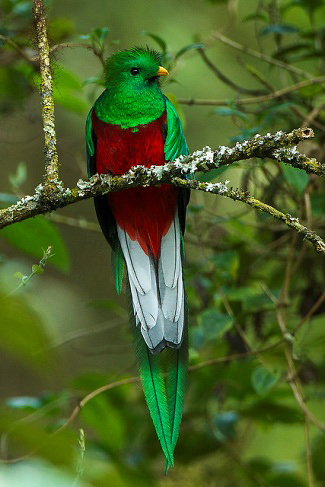
The aptly-named Resplendent Quetzal by Francesco Veronesi. A fabulous bird even though this particular individual does not have a full-length tail in which the central tail feathers may extend up to 65 cm (2 ft) beyond the rest of the tail!
- Birds, so many birds, in such a small area
- Over 900 species in just 50,000 sq km, of which it is possible to record over 500 in two weeks and nearly 600 in three
- Including up to 80 Central American Endemics and about 40 species confined to the highlands spanning the border of Costa Rica and Panama
- In one of the best selections of the world's most spectacular birds, including Sunbittern, Scarlet Macaw, nearly 50 hummingbirds, Resplendent Quetzal, seven trogons, motmots such as Turquoise-browed, Rufous-tailed Jacamar, Keel-billed Toucan, Three-wattled Bellbird, Bare-necked Umbrellabird, Lovely, Snowy, Turquoise and Yellow-billed Cotingas, and Red-capped Manakin
- As well as sloths, howler and spider monkeys, nesting turtles, basilisk lizards, colourful frogs, giant dragonflies and numerous
butterflies - So Costa Rica's got the lot
- And all in a mainly scenic mountainous country with one of the most consistently active volcanoes on Earth, and about 12% of its land within reserves, the highest percentage of 'protected' land in the world
- As if to prove how birdy Costa Rica is, on October 25th 2015 Ernesto Carman Moyher and Jairo Jimenez Chavez recorded 351 bird species in less than 24 hours, the third highest day total anywhere in the world after Ecuador (425) and Northern Peru (354). They covered 403 km by car and 7 km on foot, travelling from the Pacific coast to the slopes of the Irazu volcano and down to the Caribbean lowlands, visiting places such as Punta Morales, Carara National Park, Irazu Volcano, Braulio Carrillo National Park and Las Brisas Nature Reserve. In 2017 488 species were seen on an 8-day bird race!
- Kekoldi is one of four locations in the world where over a million raptors pass over in a single season, the other three being Batumi in Georgia, Eilat in Israel and Veracruz in Mexico. Over 2.5 million birds are recorded between September and November each year over Kekoldi in the Talamanca Mountains including over a million Turkey Vultures and Broad-winged Hawks, 250,000 Mississippi Kites and over 50,000 Swainson's Hawks, as well as Peregrines, and Sharp-shinned and Zone-tailed Hawks.
- Many of Costa Rica's most spectacular birds, including Resplendent Quetzal, Three-wattled Bellbird, Fiery-billed Aracari, Long-tailed Silky Flycatcher, Flame-throated Warbler and Zeledonia, also occur in west Panama. There and in the rest of Panama it is possible to see other birds such as Blue-and-yellow, Great Green and Red-and-green Macaws, Ocellated Antbird, Yellow-collared Chlorophonia, Tody Motmot and Sapayoa.
- From Puerto Viejo de Sarapiqui in Costa Rica it is possible to reach, via a three to four hour boat journey, the lavish Rio Indio Lodge in Rio Maiz Biological Reserve, Nicaragua. Over 400 species have been recorded near this lodge including Agami Heron, all six American kingfishers, Sunbittern, Great Green and Scarlet Macaws, Bare-crowned and Ocellated Antbirds, Thicket Antpitta and Snowy Cotinga.
- It is perhaps no coincidence that Costa Rica, one of the 'birdiest' countries in the world, also happens to be the number one (for the third time in 2016) happiest and greenest country in the world according to the Happy Planet Index which is calculated by the New Economics Foundation. This index measures resource use (Costa Rica uses a mere quarter of the resources that are typically used in a country in the Western world), and how long and happy a life people enjoy as a result, hence while some so-called 'more developed' countries may score highly when it comes to life expectancy and well-being the environmental cost of this is extremely high. Numbers two to ten in the list of 140 countries are Mexico, Colombia, Vanuatu, Vietnam, Panama, Nicaragua, Bangladesh, Thailand and Ecuador. The UK came in at number 34 and the USA at 108.
Best Birds and other wildlife in Costa Rica
Birds
Mainland Endemics 5
Mangrove Hummingbird, Coppery-headed Emerald, Grey-tailed (White-throated) Mountaingem (Cordillera de Talamanca), Costa Rican (Cabanis's/Prevost's) Ground
Sparrow and Black-cheeked Ant Tanager. Also, Guanacaste Hummingbird (Amazilia alfaroana) which is known only from a single 1896 specimen from Volcan
de Miravalles in the northwest, and three species endemic to the Cocos Islands, 300 km (180 miles) offshore; a cuckoo, a flycatcher and a finch.
Near-endemics
Costa Rica and Panama 74 (13 hummingbirds, two trogons, two cotingas and two silky-flycatchers) Black Guan, Black-breasted Wood-quail, Buff-fronted Quail-dove, Purplish-backed Quail-dove, Chiriqui Quail-dove, Dusky Nightjar, Costa Rican Swift, Veraguas Mango, White-crested Coquette, Garden Emerald, Black-bellied Hummingbird, White-tailed Emerald, Charming Hummingbird, Snowy-bellied Hummingbird, Talamanca (Magnificent) Hummingbird, Fiery-throated Hummingbird, White-bellied Mountain-gem, Magenta-throated Woodstar, Volcano Hummingbird, Scintillant Hummingbird, Costa Rican Pygmy-owl, Lattice-tailed Trogon, Baird’s Trogon, Fiery-billed Aracari, Prong-billed Barbet, Golden-naped Woodpecker, Red-fronted Parrotlet, Sulphur-winged Parakeet, Black-hooded Antshrike, Dull-mantled Antbird, Silvery-fronted Tapaculo, Southern Spot-crowned Woodcreeper, Buffy Tuftedcheek, Streak-breasted Treehunter, Chiriqui (Buff-throated) Foliage-gleaner, Ruddy Treerunner, Orange-collared Manakin, Turquoise Cotinga, Yellow-billed Cotinga, Olive-streaked Flycatcher, Black-capped Flycatcher, Dark Pewee, Ochraceous Pewee, Yellow-green (Scrub) Greenlet, Yellow-winged Vireo, Silvery-throated Jay, Ochraceous Wren (range also probably reaches Colombia), Timberline Wren, Riverside Wren, Isthmian (Plain) Wren, Black-faced Solitaire, Black-billed Nightingale-thrush, Sooty Thrush, Black-and-yellow Silky-flycatcher, Long-tailed Silky-flycatcher, Golden-browed Chlorophonia, Spot-crowned Euphonia, Sooty-capped Bush-tanager, Costa Rican Brush-finch, Yellow-thighed Finch, Large-footed Finch, Volcano Junco, Wrenthrush, Flame-throated Warbler, Chiriqui Yellowthroat, Black-cheeked Warbler, Black-eared (Three-striped) Warbler, Collared Whitestart, Black-thighed Grosbeak, Sulphur-rumped Tanager, Cherrie’s (Scarlet-rumped) Tanager, Peg-billed Finch, Slaty Flowerpiercer and Spangle-cheeked Tanager.
Costa Rica, Panama and Colombia 5 Blue-throated (Emerald) Toucanet, Tawny-capped Euphonia, Sooty-faced Finch, Black-and-yellow Tanager and Blue-and-gold Tanager.
Costa Rica, Panama and Nicaragua 6 Purple-throated Mountain-gem, Vermiculated Screech-owl, Bare-necked Umbrellabird, Canebrake Wren, Yellow-crowned Euphonia and Nicaraguan Seed-finch.
Costa Rica and Nicaragua 2 Tawny-chested Flycatcher and Nicaraguan Grackle.
Costa Rica, Nicaragua and Honduras 1 White-eared Ground-sparrow.
Other Specialities
Great Curassow, Resplendent Quetzal, Black-crested Coquette, Snowcap, Violet Sabrewing, Keel-billed Motmot, Three-wattled Bellbird, and Lovely and Snowy
Cotingas, Also a chance of Great Green Macaw, Agami Heron, tinamous, wood quails, owls, Northern Royal Flycatcher, Green-and-rufous Kingfisher, Lanceolated
Monklet, White-faced Nunbird and Black-crowned Antpitta.
Others
Bare-throated and Fasciated Tiger Herons, Boat-billed Heron, Roseate Spoonbill, Jabiru, Brown Pelican, Magnificent Frigatebird, Brown Booby, Anhinga, King
Vulture, American Swallow-tailed Kite, Ornate Hawk Eagle, White Hawk, Collared Forest Falcon, an estimated 5 million raptors which migrate over Costa Rica
during October, Sunbittern, Grey-cowled and Russet-naped Wood Rails, Sungrebe, Limpkin, Double-striped Thick-knee, Northern Jacana, pigeons and quail
doves, Scarlet Macaw, parrots, Great Potoo, nearly 50 hummingbirds, seven trogons, motmots, kingfishers, Rufous-tailed Jacamar, puffbirds, Red-headed
Barbet, Blue-throated and Yellow-eared Toucanets, Collared Aracari, Chestnut-mandibled and Keel-billed Toucans, woodpeckers, woodcreepers, antbirds
including Ocellated and Spotted, antthrushes, antpittas, Rufous Piha, manakins, Masked and Black-crowned Tityras, flycatchers including Fork-tailed and
Scissor-tailed (Nov-Mar), Black-capped Pygmy Tyrant (the smallest passerine bird in the world along with Short-tailed Pygmy Tyrant), wrens, American
Dipper, nightingale thrushes, Black-faced Solitaire, Tropical Parula, wintering warblers including Golden-winged and Blackburnian, Scarlet-thighed Dacnis,
Green and Red-legged Honeycreepers, tanagers, and Chestnut-headed and Montezuma Oropendolas.
Mammals
Hoffmann's Two-toed and Brown-throated Three-toed Sloths, Central
American Squirrel, Geoffroy's Spider, Mantled Howler and White-faced Capuchin Monkeys, Humpback and Sperm
Whales (both mostly Dec-Jan), White-nosed Coati, Collared and White-lipped Peccaries, Greater Bulldog (Fishing) Bat and
Neotropical River Otter. Also a chance of West Indian Manatee, Baird's Tapir, Northern Tamandua, Silky Anteater, Nine-banded
Armadillo, Bushy-tailed Olingo, Common Opossum, Kinkajou and Tayra.
Reptiles, Amphibians and Fish
Whale Shark, Manta Ray (especially in Gulf of Papagayo, mainly Dec-Mar), Spectacled Caiman,
American Crocodile, many amazing frogs including Glass Frogs, Red-eyed Tree Frog and Poison-dart Frogs, basilisk lizards, and Green (mostly Jul-Sep on
Caribbean coast), Hawksbill (mostly Jul-Sep on Caribbean coast), Leatherback (mostly Nov-Feb on Pacific coast and Mar-May on Caribbean coast),
Loggerhead (mostly Aug-Sep on Caribbean coast) and Olive Ridley (Jun-Dec, mostly Sep-Nov on Pacific coast) Turtles.
Invertebrates
Helicopter Damselflies (the largest dragonflies in the world),
Hercules Beetle and many spectacular butterflies.
Other Natural Wonders of Costa Rica
Arenal Volcano One of the most consistently active volcanoes in the world, rising to 1657 m (5436 ft). Almost daily, lava and huge red-hot rocks tumble down the slopes and huge columns of ash rise from the crater.
Best Sites for Birds and other wildlife in Costa Rica
- Standard Circuit
- El Copal Snowcap, White-crested Coquette, Black-headed Antthrush, Tawny-chested Flycatcher and Blue-and-gold Tanager.
- Ujaras Costa Rican Ground Sparrow.
- Savegre Valley/Cerro de la Muerte Resplendent Quetzal, hummingbird feeders at Hotel Savegre, Hotel Suria, La Georgina (good for Fiery-throated Hummingbird) and Paraiso de Quetzals (also good for Fiery-throated Hummingbird), Buffy Tuftedcheek, Dark Pewee, Long-tailed Silky Flycatcher, Flame-throated and Black-cheeked Warblers, Zeledonia, Golden-browed Chlorophonia and, high up, Timberline Wren, Volcano Junco and Peg-billed Finch. Also a chance of Buff-fronted (Costa Rican) Quail Dove, Bare-shanked Screech Owl and Silvery-throated Jay (Los Robles FR).
- La Providencia Road Buffy Tuftedcheek, Flame-throated Warbler and Zeledonia.
- Tapanti NP Golden-browed Chlorophonia. Also a chance of Lovely Cotinga.
- Rancho Naturalista Sunbittern, hummingbird feeders and bathing pools for species such as Black-crested Coquette, Snowcap, Purple-crowned Fairy and Violet Sabrewing, Broad-billed and Rufous Motmots, Spotted Antbird, Lovely Cotinga, White-collared (lek), White-crowned and White-ruffed Manakins, and Tawny-chested Flycatcher. Also a chance of Paint-billed Crake.
- Irazu Volcano NP Costa Rican Ground Sparrow. Also a chance of Resplendent Quetzal and Buffy-crowned Wood Partridge.
- Braulio Carrillo NP Lattice-tailed Trogon, White-ruffed Manakin, White-throated Shrike Tanager, Scarlet-thighed Dacnis and Mantled Howler. Also a chance of Snowcap (especially at nearby El Tapir Hummingbird Garden), Yellow-eared Toucanet and Black-crowned Antpitta.
- Veragua Rainforest Reserve Bare-necked Umbrellabird (Dec-Jan), Purple-crowned Fairy and Red-eyed Tree Frog.
- La Selva (Biological Station - Organization for Tropical Studies) Hoffmann's Two-toed Sloth, Mantled Howler, Red-eyed Tree Frog, Giant Helicopter Damselfly, Great Curassow, Semi-plumbeous Hawk, Great Green Macaw, Slaty-tailed Trogon, Broad-billed and Rufous Motmots, Pied and White-necked Puffbirds, Chestnut-mandibled and Keel-billed Toucans, Chestnut-coloured and Rufous-winged Woodpeckers, Black-capped Pygmy-Tyrant, Snowy Cotinga, Rufous Piha, and Red-capped and White-collared (lek) Manakins. Also a chance of Tayra, Agami Heron, Sungrebe, Sunbittern, Great Potoo, Crested Owl and Three-wattled Bellbird (mostly Mar-Jun).
- Selva Verde Red-eyed Tree Frog, and Black-and-green and Blue-jeans Poison-Dart Frogs.
- La Paz Waterfall Gardens hummingbird feeders for hummingbirds such as Violet Sabrewing, Green Thorntail and Black-bellied Hummingbird, as well as Sooty-faced Finch.
- Tirimbina Rainforest Center Strawberry Poison-Dart Frog and Helicopter Damselfly. Also a chance of Sunbittern, Great Green Macaw, Broad-billed and Rufous Motmots, and White-collared Manakin.
- Catarata del Toro hummingbird feeders for hummingbirds including Coppery-headed Emerald, Violet Sabrewing and Black-bellied Hummingbird.
- Bosque de Paz feeders for Black Guan, hummingbirds etc. Also a chance of Resplendant Quetzal and Scaled Antpitta.
- Arenal Area Arenal Volcano, Great Curassow (at feeders at Arenal Observatory Lodge), Broad-billed and Rufous Motmots, Black-crested Coquette, Keel-billed Toucan, Bare-crowned, Ocellated and Spotted Antbirds, Thicket Antpitta, Streak-crowned Antvireo, Lovely Cotinga (with antbirds and antpitta along trail below Arenal Observatory Lodge), White-collared Manakin, Scarlet-thighed Dacnis and Red-eyed Tree Frog (Arenal Observatory Lodge gardens). Also a chance of Uniform and White-throated Crakes (at Sendero Bogarin Reserve feeders), Keel-billed Motmot (along old road to Arenal Observatory Lodge), Lanceolated Monklet, White-fronted Nunbird and White-throated Shrike Tanager.
- Monteverde Together with the Santa Elena Reserve 400+ birds including 30 hummingbirds, 5000+ moths and 2500 plants including 420 orchids. Speciality birds include Resplendent Quetzal (mostly Jan-Jul, especially Curi Cancha Reserve), Three-wattled Bellbird (mostly Mar-Jul, especially Bajo del Tigre and Curi Cancha Reserves), Ornate Hawk Eagle, Blue-diademed Motmot, Coppery-headed Emerald and Violet Sabrewing. Also a chance of Black-breasted Wood Quail, Barred Forest Falcon, Chiriqui Quail Dove, Lovely Cotinga, Golden-browed Chloroponia, Scarlet-thighed Dacnis, White-eared Ground Sparrow, Hoffmann's Two-toed Sloth, Bushy-tailed Olingo (at hummingbird feeders at night), Common Opossum and Kinkajou.
- San Gerardo Research Station/Children's Eternal Rainforest Great Curassow, Three-wattled Bellbird, Bare-necked Umbrellabird (lek, best visited mid-April to mid-May), Golden-bellied Flycatcher, Azure-hooded Jay and Blue-and-gold Tanager.
- Santa Elena Reserve Black Guan, Collared (Orange-bellied) Trogon, Streak-breasted Treehunter and Bare-necked Umbrellabird (most likely along Encantado Trail). Also a chance of Buff-fronted (Costa Rican) Quail Dove.
- Hacienda Solimar Bare-throated Tiger Heron, Jabiru, Spectacled Owl and Long-tailed Manakin.
- Carara National Park/Rio Tarcoles/Mangrove Boat Trips (Big) American Crocodiles, Hoffmann's Two-toed Sloth, Mantled Howler, White-faced Capuchin, White-nosed Coati, Bare-throated Tiger Heron, Boat-billed Heron, Scarlet Macaw, Baird's and Slaty-tailed Trogons, Turquoise-browed Motmot, White-necked and White-whiskered Puffbirds, Fiery-billed Aracari, Chestnut-mandibled Toucan, antbirds, Rufous Piha (Punta Leona FR), and Long-tailed (lek), Red-capped and Orange-collared (lek along River Trail) Manakins. Also a chance of Northern Tamandua, Kinkajou, Green-and-black Poison-dart Frog, Collared Forest Falcon, Rufous-necked Wood Rail, Striped Owl, Streak-chested Antpitta, Green Shrike Vireo, Northern Royal Flycatcher, and Turquoise and Yellow-billed Cotingas.
- Cerro Lodge, near Tarcoles Scarlet Macaw, Turquoise-browed Motmot and Yellow-billed Cotinga.
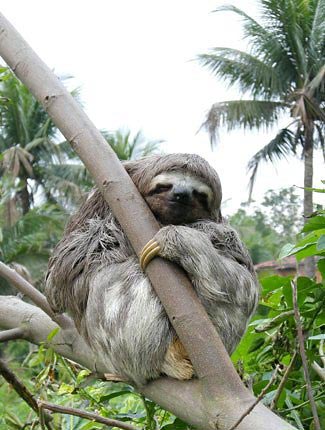
Three-toed Sloth by Chris Townend.
- South
- Talari Mountain Lodge White-crested Coquette and Turquoise Cotinga.
- Los Cusingos Reserve Baird's Trogon, White-crested Coquette, Rufous Piha, Turquoise Cotinga and Red-capped Manakin (lek).
- San Vito Chiriqui (Masked) Yellowthroat and Costa Rican (Stripe-headed) Brush Finches.
- Las Cruces Biological Station/Wilson Botanical Garden hummingbirds such as White-tailed Emerald.
- Esquinas Rainforest Lodge Great Curassow, Baird's Trogon, Golden-naped Woodpecker, Orange-collared and Red-capped (lek) Manakins, Black-cheeked Ant Tanager, White-throated Shrike Tanager and night Frog Walks for Red-eyed Tree Frog.
- Golfito Road and Rio Rincon Bridge, 3 km south of Rincon de Osa Scarlet Macaw, Baird's Trogon, Turquoise and Yellow-billed Cotingas, and Black-cheeked Ant Tanager, with Mangrove Hummingbird nearby.
- Playa Nicuesa Rainforest Lodge, Piedras Blancas NP Scarlet Macaw, trogons including Baird's, Blue-crowned, Red-capped and Orange-collared (lek) Manakins, Black-cheeked Ant Tanager, Emerald Glass Frog and Red-eyed Tree Frog.
- Bosque del Rio Tigre Lodge, Osa Peninsula Central American Spider Monkey, King Vulture, White-crested Coquette, White-tipped Sicklebill, Black-hooded Antshrike, Turquoise Cotinga, Orange-collared and Red-capped Manakins, and Black-cheeked Ant Tanager (at feeders). Also a chance of Uniform Crake.
- Bosque del Cabo Lodge, Osa Peninsula Central American Spider Monkey, Red-eyed Tree Frog, poison-dart frogs, Helicopter Damselfly, trogons including Baird's and Red-capped Manakin (lek).
- Corcovado NP, Osa Peninsula Humpback and Sperm Whales, turtles, Central American Squirrel, Geoffroy's Spider, Mantled Howler and White-faced Capuchin Monkeys, Scarlet Macaw, Turquoise Cotinga, Rufous Piha, and Red-capped and Orange-collared Manakins. Also a chance of Northern Tamandua, Baird's Tapir (especially near Sirena Biological Station where habituated to the many visitors), White-lipped Peccary, Yellow-billed Cotinga and Three-wattled Bellbird (mostly Oct-Feb).
- Tiskita Jungle Lodge Mantled Howler, Central American Spider and White-faced Capuchin Monkeys, Giant Helicopter Damselfly, King Vulture, Baird's Trogon and Red-capped Manakin.
- West Coast
- Hacienda Baru Purple-crowned Fairy, Yellow-throated Toucan, Fiery-billed Aracari, Orange-collared and Red-capped (at lek) Manakins.
- Manuel Antonio NP A chance of Silky Anteater (on boat trips to mangroves), Northern Tamandua, Two-toed and Three-toed Sloths, White-faced Capuchin, Mantled Howler Monkey and Rainbow Grasshoppers.
- Northwest
- Palo Verde NP Numerous waterbirds usually most active at their nests in January (a good time to look for boa constrictors which feed on the eggs and chicks), Bare-throated Tiger Heron, Boat-billed Heron, Jabiru, Double-striped Thick-knee, Turquoise-browed Motmot and Long-tailed Manakin. Also a chance of Northern Tamandua, Nine-banded Armadillo, Great Curassow and Spectacled Owl.
- Playas Nancite, Naranjo and Ostional Green, Hawksbill, Leatherback and hundreds of thousands of Olive Ridley (mainly Playa Ostional where thousands may arrive to nest at the same time) Turtles.
- Las Baulas NMP/Tamarindo Bay NWR Leatherback and Olive Ridley Turtles.
- Buena Vista Lodge Turquoise-browed Motmot and Long-tailed Manakin.
- Heliconias Lodge Lovely Cotinga. Also a chance of Purplish-backed Quail Dove, and Keel-billed and Tody Motmots.
- Celeste Mountain Lodge, Volcan Tenorio Lattice-tailed Trogon and Tody Motmot.
- North
- Lago Cano Negro including boat trips along Rio Frio in Cano Negro Wildlife Refuge Bare-throated Tiger Heron, Sungrebe and Nicaraguan Grackle. Also a chance of Agami Heron, White-throated and Yellow-breasted Crakes, Striped Owl, Green-and-rufous Kingfisher, Bare-crowned Antbird, Snowy Cotinga and Nicaraguan Seed-Finch.
- Laguna del Lagarto Great Curassow, Sungrebe, Green-and-black and Strawberry Poison-dart Frogs. Also a chance of Agami Heron, Great Green and Scarlet Macaws, and Ocellated Antbird.
- East Coast
- Tortuguero NP Hoffmann's Two-toed Sloth, Mantled Howler, Spider Monkey, Green, Hawksbill and Leatherback Turtles, Spectacled Caiman, Basilisk Lizard, Greater Bulldog (Fishing) Bat, Neotropical River Otter, Boat-billed Heron, Sungrebe, Green-and-rufous Kingfisher, and Red-capped and White-collared Manakins. Also a chance of West Indian Manatee, Loggerhead Turtle, Red-eyed Tree Frog, Great Green Macaw, Agami Heron and Snowy Cotinga.
- Pacuare Reserve Green and Leatherback Turtles (Mar-Aug), and the only nesting site of Agami Heron in Costa Rica and one of only a few accessible nesting sites in the world (May-Sep).
Best Times for Birds and other wildlife in Costa Rica
Rain is possible all year round in the mountainous centre of the country and along the Caribbean coast but Costa Rica as a whole is usually less wet between December and April and most birds can be seen during this time, especially in the driest months of February and March which also fall within the periods when Resplendent Quetzal (Jan-Jul, especially Mar-Jun) and Three-wattled Bellbird (Mar-Jun) usually nest, although the peak time to see Bare-necked Umbrellabird at the lek is mid-April to mid-May. The northern summer period, known as 'Green Season' in Costa Rica, sees fewer tourists, lower rates in many hotels and more frequent, often daily, rain.
Many other resident birds nest in June-July and despite this period falling in the wetter season this is also a good time to look for the quetzal (although it loses its long tail streamers at this time of the year) and bellbird, when quetzals usually migrate down the Pacific slope into less dense forest at Monteverde (mostly in June) and bellbirds normally congregate on the same slope (mostly in July). July is also the best time to look for Snowcap, when this hummingbird descends to lowland Caribbean forest, where Bare-necked Umbrellabirds usually spend their non-breeding season (Jun-Mar).
The best times to see turtles are July to December on the Pacific coast (when huge numbers of Olive Ridley Turtles usually come ashore around the last quarter of the moon each month, especially in September, October and November) and April to September on the Caribbean coast. The best time for whales is December and January.
Recommended Bird Books etc. for Costa Rica
Birds of Central America by A C Vallely and D Dyer. PUP, 2018.
Birds of Costa Rica by R Garrigues and R Dean. Comstock, 2014 (Second Edition).
The Wildlife of Costa Rica: A Field Guide by F A Reid et al. Comstock, 2010.
An Illustrated Field Guide to the Birds of Costa Rica by V Esquivel Soto. Incafo, 2008 (Second Edition).
Where to watch Birds in Costa Rica by B Lawson. Helm, 2010.
Mammals, Amphibians, and Reptiles of Costa Rica by C L Henderson. University of Texas Press, 2011.
The Mammals of Costa Rica by M Wainwright. CUP, 2007.
A Field Guide to the Mammals of Central America and Southeast Mexico by F A Reid. OUP, 2009 (Second Edition).
Butterflies, Moths and Other Invertebrates of Costa Rica: A Field Guide by C L Henderson. University of Texas Press, 2010.
A Swift Guide to the Butterflies of Mexico and Central America by J Glassberg. Sunstreak Books, 2007.
National Audubon Society Field Guide to Tropical Marine Fishes by C L Smith. Alfred A Knopf, 1997.
Apps etc.
Costa Rica Birds Field Guide.
Where to watch birds in Central America & the Caribbean by N Wheatley and D Brewer. Helm, 2001.
Don’t know which country/countries/regions to visit in Central America? Then it may be worth considering taking a look at this book, written by this website’s author and David Brewer. It is many years old of course but it still provides a starting point, an overview and a guiding light to the best birds and the best places to look for them in the region, and could save hours of searching for similar information on the internet. However, it is important to check more up-to-date sources for sites which have been opened up, sites and species which have been discovered, lodges that have been built etc. since the book was published.
Birding and Wildlife Trip Reports for Costa Rica
Many trip reports, some for Costa Rica, are posted on the websites listed here. On some of these websites some reports are independent and some are posted by tour companies who organize tours to Costa Rica. These tour companies and others also post their own reports on their websites, which are listed under 'Some Organized Tours to Costa Rica' below.
- The best website for trip reports is CloudBirders
- but these are also worth a look
- Birdtours
- Fatbirder
- Jon Hornbuckle
- Mammal Watching
Local bird and wildlife guides in Costa Rica
The costs of organized tours partly reflect the quality of the tour leaders. Some leaders are certainly better than others and many companies claim their leaders are the best but even the best rely at least to some extent on the exceptional skills of the local guides they employ. If you are travelling independently, employing such local guides will greatly increase your chances of seeing the wildlife you wish to see.
Accommodation for birders in Costa Rica
Some Organized Tours for birds and other wildlife to Costa Rica
There are many tour companies who organize tours to see mammals, birds, other wildlife and other natural wonders. The cost of these tours vary considerably according to such variables as the airlines used, the number of days the tours last, the number of sites visited, the number of people in the group (an important consideration if you wish to see such wildlife as rainforest mammals and birds), the number of tour leaders, the standard of accommodation and transport, and the percentage profit the company hopes to make. Generally, where the number of days tours last and the number of sites visited are similar, the cheapest tours are those that use the cheapest airlines, accommodation and local transport, that have the largest groups with the least number of leaders, and that make the least amount of profit. The most expensive tours tend to be those which are exceptionally long, use the most expensive accommodation (ridiculously lavish in some cases, even for single nights) and which make the most profit. Some tour costs partly reflect the quality of the tour leaders. Some leaders are certainly better than others and many companies claim their leaders are the best but even the best rely at least to some extent on the exceptional skills of the local guides they employ.
While tour companies organize tours with set itineraries many also organize custom tours for individuals and private groups who instead of taking a tour with a set itinerary want to follow their own itinerary to suit their own personal tastes, whether it be mammals, birds, other wildlife, other natural wonders or even man-made attractions, or a mixture of them all. Many organized tours with set itineraries are also fast-paced and target as many species as possible, whether they are mammals, birds or other wildlife or everything, which usually leaves little time to enjoy the best sites and individual species, but on a custom tour those taking part can specify the pace and the sites and species they wish to concentrate on. Custom tours also suit people who like to travel with people they already know, rather than with a group of strangers, and people with partners with different interests. Individuals and small groups will almost certainly have to pay more than the price of an organized tour with a set itinerary but a large group of friends may be able to travel for less than the price quoted for a set tour.
Tour companies who run organized tours or can arrange custom tours to Costa Rica include the following.
