
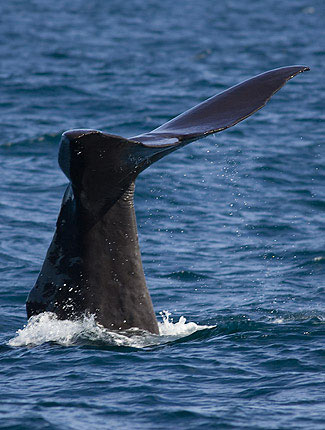
Sperm Whale fluke by Ray Wilson.
- A few of the Caribbean’s and the world’s most spectacular localized birds, including two endemic parrots, and the near-endemic Blue-headed Hummingbird, Purple-throated Carib and Brown Trembler
- And a few of the Caribbean's and the world's most spectacular other birds including Magnificent Frigatebird, Ringed Kingfisher and Green-throated Carib
- But Dominica is perhaps more famous for being one of the best places in the world to see Sperm Whales
- And Pilot Whales, and Spinner and Spotted Dolphins
- With a chance of other whales as well, including Bryde's, Cuvier’s Beaked, Dwarf Sperm, Pygmy Sperm, False Killer and Melon-headed, and other dolphins such as Bottlenose and Fraser's
- On and around a scenic, mountainous, heavily forested island
- The small island of Dominica rises steeply out of the Caribbean Sea to over 1400 metres (4593 feet) and the high, rugged interior receives an average of about five metres (16 feet) of rain a year, ideal conditions for waterfalls. So much water also means Dominica is a lush, green island, a world away from the hustle and bustle of many other Caribbean islands. And there is much more to Dominica than the verdant forests. Just offshore the deep waters along the leeward coast support many whales and dolphins, and are particularly important as a calving ground for Sperm Whales. These whales are resident and males or more usually mothers with calves can be seen with surprising reliability on boat trips out of the capital Roseau. On such trips, on comfortable, spacious catamarans, which usually go out for three to four hours mornings and afternoons, it is possible, with rum punch in hand, to watch the whales' tail flukes arcing over as they dive while listening to the clicks of the highly vocal whales through the onboard hydrophones and perhaps thinking about the deepest dive ever recorded which was 2000 metres (6500 feet) during a dive which lasted 1 hour 13 minutes off Dominica in 1991.
- Many organized birding tours to Dominica also include other islands in the Lesser Antilles where the total number of endemic bird species is 31, with the most single-island endemics on St Lucia where there are five. On that and other islands there are also Red-billed and White-tailed Tropicbirds, and, on Barbuda, the largest colony (about 18,000 pairs) of Magnificent Frigatebirds in the world.
Best Birds and other wildlife in Dominica
Birds
The species lists below are for the northern winter.
Endemics 2
Imperial and Red-necked Amazons.
Lesser Antillean Endemics 11
Lesser Antillean Swift, Purple-throated Carib, Blue-headed Hummingbird (otherwise occurs only on Martinique), Lesser Antillean Flycatcher, (Southern)
Brown Trembler, Scaly-breasted Thrasher, Forest Thrush (difficult), Lesser Antillean Euphonia, Plumbeous Warbler (otherwise occurs only on Guadeloupe),
Lesser Antillean Bullfinch and Lesser Antillean Saltator.
Lesser Antillean and Puerto Rican Endemics 3
Antillean Crested Hummingbird, Green-throated Carib and Lesser Antillean Pewee.
Others
Magnificent Frigatebird, Brown Booby (mostly Dec-May), Brown Pelican, Green and Little Blue Herons, Broad-winged Hawk, Laughing Gull, Bridled,
Roseate, Royal and Sooty Terns, Brown Noddy (terns and noddies mostly Apr-Aug), Scaly-naped Pigeon, Zenaida Dove, Ruddy Quail Dove, Mangrove Cuckoo,
Smooth-billed Ani, Black Swift (mostly Mar-Oct), Ringed Kingfisher, Grey Kingbird, Caribbean Elaenia, Black-whiskered Vireo (mostly Apr-Oct), Caribbean
Martin (mostly Feb-Sep), (Southern/Dominica) House Wren, Rufous-throated Solitaire, Eastern Red-legged Thrush (probably introduced), Tropical Mockingbird,
Pearly-eyed Thrasher, Yellow (Golden) Warbler, Bananaquit, Black-faced Grassquit and Carib Grackle.
Mammals
Sperm and (Short-finned) Pilot Whales, and Spinner and Spotted Dolphins. Also a chance of Bryde’s, Cuvier’s
Beaked, Dwarf Sperm, Pygmy Sperm, False Killer and Melon-headed Whales, and (Atlantic) Bottlenose and Fraser’s Dolphins. Red-rumped Agouti has been
introduced.
Reptiles, Amphibians and Fish
Excellent scuba-diving and snorkeling, Lesser Antillean Iguana, and Green, Hawksbill and
Leatherback Turtles which nest on some beaches along the north and east coasts, mostly from March to October.
Other Natural Wonders of Dominica
'Boiling Lake'
This large volcanic lake is believed to be the second largest ‘hot-water’ lake in the world, after
Waimangu Cauldron in New Zealand.
Best Sites for Birds, whales and other wildlife in Dominica
- Boat trips off west coast Whales, dolphins and a few seabirds.
- Syndicate Nature Trail, Northern FR Imperial and Red-necked Amazons, Lesser Antillean Swift, Blue-headed Hummingbird, Lesser Antillean Flycatcher, Brown Trembler, Scaly-breasted Thrasher, Plumbeous Warbler, Ruddy Quail Dove, Black Swift, Lesser Antillean Pewee, Rufous-throated Solitaire, Eastern Red-legged Thrush and Lesser Antillean Euphonia. Also a chance of Forest Thrush.
Best Times for Birds, whales and other wildlife in Dominica
Sperm Whales are usually present throughout the year but are most likely to be seen from November to April especially in April when there are nursery groups of females with calves. The best time for birds is usually February to June before the hurricane season which normally lasts from July to November and is usually wetter and more humid than the rest of the year. The temperature on this mildly tropical island usually varies between between 25°C and 28°C.
Recommended Bird Books etc. for Dominica
Collins Field Guide: Birds of the West Indies by N Arlott. Harper Collins, 2010.
Birds of the West Indies by H Raffaele et al. Helm, 1998.
A Field Guide to the Birds of the West Indies by James Bond. Originally published in 1936 by the Academy of Natural Sciences and reprinted many times since by several publishers including Collins and Houghton Mifflin.
National Audubon Society Field Guide to Tropical Marine Fishes by C L Smith. Alfred A Knopf, 1997.
Butterflies of the Caribbean and Florida by P Stiling. Macmillan Caribbean, 1999.
Where to watch birds in Central America & the Caribbean by N Wheatley and D Brewer. Helm, 2001.
Don’t know which country/countries/regions to visit in the Caribbean? Then it may be worth considering taking a look at this book, written by this website’s author and David Brewer. It is many years old of course but it still provides a starting point, an overview and a guiding light to the best birds and the best places to look for them in the region, and could save hours of searching for similar information on the internet. However, it is important to check more up-to-date sources for sites which have been opened up, sites and species which have been discovered, lodges that have been built etc. since the book was published.
Birding and Whale Watching Trip Reports for Dominica
Many trip reports, some for Dominica, are posted on the websites listed here. On some of these websites some reports are independent and some are posted by tour companies who organize tours to Dominica. These tour companies and others also post their own reports on their websites, which are listed under 'Some Organized Tours to Dominica' below.
- The best website for trip reports is CloudBirders
- but these are also worth a look
- Birdtours
- Fatbirder
- Jon Hornbuckle
- Mammal Watching
Local bird and whale watching guides in Dominica
The costs of organized tours partly reflect the quality of the tour leaders. Some leaders are certainly better than others and many companies claim their leaders are the best but even the best rely at least to some extent on the exceptional skills of the local guides they employ. If you are travelling independently, employing such local guides will greatly increase your chances of seeing the wildlife you wish to see.
Accommodation for birders and whale watchers in Dominica
Some Organized Tours for birds, whale watching and other wildlife to Dominica
There are many tour companies who organize tours to see mammals, birds, other wildlife and other natural wonders. The cost of these tours vary considerably according to such variables as the airlines used, the number of days the tours last, the number of sites visited, the number of people in the group (an important consideration if you wish to see such wildlife as rainforest mammals and birds), the number of tour leaders, the standard of accommodation and transport, and the percentage profit the company hopes to make. Generally, where the number of days tours last and the number of sites visited are similar, the cheapest tours are those that use the cheapest airlines, accommodation and local transport, that have the largest groups with the least number of leaders, and that make the least amount of profit. The most expensive tours tend to be those which are exceptionally long, use the most expensive accommodation (ridiculously lavish in some cases, even for single nights) and which make the most profit. Some tour costs partly reflect the quality of the tour leaders. Some leaders are certainly better than others and many companies claim their leaders are the best but even the best rely at least to some extent on the exceptional skills of the local guides they employ.
While tour companies organize tours with set itineraries many also organize custom tours for individuals and private groups who instead of taking a tour with a set itinerary want to follow their own itinerary to suit their own personal tastes, whether it be mammals, birds, other wildlife, other natural wonders or even man-made attractions, or a mixture of them all. Many organized tours with set itineraries are also fast-paced and target as many species as possible, whether they are mammals, birds or other wildlife or everything, which usually leaves little time to enjoy the best sites and individual species, but on a custom tour those taking part can specify the pace and the sites and species they wish to concentrate on. Custom tours also suit people who like to travel with people they already know, rather than with a group of strangers, and people with partners with different interests. Individuals and small groups will almost certainly have to pay more than the price of an organized tour with a set itinerary but a large group of friends may be able to travel for less than the price quoted for a set tour.
Tour companies who are running organized tours to the Lesser Antilles including Dominica in the next couple of years include the following. Many of these also offer custom tours.
