
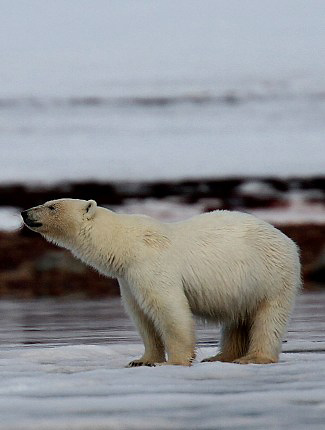
Polar Bear by Brian Field.
- The greatest concentration of Polar Bears in the world
- And a good chance of seeing the Northern Lights, at one of the most reliable places for some of the most intense displays of them in the world
- As well as a few birds including Grey Jay, Arctic Redpoll, and, possibly, Snowy Owl and Gyr Falcon
- In late summer Polar Bears begin to congregate along a 100-mile-long stretch of the Hudson Bay shoreline and by mid-October between 600 and 1000 may be present between the Nelson and Churchill River mouths; the largest concentration on Earth. Many head for the capes and headlands, especially Cape Churchill because this is usually where the winter ice in Hudson Bay first sets hard and the bears, which are very hungry after a lean summer of slim pickings on land, need to leave the land in search of seals.
- Polar Bears may be plentiful and easy to see around Churchill in northern Manitoba but so are tourists, filling the specially adapted, heated vehicles known as Tundra Buggies which seat up to 40 people at a time. It is possible to stand on the high, open platforms at the back of these 'buggies' and look down into the eyes of a fearless Polar Bear but those who prefer to watch Polar Bears in less crowded, more wild circumstances, even on foot, may wish to consider staying at one of the two remote lodges on the shores of Hudson Bay, accessible by air from Churchill, run by Churchill Wild. Perhaps better still they can be seen from boats in the beautiful surroundings of the Arctic or Spitsbergen.
- There are few birds around Churchill during the Polar Bear season, but there are more in the Winnipeg area, especially waterbirds, and in Riding Mountain National Park, a few hours by road from there, where Moose, Elk and even Black Bear (sometimes until early November) and Great Grey Owl are possible.
- During the first half of June there is usually a strong passage of migrating waterbirds through the Churchill area, where up to fifteen species of shorebird, Smith’s Longspur and Bald Eagle nest, and it is possible to see (and even swim with) Belugas from late June to mid-August, while birds present in Southern Manitoba at this time include Sharp-tailed (around Melita in southwest) and Spruce Grouse, waterbirds (especially at St Ambroise PP, Lake Manitoba), Yellow Rail (around Brandon in the southwest), Barred Owl, American Woodcock, Red-headed Woodpecker (around Brandon), Chestnut-collared Longspur (around Melita) and in Riding Mountain NP; Great Grey Owl, Evening Grosbeak and over 20 species of breeding warbler including Blackburnian, Chestnut-sided, Connecticut, Golden-winged and Mourning.
- What is thought to be the greatest concentration of snakes in the world occurs at the Narcisse Snake Dens, about 130 km north of Winnipeg, usually in early May, when tens of thousands of Red-sided Garter Snakes emerge from hibernation.
Best Birds and other wildlife in Manitoba
The lists below are for the October-November Polar Bear season.
Mammals
Polar Bear. Also a chance of Arctic (some in white winter pelage late on in season) and Red Foxes, Arctic Hare,
Red Squirrel, and Bearded and Ringed Seals, and in Southern Manitoba, (American) Black Bear, Moose and Elk (Wapiti).
Birds
Common Eider, Red Grouse (Willow Ptarmigan), Glaucous Gull, Grey Jay, Raven, Boreal Chickadee, Snow Bunting, and
Common and Arctic (Hoary) Redpolls. Also a chance of Purple Sandpiper, Snowy Owl, Gyr Falcon (including white morphs), (Rock) Ptarmigan and Pine
Grosbeak, as well as Bald Eagle and waterbirds such as Bufflehead around Winnipeg, and, in Rocky Mountain NP, resident species such as Evening
Grosbeak and, possibly, Great Grey Owl.
Other Natural Wonders of Manitoba
Northern Lights (Aurora Borealis)
These spectacular lights in the sky are currently at their most intense in the world
in northern Canada (near where the magnetic pole is currently situated) and Churchill, where they are claimed to appear up to 300 nights a year, is one
of the best places in the world to see them. There is a good chance of seeing them at the same time as Polar Bears in October-November but the peak
time to see them is February to April.
Best Sites for Birds and other wildlife in Manitoba
- Churchill Polar Bear, Willow Ptarmigan, Grey Jay and Arctic Redpoll. Also a chance of Arctic and Red Foxes, Arctic Hare, Snowy Owl, Gyr Falcon, Ptarmigan and Pine Grosbeak.
- Winnipeg Area Waterbirds such as Bufflehead. Also a chance of Bald Eagle.
- Riding Mountain NP Evening Grosbeak. Also a chance of Black Bear, Moose, Elk and Great Grey Owl.
Best Times for Birds and other wildlife in Manitoba
October-November is the best time for Polar Bears, with numbers usually peaking during late October-early November. At this time of the year it is also possible to see the Northern Lights (Aurora Borealis). They are currently at their most intense in the world in northern Canada (near where the magnetic pole is currently situated) and Churchill, where they are claimed to appear up to 300 nights a year, is one of the best places in the world to see them, although the peak time is usually February to April. The weather in October-November at the beginning of winter is changeable but usually extremely cold. Wind chill can be particularly bad and temperatures may fall as low as minus 45°C! It is therefore essential to take the appropriate clothing for such conditions, even though the ‘tundra buggies’ are heated.
Recommended Bird Books etc. for Manitoba
Mammals of North America by R W Kays and D E Wilson. PUP, 2009 (Second Edition).
Mammals of North America by F A Reid. Peterson North American Field Guides, 2006 (Fourth Edition).
Peterson Field Guide to Finding Mammals in North America by V Dinets. Houghton Mifflin, 2015.
Field Guide to the Birds of North America edited by J Dunn and J Alderfer. NGS, 2011 (Sixth Edition).
Kaufman Field Guide to Birds of North America by K Kaufman. Houghton Mifflin, 2005.
The North American Bird Guide by D Sibley. Helm, 2014 (Second Edition).
The Crossley ID Guide: Eastern Birds by R Crossley. PUP, 2011.
Peterson Field Guide to Birds of Eastern and Central North America by R T Peterson. Houghton Mifflin, 2010 (Sixth Edition).
Apps etc.
National Geographic Birds: Field Guide to North America.
The Sibley eGuide to the Birds of North America.
Peterson Birds of North America.
Audubon Birds - A Field Guide to North American Birds.
iBird Ultimate Guide to Birds.
Birding and Wildlife Trip Reports for Manitoba
Many trip reports, some for Manitoba, are posted on the websites listed here. On some of these websites some reports are independent and some are posted by tour companies who organize tours to Manitoba. These tour companies and others also post their own reports on their websites, which are listed under 'Some Organized Tours to Manitoba' below.
- The best website for trip reports is CloudBirders
- but these are also worth a look
- Birdtours
- Fatbirder
- Jon Hornbuckle
- Mammal Watching
Local bird and wildlife guides in Manitoba
The costs of organized tours partly reflect the quality of the tour leaders. Some leaders are certainly better than others and many companies claim their leaders are the best but even the best rely at least to some extent on the exceptional skills of the local guides they employ. If you are travelling independently, employing such local guides will greatly increase your chances of seeing the wildlife you wish to see.
Accommodation for birders in Manitoba
Some Organized Tours for birds and other wildlife to Manitoba
There are many tour companies who organize tours to see mammals, birds, other wildlife and other natural wonders. The cost of these tours vary considerably according to such variables as the airlines used, the number of days the tours last, the number of sites visited, the number of people in the group (an important consideration if you wish to see such wildlife as rainforest mammals and birds), the number of tour leaders, the standard of accommodation and transport, and the percentage profit the company hopes to make. Generally, where the number of days tours last and the number of sites visited are similar, the cheapest tours are those that use the cheapest airlines, accommodation and local transport, that have the largest groups with the least number of leaders, and that make the least amount of profit. The most expensive tours tend to be those which are exceptionally long, use the most expensive accommodation (ridiculously lavish in some cases, even for single nights) and which make the most profit. Some tour costs partly reflect the quality of the tour leaders. Some leaders are certainly better than others and many companies claim their leaders are the best but even the best rely at least to some extent on the exceptional skills of the local guides they employ.
While tour companies organize tours with set itineraries many also organize custom tours for individuals and private groups who instead of taking a tour with a set itinerary want to follow their own itinerary to suit their own personal tastes, whether it be mammals, birds, other wildlife, other natural wonders or even man-made attractions, or a mixture of them all. Many organized tours with set itineraries are also fast-paced and target as many species as possible, whether they are mammals, birds or other wildlife or everything, which usually leaves little time to enjoy the best sites and individual species, but on a custom tour those taking part can specify the pace and the sites and species they wish to concentrate on. Custom tours also suit people who like to travel with people they already know, rather than with a group of strangers, and people with partners with different interests. Individuals and small groups will almost certainly have to pay more than the price of an organized tour with a set itinerary but a large group of friends may be able to travel for less than the price quoted for a set tour.
Tour companies who are running organized tours to Manitoba in October-November in the next couple of years include the following. Many of these also offer custom tours.
