
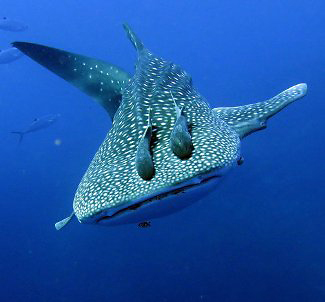
A wonderful Whale Shark by Coke & Som Smith.
- Some of Africa’s and the world’s most spectacular localized birds including Crab Plover, Mangrove Kingfisher, African Pitta, Green-headed Oriole, White-winged Apalis and Dapple-throat
- As well as some of Africa's and the world's most spectacular more widespread birds such as African Fish-eagle, Greater Flamingo, Black and Goliath Herons, and Saddle-billed Stork
- The chance to swim with Manta Rays and Whale Sharks, as well as numerous other fish on some of the most pristine coral reefs in the world
- With Dugongs and Humpback Whales also off the long Indian Ocean coastline
- And some land mammals including Lion, African Elephant, Hippopotamus and African Buffalo, most of which have been reintroduced since the mass slaughter which took place during the civil war between 1977 and 1992
- In April 2021 the British Foreign, Commonwealth & Development Office (FCDO) advised against all travel to the districts of Mueda, Nangade, Palma, Mocimboa da Praia, Muidumbe, Meluco, Macomia, Quissanga and Ibo in Cabo Delgado Province, including the islands off the coast, in the north of the country, due to attacks by groups with links to Islamic extremism, and against all but essential travel to the rest of Mozambique.
- Don’t be put off by the relatively few mammals present in Mozambique; Kruger National Park, one of the best places for mammals in Africa, lies just across the border in Eastern South Africa, and is easy to include in a visit to Mozambique.
Best Birds and other wildlife in Mozambique
Birds
Endemics 2
Mozambique Forest-warbler (small range on Njesi Plateau in northwest) and Namuli (Bar-throated) Apalis.
Near-endemics
Mozambique, Tanzania and Kenya 3 Kretschmer’s Longbill, Uluguru Violet-backed Sunbird and Zanzibar Red Bishop.
Mozambique, Tanzania and Malawi 3 Stierling’s Woodpecker, White-winged Apalis (possibly still present in Kenya) and Olive-headed Greenbul.
Mozambique, Tanzania, Malawi and Zambia 6 Black-browed Mountain Greenbul, White-chested Alethe, Forest Double-collared Sunbird, Bertram’s Weaver, Olive-headed Weaver and Vincent’s (Cape) Bunting.
Mozambique and Tanzania 3 Reichenow’s Woodpecker, Red-capped Forest-warbler (African Tailorbird) and Dapple-throat.
Mozambique, Tanzania and Zimbabwe 1 Swynnerton’s Robin.
Mozambique and Zimbabwe 2 Briar (Roberts’s) Warbler and Chirinda Apalis.
Mozambique, Zimbabwe and Malawi 1 Stripe-cheeked Greenbul.
Mozambique and Malawi 2 Olive-flanked Robin-chat and Thyolo (Cholo) Alethe.
Mozambique, Malawi and Zambia 1 Malawi (Cape) Batis.
Mozambique, South Africa and Botswana 2 Cape White-eye and Fiscal Flycatcher.
Mozambique, South Africa, Botswana and Zimbabwe 1 Cape (Orange-throated) Longclaw.
Mozambique and South Africa 5 Southern Tchagra, Brown Scrub-robin, Sentinel Rock-thrush, Neergaard’s Sunbird and Pink-throated Twinspot.
Mozambique, South Africa and Malawi 1 Rudd’s Apalis.
Mozambique, South Africa, Malawi and Zimbabwe 1 Lemon-breasted Canary (Seedeater).
Mozambique, South Africa and Zimbabwe 5 Cape Grassbird, Barratt’s Warbler, Gurney’s Sugarbird, Swee Waxbill and Cape Canary.
Other specialities
Crab Plover (mostly Nov-Mar), Mangrove Kingfisher, Eastern Green Tinkerbird, African Pitta (mostly Dec-Jan, especially early Dec), Green-headed Oriole,
Black-headed Apalis, Livingstone’s Flycatcher and Lesser Seedcracker. Also a chance of African Blue Quail, Madagascar Pond-heron (mostly May-Sep), Dwarf
Bittern (mostly Oct-Apr), Sooty Falcon (mostly Oct-Apr), Buff-spotted Flufftail, Wattled Crane, Bronze-winged Courser, Great Snipe (mostly Nov-Mar),
Boehm's Bee-eater, Cuckoo-finch and Locust Finch.
Others
African Pygmy Goose, Crested Guineafowl, African Darter, Black, Goliath and Rufous-bellied Herons, Hamerkop, Saddle-billed Stork, Greater Flamingo, Great
Frigatebird, Palm-nut Vulture, African Fish-eagle, Bateleur, African Crowned, Long-crested and Martial Eagles, Black-bellied Bustard, Grey Crowned Crane,
White-headed Lapwing, African and Lesser Jacanas, many other shorebirds, Black-rumped Buttonquail, Livingstone’s and Purple-crested Turacos, cuckoos
including African Emerald, Barred Long-tailed and Thick-billed, Black Coucal, Whistling Yellowbill, owls, Bohm’s Spinetail, Bar-tailed and Narina Trogons,
kingfishers including Brown-hooded, bee-eaters including Madagascar, Southern Carmine and Swallow-tailed, Lilac-breasted Roller, Green Woodhoopoe, Southern
Ground-hornbill, Crowned, Silvery-cheeked and Trumpeter Hornbills, barbets, honeyguides including Green-backed Honeybird, woodpeckers including Little
Spotted (Green-backed), African Broadbill, Cape, Woodwards's and East Coast (Pale) Batises, Chestnut-fronted, Retz’s and White-crested Helmetshrikes,
Black-fronted, Gorgeous, Grey-headed and Sulphur-breasted Bushshrikes, orioles, African Paradise-flycatcher, Blue-mantled and White-tailed
Crested-flycatchers, Eastern Nicator, African Spotted Creeper, greenbuls, Southern Hyliota, Collared Flycatcher (mostly Nov-Mar), White-starred Robin,
Arnot’s Chat, Collared Palm-thrush, Orange Ground-thrush, Miombo Rock-thrush, starlings, sunbirds including Purple-banded and Scarlet-chested,
Rosy-breasted and Yellow-throated Longclaws, weavers, bishops, waxbills, Red-faced Crimsonwing, Broad-tailed Paradise-whydah and Golden-breasted Bunting.
Also a chance of Greater Painted-snipe, Sooty Tern and Pennant-winged Nightjar (mostly Sep-Mar).
Mammals
Dugong, Humpback Whale (mostly Jul-Sep) and Sykes’s (Samango) Monkey, as well as species mostly reintroduced
since the civil war including Lion, Cheetah, African Elephant, Hippopotamus, African Buffalo, Sable and (Lichtenstein’s) Hartebeest.
Reptiles, Amphibians and Fish
Manta Ray (Oceanic and Reef, at cleaning stations all year but mostly Oct-Apr), Whale
Shark (mostly Oct-Mar), over 400 species of reef fish and 180 species of coral, Nile Crocodile and five species of turtle (nesting Oct-Jun, mostly
Oct-Dec). Also a chance of marlins and Sailfish.
Best Sites for Birds and other wildlife in Mozambique
- South of the Zambezi River
- Ponta Raza, Inhaca Island, Maputo Bay Crab Plover (mainly Nov-Mar), Terek Sandpiper and many other shorebirds.
- Inhambane, Barra Peninsula (Ponta da Barra) and Tofo Oceanic and Reef Manta Rays, Whale Shark, Humpback Whale, Crab Plover (mainly Nov-Mar), Terek Sandpiper and many other shorebirds, and Mangrove Kingfisher.
- Dugong Beach Lodge, Vilanculos Dugong.
- Panda Area Chestnut-fronted Helmetshrike, Rudd’s Apalis and Olive-headed Weaver.
- Bazaruto Archipelago Whale Shark, Manta Ray, Nile Crocodile (Bazaruto Island), Sykes’s Monkey, Greater Flamingo, Great Frigatebird, Crab Plover (especially in Vilanculos Coastal WS), Madagascar Bee-eater and five species of turtles (nesting Oct-Dec). Also a chance of Dugong, Sooty Tern, marlins and Sailfish.
- Rio Savane area, near Beira A chance of Black-rumped Buttonquail, African Blue Quail, Rufous-bellied Heron, Great Snipe, Mangrove Kingfisher and Locust Finch.
- Chinizua Vanga Flycatcher, White-chested Alethe and East Coast Akalat.
- M’Phingwe Camp, Catapu, including Coutadas 11 and 12, near Caia African Pitta (Mphingwe Lodge grounds and Coutada 12, a hunting concession), as well as Southern Banded Snake-eagle, Barred Long-tailed Cuckoo, Thick-billed Cuckoo, Narina Trogon, Mangrove Kingfisher, African Broadbill, Chestnut-fronted Helmetshrike, Lowland Tiny Greenbul, Black-headed Apalis, East Coast Akalat, White-chested Alethe, Livingstone’s Flycatcher and Plain-backed Sunbird.
- Zambezi River wetlands, Chimuara Lesser Jacana and White-headed Lapwing. Also a chance of Greater Painted-snipe.
- Mount Gorongosa Green-headed Oriole (endemic subspecies), as well as Vanga Flycatcher. Also a chance of Pennant-winged Nightjar, Pallid Honeyguide, White-chested Alethe, and Swynnerton’s and White-starred Robins.
- Gorongosa NP The roads in this park are usually passable only during the Apr-Nov dry season. Nile Crocodile, Black Heron, Saddle-billed Stork, Lesser Jacana, Martial Eagle, Purple-crested Turaco, Southern Carmine Bee-eater and Southern Ground-hornbill, as well as mostly reintroduced mammals such as Lion, Cheetah, African Elephant, Hippopotamus, African Buffalo, Sable and Hartebeest. Also a chance of Bronze-winged Courser.
- Mount Tsetsera Chirinda Apalis, Orange Ground-thrush and Red-faced Crimsonwing. Also a chance of Buff-spotted Flufftail.
- North of the Zambezi River
- Mount Namuli Namuli and White-winged Apalises, Dapple-throat, Cholo Alethe and Bar-tailed Trogon.
- Quirimbas Archipelago Humpback Whale (mostly out of Guludo Beach Lodge), Green and Hawksbill Turtles (mostly around Vamizi Island along with Grey Reef Shark, Giant Grouper, Bumphead Parrotfish and Napolean Wrasse), over 180 species of coral and over 400 species of reef fish. Also a chance of marlins and Sailfish.
Best Times for Birds and other wildlife in Mozambique
The seasons are notoriously unpredictable in Mozambique but the mostly hot and humid ‘summer’ usually lasts from October to April, with the heat and humidity peaking between November and January. The summer is the best period for Manta Rays and Whale Sharks and covers the peak time to look for birds such as African Pitta which like many species usually sings (and displays) the most in early December when the summer rains normally begin (they normally end in March). It is usually mostly dry in the ‘winter’ between May and September, when July-September is the best time for Humpback Whales, and July is the peak time for birds.
Recommended Bird Books etc. for Mozambique
SASOL Birds of Southern Africa by I Sinclair et al. C Struik, 2020 (Fifth Edition).
Birds of Africa south of the Sahara by I Sinclair and P Ryan. C Struik, 2011 (Second Edition).
Newman's Birds by Colour by K Newman. C Struik, 2011 (Third Edition).
Newman's Birds of Southern Africa by K and V Newman. C Struik, 2010 (Tenth Edition).
Roberts Bird Guide edited by H Chittenden. Africa Geographic, 2007.
Southern African Birdfinder by C Cohen and C Spottiswoode. New Holland Publishers, 2005.
Stuarts' Field Guide to Mammals of Southern Africa by C and M Stuart. Random House Struik, 2015 (Revised Edition).
The Kingdon Field Guide to African Mammals by J Kingdon. Bloomsbury, 2015 (Second Revised Edition).
The Kingdon Pocket Guide to African Mammals by J Kingdon. Bloomsbury, 2016 (Second Edition).
Apps etc.
eGuide to Mammals of Southern Africa
Kingdon eGuide to African Mammals.
Audubon African Wildlife.
SASOL eBirds of Southern Africa.
Newman's Birds of Southern Africa.
Roberts Multimedia Birds of Southern Africa.
Where to watch birds in Africa by N Wheatley. Helm, 1995.
Don’t know which country/countries to visit in Africa? Then it may be worth considering taking a look at this book, written by this website’s author. It is many years old of course but it still provides a starting point, an overview and a guiding light to the best birds and the best places to look for them on the continent, and could save hours of searching for similar information on the internet. However, it is important to check more up-to-date sources for sites which have been opened up, sites and species which have been discovered, lodges that have been built etc. since the book was published.
Birding and Wildlife Trip Reports for Mozambique
Many trip reports, some for Mozambique, are posted on the websites listed here. On some of these websites some reports are independent and some are posted by tour companies who organize tours to Mozambique. These tour companies and others also post their own reports on their websites, which are listed under 'Some Organized Tours to Mozambique' below.
- The best website for trip reports is CloudBirders
- but these are also worth a look
- Birdtours
- Fatbirder
- Jon Hornbuckle
- Mammal Watching
Local bird and wildlife guides in Mozambique
The costs of organized tours partly reflect the quality of the tour leaders. Some leaders are certainly better than others and many companies claim their leaders are the best but even the best rely at least to some extent on the exceptional skills of the local guides they employ. If you are travelling independently, employing such local guides will greatly increase your chances of seeing the wildlife you wish to see.
Accommodation for birders in Mozambique
Some Organized Tours for birds and other wildlife to Mozambique
There are many tour companies who organize tours to see mammals, birds, other wildlife and other natural wonders. The cost of these tours vary considerably according to such variables as the airlines used, the number of days the tours last, the number of sites visited, the number of people in the group (an important consideration if you wish to see such wildlife as rainforest mammals and birds), the number of tour leaders, the standard of accommodation and transport, and the percentage profit the company hopes to make. Generally, where the number of days tours last and the number of sites visited are similar, the cheapest tours are those that use the cheapest airlines, accommodation and local transport, that have the largest groups with the least number of leaders, and that make the least amount of profit. The most expensive tours tend to be those which are exceptionally long, use the most expensive accommodation (ridiculously lavish in some cases, even for single nights) and which make the most profit. Some tour costs partly reflect the quality of the tour leaders. Some leaders are certainly better than others and many companies claim their leaders are the best but even the best rely at least to some extent on the exceptional skills of the local guides they employ.
While tour companies organize tours with set itineraries many also organize custom tours for individuals and private groups who instead of taking a tour with a set itinerary want to follow their own itinerary to suit their own personal tastes, whether it be mammals, birds, other wildlife, other natural wonders or even man-made attractions, or a mixture of them all. Many organized tours with set itineraries are also fast-paced and target as many species as possible, whether they are mammals, birds or other wildlife or everything, which usually leaves little time to enjoy the best sites and individual species, but on a custom tour those taking part can specify the pace and the sites and species they wish to concentrate on. Custom tours also suit people who like to travel with people they already know, rather than with a group of strangers, and they are popular with people with partners with different interests. Individuals, partners and small groups will almost certainly have to pay more for a custom tour than an organized tour with a set itinerary but a large group of friends may be able to travel for less than the price quoted for a set tour.
Tour companies who run organized tours to Mozambique include the following. Many of these also offer custom tours.
