
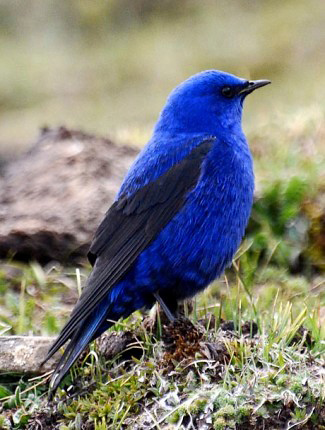
A beautiful Grandala photographed by Jon Hornbuckle.
- Over 850 bird species have been recorded in this small country, more than any other region of comparable size in Asia, including some of Asia's and the world's most spectacular localized birds, such as Himalayan Monal, Satyr Tragopan, Pied Thrush, Grandala, Himalayan Cutia, Fire-tailed Myzornis and Fire-tailed Sunbird
- And some of Asia's and the world's most spectacular other birds, not least Indian Peafowl, Lammergeier, Ibisbill, Crested Kingfisher, Great Hornbill, blue magpies, White-crested Laughingthrush and Wallcreeper
- While mammals include Indian Rhinoceros
- As well as Asian Water Buffalo and Gharial, with a slim chance of Tiger, Asian Elephant, Sloth Bear and Ganges River Dolphin
- All in some of the most spectacular scenery in the world, including eight of the ten highest mountains on Earth
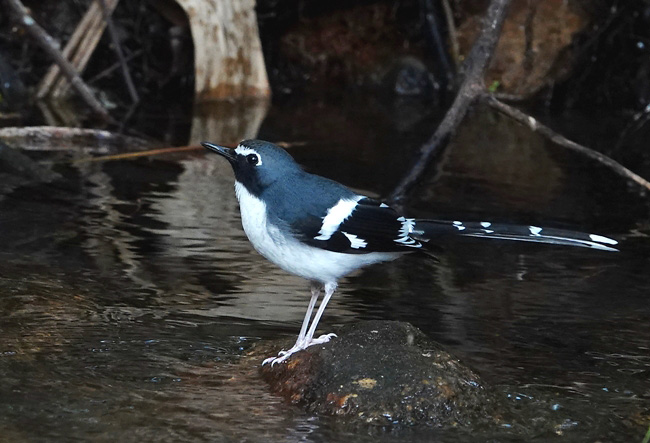
There are plenty of fast-flowing rocky streams in Nepal, the habitat of the Slaty-backed Forktail, here captured on camera by Mark Harper.
- Most people visit Nepal to go trekking in the beautiful Himalayas but far below the mountains there are subtropical lowlands known as the terai which are also worthy of exploration. The splendid Chitwan National Park, just 165 kilometres from the capital Kathmandu, is the showcase reserve. It supports a greater diversity of wildlife than any other area of the country, including numerous birds, but the stand out animals are Indian Rhinoceroses, the fifth largest land animals on Earth. There may be about 500 of them within the 360 square miles, and they may be huge, weighing a massive 2500 kilograms, about 400 stone, but they have a remarkable ability to seemingly disappear in the park’s lush Sal forests and elephant grass savannas - some of the tallest in the world. Despite this they are actually relatively easy to see in Chitwan because the many long-established lodges offer guided walks, canoe trips, jeep drives and elephant rides through the best areas. Although the rhinos like to wallow in pools and may congregate around favoured mudholes they are mainly solitary animals which feed in the mornings and evenings, and these are the times they are most likely to be seen.
- Trekkers with a keen interest in wildlife, especially birds, may wish to take on the Langtang Trek, along which it is possible to see one of the most sought-after shorebirds on Earth; the Ibisbill. Perhaps it is the remote places this bird prefers - wide, shallow, slow-moving, pebbly rivers, mostly at high-altitude in beautiful mountain scenery, from Kazakhstan through the Himalayas to China; perhaps it is the birds’ soft but striking grey, white, brown and black plumage, which blends perfectly with its chosen terrain; perhaps it is the blood-red, down-curved bill which it sometimes swishes from side to side through stones in the shallows, in an effort to dislodge invertebrates such as mayfly and stonefly larvae; perhaps it is because it is unique, in a bird family all of its own; or, perhaps it is the combination of all these things. Whatever it is that makes it so popular this wonderful wader the size of an Oystercatcher can be seen on its nesting grounds around the village of Kyangjin, at 3720 metres in the Langtang Valley, a five day trek there and back from the nearest roadhead.
- The best chance of seeing Red Panda (a very good chance actually) is near the hamlet of Hange Tham in the far southeast of the country.
- Indian Rhinoceros and many of the birds listed above, as well as others, may also be seen in Northeastern India, with Pied Thrush being one particularly notable exception, although that is arguably easier to see in Sri Lanka than Nepal. However, as far as scenery goes, Nepal is definitely the best place to look for the rhinoceros and especially the birds.
Best Birds and other wildlife in Nepal
Birds
Endemics 1 Spiny Babbler.
Specialities
Himalayan Monal, Satyr Tragopan, Blood Pheasant, Tibetan Snowcock, Snow Partridge, Swamp Francolin, Wood Snipe, Ibisbill, Snow Pigeon, Crested Kingfisher,
Western Hooded (summer) and Indian (summer) Pittas, Grey-crowned Prinia, Rufous-vented Grass-babbler (Prinia), Bristled Grassbird, Indian Grass-babbler
(Rufous-rumped Grassbird), Nepal (Immaculate) Cupwing (Wren-babbler), Indian (summer) and White-tailed Blue Robins, Pied (summer) and Long-billed Thrushes,
Grandala, Himalayan Cutia, Fire-tailed Myzornis, Black-chinned, Jerdon's, Slender-billed and Tawny-bellied Babblers, Hoary-throated Barwing, Spot-winged
Starling, Maroon-backed Accentor, Finn's Weaver, Gold-naped Finch and Red-headed Bullfinch. Also a chance of Bengal Florican.
Also a chance of Pallas's Fish-eagle, Brown Fish-owl, Pied Harrier (mostly Nov-Mar), Solitary Snipe, Indian Courser, Yellow-rumped Honeyguide, Black-headed Jay, Wallcreeper, Gould's Shortwing and Scarlet Finch.
Others
Bar-headed Goose (mostly Nov-Mar), Ruddy Shelduck (mostly Nov-Mar), Indian Peafowl, Kalij Pheasant, Red Junglefowl, Oriental Darter, Indian Pond-heron,
Red-naped (Black) Ibis, Black (mostly Nov-Mar) and Black-necked Storks, Lesser Adjutant, Lammergeier, vultures, Grey-headed Fish-eagle, Black, Golden and
Indian Spotted Eagles, Long-legged and White-eyed Buzzards, Collared Falconet, Brown Crake, River Lapwing, Bronze-winged and Pheasant-tailed Jacanas, Small
Pratincole, Great Black-headed (Pallas's) Gull (mostly Nov-Mar), Black-bellied and River Terns, Alexandrine, Plum-headed and Red-breasted Parakeets,
Green-billed Malkoha, owls, owlets, Crested Treeswift, Red-headed Trogon, Pied, Stork-billed and White-breasted (Smyrna) Kingfishers, Blue-bearded,
Chestnut-headed and Asian Green Bee-eaters, Indian Roller, barbets, Great and Oriental Pied Hornbills, lots of woodpeckers, Ashy Woodswallow, Common Iora,
minivets, Maroon Oriole, drongos including Greater Racquet-tailed, Yellow-bellied Fairy-fantail, Red-billed Blue, Yellow-billed Blue and Common Green
Magpies, Himalayan Black-lored and Red-headed Tits, White-browed Tit-warbler, Velvet-fronted Nuthatch, Brown Dipper, bulbuls, leaf-warblers,
Chestnut-headed and Grey-bellied Tesias, niltavas, Siberian (mostly Nov-Mar) and Himalayan (White-tailed) Rubythroats, White-tailed Stonechat, bush-robins,
White-rumped Shama, redstarts, Chestnut-bellied Rock-thrush, Scaly Thrush, lots of laughingthrushes including White-crested, scimitar, shrike and wren
babblers, Red-billed Leiothrix, sibias, minlas, fulvettas, yuhinas, starlings and mynas, leafbirds, flowerpeckers, Fire-tailed, Gould's and Green-tailed
Sunbirds, Robin and Rufous-breasted Accentors, rosefinches, Baya and Black-breasted (Bengal) Weavers, and Red Avadavat.
Also a chance of Falcated Duck (mostly Nov-Mar), Eastern Imperial (mostly Nov-Mar), Greater Spotted (mostly Nov-Mar), Steppe (mostly Nov-Mar) and White-tailed (mostly Nov-Mar) Eagles, Great Thick-knee, Grey-headed and Yellow-wattled Lapwings, Greater Painted-snipe, Slaty-backed and Spotted Forktails, and Black-throated Parrotbill.
Also, about 50,000 Demoiselle Cranes migrate south through the upper Kali Gandaki Valley, over passes as high as 6500 m (21,325 ft), during October.
Mammals
Indian Rhinoceros, Asian Water Buffalo, Gaur, Terai Grey Langur, Rhesus Macaque, Nilgai, Sambar, Blackbuck,
Hog and Swamp Deer, Chital, Himalayan Tahr, Common Goral and Royal's Pika. Also a chance of Asian Elephant, Sloth Bear, Ganges River Dolphin,
Fishing and Jungle Cats, Smooth-coated Otter and Yellow-throated Marten, and an outside chance of Tiger, Leopard and Red Panda.
Reptiles, Amphibians and Fish
Gharial and Mugger Crocodile.
Plants
The superb Alpine flora includes many rhododendrons which are usually
at their best in May.
Other Natural Wonders of Nepal
Himalayas Nepal is dominated by the awesome Himalayas. Eight of the ten highest mountains on Earth are there and it is possible to see four of the world's top five from the Makalu Trek; Everest at 8848 (29,028 ft), Kangchenjunga at 8586 (28,169 ft), Lhotse at 8516 m (27,939 ft) and Makalu at 8463 m (27,765 ft). Via the same trek it is also possible to reach Everest base camp at a giddy 5360 m (17,600 ft). Equally if not more stunning and one of the most beautiful sights in the world is the Annapurna Range as seen from Pokhara. Four sharp peaks shine above this massive, isolated, 50 km (30 mile) long mountain ridge, including three of the world's ten highest mountains, all rising above 8000 m (26,000 ft); Dhaulagiri 1, Manaslu and Annapurna 1.
Best Sites for Birds and other wildlife in Nepal
- Phulchowki, Kathmandu Valley, including Godaveri Botanical Gardens Kalij Pheasant, Bay Woodpecker, Red-billed Blue Magpie, Chestnut-headed and Grey-bellied Tesias, lots of warblers including Black-faced, Orange-gorgetted Flycatcher, Rufous-bellied and Small Niltavas, Blue-fronted Redstart, Golden Bush-robin, Chestnut-crowned, Streaked, Striated and White-throated Laughingthrushes, Red-billed Leiothrix, Green and Himalayan (White-browed) Shrike-babblers, Nepal, Rufous-winged and White-browed Fulvettas, Stripe-throated and Whiskered Yuhinas, Bar-throated (Chestnut-tailed) Minla, Rufous Sibia, Pygmy and Scaly-breasted Cupwings (Wren-babblers), Himalayan Black-lored and Red-headed Tits, White-tailed Nuthatch, Long-tailed Minivet, Orange-bellied Leafbird and Green-tailed Sunbird. Also a chance of Black-headed Jay, Spotted Forktail, Fire-tailed Sunbird and Yellow-throated Marten.
- Nagarjung, Kathmandu Valley White-tailed Blue Robin, Scaly Thrush, White-crested Laughingthrush, Black-chinned Babbler, Rusty-cheeked Scimitar-babbler and Scarlet Minivet.
- Shivapuri A chance of Slaty-backed and Spotted Forktails.
- Belkhu (Kathmandu-Pokhara) A chance of Ibisbill (mostly Nov-Mar).
- Pokhara Lammergeier, and Himalayan Griffon and Cinereous (Eurasian/Black) Vultures. Also a chance of Wallcreeper and Spiny Babbler.
- Chitwan NP including Sauraha area Bird specialities within park; Bengal Florican, Grey-crowned Prinia, Indian Grass-babbler, Slender-billed Babbler and Spot-winged Starling, as well as, in and around park in buffer zones, Indian Peafowl, Red Junglefowl, Oriental Darter, Lesser Adjutant, Grey-headed Fish-eagle, Indian Spotted Eagle, White-eyed Buzzard, Collared Falconet, Brown Crake, River Lapwing, Small Pratincole, Alexandrine, Plum-headed and Red-breasted Parakeets, Crested Treeswift, Stork-billed Kingfisher, Blue-bearded and Chestnut-headed Bee-eaters, Great and Oriental Pied Hornbills, woodpeckers, Western Hooded and Indian Pittas, Common Green Magpie, Black-crested Bulbul, Siberian Rubythroat, White-tailed Stonechat, White-rumped Shama and Grey-bellied Tesia. Mammal speciality; Indian Rhinoceros, as well as Sambar, Chital, Hog Deer and Terai Grey Langur. Also a chance of Tiger, Sloth Bear, Gharial, Mugger Crocodile and Gaur, as well as Greater Painted-snipe, Brown Fish-owl, Brown Boobook (Hawk-owl), Red-headed Trogon (Churia Hills), Orange-headed Thrush and Himalayan Rubythroat.
- Pithauli, Nawalparasi One of several 'vulture restaurants' in Nepal where caracasses are put out for vultures and visitors are allowed to watch them feed. These feeding stations are run by SAVE (Saving Asia's Vultures from Extinction) and possible species include mostly Himalayan Griffon and White-rumped, with a few Slender-billed and Cinereous (Eurasian/Black).
- Hetauda Ibisbill (mostly Nov-Mar).
- Koshi Tappu WR Asian Water Buffalo, Swamp Francolin, Oriental Darter, Lesser Adjutant, Bronze-winged Jacana, Small Pratincole, Great Black-headed Gull, Jungle and Spotted Owlets, Bristled Grassbird, Rufous-vented Grass-babbler, Striated Babbler and Chestnut-tailed Starling. Also a chance of Gharial, Mugger Crocodile, Ganges River Dolphin, Fishing and Jungle Cats, Bar-headed Goose, Falcated Duck, Black and Cinnamon Bitterns, Black-necked Stork, Pied Harrier, Bengal Florican, Great Thick-knee, Yellow-wattled Lapwing, Indian Courser and Greater Painted-snipe.
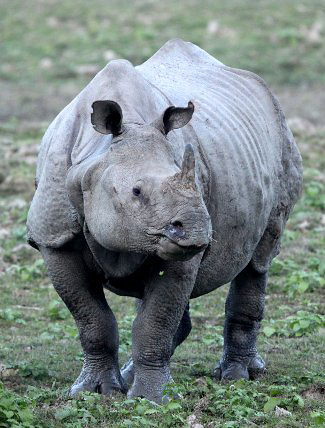
A magnificent Indian Rhinoceros by Coke & Som Smith.
- Treks
- Langtang Himalayan Monal (between Lama, Langtang and Kyanjin Gumba), Snow Partridge, Tibetan Snowcock, Blood Pheasant, Lammergeier, Himalayan Griffon, Golden Eagle, Ibisbill (Kyanjin Gumba), Wood Snipe (Kyanjin Gumba), Snow Pigeon (between Langtang and Kyanjin Gumba), Rufous-bellied Niltava, Pied and Long-billed Thrushes, Grandala, Scaly Laughingthrush, Spiny Babbler (Sybrubensi), Nepal Cupwing (Wren-babbler), Hoary-throated Barwing, Fire-tailed Myzornis (Gopte), Maroon-backed Accentor, Fire-tailed and Gould's Sunbirds, Himalayan Tahr, Common Goral and Royal's Pika. Also a chance of Satyr Tragopan, Yellow-rumped Honeyguide (at cliff bee hives between Syaburi Besi and Lama), Gould's Shortwing and Wallcreeper, and an outside chance of Red Panda.
- Annapurna Lammergeier, Himalayan Griffon, Snow Pigeon, Great Parrotbill, Golden-breasted Fulvetta and Fire-tailed Sunbird. Also a chance of Scarlet Finch, and an outside chance of Red Panda.
- Jomosom/Kali Gandaki Gorge Himalayan Monal, Satyr Tragopan, Tibetan Snowcock, Blood Pheasant, Lammergeier, Himalayan Griffon, Snow Pigeon, Crested Kingfisher, Yellow-billed Blue Magpie, Grandala, White-browed Tit-warbler, Spiny Babbler, Black-eared Shrike-babbler, Wallcreeper, Maroon-backed Accentor, Fire-tailed and Gould's Sunbirds, and Gold-naped Finch. Also a chance of Solitary Snipe. In October about 50,000 Demoiselle Cranes, in flocks of up to 5000 at a time, migrate south through the upper Kali Gandaki Valley, over passes as high as 6500 m (21,325 ft).
- Everest Base Camp (5364 m (17,598 ft)) along Khumbu Valley (15 days Lukla to Lukla, 2500 m (8200 ft) to over 5000 m (16,400 ft) so beware of altitude sickness) and Gokyo Lakes Region Views of Everest etc., Himalayan Monal (around Namche Bazaar at 3500 m (11,480 ft)), Snow Partridge, Tibetan Snowcock, Blood Pheasant, Lammergeier, Himalayan Griffon, Golden Eagle, Snow Pigeon, laughingthrushes, Green Shrike-babbler, Red-billed Leiothrix, Yellow-billed Blue Magpie, Indian Blue Robin, Blue-fronted, Güldenstädt's and White-throated Redstarts, Grandala, Grey-crested, Rufous-vented and Yellow-browed Tits, Wallcreeper, leaf-warblers, Altai, Robin and Rufous-breasted Accentors, Brandt's and Plain Mountain-finches, Dark-breasted, Great and Himalayan Beautiful Rosefinches, Crimson-browed Finch, Red-headed Bullfinch and Himalayan Tahr. Also a chance of Ibisbill and Fire-tailed Myzornis.
- Off the beaten track
- Lumbini area Sarus Crane and Pheasant-tailed Jacana. Also a chance of Nilgai and Jungle Cat.
- Bardia NP A chance of Tiger, Indian Rhinoceros (reintroduced), Sloth Bear, Asian Elephant, Gharial, Mugger Crocodile, Ganges River Dolphin (in Karnali River at west end of park), Blackbuck, Nilgai, Sambar, Hog and Swamp Deer, Chital, Smooth-coated Otter, Brown Fish-owl, Crested Kingfisher, Great Hornbill, Great Slaty Woodpecker and Wallcreeper.
- Khairapur Sanctuary Blackbuck.
- Shukila Phanta WR Indian Peafowl, Black-necked and Painted Storks, Lesser Adjutant, Red-headed and Slender-billed Vultures, Grey-headed Fish-eagle, River Lapwing, Bristled Grassbird, Jerdon's and Tawny-bellied Babblers, Baya, Black-breasted and Finn's Weavers, Hog and Swamp Deer, and Chital. Also a chance of Brown Fish-owl and an outside chance of Leopard and Tiger.
Best Times for Birds and other wildlife in Nepal
The best time to visit the lowlands is between November and March, especially February-March when the numbers of wintering birds from the north and the high Himalayas are usually at their peak. The lowland monsoon season usually lasts from June to September. The best time to trek into the high mountains is from mid-April to late May when most of the middle and high altitude bird specialities usually breed and are therefore at their most active. This is also a great time for flowers, which are abundant. Mountain viewing conditions however are usually best during the northern autumn.
Recommended Bird Books etc. for Nepal
Birds of Nepal by R Grimmett et al. Helm, 2016 (Second Edition).
Birds of the Indian Subcontinent by R Grimmett, and C and T Inskipp. Helm, 2012.
A Field Guide to the Birds of the Indian Subcontinent by K Kazmierczak. Helm, 2008.
Pocket Guide to the Birds of the Indian Subcontinent by R Grimmett, and C and T Inskipp. Helm, 1999.
Birds of South Asia: The Ripley Guide Volumes 1 and 2 by P C Rasmussen and J C Anderton. Lynx Edicions and Smithsonian Institution, 2012.
Indian Mammals: A Field Guide by V Menon. Hachette, 2014.
Field Guide to the Mammals of the Indian Subcontinent by K K Gurung and R Singh. Helm, 1998.
Apps etc.
eGuide to Birds of the Indian Subcontinent.
Where to watch birds in Asia by N Wheatley. Helm, 1996.
Don’t know which country/countries/regions to visit in Asia? Then it may be worth considering taking a look at this book, written by this website’s author. It is many years old of course but it still provides a starting point, an overview and a guiding light to the best birds and the best places to look for them in the region, and could save hours of searching for similar information on the internet. However, it is important to check more up-to-date sources for sites which have been opened up, sites and species which have been discovered, lodges that have been built etc. since the book was published.
Birding and Wildlife Trip Reports for Nepal
Many trip reports, some for Nepal, are posted on the websites listed here. On some of these websites some reports are independent and some are posted by tour companies who organize tours to Nepal. These tour companies and others also post their own reports on their websites, which are listed under 'Some Organized Tours to Nepal' below.
- The best website for trip reports is CloudBirders
- but these are also worth a look
- Birdtours
- Fatbirder
- Jon Hornbuckle
- Mammal Watching
Local bird and wildlife guides in Nepal
The costs of organized tours partly reflect the quality of the tour leaders. Some leaders are certainly better than others and many companies claim their leaders are the best but even the best rely at least to some extent on the exceptional skills of the local guides they employ. If you are travelling independently, employing such local guides will greatly increase your chances of seeing the wildlife you wish to see.
Accommodation for birders in Nepal
Some Organized Tours for birds and other wildlife to Nepal
There are many tour companies who organize tours to see mammals, birds, other wildlife and other natural wonders. The cost of these tours vary considerably according to such variables as the airlines used, the number of days the tours last, the number of sites visited, the number of people in the group (an important consideration if you wish to see such wildlife as rainforest mammals and birds), the number of tour leaders, the standard of accommodation and transport, and the percentage profit the company hopes to make. Generally, where the number of days tours last and the number of sites visited are similar, the cheapest tours are those that use the cheapest airlines, accommodation and local transport, that have the largest groups with the least number of leaders, and that make the least amount of profit. The most expensive tours tend to be those which are exceptionally long, use the most expensive accommodation (ridiculously lavish in some cases, even for single nights) and which make the most profit. Some tour costs partly reflect the quality of the tour leaders. Some leaders are certainly better than others and many companies claim their leaders are the best but even the best rely at least to some extent on the exceptional skills of the local guides they employ.
While tour companies organize tours with set itineraries many also organize custom tours for individuals and private groups who instead of taking a tour with a set itinerary want to follow their own itinerary to suit their own personal tastes, whether it be mammals, birds, other wildlife, other natural wonders or even man-made attractions, or a mixture of them all. Many organized tours with set itineraries are also fast-paced and target as many species as possible, whether they are mammals, birds or other wildlife or everything, which usually leaves little time to enjoy the best sites and individual species, but on a custom tour those taking part can specify the pace and the sites and species they wish to concentrate on. Custom tours also suit people who like to travel with people they already know, rather than with a group of strangers, and people with partners with different interests. Individuals and small groups will almost certainly have to pay more than the price of an organized tour with a set itinerary but a large group of friends may be able to travel for less than the price quoted for a set tour.
Tour companies who run organized tours or can arrange custom tours to Nepal include the following.
- Birdfinders
- Birdquest
- Naturetrek
- Wildlife Worldwide
- Wise Birding Holidays
- We are a small wildlife watching holiday company based in Devon (UK) specialising in birdwatching and mammal watching holidays across the world. What sets us apart from other wildlife watching companies is quite simple:
- 1 – small group sizes: (average between 4 – 8 people)
- 2 – a commitment to conservation: (donation after each tour)