
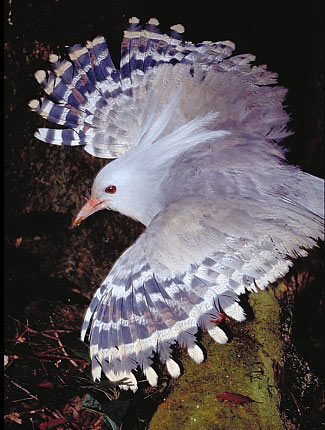
The unique Kagu, in display, by Jon Hornbuckle.
- The only place in the world to see the unique Kagu which is in a family of birds all of its own
- And the New Caledonian Crow which is one of the few birds and animals to use tools; in this case, twigs to extract grubs from trees
- The 22 endemic birds also include other spectacular species such as Cloven-feathered Dove, Horned Parakeet, Barred and Crow Honeyeaters, Yellow-bellied Robin and Red-throated Parrotfinch, with near-endemics including Red-bellied Fruit-dove, Cardinal Myzomela and Southern Shrikebill.
- While more widespread spectacular birds include Great and Lesser Frigatebirds, Red-footed Booby and Tahiti Petrel
- All on a mountainous island with remnant rainforest and offshore islands surrounded
by rich coral reefs
- Tour companies often combine New Caledonia with other islands in the western Pacific, including Fiji, Vanuatu and Western Samoa, and New Caledonia is also visited on the Western Pacific Odyssey, a cruise from New Zealand to Japan. There are 35 bird species endemic to Fiji including Golden, Orange and Whistling Doves, Crimson, Masked and Maroon Shining-parrots, and two silktails, as well as Red-tailed and White-tailed Tropicbirds. The 11 endemics on Vanuatu include Tanna Fruit-dove, a kingfisher and Buff-bellied Monarch, which are quite easy to see but to have a chance of the rest of the endemics it is necessary to trek high up into the forests of the island of Espiritu Santo and camp. Then it is possible to see Vanuatu (Baker's) Imperial-pigeon, Vanuatu Honeyeater and Santo Thicketbird, as well as the near-endemic Santa Cruz Ground-dove, Palm Lorikeet and Rusty-winged Starling. The endemic Mountain Starling and Royal Parrotfinch are very rare and not likely to be seen. On the island of Upolu in Western Samoa it is possible to see seven out of the eight known surviving Samoan endemics only a short distance from Apia, the main town; Flat-billed Kingfisher, Mao, Samoan Whistler, Samoan Triller, Samoan Fantail, Samoan Flycatcher and Red-headed Parrotfinch, as well as Samoan Myzomela and Samoan Starling. To see Samoan White-eye it is necessary to hike up Mount Silisili on the island of Savai’i. Tooth-billed Pigeon may be extinct. Other possibilities on Upolu include Many-coloured Fruit-dove and Blue-crowned Lorikeet, as well as White-tailed Tropicbird, Grey-backed Tern and Common White Tern.
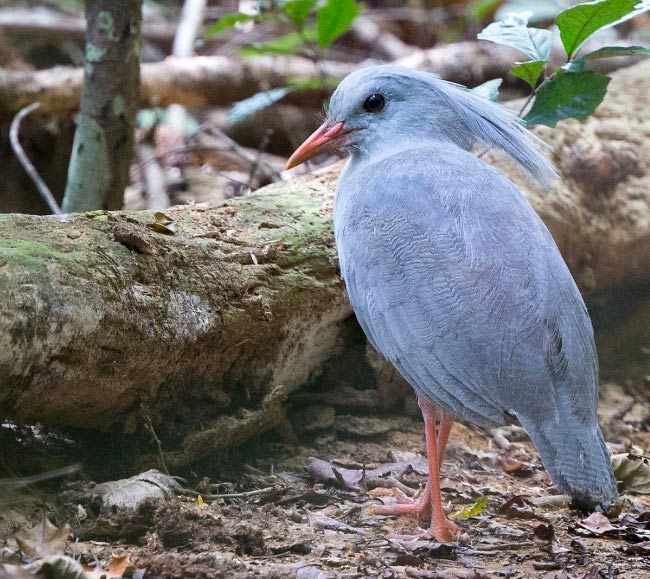
Kagus are usually remarkably confiding, like this one which was seen by Simon Colenutt.
Best Birds and other wildlife in New Caledonia
Birds
Endemics 22
Mainland 19
Kagu, New Caledonian Imperial-pigeon, Cloven-feathered Dove, White-bellied (New Caledonian) Goshawk, Horned Parakeet, New Caledonian Parakeet, Crow
Honeyeater, New Caledonian Friarbird, New Caledonian (Scarlet) Myzomela, Barred Honeyeater, New Caledonian Whistler, New Caledonian Cicadabird, New
Caledonian Streaked Fantail, New Caledonian Crow, Yellow-bellied Robin, New Caledonian Thicketbird, Green-backed White-eye, Striated Starling and
Red-throated Parrotfinch.
Loyalty Islands 3 Ouvea Parakeet, Large Lifou White-eye and Small Lifou White-eye.
('New Caledonian Storm-petrel' (similar to New Zealand Storm-petrel) remained undescribed in 2021. It was believed at that time to range through the subtropical western Pacific as far west as the Brisbane Seamounts off eastern Australia)
New Caledonian Nightjar, New Caledonian Rail and New Caledonian (Painted) Buttonquail are probably or presumed extinct, there have been no recent records of New Caledonian Owlet-nightjar, and there is only one old record (from Mount Ignambi) of New Caledonian Lorikeet)
Near-endemics
New Caledonia and Vanuatu 5 Grey-eared (Dark-brown) Honeyeater, Fan-tailed Gerygone, Melanesian (Vanuatu) Whistler, South Melanesian Cuckooshrike and Southern Shrikebill.
New Caledonia, Vanuatu and Solomon Islands 5 Red-bellied Fruit-dove, Satin (Glossy) Swiftlet, Cardinal Myzomela, Long-tailed Triller and Melanesian Flycatcher.
Others
Pacific Black Duck, Brown and Red-footed Boobies, Little Pied Cormorant, Great and Lesser Frigatebirds, Pacific Reef-egret, White-faced Heron, Rufous
Night-heron, Swamp Harrier, Whistling Kite, Brown Goshawk, Buff-banded Rail, Australasian (Purple) Swamphen, Wandering Tattler, Silver Gull, Greater
Crested Tern, Metallic Pigeon, Brown-capped (Pacific) Emerald Dove, Coconut Lorikeet, Fan-tailed Cuckoo (pyrrophanus), Shining Bronze-cuckoo,
White-rumped Swiftlet, Sacred Kingfisher, White-breasted Woodswallow, Golden and Rufous Whistlers, Grey Fantail and Silvereye.
Also a chance of Tahiti and White-winged (Gould’s) Petrels, Short-tailed and Wedge-tailed Shearwaters, Black-naped, Bridled, Roseate and Common White Terns, Black and Brown Noddies, and Blue-faced Parrotfinch. Introduced species include Wild Turkey, Red-vented Bulbul, Common Myna, Common Waxbill and Chestnut-breasted Mannikin.
Mammals
No land mammals except for nine species of bat, including New Caledonian Flying Fox.
Fish
The rich marine life includes about 2000 fish species.
Best Sites for Birds and other wildlife in New Caledonia
- Rivière Bleue Provincial Park Kagu, White-bellied Goshawk, New Caledonian Imperial-pigeon, Horned and New Caledonian Parakeets, New Caledonian Myzomela, Barred Honeyeater, New Caledonian Friarbird, New Caledonian Cicadabird, New Caledonian Whistler, New Caledonian Crow, Yellow-bellied Robin, Green-backed White-eye, Striated Starling and Red-throated Parrotfinch. Also a chance of Cloven-feathered Dove and Crow Honeyeater.
- Parc des Grandes Fougeres Usually a better chance than at Rivière Bleue of Cloven-feathered Dove, Crow Honeyeater, New Caledonian Crow and Melanesian Flycatcher, and the best place for Southern Shrikebill and New Caledonian Thicketbird (rare and difficult to see by the road into the park). Also present are all other mainland endemics, as well as Metallic Pigeon and South Melanesian Cuckooshrike.
- Mount Koghis White-bellied Goshawk, Cloven-feathered Dove, Metallic Pigeon, Barred and Grey-eared Honeyeaters, New Caledonian Cicadabird, Green-backed White-eye, Striated Starling and Red-throated Parrotfinch.
- Noumea (Grande Terre)-Lifou-Uvea Ferry Brown and Red-footed Boobies, and Great and Lesser Frigatebirds. Also a chance of Tahiti and White-winged Petrels, Short-tailed and Wedge-tailed Shearwaters, Black-naped, Bridled, Roseate and Common White Terns, and Black and Brown Noddies.
- Lifou, Loyalty Islands Red-bellied Fruit Dove, Cardinal Myzomela, and Large Lifou and Small Lifou White-eyes. Also a chance of Blue-faced Parrotfinch.
- Ouvea, Loyalty Islands Red-bellied Fruit Dove and Ouvea Parakeet.
Best Times for Birds and other wildlife in New Caledonia
August to early November.
Recommended Bird Books etc. for New Caledonia
Birds of Melanesia by G Dutson. Helm, 2011. (covers New Caledonia).
Birds of the Solomons, Vanuatu and New Caledonia by C Doughty, N Day and A Plant. Helm, 1999.
A Field Guide to The Birds of Hawaii and the Tropical Pacific by H D Pratt, P L Bruner and D G Berrett. PUP, 1987.
Birds of Hawaii, New Zealand, and the Central and West Pacific by B v Perlo. PUP, 2011.
Where to watch birds in Australasia & Oceania by N Wheatley. Helm, 1998.
Don’t know which country/countries/regions to visit in Australasia? Then it may be worth considering taking a look at this book, written by this website’s author. It is many years old of course but it still provides a starting point, an overview and a guiding light to the best birds and the best places to look for them in the region, and could save hours of searching for similar information on the internet. However, it is important to check more up-to-date sources for sites which have been opened up, sites and species which have been discovered, lodges that have been built etc. since the book was published.
Birding and Wildlife Trip Reports for New Caledonia
Many trip reports, some for New Caledonia, are posted on the websites listed here. On some of these websites some reports are independent and some are posted by tour companies who organize tours to New Caledonia. These tour companies and others also post their own reports on their websites, which are listed under 'Some Organized Tours to New Caledonia' below.
- The best website for trip reports is CloudBirders
- but these are also worth a look
- Birdtours
- Fatbirder
- Jon Hornbuckle
- Mammal Watching
Local bird and wildlife guides in New Caledonia
The costs of organized tours partly reflect the quality of the tour leaders. Some leaders are certainly better than others and many companies claim their leaders are the best but even the best rely at least to some extent on the exceptional skills of the local guides they employ. If you are travelling independently, employing such local guides will greatly increase your chances of seeing the wildlife you wish to see.
Accommodation for birders in New Caledonia
Some Organized Tours for birds and other wildlife to New Caledonia
There are many tour companies who organize tours to see mammals, birds, other wildlife and other natural wonders. The cost of these tours vary considerably according to such variables as the airlines used, the number of days the tours last, the number of sites visited, the number of people in the group (an important consideration if you wish to see such wildlife as rainforest mammals and birds), the number of tour leaders, the standard of accommodation and transport, and the percentage profit the company hopes to make. Generally, where the number of days tours last and the number of sites visited are similar, the cheapest tours are those that use the cheapest airlines, accommodation and local transport, that have the largest groups with the least number of leaders, and that make the least amount of profit. The most expensive tours tend to be those which are exceptionally long, use the most expensive accommodation (ridiculously lavish in some cases, even for single nights) and which make the most profit. Some tour costs partly reflect the quality of the tour leaders. Some leaders are certainly better than others and many companies claim their leaders are the best but even the best rely at least to some extent on the exceptional skills of the local guides they employ.
While tour companies organize tours with set itineraries many also organize custom tours for individuals and private groups who instead of taking a tour with a set itinerary want to follow their own itinerary to suit their own personal tastes, whether it be mammals, birds, other wildlife, other natural wonders or even man-made attractions, or a mixture of them all. Many organized tours with set itineraries are also fast-paced and target as many species as possible, whether they are mammals, birds or other wildlife or everything, which usually leaves little time to enjoy the best sites and individual species, but on a custom tour those taking part can specify the pace and the sites and species they wish to concentrate on. Custom tours also suit people who like to travel with people they already know, rather than with a group of strangers, and people with partners with different interests. Individuals and small groups will almost certainly have to pay more than the price of an organized tour with a set itinerary but a large group of friends may be able to travel for less than the price quoted for a set tour.
Tour companies who are running organized tours to New Caledonia in the next couple of years include the following. Many of these also offer custom tours.
