
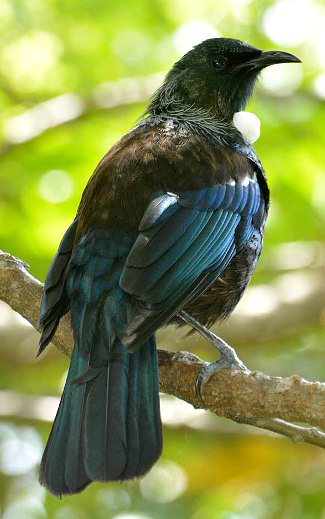
A Tui on Tiritiri Matangi Island by Jon Hornbuckle.
- New Zealand has a highly unique flora and fauna, of which about half is endemic
- Including six endemic bird families; five kiwis, three New Zealand parrots, two New Zealand wrens, three mohouas, four New Zealand wattlebirds, and Stitchbird, and over 50 bird species in total, also including Blue Duck, Black Stilt, Wrybill, Tui, Takahe and Weka
- And the islands are equally famous for seabirds, including albatrosses, petrels, shearwaters and New Zealand Storm-petrel
- And cetaceans such as Sperm Whale, and Bottlenose, Dusky and Hector's Dolphins
- As well as sealions and fur seals
- All in some of the most stunning scenery in the world, especially the mountainous South Island which is complete with fjords and glaciers
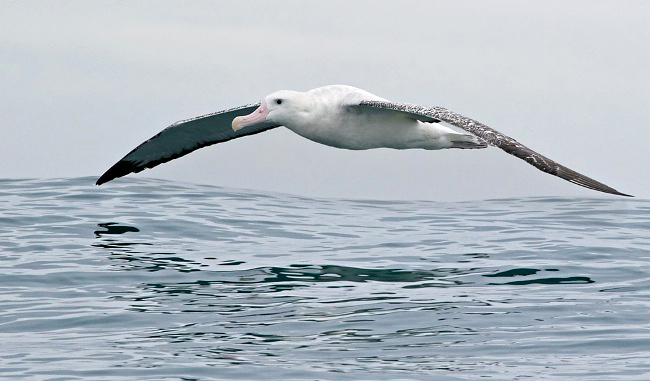
Seabirds can be seen at close range off Kaikoura on South Island, spectacular seabirds such as Antipodean or Gibson's Wandering Albatross above, and Westland Petrel and Salvin's Albatross below, all superbly captured by Lars Petersson.
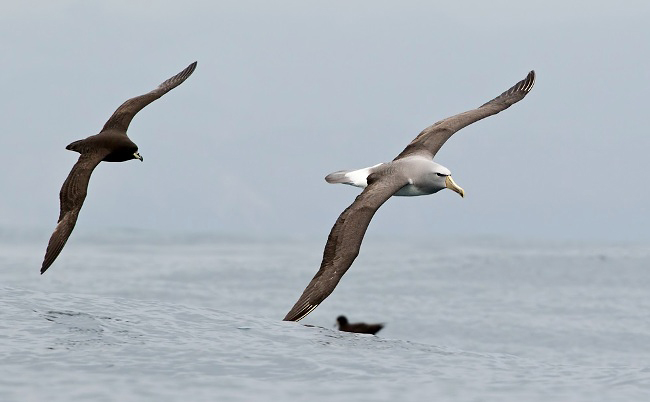
- Sperm Whales can be seen in several places around the world but none are arguably as reliable and picturesque as Kaikoura, a scenic two-and-a-half-hour drive north of Christchurch on South Island, New Zealand. Few too can boast a supporting cast which usually includes huge pods of acrobatic Dusky Dolphins and one of the most amazing selection of seabirds in the world, including albatrosses. Sperm Whales are capable of diving 3000 metres down and they live off Kaikoura all year round thanks to a plentiful supply of food in the two-kilometre-deep canyon which is just a few hundred metres offshore. Between dives the whales spend several minutes breathing at the surface so seeing them is almost guaranteed on the two-and-half-hour trips on modern catamarans designed especially for whale watching and equipped with hydrophones to locate the whales. These boats are allowed to approach close enough to see the scars, some circular and hand-sized, on the skins of some of the whales, which have probably been inflicted by the hooks and suckers of their main prey, aptly-named Colossal and Giant Squids, during fierce battles in the abyss.
- Most endemic landbirds have become extinct on the mainland primarily due to the clearance of land for livestock farming, hunting and short-sighted introductions of alien predators such as Polynesian Rat, Ferret and Stoat, and these days many endemic landbirds now survive only in translocated populations on predator-free offshore islands. The same is true of the Shore Plover which was once widespread around the coast of North and South Islands but has been driven to the brink of extinction mainly by introduced predators. In 2012, a year after the islands of Motutapu and neighbouring Rangitoto were declared predator-free, Shore Plovers were released on Motutapu and they can now be seen on there and Rangitoto, two islands in the Hauraki Gulf joined by a bridge and a short ferry ride from Auckland.
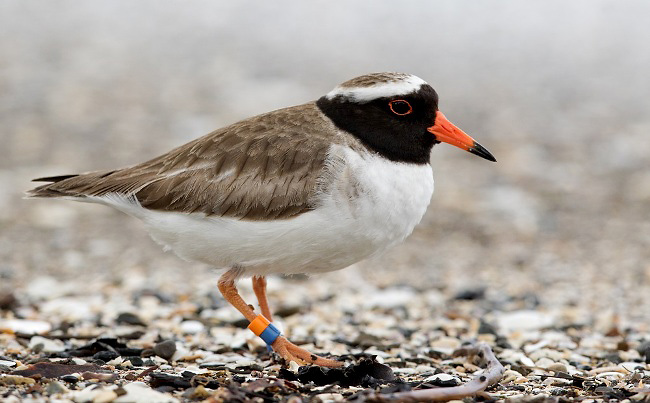
A Shore Plover on the island off Rangitoto near Auckland by Lars Petersson.
- The last stronghold of the Shore Plover are the Chatham Islands, a remote archipelago which lies about 800 km east of the main islands of New Zealand. Alas the main islands are as ecologically bleak as the ‘mainland’ with herds of livestock grazing fields of non-native plants and barely a native bird in sight and at least 13 bird species unique to the islands have become extinct since humans first arrived. However, eight endemics and three breeding endemic seabirds have somehow survived; two shags, an oystercatcher, a snipe, a parakeet, a pigeon, a gerygone and a robin, as well as Chatham Albatross, Chatham Petrel and the very rare Magenta Petrel or Taiko. It is possible to see some of these by volunteering to help out with the ongoing management and research projects on small islands such as Mangere, a strict nature reserve accessible by boat from Pitt Island, where Chatham Snipe, Shore Plover, Chatham Parakeet (an endemic restricted to Mangere and Little Mangere Islands), Red-crowned Parakeet, hybrids between the two, and Black Robin (40-45 on Mangere in 2019, the rest, about 250, on Rangatira, the other side of Pitt Island) occur, as well as the endemic race of Tomtit and Tui. Another way to see some of the birds of the Chatham Islands is to go on a cruise from New Zealand to the Subantarctic Islands during which it is possible to get close enough to Rangatira (also known as Southeast Island, where landings are not permitted) to see Pitt Shag, Chatham Oystercatcher and Shore Plover, as well as Tomtit and Tui, from Zodiacs. On the main Chatham Island it is possible to see Chatham Shag, Chatham Pigeon and Chatham Gerygone, as well as Little (Blue) Penguin. The other Subantarctic Islands of Australia and New Zealand, including Antipodes, Auckland, Bounty, Campbell, Macquarie and Snares, support millions of marine mammals and birds including elephant seals, fur seals and sealions, King, Royal, Erect-crested and Snares Penguins, and Wandering, Royal, Light-mantled, Buller's, Salvin's, White-capped and Campbell Albatrosses, as well as Auckland Island Snipe.
Best Birds and other wildlife in New Zealand
Birds
Endemics 54 (not including Chatham (8) and Subantarctic (13) Islands) (Six endemic families: kiwis (5 species), NZ parrots (3), NZ wrens (2), mohouas (3), NZ wattlebirds (4) and Stitchbird, as well as four shags and seven shorebirds) Widespread 26 Paradise Shelduck, Blue Duck, New Zealand Scaup, Brown Teal, New Zealand Pigeon, Weka, Spotted Shag, South Island Oystercatcher, Variable Oystercatcher, Shore Plover (being reintroduced to various offshore islands with last wild birds on Chatham), Wrybill, Black-billed Gull, Black-fronted Tern (mainly South Island), New Zealand Falcon, New Zealand Kaka, Yellow-fronted Parakeet, Malherbe’s Parakeet (local), Red-fronted Parakeet (local), Rifleman, Tui (mainly North Island), New Zealand Bellbird, Grey Gerygone, New Zealand Fantail, New Zealand Tomtit, New Zealand Fernbird and New Zealand Pipit.
North Island 9 Little Spotted Kiwi (islands offshore), Northern Brown (North Island) Kiwi, New Zealand Grebe, Northern Red-breasted Plover, Whitehead, North Island Kokako, North Island Saddleback, Stitchbird and North Island Robin.
South Island 18 Great Spotted Kiwi (introduced to Little Barrier Island off North Island), Southern Brown Kiwi (also Stewart Island), Okarito Kiwi, South Island Takahe, Yellow-eyed Penguin (mostly Nov-May, also Subantarctic Islands), Whenua Hou (South Georgia) Diving-petrel, Rough-faced Shag (New Zealand King Cormorant) (Marlborough Sounds), Otago (Bronze) Shag, Black Stilt (Upper Waitaki Valley), Southern Red-breasted Plover (also Stewart Island), Kakapo (not many more than a hundred Kakapos exist, on four offshore islands, one of which is Codfish Island, for which, like some other islands, permission is rarely granted to visit by the Government's Department of Conservation), Kea, New Zealand Rockwren, Yellowhead, Pipipi (also Stewart Island), South Island Kokako, South Island Saddleback and South Island Robin.
Stewart Island 1 Foveaux Shag.
(New Zealand Storm-petrel breeds in north New Zealand (mostly Feb-Jul) and ranges at sea as far as Australia and Fiji)
Near-endemics
Australia and New Zealand 11 Fiordland Penguin, Snares Penguin, Little (Blue) Penguin, Fluttering Shearwater, Hutton’s Shearwater, Australasian Gannet, Great Pied Cormorant, Double-banded Plover (mostly Nov-Mar), Black-fronted Dotterel, Black-shouldered (Masked) Lapwing and White-fronted Tern.
Other seabirds
Antipodean, Northern Royal, Southern Royal, Wandering, Black-browed, Campbell, (Northern) Buller's, Grey-headed, Salvin's and White-capped Albatrosses,
Grey-backed, White-faced and Wilson's Storm-petrels, Northern and Southern Giant Petrels, Black (Parkinson's), Cape, Cook's, Pycroft's, Westland and
White-chinned Petrels, Broad-billed and Fairy Prions, Buller's, Flesh-footed, Little, Short-tailed and Sooty Shearwaters, Common Diving-petrel,
Australasian Gannet, Caspian and Fairy Terns, and Brown Skua. Also a chance of (Southern) Buller's Albatross, Mottled Petrel (mostly Nov-Mar), Antarctic
Tern and Grey Noddy.
Others
Great Crested Grebe, White-faced Heron, Australasian Bittern, Royal Spoonbill, Great Pied, Little Black and Little Pied Cormorants, Swamp Harrier,
Australasian Swamphen (Pukeko), Pied Stilt, wintering shorebirds such as Bar-tailed Godwit and Red Knot, Kelp and Silver (Red-billed) Gulls, Shining
Bronze-cuckoo (mostly Nov-Mar), Long-tailed Koel (mostly Nov-Mar), Morepork (also occurs on Norfolk Island, Australia), Sacred Kingfisher, Welcome Swallow
and Silvereye. Also a chance of Baillon's Crake.
Introduced Species
Brown Quail, Australian Magpie, Eurasian Skylark, Common Myna, Common Starling, Eurasian Blackbird, Song Thrush, House Sparrow, Dunnock, Common Chaffinch,
European Greenfinch, European Goldfinch and Yellowhammer.
Mammals
Sperm Whale, (Common) Bottlenose, Common, Dusky and Hector's Dolphins, New
Zealand Fur Seal and New Zealand (Hooker's) Sealion. Also a chance of Killer Whale. (There are no native land mammals in New
Zealand except for bats).
Reptiles, Amphibians and Fish
Tuataras, two species of ancient animals which are not
lizards but the only survivors in an order (Sphenodontia) of reptiles which occurred across the world during the time
of the dinosaurs, but, apart from the two remaining species on New Zealand's offshore islands, died out over 65
million years ago. From December to March hundreds of Short-tail Stingrays usually appear in Poor Knights Marine
Reserve, north of Auckland off North Island.
Plants
The vegetation includes ancient ferny forests of podocarps festooned with
epiphytes, and a highly endemic Alpine flora.
Other Natural Wonders of New Zealand
Central North Island Much geothermal activity including boiling mud pools and steam vents.
Waitomo Caves Caves adorned with thousands of glowing gnat larvae, viewable on underground boat trips.
Best Sites for Birds and other wildlife in New Zealand
- North Island
- Muriwai Australasian Gannet colony.
- Marsden Cove Pelagic Pycroft’s Petrel and New Zealand Storm-petrel, as well as Little Penguin, Black and Cook’s Petrels, Northern Giant Petrel, Fairy Prion, Buller’s, Flesh-footed, Fluttering, Little and Short-tailed Shearwaters, and Common Diving-petrel.
- Waipu Northern Red-breasted Plover and New Zealand Pipit. Also a chance of Fairy (a few pairs) and White-fronted Terns.
- Rangihoua Heritage Park near Kerikeri A chance of Northern Brown Kiwi on night walks.
- Tawharanui Regional Park, near Warkworth A fenced, predator-free area which supports re-introduced New Zealand Bellbird, North Island Saddleback and North Island Robin, as well as Brown Teal, South Island Takahe, Kaka, New Zealand Pigeon, Tui, Grey Gerygone, Whitehead and New Zealand Fantail. Also a chance of Northern Brown Kiwi.
- Hauraki Gulf Pelagic Boat Trips New Zealand and White-faced Storm-petrels, Black and Cook's Petrels, Fairy Prion, and Buller's, Flesh-footed and Fluttering Shearwaters. Also a chance of Little Penguin, Little Shearwater, Common Diving-petrel, White-fronted Tern and Grey Noddy (mainly from January).
- Tiritiri Matangi Island Little Spotted Kiwi (usually only possible on night walks during an overnight stay), Brown Teal, South Island Takahe ((lighthouse/visitor center area), Red-fronted Parakeet, North Island Kokako, North Island Saddleback (extinct on mainland) and Stitchbird (in its own family and now extinct on the mainland; most likely at feeding stations, especially along the Kawerau Track and Ridge Track), as well as Variable Oystercatcher, Australasian Swamphen, Tui, New Zealand Bellbird, Rifleman, Whitehead, Grey Gerygone, New Zealand Fantail, North Island Robin and New Zealand Fernbird. Also a chance of Northern Tuatara.
- Miranda Wrybill, Northern Red-breasted Plover, South Island and Variable Oystercatchers, Black-billed Gull and large numbers of wintering shorebirds which breed in the northern hemisphere such as Bar-tailed Godwit and Red Knot, all best looked-for at high tide.
- Whitianga pelagic boat trips A chance of Pycroft's Petrel, Little Shearwater, Fairy Prion, White-faced Storm-petrel, albatrosses and other petrels.
- Lake Taupo and area Blue Duck (Tongariro River), as well as New Zealand Grebe, New Zealand Scaup, Australasian Bittern, Black-billed Gull and New Zealand Fernbird.
- Pureora Forest Kaka, Red-fronted and Yellow-fronted Parakeets, and New Zealand Fernbird. Also a chance of North Island Kokako, Rifleman and Whitehead.
- Zealandia, near Wellington New Zealand's first mainland cat, rat and stoat free sanctuary with Little Spotted Kiwi, New Zealand Scaup, New Zealand Falcon, South Island Takahe, Kaka, Red-fronted Parakeet, Morepork, North Island Saddleback, Stitchbird and Tui.
- Kapiti Island Little Spotted Kiwi (usually only possible on night walks during an overnight stay), South Island Takahe, Weka, New Zealand Pigeon, Kaka, Red-fronted Parakeet, Tui, New Zealand Bellbird, North Island Kokako, North Island Saddleback, Whitehead and North Island Robin. Also a chance of Little Penguin and Long-tailed Koel.
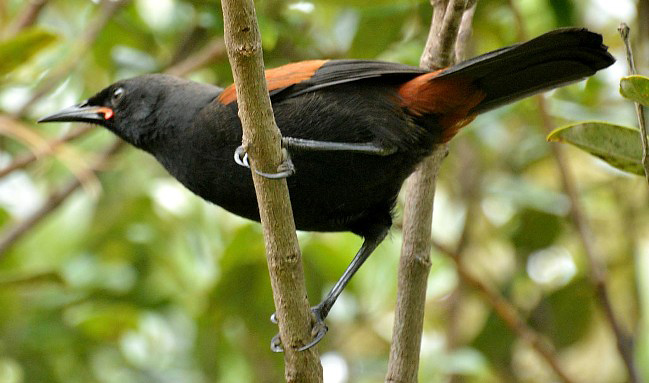
A North Island Saddleback on Tiritiri Matangi Island by Jon Hornbuckle.
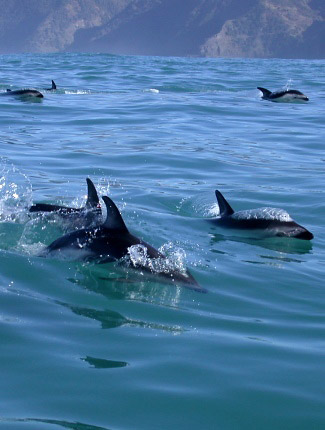
Dusky Dolphins at Kaikoura by Peter Alfrey.
- South Island
- Marlborough/Queen Charlotte Sound boat trips Rough-faced Shag, Malherbe’s Parakeet (Blumine Island) and South Island Saddleback (Motuara Island), as well as Weka, New Zealand Bellbird and South Island Robin. Also a chance of Yellowhead and Hector's Dolphin.
- Kaikoura Wandering, Northern Royal, Black-browed, Campbell and Salvin's Albatrosses, Northern Giant Petrel, Cape, Westland and White-chinned Petrels, Fairy Prion, Hutton's Shearwater, Sperm Whale and Dusky Dolphin. Also a chance of Little Penguin, Southern Royal, Buller's and White-capped Albatrosses, Southern Giant Petrel, Buller's and Flesh-footed Shearwaters, Hector's Dolphin and New Zealand Fur Seal.
- Arthur's Pass/Hawdon Valley Kea and Rifleman. Also an outside chance of Great Spotted Kiwi.
- Bullock Creek, Punakaiki (Paparoa NP), north of Greymouth Great Spotted Kiwi (possible on night walks) and Weka.
- Okarito, near Franz Josef Glacier Okarito Kiwi (possible on night walks).
- Fox Glacier Kea.
- Lake Moeraki Fiordland Penguin (Monroe's Beach).
- Haast Southern Brown (Haast) Kiwi.
- Haast Pass Rifleman, Yellowhead and Pipipi.
- MacKenzie Basin Black and Pied (and hybrid) Stilts, Wrybill, Black-fronted Tern, New Zealand Falcon and Southern Red-breasted Plover. Also a chance of Baillon's Crake (Otematata).
- Oamaru Little Penguin colony (just outside town) and Otago Shag.
- Otago Peninsula, Dunedin Yellow-eyed Penguin, small Northern Royal Albatross colony (Taiaroa Head), Otago and Spotted Shags, and New Zealand Fur Seal.
- Fiordland NP Rockwren (Homer Tunnel, Upper Hollyford Valley), Blue Duck (Upper Hollyford Valley), New Zealand Falcon, Kea, Yellow-fronted Parakeet, Rifleman and Pipipi. Also a chance of Yellowhead (Eglington Valley).
- Milford Sound Fiordland Penguin colony (Harrison Cove). Also a chance of Bottlenose, Common and Dusky Dolphins, and New Zealand Fur Seal.
- Stewart Island including pelagic boat trips Southern Brown Kiwi (possible on night walks), Little, Fiordland and Yellow-eyed (Bench Island) Penguins, Buller's, Campbell, Salvin's, Shy and Southern Royal Albatrosses, Northern and Southern Giant Petrels, Cape, Cook’s, Westland and White-chinned Petrels, Broad-billed Prion, Buller’s and Sooty Shearwaters, Grey-backed and White-faced Storm-petrels, Common Diving-petrel, Foveaux and Spotted Shags, and Brown Skua. Also a chance of (Southern) Buller's Albatross, Mottled Petrel and Antarctic Tern.
- Ulva Island Weka, Kaka, Yellow-fronted Parakeet, Yellowhead, South Island Saddleback, Rifleman, South Island Robin, Tomtit and Pipipi.
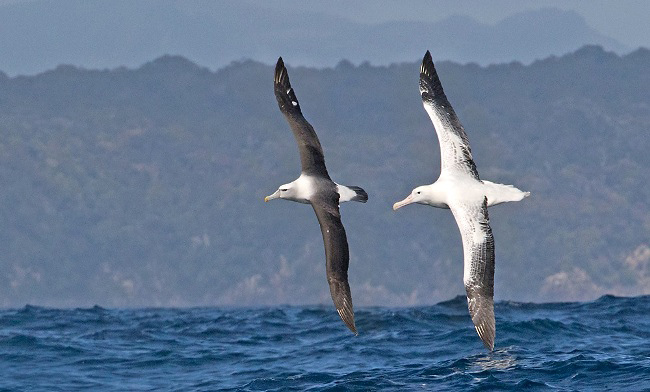
A brilliant image of Shy and Southern Royal Albatrosses together, taken from a pelagic boat trip off Stewart Island by Lars Petersson.
Best Times for Birds and other wildlife in New Zealand
Since Sperm Whales are present year round off Kaikoura the best time to visit in search of other cetaceans and birds is during the southern spring between late October and mid-December, although the warmest months are December to February (late November is the start of the 'high' tourist season). The average temperature in Kaikoura at this time ranges from 10°C to 20°C (50°F to 70°F) but it is always cooler at sea so warm waterproof clothing is recommended for boat trips. The peak time for wild flowers is usually the second half of January.
Recommended Bird Books etc. for New Zealand
The Field Guide to the Birds of New Zealand by B Heather and H Robertson. Penguin, 2015 (Fourth Edition).
The Hand Guide to the Birds of New Zealand by H Robertson and B Heather. Penguin, 2015 (Second Edition).
Birds of New Zealand: A Photographic Guide by P Scofield and B Stephenson. Auckland University Press, 2013.
The 50 Best Birdwatching Sites In New Zealand by L Light. John Beaufoy Publishing, 2019.
Birds of New Zealand: Locality Guide by S Chambers. Arun Books, 2014 (Fourth Edition).
Field Guide to the Wildlife of New Zealand by J Fitter. Bloomsbury, 2018.
Bradt Travel Guide: New Zealand Wildlife by J Fitter. Bradt, 2009.
Apps etc.
Birds of New Zealand.
Birding and Wildlife Trip Reports for New Zealand
Many trip reports, some for New Zealand, are posted on the websites listed here. On some of these websites some reports are independent and some are posted by tour companies who organize tours to New Zealand. These tour companies and others also post their own reports on their websites, which are listed under 'Some Organized Tours to New Zealand' below.
- The best website for trip reports is CloudBirders
- but these are also worth a look
- Birdtours
- Fatbirder
- Jon Hornbuckle
- Mammal Watching
Local bird and wildlife guides in New Zealand
The costs of organized tours partly reflect the quality of the tour leaders. Some leaders are certainly better than others and many companies claim their leaders are the best but even the best rely at least to some extent on the exceptional skills of the local guides they employ. If you are travelling independently, employing such local guides will greatly increase your chances of seeing the wildlife you wish to see.
- Aurora Charters (Stewart Island)
- Ulva's Guided Walks (Stewart Island)
Accommodation for birders in New Zealand
Some Organized Tours for birds and other wildlife to New Zealand
There are many tour companies who organize tours to see mammals, birds, other wildlife and other natural wonders. The cost of these tours vary considerably according to such variables as the airlines used, the number of days the tours last, the number of sites visited, the number of people in the group (an important consideration if you wish to see such wildlife as rainforest mammals and birds), the number of tour leaders, the standard of accommodation and transport, and the percentage profit the company hopes to make. Generally, where the number of days tours last and the number of sites visited are similar, the cheapest tours are those that use the cheapest airlines, accommodation and local transport, that have the largest groups with the least number of leaders, and that make the least amount of profit. The most expensive tours tend to be those which are exceptionally long, use the most expensive accommodation (ridiculously lavish in some cases, even for single nights) and which make the most profit. Some tour costs partly reflect the quality of the tour leaders. Some leaders are certainly better than others and many companies claim their leaders are the best but even the best rely at least to some extent on the exceptional skills of the local guides they employ.
While tour companies organize tours with set itineraries many also organize custom tours for individuals and private groups who instead of taking a tour with a set itinerary want to follow their own itinerary to suit their own personal tastes, whether it be mammals, birds, other wildlife, other natural wonders or even man-made attractions, or a mixture of them all. Many organized tours with set itineraries are also fast-paced and target as many species as possible, whether they are mammals, birds or other wildlife or everything, which usually leaves little time to enjoy the best sites and individual species, but on a custom tour those taking part can specify the pace and the sites and species they wish to concentrate on. Custom tours also suit people who like to travel with people they already know, rather than with a group of strangers, and people with partners with different interests. Individuals and small groups will almost certainly have to pay more than the price of an organized tour with a set itinerary but a large group of friends may be able to travel for less than the price quoted for a set tour.
Tour companies who run organized tours or can arrange custom tours to New Zealand include the following.
