
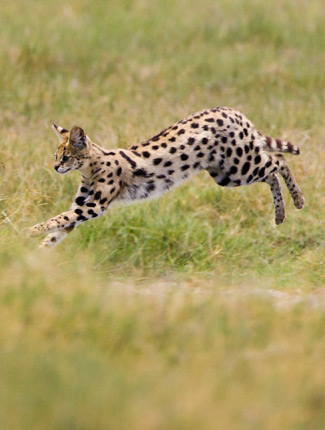
The long-legged Serval, here in the Ngorongoro Crater, by Francesco Veronesi.
- As far as numbers and variety of large mammals are concerned, this is probably the best wildlife experience in Africa and the world
- Thanks to the seasonal presence in the Serengeti of the largest gathering of hoofed mammals in the world, which usually consists of over a million Blue Wildebeest, over a quarter of a million Thomson's Gazelles and about 200,000 Burchell's Zebras, as well as their predators, including Lion, Leopard, Cheetah, Spotted Hyaena and, possibly, African Wild Dog
- And other mammals such as African Elephant, Giraffe, Hippopotamus,
Black Rhinoceros, African Buffalo, Serval,
Black-and-white Colobus Monkey, Topi,
Impala and Klipspringer - As well as some of Africa's and the world's most spectacular birds including flocks of flamingos, Common Ostrich, African Fish-eagle, Secretary Bird, Saddle-billed Stork, Kori Bustard and Golden-winged Sunbird
- With Whale Shark and numerous coral reef fish offshore
- All in some of the most wonderful landscapes on Earth including the Ngorongoro Crater and the Serengeti
- The Serengeti is one of the most magnificent settings on the planet. The Maasai pronounciation is ‘Siringitu’ and translated it means ‘the place where the land goes on forever'. This is the land where man was born, and being in this primeval place really does instil a sense of this in most visitors. It is where many human visitors feel ‘at home’; back where we belong, in contact with nature, roaming the savannah on the seemingly endless African plains full of other wildlife. It may get overcrowded with tourists - ironically in search of experiencing one of the world’s last great wildernesses – but it is still, without doubt, a wondrous place to be. Rivers lined with beautiful flat-topped acacia trees run through grassy plains as far as the eye can see and there are animals everywhere, sheltering in the shade of the acacias, drinking in the rivers or grazing on the plains, ears taught, listening out for the numerous predators, especially Lions. There are so many Lions here, as well as healthy populations of Cheetah, Leopard and Spotted Hyaenas, because there are so many animals to eat, not only wildebeest, gazelles and zebras, but also Elephants, Giraffes, Buffalo, Hippopotamuses, Topi and Impala. Birds abound too, from colourful Lilac-breasted Rollers to more sombre but endemic Grey-breasted Francolins.
- Visitors may wish to include some offshore islands in their trip to Northern Tanzania. There are four endemic birds on Pemba; a green-pigeon, scops-owl, a white-eye and a sunbird, as well as Crab Plover, Mangrove Kingfisher and many coral reef fish. On Zanzibar Jozani Forest supports Zanzibar Red Colobus and Sykes's Monkeys, Zanj Elephant Shrew, Zanzibar Bushbaby, Small-eared Galago and Ader's Duiker, while around the shoreline and offshore it is possible to see Crab Plover, Mangrove Kingfisher and many coral reef fish, with a chance of Humpback Whale, and Hump-backed and Indo-Pacific Bottlenose Dolphins. For Whale Shark it is best to head to Mafia Island Marine Park where there is also a chance of Humpback Whale and an outside chance of Dugong (around Chole Island where Comores Flying Foxes may be seen.
- Lake Natron is off the standard safari circuit in Northern Tanzania but well worth a visit especially to witness the phenomenal flamingo spectacle. This huge lake is the world’s most important breeding site for the Lesser Flamingo and in February 2019 there was, compared to 2018, a 130% increase in the number of adults (1,750,000) and a 600% increase in the number of chicks (995,000). The flamingos usually lay their eggs during the end of the dry season in September and October and the chicks start to hatch in the early part of the wet season, mainly in December. During the rainy period (Nov-May) getting around may be tricky due to waterlogged tracks, wet mud and so on.
- There are 35 endemic bird species on mainland Tanzania, with four more on Pemba Island. Widespread endemics include Grey-breasted Francolin (Spurfowl), Tanzanian Red-billed Hornbill, Emin's (D'Arnaud's) Barbet, Yellow-collared Lovebird and Ashy Starling, while Beesley's Lark and Kilimanjaro White-eye have more restricted ranges in the north. The most endemics (20) occur off the beaten track in isolated mountain ranges of Eastern Tanzania known as the Eastern Arc Mountains and they are Udzungwa Forest-partridge, Rubeho Forest-partridge, Usambara Eagle-owl, Uluguru Bushshrike, Usambara Hyliota, Long-billed Forest-warbler (Tailorbird) (east Usambaras), Winifred’s (Mrs Moreau’s) Warbler (Udzungwas and Ulugurus), Rubeho (Mrs Moreau’s) Warbler (Rubeho-Ukaguru Mountains), Yellow-throated Mountain Greenbul (Udzungwas, Ukagurus and Ngurus), Uluguru Mountain Greenbul, Montane Tiny (Usambara) Greenbul (Usambaras, Ngurus and Nguus), Usambara Thrush, Usambara Akalat, Iringa Akalat, Rubeho Akalat, Banded Sunbird, Moreau’s Sunbird, Loveridge’s Sunbird (Ulugurus), Rufous-winged Sunbird (east Udzungwas) and Usambara Weaver (Usambaras, Ulugurus and Udzungwas). To look for these birds it is best to head for Chome Forest Reserve in the South Pare Mountains; the forest above Lushoto in the West Usambara Mountains; Amani Forest Camp and Kihuwi-Sigi Nature Reserve in the East Usambara Mountains where Usambara Eagle-owl, the rare Dapple-throat, Green-headed Oriole, Usambara Hyliota, Long-billed Forest-warbler, Kretschmer's Longbill, and Banded and Uluguru Violet-backed Sunbirds occur; the Uluguru Mountains where White-winged Apalis, Green Barbet, Uluguru Bushshrike, Uluguru Mountain Greenbul, Chapin’s Apalis, Winifred's (Mrs Moreau’s) Warbler, Orange Ground-thrush, Loveridge’s Sunbird and Bertram’s Weaver occur; and the Udzungwa Mountains National Park for White-winged Apalis, Bar-tailed and Narina Trogons, Yellow-throated Woodland-warbler, Iringa and Sharpe’s Akalats, Rufous-winged Sunbird, Kipengere Seedeater and Oriole Finch, with a chance of Dapple-throat, Swynnerton’s Robin and White-chested Alethe, as well as Iringa Red Colobus, Sanje Mangabey, and Gentle and Kipunji Monkeys.
- In much less crowded Southern Tanzania it is possible to see most of the same mammals as in Northern Tanzania, including, possibly, African Wild Dog, in some of the biggest, wildest places on Earth, such as Selous Game Reserve which is one of the few places in Africa where walking safaris are allowed.
Best Birds and other wildlife in Northern Tanzania
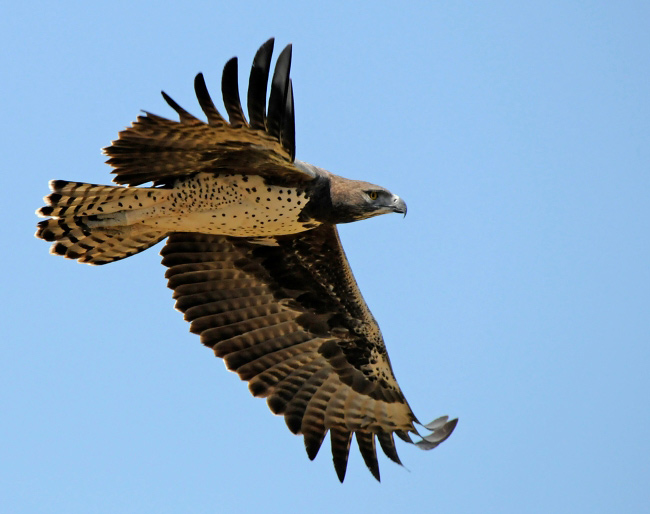
Martial Eagle, one of the many impressive raptors in Northern Tanzania, by Marie-France Grenouillet.
Birds
Endemics 39 (35 on mainland, 4 on Pemba Island) Of these the ones likely to be seen on the main circuit of Northern Tanzania are Grey-breasted Francolin, Yellow-collared Lovebird, Beesley's Lark and Ashy Starling.
Other specialities Yellow-throated Sandgrouse, Hartlaub's Turaco, Grey-crested Helmetshrike, Northern Pied Babbler, Athi Short-toed, Foxy, Pink-breasted and Short-tailed Larks, Pangani Longclaw, Oriole Finch, Taveta Golden Weaver and Rufous-tailed Weaver (recently recorded in Masai Mara in Kenya but main range is in northern Tanzania). Also a chance of Karamoja Apalis.
Others Common Ostrich, Greater and Lesser Flamingos, Black and Goliath Herons, Hamerkop, Saddle-billed Stork, Great White and Pink-backed Pelicans, many raptors including vultures, Secretary Bird, African Fish-eagle, Martial Eagle and Pygmy Falcon, bustards including Kori, Grey Crowned Crane, Blacksmith and Chestnut-banded Plovers, Black-winged Lapwing, African Jacana, Temminck's Courser, sandgrouse, pigeons and doves, owls including Verreaux's Eagle-owl, mousebirds, Narina Trogon, kingfishers, bee-eaters including Cinnamon-chested, Lilac-breasted Roller, woodhoopoes, hornbills, Southern Ground-hornbill, barbets including Red-and-yellow, shrikes including Magpie, African Paradise-flycatcher, Silverbird, robin-chats, starlings including Superb, Red-billed and Yellow-billed Oxpeckers, over 20 sunbirds including Golden-winged and Malachite, Rosy-breasted Longclaw, weavers, widowbirds, bishops, waxbills and whydahs. Also a chance of African Crowned Eagle, Greater Painted-snipe, Bar-tailed Trogon and Giant Kingfisher.
Mammals
Lion, Leopard, Cheetah, African Elephant, Giraffe, Hippopotamus, Black Rhinoceros,
Spotted Hyaena, Burchell's Zebra, Blue Wildebeest, African Buffalo, Serval, (Eastern) Black-and-white Colobus Monkey,
Olive Baboon, Bat-eared Fox, Spring Hare, Eland, Waterbuck, Topi, Hartebeest, Impala, Grant's and Thomson's Gazelles,
Klipspringer and Comores Flying Fox. Also a chance of Aardvark, Aardwolf and Crested Porcupine, and an outside chance of
African Wild Dog and Ground Pangolin.
Additional species present on Zanzibar include Humpback Whale (mostly August), Zanzibar Red Colobus Monkey, Zanj Elephant Shrew, Zanzibar Bushbaby, Small-eared Galago and Ader's Duiker, with a chance of Hump-backed and Indo-Pacific Bottlenose Dolphins.
Reptiles, Amphibians and Fish
Nile Crocodile, Whale Shark (Oct-Mar) and
many coral reef fish.
Other Natural Wonders of Northern Tanzania
Serengeti-Masai Mara The ultimate African plains, covering about 25,000 sq km (9650 sq miles), of which about 23,500 sq km (9060 sq miles) are in the Serengeti.
Ngorongoro Crater Not a crater at all but the largest complete, unflooded caldera on Earth, a nearly circular depression with a diameter of about 20 km (12 miles) and steep slopes which rise about 600 m (2000 ft) from the floor, the result of an ancient volcano collapsing. It is inhabited by many mammals and birds, but not Giraffes which are unable to traverse the steep walls, or female Elephants (just huge, lone bulls).
Kilimanjaro The 'mountain that glitters', the translation from Swahili to English, is the highest peak in Africa, rising imposingly over 4600 m (15,000 ft) from the surrounding plains to 5892 m (19,330 ft) above sea level. This huge, isolated, inactive, snow-capped volcano covers an area of about 100 km (60 miles) by 65 km (40 miles) and dominates the landscape over a huge area.
Best Sites for Birds and other wildlife in Northern Tanzania
- Arusha NP Klipspringer, Hartlaub's Turaco, Narina Trogon, Pangani Longclaw and Taveta Golden Weaver. Also a chance of African Crowned Eagle and Bar-tailed Trogon.
- Engikaret (Lark Plains) Temminck's Courser, and Athi Short-toed, Beesley's, Foxy, Pink-breasted and Short-tailed Larks.
- Tarangire NP Over 550 bird species recorded including Pygmy Falcon, Yellow-throated Sandgrouse, Yellow-collared Lovebird, Magpie Shrike, Northern Pied Babbler, Ashy Starling and Pangani Longclaw, as well as many mammals such as African Elephants and Giraffes.
- Lake Manyara NP Lion, Lesser Flamingo and Black Heron. Also a chance of Crested Porcupine.
- Ngorongoro Rim Golden-winged and Malachite Sunbirds, Cinnamon-chested Bee-eater and Oriole Finch.
- Ngorongoro Crater Lion, Cheetah, large bull African Elephants, Hippopotamus, Black Rhinoceros, Spotted Hyaena, Serval, Bat-eared Fox, Lesser Flamingo (peak numbers usually in June), Chestnut-banded Plover, Black-winged Lapwing and Rufous-tailed Weaver.
- Serengeti Lion, Leopard, Cheetah, Giraffe, Spotted Hyaena, Burchell's Zebra, Blue Wildebeest, Bat-eared Fox, Grey-breasted Francolin, Yellow-throated Sandgrouse, Fischer's Lovebird, Southern Ground-hornbill, Silverbird and Rufous-tailed Weaver. Also a chance of Aardvark, Aardwolf, Spring Hare, Grey-crested Helmetshrike (south) and Karamoja Apalis, and an outside chance of Ground Pangolin.
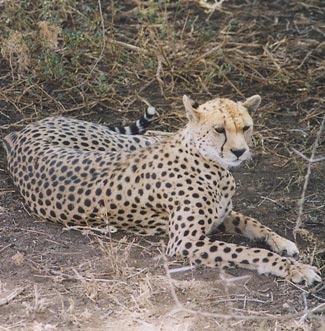
Cheetah in the Serengeti by Alice Perry.
Best Times for Birds and other wildlife in Northern Tanzania
The best time to visit in search of mammals is February-March when many grazing animals are giving birth to calves and therefore attracting many predators in the southeast Serengeti, and June when the migrating animals, mainly wildebeest, cross the Grumeti River in the north Serengeti. The Blue Wildebeest migration depends on the rains but the largest gathering of ungulates (hoofed mammals) in the world takes place in the Serengeti during the wet season which usually lasts from November to May. There are usually one to two million large mammals, mostly wildebeest, in the southeast Serengeti by January and they stay until April, usually calving in February-March when they attract numerous predators. In May-June there is a general movement of animals northwest through the central Serengeti, a time when herds of wildebeest up to 40 km (25 miles) long have been seen from the air. They are heading west toward Lake Victoria and north to the Masai Mara in Kenya and the wildebeest, as well as numerous Burchell's Zebras and Thomson's Gazelles, usually reach the Grumeti River in June (sometimes July). Then, at several places along the river, they may be seen struggling across, desperately trying to avoid the crocodiles. Those that make it usually remain in the Mara until October-November when they begin their return to the Serengeti.
Birding is particularly good in February-March when many resident birds nest and are therefore at their most active and attractive.
Recommended Bird Books etc. for Northern Tanzania
Field Guide to the Birds of East Africa by T Stevenson and J Fanshawe. Helm, due 2020 (Second Edition).
Field Guide to the Birds of Kenya and Northern Tanzania by D Pearson et al. Helm, 2005.
Birds of Africa south of the Sahara by I Sinclair and P Ryan. C Struik, 2011 (Second Edition).
The Kingdon Field Guide to African Mammals by J Kingdon. Bloomsbury, 2015 (Second Revised Edition).
The Kingdon Pocket Guide to African Mammals by J Kingdon. Bloomsbury, 2016 (Second Edition).
Bradt Travel Guides: East African Wildlife by P Briggs. Bradt, 2015 (Second Edition).
Watching Wildlife: East Africa by M D Firestone et al. Lonely Planet, 2009 (Second Edition).
Apps etc.
The Kingdon Guide to African Mammals.
Audubon African Wildlife.
eGuide to Birds of East Africa.
Where to watch birds in Africa by N Wheatley. Helm, 1995.
Don’t know which country/countries to visit in Africa? Then it may be worth considering taking a look at this book, written by this website’s author. It is many years old of course but it still provides a starting point, an overview and a guiding light to the best birds and the best places to look for them on the continent, and could save hours of searching for similar information on the internet. However, it is important to check more up-to-date sources for sites which have been opened up, sites and species which have been discovered, lodges that have been built etc. since the book was published.
Birding and Wildlife Trip Reports for Northern Tanzania
Many trip reports, some for Northern Tanzania, are posted on the websites listed here. On some of these websites some reports are independent and some are posted by tour companies who organize tours to Northern Tanzania. These tour companies and others also post their own reports on their websites, which are listed under 'Some Organized Tours to Northern Tanzania' below.
- The best website for trip reports is CloudBirders
- but these are also worth a look
- Birdtours
- Fatbirder
- Jon Hornbuckle
- Mammal Watching
Local bird and wildlife guides in Northern Tanzania
The costs of organized tours partly reflect the quality of the tour leaders. Some leaders are certainly better than others and many companies claim their leaders are the best but even the best rely at least to some extent on the exceptional skills of the local guides they employ. If you are travelling independently, employing such local guides will greatly increase your chances of seeing the wildlife you wish to see.
Accommodation for birders in Northern Tanzania
Some Organized Tours for birds and other wildlife to Northern Tanzania
There are many tour companies who organize tours to see mammals, birds, other wildlife and other natural wonders. The cost of these tours vary considerably according to such variables as the airlines used, the number of days the tours last, the number of sites visited, the number of people in the group (an important consideration if you wish to see such wildlife as rainforest mammals and birds), the number of tour leaders, the standard of accommodation and transport, and the percentage profit the company hopes to make. Generally, where the number of days tours last and the number of sites visited are similar, the cheapest tours are those that use the cheapest airlines, accommodation and local transport, that have the largest groups with the least number of leaders, and that make the least amount of profit. The most expensive tours tend to be those which are exceptionally long, use the most expensive accommodation (ridiculously lavish in some cases, even for single nights) and which make the most profit. Some tour costs partly reflect the quality of the tour leaders. Some leaders are certainly better than others and many companies claim their leaders are the best but even the best rely at least to some extent on the exceptional skills of the local guides they employ.
While tour companies organize tours with set itineraries many also organize custom tours for individuals and private groups who instead of taking a tour with a set itinerary want to follow their own itinerary to suit their own personal tastes, whether it be mammals, birds, other wildlife, other natural wonders or even man-made attractions, or a mixture of them all. Many organized tours with set itineraries are also fast-paced and target as many species as possible, whether they are mammals, birds or other wildlife or everything, which usually leaves little time to enjoy the best sites and individual species, but on a custom tour those taking part can specify the pace and the sites and species they wish to concentrate on. Custom tours also suit people who like to travel with people they already know, rather than with a group of strangers, and people with partners with different interests. Individuals and small groups will almost certainly have to pay more than the price of an organized tour with a set itinerary but a large group of friends may be able to travel for less than the price quoted for a set tour.
Tour companies who run organized tours or can arrange custom tours to Northern Tanzania include the following.
- Birdquest
- Rockjumper
- Shoebill Safaris
- Shoebill Safaris is one of the leading eco-tour operators for bird watching, gorilla tracking and safaris in East Africa. From swamps and tropical forest to the Rift Valley you are sure to record as many species as your eyes can see in Kenya, Rwanda, Tanzania and Uganda.
- Sunbird
- Victor Emanuel Nature Tours
- Wildlife Travel