
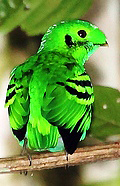
- A fabulous Green Broadbill at Danum Valley, Borneo by Nigel Voaden, a bird of the rainforests of South-East Asia.
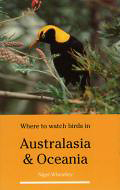
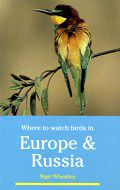
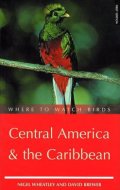
- Not sure which continent or which country/countries to visit? Why not take a look at the six 'Where to Watch Birds' books written by this website’s author. They are all many years old of course, published by Helm between 1994 and 2001, but they still provide a starting point, an overview and a guiding light to the best birds and the best places to look for them in each region, and could save hours of searching for similar information on the internet. However, it is important to check more up-to-date sources for the latest information on sites etc.
- Reviews of the books can be read at Reviews (pdf 236KB).
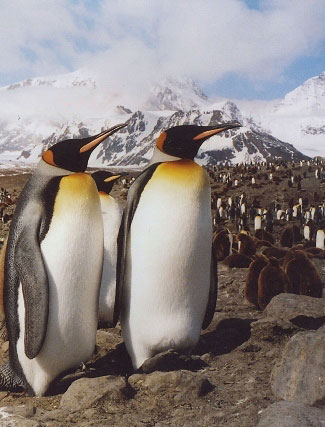
King Penguins on South Georgia by Nigel Wheatley. A small-ship cruise to Antarctica via South Georgia and the Falklands is possibly the ultimate wildlife experience on Earth, although there are many contenders!
DESTINATIONS A-Z
The destinations listed and linked below are the ones we believe are the best in the world for birds and other wildlife. They have been chosen very carefully and for a multitude of reasons, but mainly based on personal experience of some of them and on dreams of visiting the rest, dreams resulting from what we have heard, read or seen.
It is our intention to update this list regularly as we add destinations and it was last updated in May 2021. We're getting there but some destinations missing as of then are some of the Lesser Antilles, Libya, Guinea, Ivory Coast, Togo, Niger, Nigeria, Sudan, South Sudan, Denmark, Belgium, Syria, Lebanon, Palestine, Yemen, Iraq, Qatar, North Korea and Brunei.
If you would like to contribute something about any of these or know of any other destinations you think should be on the list below please Email us.
For more information see ...
The Best (100) Birds in the World,
The Best (100) Wildlife in the World and
Best (50) Other Natural Wonders.
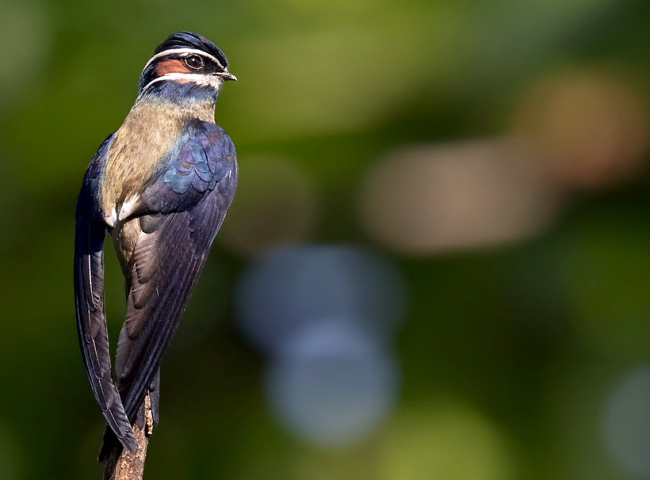
The Whiskered Treeswift occurs from southern Myanmar through peninsular Thailand and Malaya to the Philippines, Borneo and Sumatra where this one was captured on camera by Lars Petersson.
Mongabay went as far as comparing data on amphibians, reptiles, fish, birds, mammals and vascular plants to compile a list of the most biodiverse countries. The biggest countries came out on top but on a per square mile basis the small country biodiversity champions were, in ascending order, Brunei, The Gambia, Belize, Jamaica, El Salvador, Costa Rica, Rwanda, Equatorial Guinea and Panama.
And now for the A-Z of Destinations
The destinations are listed alphabetically with very brief summaries for those linked to more detailed pages, reached by clicking on the destination name, in dark blue. Destinations not linked to more detailed pages, in light blue, are described in a bit more detail here, in italics.
The first and arguably most important destination to consider is a Local Patch, somewhere preferably a short walk from home where it is possible to see a wide range of birds and other wildlife any time of the year.
A
Abruzzo National Park - Italy
See Italy - Abruzzo National Park, below.
Afghanistan
Hardly anyone has been travelling, let alone birding, in Afghanistan for decades. Bad news for birders because, apart from a number of Central Asian and
west Himalayan specialities, including Tibetan Sandgrouse, Turkestan and White-cheeked Tits, Kashmir and White-cheeked Nuthatches, Afghan (Dead Sea)
Sparrow and Black-and-yellow Grosbeak, there is also the near-endemic Afghan Snowfinch. The British Foreign Office usually advise against all
travel to Afghanistan and yet at least one tour company was planning a trip to Band-e-Amir National Park in the Hindu
Kush in 2021, once one of the most popular tourist destinations in the country. The endemic Afghan Snowfinch occurs there, along with Large-billed
Reed-warbler. The snowfinch was identified in 1937 and described by a British army colonel called Richard Meinertzhagen, a controversial character who was
once considered to be one of Britain’s greatest ornithologists, finding many new species around the world, but who has since been exposed as a fraud,
writing fake diaries and reports, and stealing bird skins from other collections. One by one, all his scientific discoveries have been discredited, except
one, the bird he named ‘Theresa’s Sparrow’, after the zoologist Theresa Rachel Clay who was his cousin. Not much is known about the rest of the current
birdlife but this rugged land of desert, steppe and mountains that rise to 7484 m (24,554 ft) at Mount Zebak in the Pamirs, has many different ecological
zones which support a wide variety of birds and the likes of Snow Leopards and Marco Polo Sheep. The summers are normally very hot, the winters usually
very cold.
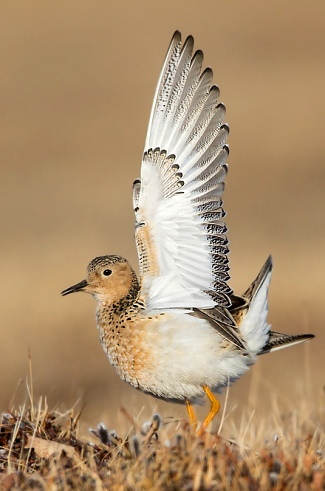
A beautiful, intricately-marked, displaying Buff-breasted Sandpiper at Barrow by Dubi Shapiro.
Alaska
Millions of seabirds and fur seals on the Pribilof Islands; one of the greatest concentrations of birds and mammals in the world, as well as the endemic
McKay's Bunting, other spectacular localised birds such as Emperor Goose, Spectacled and Steller's Eiders, Red-faced Cormorant, Red-legged Kittiwake,
Aleutian Tern, and nesting shorebirds such as Bristle-thighed Curlew and Rock Sandpiper, as well as Grizzly Bears, Killer Whales, Musk Ox, Moose and Sea
Otters, with a chance of Polar Bear at Barrow where, in autumn/fall, it is also possible to see many Ross's Gulls.
Alaska - Southeast
A chance to see Humpback Whales bubble-net feeding, Grizzly Bears fishing, and Black Bears, amongst the mountains, glaciers, fjords and temperate
rainforests of wild northwest America.
Albania
This small country alongside the Adriatic is a land of coastal dunes, salinas, marshes, beech woods, pine woods and fir forests on the inland mountains
where in Valbone Valley National Park there is a chance of seeing such birds as Rock Partridge, Black and White-backed Woodpeckers, and Northern (Eurasian)
Nutcracker. Divjaka-Karavasta National Park near Berat supports about 5% of the world's breeding Dalmatian Pelicans as well as Pygmy Cormorant, Greater
Flamingo and passage migrant waterbirds such as Marsh Sandpiper and Caspian Tern, with Collared Flycatcher present too. More waterbirds can be found
along the coast including the likes of Collared Pratincole and Slender-billed Gull. The first half of April is best for birds, early June for butterflies
and flowers.
Alberta - Canada
See Canada - Alberta, below.
Aldabras
Over 1000 km (700 miles) southwest of the Seychelles and actually much closer to the Comoros and Madagascar but administered by the Seychelles lies one of
the largest coral atolls in the world, with four main islands; Aldabra, Assumption, Astove and Cosmoledo. The low-lying islands support four endemic birds;
Aldabra Drongo, Aldabra White-eye, Abbott's (Souimanga) Sunbird and Aldabra Fody, as well as an endemic subspecies of White-throated Rail (the last
remaining flightless bird in the Indian Ocean), spectacular seabird colonies with Brown, Masked and Red-footed Boobies, and Great and Lesser Frigatebirds,
and other seabirds such as Red-tailed and White-tailed Tropicbirds, and Black-naped and Common White Terns. As for other wildlife there are Coconut Crabs
and over 100,000 Aldabra Giant Tortoises, while coral reefs support a colourful array of reef fishes, Blacktip Reef and Lemon Sharks, and Green and
Hawksbill Turtles.
Algeria
Much of the interior of the second largest country in Africa - about 2000 km by 2000 km - is Sahara Desert but there are mountains in the north,
including the Kabylie of the Babors (Babor Mountains) where the endemic Algerian Nuthatch occurs, and in the late 2010s it was possible to visit the
forests there. No binoculars or telescopes were allowed in the country but cameras and long lenses were! The easiest place to see the nuthatch was in
Bouafroun (Djimla) Forest, 120 km and two to three hours by road from the city of Constantine, accessible directly by air from France, where there is an
impressive canyon with Peregrine Falcon (brookei), Alpine Swift, Eurasian Jackdaw (cirtensis), Blue Rock-thrush and Spanish Sparrow. Other
forest birds include Maghreb Owl, Maghreb Green (Levaillant's) Woodpecker, Great Spotted Woodpecker (numidus), Atlas (Pied) Flycatcher, Western
Bonelli’s Warbler, African Blue Tit (ultramarinus), Coal Tit (ledouci), Short-toed Treecreeper (mauritanica) and Eurasian Jay
(cervicalis). Along the nearby Mediterranean coast it is possible to see Ferruginous Duck, Western Swamphen, African/Eurasian Reed Warbler
(ambiguus) and Barbary Macaque. Tristram’s Warbler and Red 'Atlas' Crossbill occur near El Achir. Western Palearctic listers head down south too,
for Red-billed Firefinch which can be seen in the garden of the Hotel Bois Petrifie in the town of Tamanrasset, and African Silverbill which occurs nearby.
The best time of the year to visit is May to September.
Amazon (Brazil)
See Brazil - Amazon , below.
Ambon
See Indonesia - Moluccas, below.
American Samoa (for Western Samoa see Samoa, below)
American Samoa supports three Samoan endemics shared with (Western) Samoa; Samoan (Crimson-crowned) Fruit-dove, Samoan (Cardinal) Myzomela and Samoan
Starling, as well as Blue-crowned Lorikeet, Many-coloured Fruit-dove, Polynesian Wattled Honeyeater, the powelli race of Fiji Shrikebill on the islands of
Ta'u and Ofu-Olosega which some taxonomists believe to be a full species, and Polynesian Starling, while the many seabirds breeding on Rose Atoll NWR
include Red-tailed Tropicbird, boobies, frigatebirds, noddies, and Sooty and Common White Terns.
Andorra
This tiny tax haven principality less than 200 sq miles/500 sq km in extent popular with hikers and over ten million skiers per annum lies in the scenic
eastern Pyrenees at an average elevation of over 6500 feet (1996 m), rising to nearly 10,000 feet (2942 m) at Coma Pedrosa. The rugged terrain supports
a superb flora, many mountain butterflies including Apollos, and a typical Pyrenean avifauna with Griffon Vulture, Short-toed Eagle, Eurasian Crag Martin,
Yellow-billed (Alpine) Chough, Alpine Accentor, Citril Finch and Rock Bunting, while high up there is also a chance of Lammergeier, Golden Eagle,
Wallcreeper and White-winged Snowfinch.
Angola
Angola has a massive bird list of about 1000 species, of which 19 are endemic; Grey-striped and Swierstra’s Francolins, Red-crested Turaco,
Red-backed Mousebird, Pale-throated (Naked-faced) and White-bellied (White-headed) Barbets, Gabela Helmetshrike, White-fronted Wattle-eye, Braun’s
(Luhder’s) and Gabela (Luhder’s) Bush-shrikes, Pulitzer’s Longbill, Hartert’s Camaroptera, Huambo Cisticola, Angola (White-throated) Greenbul,
Benguela Long-tailed (Meves’s) Starling, Angola Slaty-flycatcher, Gabela Akalat, Montane (Ludwig’s) Double-collared Sunbird and Angola Waxbill, as well as
Golden-backed Bishop which may have been introduced to Sao Tome. There are many near-endemics too, including 16 shared only with Namibia, and they include
Finsch's Francolin, Anchieta's Barbet, Angola and Margaret's Batises, Ground Batis (White-tailed Shrike), Bocage's, Gorgeous and Monteiro’s Bush-shrikes,
Rockrunner, Angola Cave-chat, White-headed Robin-Chat, Bocage's Akalat, Bocage's Sunbird and Cinderella Waxbill, while more widespread species include
Greater and Lesser Flamingos, Damara Tern, Black, Blue-breasted and Swallow-tailed Bee-eaters, Blue-throated and Lilac-breasted Rollers, Chattering
Yellowbill and Yellow-bellied Wattle-eye. Don't expect to see any grazing mammals or their predators though - they are all shot for food in this very poor
country. There are a few monkeys and they include the tiny Angolan (Southern) Talapoin. The best time to look for birds is September, usually before the
rainy season kicks in.
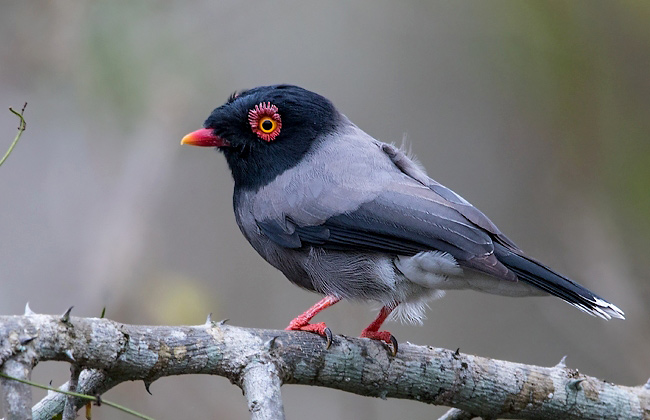
A striking Gabela Helmetshrike in the Caxito Forest, Angola by Dubi Shapiro.
Antarctica - Emperor Penguins
Sail and fly in (at great expense) to spend a few days at an Emperor Penguin colony.
Antarctica, South Georgia and the Falklands
Whales, dolphins, elephant seals, fur seals, penguins, albatrosses and innumerable other seabirds in the most amazing settings on Earth make this
A Top Ten Destination. Possibly the greatest concentration of life in the world on South Georgia includes vast colonies
of King Penguins and nesting albatrosses such as Wandering and Light-mantled, while to the south lies the extreme beauty of Antarctica completed by
Antarctic and Snow Petrels.
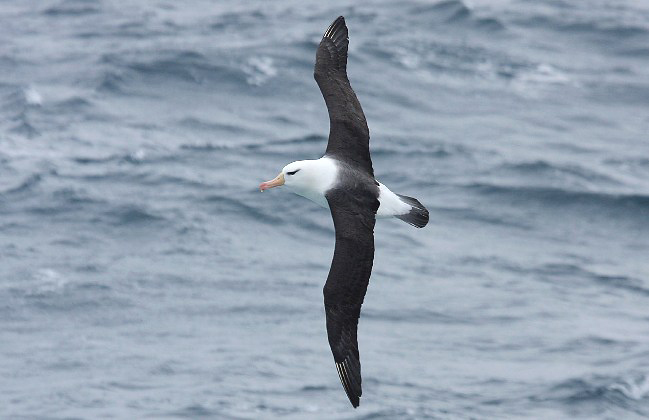
Albatrosses in the Southern Ocean between The Falklands and South Georgia include the handsome Black-browed. Image by Jon Hornbuckle.
Arctic Canada and Greenland
See Canada - Arctic, below.
Arctic Russia
See Russia -Arctic, below.
Argentina - Northern
Condors, flamingos, localised specialities such as Black-legged Seriema and Rufous-throated Dipper, and a brilliant hummingbird called a Red-tailed Comet,
in the spectacular high Andes.
Argentina - Southern
Killer Whales 'beaching' in pursuit of seal pups, Southern Right Whales, Southern Elephant Seals, up to a million Magellanic Penguins at their largest
rookery in the world, Andean Condors, Magellanic Plovers, Tawny-throated Dotterels, Magellanic Woodpeckers and the very rare and localised Hooded
Grebe.
Arizona - Southeast
See USA - Arizona, below.
Arkansas - USA
See USA - Arkansas, below.
Armenia
Landlocked Armenia is dominated by the lofty Lesser Caucasus mountains which rise to 4090 m (13,420 ft) at Mount Aragats although there is also
some semi-desert and a large area of fish ponds at lower elevations. Situated at the junction of Europe, the Middle East and Asia there is a superb
selection of birds to be seen in a very small area just a quarter the size of England, including Pygmy Cormorant, Marbled Teal, White-headed Duck
(Armash fish ponds), Lammergeier, Levant Sparrowhawk, Caspian Snowcock (Gndasar Mountain), Caucasian Grouse (Tsaghkunyats Mountains), White-tailed
Lapwing (Armash fish ponds), Armenian Gull, Blue-cheeked Bee-eater, Bimaculated Lark, White-throated Robin, Finsch's and Red-tailed Wheatears, Blackstart,
Western and Eastern Rock Nuthatches, Green, Menetries's, Moustached and Upcher's (a late arriving summer visitor) Warblers, Rosy Starling, Radde's
Accentor, Eurasian Crimson-winged Finch and Grey-necked Bunting. During the autumn, especially early September, large numbers of Demoiselle Cranes pass
through Lake Sevan. Mammals include the Bezoar Ibex which occurs in the Yeranos Mountains, and more than 230 species of butterfly include Caucasian
specialities and there is a chance of seeing 80 species during the last week of June including Kurdish Copper and Persian Fritillary. The best time for
birds is late May to the middle of June.
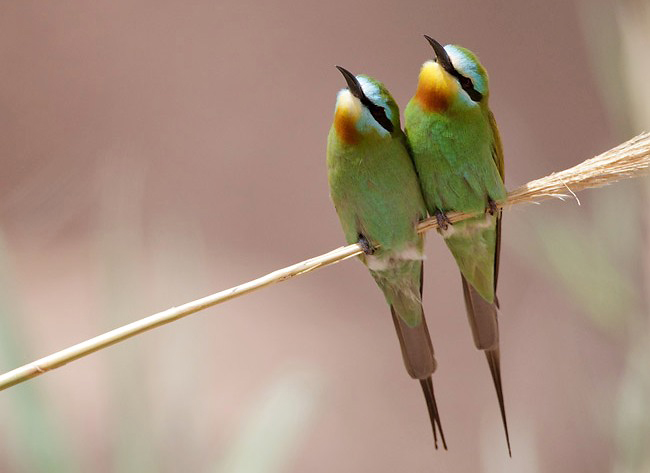
Blue-cheeked Bee-eaters nest in Armenia. Image by Michael McKee.
Atlantic Odyssey
For people who love seabirds and can arrange a holiday lasting 30 days (to Ascension), 36 days (to Cape Verde), 44 days (to Madeira) or even longer, all
the way to mainland Europe, this could be the actual 'Trip of a Lifetime' for in addition to the Top Ten Destination that involves
Antarctica and South Georgia summarised above the ship sails on, north through the Atlantic to Gough Island, Tristan da Cunha, St Helena and so on, making
it possible to see 40, even 50, species of seabird, as well as island endemics such as Ascension Frigatebird, St Helena Plover and Gough Moorhen, and
numerous whales and dolphins.
Australia - Eastern (Queensland)
Platypus, Koala, the Great Barrier Reef and over 50 birds endemic to eastern Australia including Albert's and Superb Lyrebirds, Rufous Scrub-bird,
Paradise and Victoria's Riflebirds, Golden, Regent and Satin Bowerbirds, and Chowchilla, as well as more widespread spectacular birds such as
Southern Cassowary.
Australia - Northern
Saltwater Crocodiles in Kakadu and nearly 30 birds endemic to north and northwest Australia including Hooded Parrot, Rainbow Pitta, Purple-crowned
Fairy-wren, White-throated Grasswren and Gouldian Finch, amongst more widespread species such as Pied Heron and Blue-winged Kookaburra.
Australia - Northwestern
Tens of thousands of wintering shorebirds at Broome including Oriental Plover, Little Curlew, Great Knot and Asian Dowitcher, and localised endemics like
Black Grasswren in the remote Kimberley.
Australia - Outback
Red Kangaroo and endemic Australian birds including Emu, Malleefowl, Letter-winged Kite, Banded Stilt, Red-necked Avocet, Inland Dotterel, Major
Mitchell’s Cockatoo, Chestnut-breasted Whiteface and several grasswrens, in some superb desert locations where at night there seems to be more stars than
sky.
Australia - Southeastern (Victoria-Tasmania)
Platypus, Koala, Tasmanian Devil, kangaroos, wombats and over 30 birds endemic to the region including 14 on Tasmania, birds such as Cape Barren Goose,
Gang-gang Cockatoo, Superb Parrot, Rufous Bristlebird, Regent Honeyeater, Pilotbird, Rockwarbler, Flame and Pink Robins, and, on Tasmania only,
Forty-spotted Pardalote.
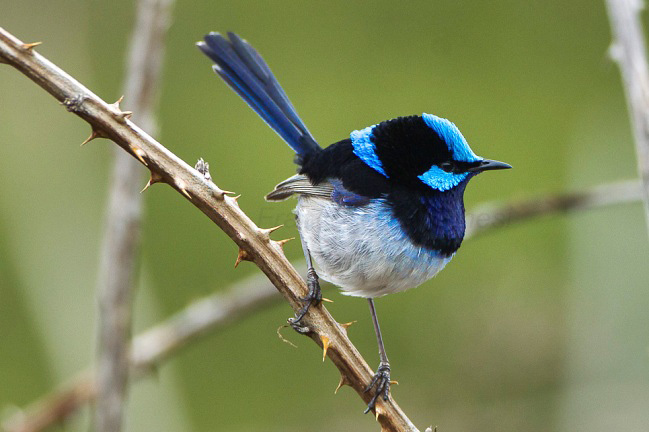
A male Superb Fairy-wren, one of several brilliant fairy-wrens in Australia, by Francesco Veronesi.
Australia - Western
Dugong, Whale Shark, Manta Ray, Numbat, Honey Possum and over 20 birds endemic to western Australia including Long-billed and Short-billed Black-cockatoos,
Noisy Scrub-bird, Blue-breasted and Red-winged Fairy-wrens, Western Bristlebird, Western Spinebill and Western Whipbird.
Austria
Pygmy Cormorant, Great Bustard, Eastern Imperial Eagle, possible Saker Falcon, ten European woodpeckers, Northern (Eurasian) Nutcracker and fine alpine
scenery in a tiny, land-locked country.
Azerbaijan
This small country supports a long list of specialities including Caucasian Grouse, Caspian and Caucasian Snowcocks, Black Francolin, See-see Partridge,
Shikra, Black-winged Pratincole, White-winged (Güldenstädt's) Redstart, Finsch’s and Red-tailed Wheatears, Green, Ménétries's and Upcher’s Warblers,
Caucasian (Mountain) Chiffchaff, Semi-collared Flycatcher, Caspian Tit, Eastern Rock Nuthatch, Radde's Accentor, Pale Sparrow (Rockfinch), (Caucasian)
Twite, 'Caucasian' Great Rosefinch, Eurasian Crimson-winged Finch and Grey-necked Bunting, while other birds present include Chukar, Pygmy Cormorant,
Lammergeier, White-tailed Lapwing, Blue-cheeked Bee-eater, White-throated Robin, Rosy Starling, Red-fronted Serin, and Mongolian and Trumpeter Finches.
These birds are best looked for from mid-May to mid-June and the best areas are Hyrcan National Park (Caspian Tit), the High Caucasus (Caucasian Grouse
and Great Rosefinch (Mount Shahdagh)), and the Autonomous Republic of Nakhchiva (Caspian Snowcock, See-see Partridge, Red-tailed Wheatear, Eastern Rock
Nuthatch, Radde’s Accentor and Pale Sparrow). During the northern winter birds include Greater and Lesser White-fronted Geese, Marbled Teal, White-headed
Duck, Dalmatian and Great White Pelicans, Eastern Imperial Eagle, Little Bustard (thousands in and around Aggol National Park), Grey-headed Swamphen and
Pallas's (Great Black-headed) Gull. Many species pass through on migration as well and there is a bottleneck on the the narrow coastal plain below the
rock of Besh Barmag less than 100km north of the capital Baku where over a million birds have been recorded during the autumn/fall including waterbirds,
raptors, rollers and Blue-cheeked Bee-eaters. Mammals are less prominent but aerial maps of Azerbaijan even in the mid-2010s showed the presence of great
tracts of near-pristine forest where Brown Bears, Wolves and even Leopards still lived.
Azores
Sperm and other whales, Striped and other dolphins, seabirds such as Bulwer's Petrel, Barolo (Little) and Cory's Shearwaters, and Band-rumped (Grant's)
and Monteiro's Storm-petrels, as well as the rare endemic Azores Bullfinch, on and around nine isolated volcanic islands in the Atlantic,
also famous amongst European birders for the astonishing variety of lost North American birds which have landed there, in September-October.
B
Babar
See Lesser Sundas, below.
Bacan
See Moluccas, below.
Baffin Island - Canada
See Canada - Baffin Island, below.
Bahamas
Eight endemic birds; Inagua Woodstar (Great Inagua), Bahama Lizard-cuckoo, Bahama Swallow, Bahama Nuthatch (may have become extinct due to Hurricane Dorian
in 2019), Northern Red-legged Thrush, Bahama Oriole, Bahama Yellowthroat and Bahama Warbler, as well as near-endemics Bahama Woodstar, Cuban Emerald, West
Indian Woodpecker, Cuban Amazon, La Sagra's Flycatcher, Cuban Pewee and Olive-capped Warbler, and wintering Kirtland's Warblers, all in one of the best
places in the world to swim with dolphins, sharks and sting rays.
Bahrain
The small, green farms on this otherwise arid archipelago in the central Arabian (Persian) Gulf attract a wide variety of passage migrant birds, including
Egyptian Nightjar (regular in late October-early November) and Hypocolius (also regular in late October-early November, sometimes all winter), while
rocky hills support (Eastern/Iranian persica) Mourning Wheatear and around the coast are Socotra Cormorants (half the world’s population nests on Bahraini
islets, notably the Hawar Islands which hard to access and also support the world’s biggest colony of Western Reef-egrets). Large numbers of shorebirds
pass through between July and October, and passing landbirds, most numerous in March and April, have included White-throated Robin and Menetries’s Warbler.
Other animals include Indo-pacific Bottlenose Dolphins, Green Turtles and the largest herd of Dugongs in the world, formed when mainly mothers and calves
gather between Bahrain and the Hawar Islands between August and early April, especially in late autumn.
Baja California - Mexico
See Mexico - Baja California, below.
Balearic Islands
See Mallorca and Menorca, below
Bali, Indonesia
See Indonesia - Bali, below
Banggai Islands
See Sulawesi's satellites, below.
Bangladesh
This small, heavily populated country is perhaps best known in the world of wildlife for Spoon-billed Sandpipers and the Sundarbans. Up to perhaps 30% of
the few Spoon-billed Sandpipers left on this planet spend the northern winter (November to March) in Bangladesh, along with tens of thousands of other
wintering shorebirds including Spotted (Nordmann’s) Greenshank, Great Knot and Asian Dowitcher. The first specimen of the sandpiper was collected in
Bangladesh in the mid-19th Century and the country still retains the record for the highest single count anywhere in the world; 202 at Moulevir Char in
1989. Since then a count of more than 100 has never been recorded and numbers have fallen to a minimum of 48 on the Meghna Estuary in the mid 2010s. Hatiya
Island near Cox's Bazar, famed for what may be the longest continuous beach in the world, is a major wintering site for Indian Skimmers. The Sundarbans is
thought to be the largest mangrove forest left in the world and the place where there are perhaps more Tigers than anywhere else. Also possible on boat
trips through the creeks are Ganges River Dolphin, the rare Masked Finfoot, Great Thick-knee, and Black-capped, Brown-winged and Ruddy Kingfishers. In the
northeast of the country, near Srimangal, there is a wetland reserve called Hail Haor where Falcated Duck, Pallas’s Fish-eagle (at Baikka Beel), Pied
Harrier, Greater Painted-snipe, and Bronze-winged and Pheasant-tailed Jacanas occur, and several forest parks and reserves including Adampur (Orange-headed
Thrush), Kalachara (Chestnut-headed Bee-eater), Lawachara/Lowacharra (Malay Night-heron, Rosy Minivet, Black-breasted Thrush and Grey-bellied Tesia, as
well as Hoolock Gibbon and Phayre’s Langur), and Satchari (Black Baza, Red-headed Trogon and Common Green Magpie).
Barbados
There is not much natural habitat left on the coral island of Barbados, much more famous for its sugar plantations and white beaches than the few birds
present but they do include the ubiquitous endemic Barbados Bullfinch, as well as Masked Duck, Royal Tern, Scaly-naped Pigeon (more easily seen here than
on many other islands in its Caribbean range), Common Ground-dove, Zenaida Dove, Green-throated Carib, Antillean Crested Hummingbird, Black-whiskered
Vireo, Caribbean Martin, Caribbean Elaenia, Mangrove (Yellow) Warbler (in and around the Graeme Hall Nature Sanctuary mangroves, arguably the best birding
site on the island), Bananaquit, Black-faced Grassquit, Shiny Cowbird and Carib Grackle (a population with males and females in similar plumage). Good
places for shorebirds are Chancery Lane Swamp and Woodbourne Refuge.
Bay of Fundy (New Brunswick-Nova Scotia, Eastern Canada)
See Canada - Bay of Fundy, below.
Beidaihe and Happy Island - China
See China - Beidaihe, below.
Belarus
Take a trip back in time to what much of northern Europe used to look like; great expanses of meadows, marshes and forests, home to Great Snipe (possibly
displaying at leks), Marsh and Terek Sandpipers, Great Grey Owl, Aquatic Warbler and Azure Tit.
Belize
Whale Shark, possibly West Indian Manatee, coral reef fish and spectacular birds including Orange-breasted Falcon, Keel-billed Toucan and Yucatan Jay, with
Great Curassows and Ocellated Turkeys at Tikal just across the border in Guatemala.
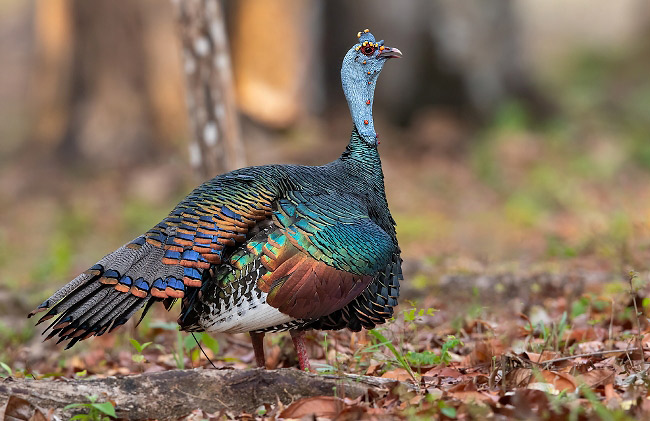
A male Ocellated Turkey at Tikal, Guatemala, by Dubi Shapiro.
Benin
This small country lies between the major Upper Guinea and Lower Guinea forest blocks in a southern extension of sub-Saharan savanna sometimes called the
'Dahomey Gap'. There are lots of waterbirds in the coastal lagoons and lakes along the south coast including African Pygmy-goose and Damara Tern (April to
October), and several small, remnant forest patches in the densely-populated south, the best of which is Lama Classified Forest which supports birds such
as African Cuckoo-hawk, Ahanta Francolin, Western Crested Guineafowl, White-spotted Flufftail, Narina Trogon, Rosy Bee-eater (a non-breeding visitor),
Western Long-tailed (White-crested) Hornbill, several greenbuls including Baumann’s, Grey Longbill, Buff-throated Apalis, West African (Chestnut) Wattle-eye
and Puvel's Illadopsis, and it is a very important site for Red-bellied Monkey, locally known as ‘Zinkaka’, which is endemic to the Dahomey Gap. In the far
northwest next to Burkina Faso is Pendjari National Park, one of the last strongholds for wildlife in West Africa with rather elusive Elephants, Lions,
Leopards and Buffalos, as well as Hippo, Serval, Roan, Korrigum (Topi) and even Cheetah although the total population of the latter species in the WAP
complex which encompasses Parc W (Benin, Burkina Faso and Niger), Arli (Burkina Faso) and Pendjari was estimated to be no more than 20 individuals in 2017.
Birds recorded in Pendjari include Saddle-billed Stork, African Fish-eagle, Beaudouin’s Snake-eagle, Kori Bustard, Black Crowned Crane, Red-throated
Bee-eater, Abyssinian Roller, Northern (Abyssinian) Ground-hornbill and Exclamatory Paradise-whydah, a similar avifauna to that of Parc W in the extreme
north of the country. It is normally dry up north from November to May while the driest time of the year in the constantly humid south is usually December
to March.
Bermuda
This 21 square mile (54 square km) somewhat depauperate archipelago in the North Atlantic about 570 miles (920 km) east of Cape Hatteras in North Carolina
is most famous in the birding world for the endemic breeding Bermuda Petrel, or Cahow as it is called on Bermuda. When Columbus sailed past Bermuda
in 1492 an estimated half a million pairs of Bermuda Petrels were probably present. It did not take long after the arrival of people, especially the
English in the early 1600s, with their pigs, cats, dogs and rats, to push the petrel to what was thought to be extinction. Then a petrel was picked up
alive in 1906. Three others followed, in 1935, 1941 and 1945, before an expedition to search for birds was organized in 1951 and seven nesting pairs were
found. Since then, thanks mainly to the efforts of David B. Wingate who was present during the expedition, the numbers have risen to 70 pairs in 2003 and
130 by 2019, by which time it was possible for visitors to see some petrels, on boat trips run by the Bermuda Audubon Society in November, the
best time to see the petrels, especially during the new moon (birds usually leave during December before returning to lay their eggs). When these trips
are cancelled in bad weather it is possible to see the birds with a telescope from Cooper’s Island/Point, especially after 4 p.m. as they begin to
approach land. Bermuda Petrels are normally present through to April and another good time to look for them is in late February-early March when
White-tailed Tropicbirds are also present (usually until August). The 20 or so resident bird species include Eastern Bluebird, Grey Catbird and the
bermudianus form of White-eyed Vireo. Many more species have been recorded, mainly because Bermuda is a refuge for lost migrant North
American passerines, particularly from mid-September to mid-October when no less than 38 species of warbler were recorded one autumn (1998). Over a hundred
species including 20 or so warblers may remain throughout the winter. The top all-round birding site is Spittal Pond, good, according to the season, for
White-tailed Tropicbirds and warblers although Ferry Point Park is another well-known site for migrants.
Bhutan
Where vast tracts of pristine forest, Golden Langurs and so many brilliant Himalayan birds are part of the Gross National Happiness, birds such as
Himalayan Monal, Satyr Tragopan, White-bellied Heron, Pallas's Fish-eagle, Ibisbill, Ward’s Trogon, Rufous-necked Hornbill, Beautiful Nuthatch, Himalayan
Cutia and Fire-tailed Myzornis.
Bioko, Equatorial Guinea
Bioko (called Fernando Po during Portuguese colonization) is a rugged mountainous volcanic island rising to 3000 m (nearly 10,000 ft) at Pico Basile
in the Gulf of Guinea 32 km off the west coast of Cameroon. It is about 70 km long and about 30 km across with many plantations having replaced a lot of
the native rainforest. Nearly 200 bird species have been recorded including two endemics: Bioko Batis and Bioko Speirops. There are also at least 28
endemic subspecies including those of Mountain Saw-wing, Grey-necked Rockfowl (Red-headed Picathartes) and Ursula’s Sunbird, while other birds present
include White-tailed Tropicbird, Cameroon Olive-pigeon, Bar-tailed Trogon, Chocolate-backed Kingfisher, Blue-moustached Bee-eater, Grey-headed Broadbill,
Black-necked Wattle-eye, Short-tailed (Bocage's) Akalat, Green Longtail, White-tailed Warbler, Cameroon Sunbird and Shelley's Oliveback. The island is the
best place in the world to see (Bioko) Drills while other mammals include White-bellied (Tree) Pangolin, African Linsang and several monkeys; (Bioko) Black
Colobus, (Pennant’s) Red Colobus, Crowned, (Bioko) Putty-nosed and (Bioko) Red-eared Monkeys, and the rarer Preuss’s Monkey which occurs at higher
altitudes, usually only accessible during January and February, the driest months and best time to visit.
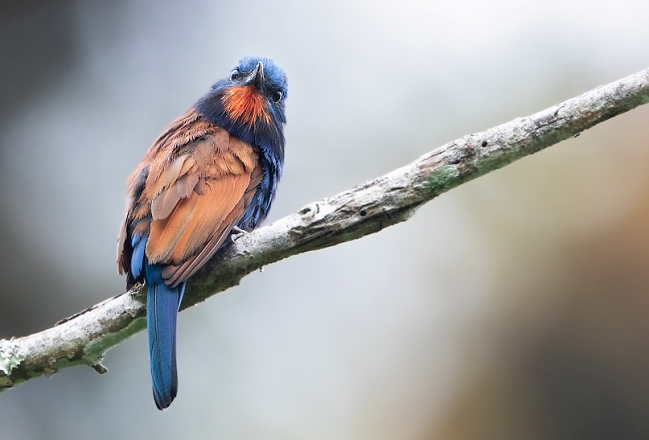
A fine portrait of a Blue-moustached Bee-eater taken on Pico Basile on the island of Bioko by Dubi Shapiro.
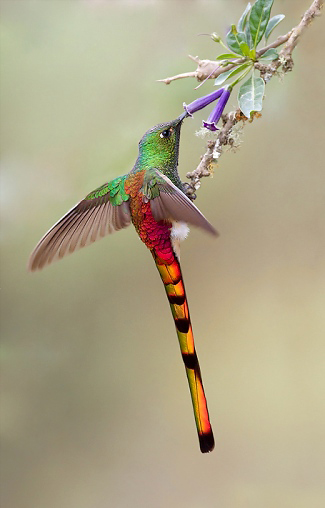
One of the best images ever of one of the most spectacular hummingbirds, a Red-tailed Comet by Dubi Shapiro, taken at a place called Siberia in Bolivia.
Bolivia
Several spectacular macaws including the endemic Blue-throated, 17 other endemics including Horned Curassow, Black-hooded Sunbeam, Masked Antpitta, Apolo
(Swallow-tailed) Cotinga and Cochabamba Mountain-finch, and numerous near-endemics including 84 species shared only with Peru, and 29 only with Argentina,
with the latter group including Red-tailed Comet, one of the most beautiful hummingbirds, all in the birdiest landlocked country on Earth.
Borneo - Malaysia
A Top Ten Destination thanks to Orang-utan, Proboscis Monkey, Bornean Gibbon and many top birds, not least 64 endemics,
including Whitehead’s Trogon, Black-crowned, Blue-banded, Blue-headed and Bornean Banded Pittas, Hose’s and Whitehead’s Broadbills, Bornean Bristlehead,
Everett’s Thrush, Fruithunter and Whitehead’s Spiderhunter, as well as many trogons, kingfishers, bee-eaters, broadbills, hornbills and babblers, all in
some of the oldest, tallest and richest
rainforest on Earth.
Bosnia-Herzegovina
Much of this country is made up of arid, karst, limestone mountains although there is a large wetland reserve in the south called Hutovo Blato which is
contiguous with wetlands associated with the Neretva Delta. The best time to visit is during spring migration especially late April to late May when on
a visit which includes the mountains and the Neretva area the following birds may be seen; Ferruginous Duck, Rock Partridge, Squacco Heron, Little
Bittern, Pygmy Cormorant, Lesser Spotted and Short-toed Eagles, Levant Sparrowhawk, Red-footed Falcon, White-winged Tern, Lesser Grey Shrike, Northern
(Eurasian) Nutcracker, Yellow-billed (Alpine) Chough, Eastern Orphean and Olive-tree Warblers, Sombre Tit, Western Rock Nuthatch, Collared Flycatcher, and
Black-headed and Rock Buntings.
Bosque del Apache (New Mexico) - USA
See USA - Bosque del Apache, below.
Botswana
Many mammals including a good chance of African Wild Dogs, and lots of birds especially in the Okavango Delta, including Slaty Egret, Wattled Crane and
Pel's Fishing-owl, in a country where over a fifth of the terrain lies within unfenced 'protected' areas.
Brazil - Amazon
The largest river on the planet, flowing through the richest rainforest in the world which supports the greatest diversity of life on Earth, with many
birds including parrots, macaws, hummingbirds, jacamars, toucans, antbirds and cotingas, notably Crimson Fruitcrow, Guianan Cock-of-the-rock and
Guianan Red Cotinga, and mammals such as sloths, tamarins, marmosets and monkeys.
Brazil - Carajas
Carajas National Forest in southeastern Para state, northeast Brazil, is one of the richest areas for birds in Amazonia. It is possible to see and/or hear
250 species in a few days and they may include Peruvian Recurvebill, Black-chested Tyrant and Black-and-white Tody-flycatcher, as well as Bare-faced
Curassow, White-crested Guan, Red-throated Piping-guan, Chestnut-headed Chachalaca, Grey-bellied Goshawk, Harpy Eagle, Cryptic Forest-falcon, Black-winged
Trumpeter, Rufous-sided and Russet-crowned Crakes, Marbled Wood-quail, Blue-and-yellow, Hyacinth, Red-and-green and Scarlet Macaws, Jandaya and Pearly
Parakeets, Red-fan and Vulturine Parrots, Dot-eared Coquette, Blue-necked Jacamar, Rufous-necked Puffbird, Eastern Red-necked Aracari, Banded and
Southern Wing-banded Antbirds, Long-winged Antwren (paraensis), Black-bellied and Black-breasted Gnateaters, Fiery-capped and Opal-crowned Manakins,
Guianan Red Cotinga, Purple-breasted, Spangled and White-tailed Cotingas, the wallacei subspecies of White Bellbird, Sharpbill, Blackish Pewee, White-naped
Jay, Rose-breasted Chat, Para (Guianan) Gnatcatcher, Spotted Tanager, Red-billed Pied Tanager and Yellow-shouldered Grosbeak. In the same region, around
the town of Caxias in Maranhao state are restricted-range birds such as Buff-browed Chachalaca, Kaempfer’s Woodpecker, Moustached Woodcreeper and Hooded
Gnateater, along with Lesser Crescent-chested Puffbird, Curl-crested Jay, and Blue and Coalcrest, with a chance of Rufous-vented Ground-cuckoo. The best
time to visit is August-September.
Near Belem, also in Para state, it is possible to see the endemic Hooded Gnateater, as well as Buff-browed Chachalaca and Olive-backed Foliage-gleaner while the amazing Golden Parakeet is being reintroduced to a city park and other birds in and near the city include White-browed Hawk, Vulturine Parrot, the nominate subspecies of Willis’s Antbird, Grey Antwren, Cinereous Antshrike, Purple-breasted and White-winged Cotingas, and Crimson-hooded and Opal-crowned Manakins. Endemic to the lower Amazon, Scaled Spinetail occurs on Mexiana Island at the mouth of the river, and Little Wood-rail can be seen at Salgado Paraense near Salinopolis, along with Scarlet Ibis, Rufous Crab-hawk, Sunbittern, Mangrove Cuckoo and Plain-bellied Emerald.
Brazil - Central (Minas Gerais)
Some tour companies tie a trip to the Pantanal with the Campo and Cerrado Region of Minas Gerais state in Central Brazil where the main sites are:
Serra da Canastra National Park, where it is possible to see Brazilian Merganser, one of the rarest birds in the world, as well as Giant Anteater,
Black-ear-tufted Marmoset, Red-legged Seriema, Aplomado Falcon, Golden-capped Parakeet, Toco Toucan, Campo Miner, Grey-backed Tachuri, Cock-tailed,
Sharp-tailed and Streamer-tailed Tyrants, Collared Crescentchest, Helmeted Manakin, White-rimmed and White-striped Warblers, Blue Finch and
Yellow-rumped Marshbird; Serra do Cipo National Park, where the main attractions are Hyacinth Visorbearer, possibly Horned Sungem, Cipo Canastero and
(Cipo) Long-tailed Cinclodes, along with Cinereous Warbling-finch and Pale-throated Pampa-finch; Serra do Caraca National Park, where there is a chance
of Maned Wolf on the monastery steps and Black-ear-tufted Marmoset, as well as Slaty-breasted Wood-rail, Orange-eyed Thornbird, Serra Antwren, Rufous
Gnateater, Red-ruffed Fruitcrow, Swallow-tailed Cotinga and Pin-tailed Manakin; and Caratinga National Park, where Buffy-headed Marmoset, and Brown Howler
and Woolly Spider Monkeys occur, and there is a chance of Three-toed Sloth and Giant Helicopter Damselfly. The best time to visit is the dry season, July
to October.
From Belo Horizonte in Minas Gerais state it is not far east to the state of Espirito Santo where the adjacent Rio Doce Private Forest Reserve and Sooretama Biological Reserve protect one of the largest remnants of Atlantic coastal lowland rainforest and support Red-billed Curassow, White-necked Hawk, Black-cheeked Gnateater, Black-headed Berryeater and White-winged Cotinga. Not far from there is the town of Santa Theresa where the hummingbird feeders at the home of the late Dr Augusto Ruschi attract a whirl of hummers, including Frilled Coquette. Santa Theresa city park is a good place to see Masked Titi Monkey, Geoffroy’s Marmosets and Common Opossums (on the bird tables at night) and Santa Lucia Reserve near Santa Theresa supports Cinnamon-vented Piha, Bare-throated Bellbird, Sharpbill and many tanagers.
In 2018 a new reserve was created in the rocky uplands of eastern Minas Gerais to help protect the recently rediscovered Blue-eyed Ground-Dove.
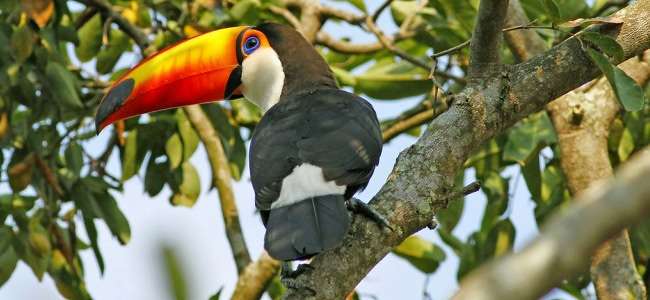
Brazil is the best place to see Toco Toucan. Image by Chris Townend.
Brazil - Alta Floresta
This luxurious Cristalino Lodge is about an hour by road and half an hour by river from Alta Floresta which is accessible by air in one
and a half hours from Cuiaba, the gateway to the Pantanal, hence the two destinations are often combined by tour operators. Cristalino is situated in
southern Amazonian rainforest, the richest place for birds on Earth, hence nearly 600 bird species have been recorded. Many are thin on the ground and/or
shy and skulking though so a stay of at least a week is recommended to stand a chance of seeing some of the numerous specialities such as Razor-billed
Curassow, Red-throated Piping-guan, Zigzag Heron, Harpy Eagle, White-browed Hawk, Cryptic Forest-falcon, Green-winged Trumpeter, Crimson-bellied Parakeet,
White-faced Amazon (Kawallʼs Parrot), Pavonine Quetzal, Tapajos Hermit, Brown-banded, Eastern Striolated and Rufous-necked Puffbirds, Blue-necked Jacamar,
Black-girdled Barbet, Curl-crested Aracari, Gould's Toucanet, Glossy Antshrike, Bare-eyed Antbird, Alta Floresta (Spotted) Antpitta, Zimmerʼs Tody-Tyrant,
Flame-crested and Snow-capped Manakins, Tooth-billed Wren and Yellow-shouldered Grosbeak, as well as more widespread species such as Agami Heron,
Sunbittern, Blue-and-yellow, Red-and-green and Scarlet Macaws, Great and Paradise Jacamars, Long-billed Woodcreeper, Black-spotted Bare-eye,
Chestnut-belted Gnateater, Pompadour, Purple-throated and Spangled Cotingas, Bare-necked Fruitcrow, Amazonian Umbrellabird, White-browed Purpletuft,
Band-tailed Manakin, Musician Wren and Paradise Tanager. There are two 50 metre high canopy towers, lots of trails and boat trips along the blackwater
rivers are available to seek out the birds and mammals, which include Red-handed Howler and several other monkeys. The best time to visit is
October-November at the start of the rainy season when more birds are in song and there are more antswarms. Similar species occur at Rio Azul
Jungle Lodge, three hours by road from Alta Floresta, including Tapajos Hermit, and the forest here is a good place to see the rare Bald
Parrot.
Brazil - Northeast
In the states of Alagoas, Bahia, Ceara and Pernambuco it is possible to see over 450 species on a regular trip including well over 100 of Brazil’s 268
endemics, many of which are rare and highly localised in remnant patches of three main habitats: the arid, thorny scrub and woodland of the Caatinga,
savanna-like Cerrado, and Atlantic Forest. In the Fortaleza-Recife region the stunning Arapire Manakin which has a tiny range occurs in the Crato area
along with White-browed Antpitta, with Scarlet-throated Tanager between there and Quixada. The very localized endemic Grey-breasted Parakeet can be seen
at the Hotel de Remanso on the Quixada-Serra de Baturite Road and in the serra along with Ceare (Rufous) Gnateater and a few extra possible ‘ceara’splits.
South from Recife, between there and Salvador, the very rare White-collared Kite is possible at Murici along with Alagoas Antwren, Scalloped
Antbird, Black-cheeked Gnateater and Seven-coloured Tanager. Inland, the place for Lear's Macaw is Canudos. South of Salvador the greatest concentration of
endemics in Brazil occurs in the Boa Nova area in Bahia with species present including Giant Snipe, Pygmy Nightjar, Frilled Coquette, Large Pale-browed
Treehunter, Narrow-billed Antwren, Rio de Janeiro, Scaled, Slender and White-bibbed Antbirds, Fork-tailed and Hangnest Tody-tyrants, Pink-legged
Graveitero, Pin-tailed Manakin and Dubois's Seedeater. South of Boa Nova Buff-throated Purpletuft and Cinnamon-vented Piha occur at Serra Bonita and the
two outstanding cotingas, Banded and White-winged, are both at Veracel. Inland, Helmeted Manakin occurs at Caetite. The mammals of this huge region
include White-tufted-ear and Wied's Black-tufted-ear Marmosets, and Coimbra-Filho's Titi Monkey. The best time for birding is January at the start of the
rainy season when more birds are vocal.
Brazil - Roraima
The Amazonian lowlands, Tepuis cloud forests, palm swamps, savannas and marshes of Brazil's northernmost state support many range-restricted species such
as Crestless Curassow, Sun Parakeet, Hoary-throated Spinetail, and Rio Branco and Yapacana Antbirds, in the Guianan Shield, Imeri (west of the Rio Branco)
and Pantepui areas of endemism. From Boa Vista (accessible by air from Manaus) head north to the Serra do Tepequem (a southern extension of the Tepui) and
on to Viruá National Park, 30 mins by road from Caracarai City, for the aforementioned species, as well as Slate-coloured Hawk, Sunbittern, Blue-and yellow
and Red-and-green Macaws, Black-headed and Caica Parrots, Golden-winged Parakeet, Scarlet-shouldered Parrotlet, Tufted Coquette, Green-tailed and Paradise
Jacamars, Spotted Puffbird, Channel-billed Toucan, Guianan Toucanet, Black-necked and Green Aracaris, Black-headed, Ferruginous-backed, Rufous-throated and
White-bellied Antbirds, Guianan Tyrannulet, Rufous-crowned Elaenia, Guianan Cock-of-the-rock, Black, White-crowned and Yellow-crested Manakins, Cayenne
Jay, Campina (Black-billed) Thrush, Burnished-buff Tanager, White-naped Seedeater and Plumbeous Euphonia (mostly Apr-Aug). The dry season extends from
September to March.
Brazil - Southeast
More endemic birds than any other corner of South America (74), plus 76 shared with far north Argentina and east Paraguay and a whole load more Atlantic
Forest Endemics, many of which are localized, rare and little-known but they include such star birds as Black-headed and Hooded Berryeaters, Cinnamon-vented
Piha, Black-and-gold, Grey-winged and Swallow-tailed Cotingas, Bare-throated Bellbird, Buff-throated Purpletuft and Elegant Mourner, as well as some
very large antshrikes and several stunning tanagers not least Brassy-breasted, Cherry-throated and Red-necked.
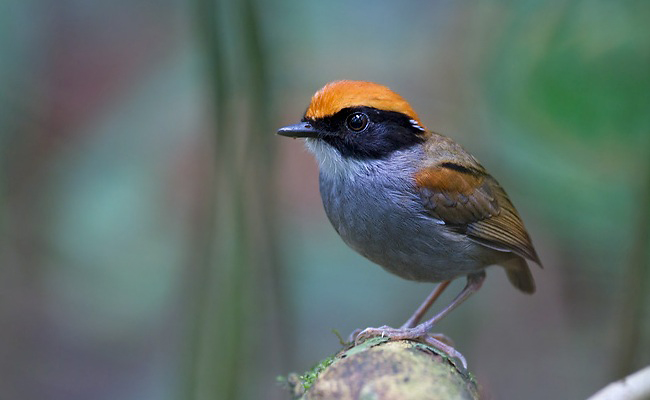
Black-cheeked Gnateater at the 'REGUA' Reserve in Southeast Brazil by Dubi Shapiro.
Brazil - Southern (Pantanal-Iguassu)
One of the greatest concentrations of wildlife in South America, in one of the world's most extensive wetlands, the Pantanal, the best place in the world
to see Jaguars, with other mammals including Giant Anteater, Giant Otter and Brazilian Tapir, and numerous birds such as Southern Screamer, Sunbittern,
Hyacinth Macaw and Toco Toucan.
British Columbia (Western Canada)
See Canada - Western Canada, below.
Bulgaria
Wallcreepers inland and a spectacular migration flyway for pelicans, shorebirds and so on along the coast, with Red-breasted Geese in winter.
Burkina Faso
This mostly flat, landlocked, low-lying West African country supports a wide range of birds from those of the Sahel in the north through the Sudan-Guinea
Savanna, rivers and lakes to tropical forest species in the south. Species include Arabian and Savile’s Bustards, Black Crowned Crane, Lesser Jacana,
Greater Painted-snipe, Cream-coloured Courser, Black-headed Lapwing, Senegal Parrot, Golden Nightjar, Red-throated Bee-eater, Abyssinian and Blue-bellied
Rollers, Bearded Barbet, Kordofan Lark, Pied-winged Swallow, Blackcap Babbler, Oriole Warbler, Senegal Eremomela, Cricket Warbler, Sennar Penduline-tit,
Chestnut-bellied Starling, Sudan Golden Sparrow, Grey-headed Oliveback and many birds that spend the northern winter in West Africa and the northern
summer in Europe including large numbers of Garganey. The best place for forest birds is probably Beregadougou Hill in the southwest. In the extreme
southeast lies the W - Arli - Singou National Park complex which extends into Benin and Niger and supports specialities such as the isolated West African
subspecies of Golden-tailed Woodpecker. Also south of Ouagadougou, the delightfully named capital pronounced waga-doo-goo, over 300 species have been
recorded at Nazinga Game Ranch along the border with Ghana including 43 diurnal raptors, five nightjars and seven bee-eaters. One of the best wetlands
may still be the Lake Oursi-Lake Darkoye Important Bird Area west of Markoye in the far north. The rainy season makes overland travel tricky so the best
time to visit Burkina Faso is from November to June.
Burma
See Myanmar, below.
Buru
See Moluccas, below.
Burundi
This small, densely-populated country still supports 24 of the 36 Albertine Rift Endemics; Handsome Francolin, Rwenzori Turaco, Dwarf Honeyguide, Rwenzori
Batis, Albertine Sooty Boubou, Stripe-breasted Tit, Grauer’s Warbler, Black-faced and Rwenzori Apalises, Grauer’s Swamp-warbler, Red-faced Woodland-warbler,
Neumann’s (Short-tailed) Warbler, Red-collared Mountain-babbler, Yellow-eyed Black-flycatcher, Archer’s Robin-chat, Red-throated Alethe, Blue-headed,
Purple-breasted, Regal and Rwenzori (Stuhlmann’s) Double-collared Sunbirds, Strange Weaver, and Dusky and Shelley’s Crimsonwings. The place to head for
these forest birds is Kibira, contiguous with Nyungwe Forest in neighbouring Rwanda, which also supports Black-billed Turaco, Narina Trogon,
Cinnamon-chested Bee-eater, White-headed Woodhoopoe, Rwenzori Hill-babbler, Equatorial Akalat, Black-faced Prinia, Mountain Oriole, Slender-billed Starling
and Yellow-bellied Waxbill. Other good birding sites include the Rusizi Delta near the capital Bujumbura (lots of waterbirds including African Skimmer);
Lake Rwihinda (Papyrus Yellow Warbler and Papyrus Gonolek); Kigwena-Rumonge Forest NP (Owl-faced Monkey), The Congo-Nile Ridge Park, Nyakazu, Mwishanga
Forest NP and Ruvubu NP (named after the Hippos there this stretch of the Ruvubu River is good for waterbirds, Red-faced Barbet, Papyrus Yellow Warbler and
Papyrus Gonolek). The main wet seasons usually last from February to May and September to November, and the driest times of the year are normally from
June to August and December to January.
C
California (Northern) - USA
See USA - California (Northern), below.
California (Southern) - USA
See USA - California (Southern), below.
Cambodia
Several spectacular birds very difficult or impossible to see elsewhere including Giant and White-shouldered Ibises, Greater Adjutant, Bengal Florican,
White-rumped Pygmy-falcon and Black-headed Woodpecker, the biggest breeding colonies of waterbirds in Southeast Asia with Spot-billed Pelicans and Painted
Storks, and some wonderful mammals such as Yellow-cheeked Gibbon and Black-shanked Douc Langur.
Cameroon
The richest birdlife in West Africa with many specialities including five endemics; Mount Cameroon Francolin, Bannerman's Turaco, Banded Wattle-eye, Mount
Cameroon Speirops and Bates's Weaver, as well as Scissor-tailed Kite, Black Crowned Crane, Egyptian Plover, Grey Pratincole, Grey-headed Broadbill,
Green-breasted and Mount Kupe Bushshrikes, and Grey-necked Rockfowl, with a chance of Quail-plover and Brown-chested Lapwing.
Canada - Alberta
Black and possibly Grizzly Bears, American Bison, Moose, Elk, Bighorn Sheep and Mountain Goat, as well as birds such as Bald Eagle, Harlequin Duck, Varied
Thrush, Mountain Bluebird and Clark’s Nutcracker, in prairie potholes and grasslands, and the scenic forested, snowy mountains of the Rockies.
Canada - Arctic, and Greenland
Polar Bear, Walrus, Beluga, Bowhead Whale, Musk Ox, seabird cities with Little Auks (Dovekies) and Thick-billed Murres (Brunnich's Guillemots), and other
spectacular birds such as Gyr Falcon, Snowy Owl and Ivory Gull, all in wonderful settings, make this A Top Ten Destination.
Canada - Baffin Island
The best place in the world for Narwhal, plus a chance of Polar Bear, Walrus, Beluga and Bowhead Whale, as well as passing birds such as Ivory and
Sabine’s Gulls.
Canada - Eastern (Bay of Fundy, New Brunswick-Nova Scotia)
Fin, Northern Right and a chance of Humpback Whales, summering seabirds, and passing shorebirds and warblers.
Canada - Manitoba
The greatest concentration of Polar Bears in the world, at Churchill during October. In the first half of June Churchill is a good place to see passing
shorebirds and from late June to mid-August it is possible to see (and even swim with) Belugas there.
Canada - Newfoundland
The largest northern summer numbers of Humpback Whales in the world and spectacular seabird colonies including over half a million Atlantic Puffins on
Great Island alone, the largest colony in North America.
Canada - Northwest Territories
The most famous place for wildlife in Canada’s Northwest Territories province is Wood Buffalo National Park where the spectacular Whooping Crane, one of
the rarest birds in the world, nests. The cranes usually return from their wintering grounds in Texas in mid-April and leave during September-October. The
45,000 sq km park also supports breeding American White Pelicans and American Avocets, up to a million wildfowl during the autumn/fall migration period,
and mammals such as bison, bears, wolves, wolverines, lynx, moose and caribou but all, even the thousands of bison, can be extremely elusive in what is an
area larger than Switzerland. To the north in the Yellowknife region boreal habitats in the Great Slave Lake area support Bald Eagle, Sandhill Crane, Alder
and Olive-sided Flycatchers, Grey Jay, Blackpoll, Orange-crowned, Tennessee and Wilson’s Warblers, Western Tanager and Rusty Blackbird. The best time of
year to look for such birds is late June-early July.
Canada - Nunavut
It is possible to fly to the town of Cambridge Bay on Victoria Island in the high Arctic of Canada, from where visitors can travel by vehicle on a few
roads and tracks to: (i) the base of Mount Pelly where shorebirds including American Golden Plover, Baird’s, Semipalmated and Stilt Sandpipers, and
Red-necked Phalarope nest alongside Long-tailed Jaeger (Skua), Arctic Tern, Horned (Shore) Lark, Lapland Longspur (Bunting) and Snow Bunting. Also possible
are Yellow-billed Loon (White-billed Diver) and Muskox, and, if there are lots of lemmings, Snowy Owl and Pomarine Jaeger (Skua); (ii) Dease and Simpson
Straits overlooking the Northwest Passage, a good place for Ringed Seals, and where the tundra supports breeding Tundra (Bewick’s) Swan, Greater
White-fronted Goose, Common and King Eiders, Long-tailed Duck and shorebirds which may include Buff-breasted, Pectoral and White-rumped Sandpipers; and
(iii) the interior where nesting birds include Red (Grey) Phalarope and Sabine’s Gull. The best time is late June-early July.
Canada - Point Pelee (Ontario)
A migration bottleneck in spring for up to 30 species of New World warblers, as well as vireos, orioles and tanagers, and a good place to catch up with
American Woodcock.
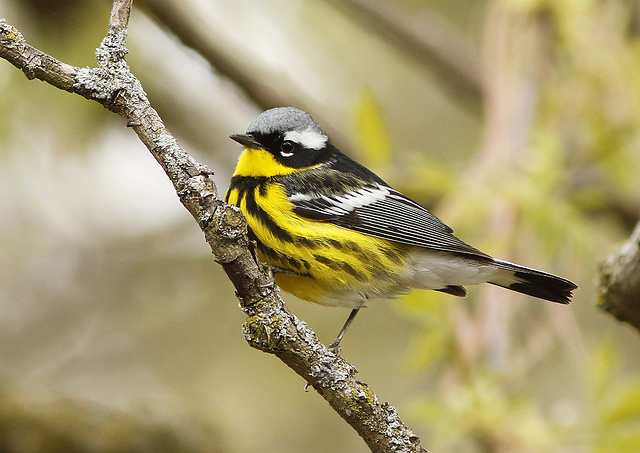
A superb Magnolia Warbler by David Beadle, one of many warblers possible on a good day at Point Pelee.
Canada - Quebec
A good chance of Beluga, Blue, Fin, Humpback and Minke Whales by boat, zodiac and kayak where the Saguenay Fjord meets the St Lawrence, out of the town
of Tadoussac from mid-June to September, especially mid-September for Blue Whale. Also, Laurentides Wildlife Reserve is a good place for Black Bear (from
hides and vehicles), Matane Wildlife Reserve for Moose and the Gaspe Peninsula/Gaspesie National Park for (Woodland) Caribou and a colony of nearly 50,000
pairs of Northern Gannets, possibly the largest on Earth, on Bonaventure Island. Other birds possible include Bald Eagle, Ruffed and Spruce Grouse, Boreal
Chickadee, up to 20 species of warbler, and Evening and Pine Grosbeaks, with Bicknell's Thrush at the top of Mount Saint Anne near Perce. During
late September-early October, when the autumnal colours are usually at their peak, up to 50,000 migrating Snow Geese and other waterfowl gather at the Cape
Tourmente National Wildlife Area.
Canada - Saskatchewan
In the first half of October small groups of Whooping Cranes and thousands of Sandhill Cranes, as well as tens of thousands of Canada and Snow Geese with
fewer Greater White-fronted and Ross’s Geese, and lots of ducks, migrate south across southern Saskatchewan stopping to rest and refuel in pothole country
east of Saskatoon, while in the boreal forest in Prince Albert National Park there is a chance of seeing Spruce Grouse, Northern Saw-whet Owl, American
Three-toed, Black-backed and Pileated Woodpeckers, Grey Jay, Boreal Chickadee, Bohemian Waxwing, sparrows which could include Harris’s and, occasionally,
Evening and/or Pine Grosbeaks, as well as Elk and Moose. Late May and June is the best time to enjoy the breeding birds of the vast prairie grasslands and
wetlands of southern Saskatchewan including American White Pelican, Ferruginous Hawk, Yellow Rail (unlikely to be seen), Upland Sandpiper, Sprague’s Pipit,
Baird’s Sparrow, Chestnut-collared and McCown’s Longspurs, and Yellow-headed Blackbird.
Canada - Western (British Columbia)
Grizzly Bears fishing for salmon, viewable from raised platforms, the greatest concentration of Killer Whales in the world, viewable from shore, boat and
kayak, Black Bears and even 'Spirit Bears' make this A Top Ten Destination.
Canada - Yukon
The Yukon is where Canada’s highest mountains are, as well as the largest non-polar icefields on Earth. There are not so many birds but the boreal forest
and tundra alongside the 350-mile-long gravel road known as the Dempster Highway between Dawson City and Inuvik at 68°N 120 miles inside the Arctic Circle
support Gyr Falcon, Long-tailed Jaeger (Skua), Northern Hawk-owl, Northern Wheatear, Smith’s Longspur and Grey-crowned Rosy-finch, as well as Black and
Grizzly Bears, and Moose. The best time to be there is late May-early June.
From mid-September to late October up to 50 Grizzly Bears arrive at Bear Cave Mountain to feast on salmon where thermal springs warm the river so it flows all year round. Due to its remote location close to the Arctic Circle access is very difficult and restricted and it may be necessary to book the adventure camp, accessible by helicopter from Dawson City, up to three years in advance.
Canary Islands
The Canary Islands which lie about 100 km off the southern coast of Morocco are the tops of a volcanic mountain range lying beneath the Atlantic Ocean and
although Pico de Teide rises to 12,198 ft (3718 m) on the island of Tenerife and often has snow on it vast areas of that island and those to the east
(Gran Canaria, Fuerteventura and Lanzarote) are barren, solidified lava, moon-like landscapes whereas on the wetter western islands El Hierro, Gomera and
La Palma there are remnant laurel forests. The islands support: at least six endemic bird species: Dark-tailed (Bolle’s) Laurel-pigeon (Tenerife and other
western islands), White-tailed Laurel-pigeon (Tenerife, Gomera and La Palma), Canary Islands Chiffchaff, Fuerteventura Stonechat, Tenerife Blue Chaffinch
and Gran Canaria Blue Chaffinch; three near-endemics - Plain Swift, Berthelot's Pipit and Island Canary; and many endemic subspecies of more widely
distributed birds, including African Houbara (Bustard) (fuertaventurae on Fuerteventura and Lanzarote), African Blue Tit (four subspecies) and
Goldcrest (teneriffae on Tenerife and Gomera). Tenerife supports the greatest diversity of endemic and near-endemic birds. Also present on
Fuerteventura are Egyptian Vulture (majorensis), Cream-coloured Courser, Black-bellied Sandgrouse, Lesser Short-toed Lark and Trumpeter Finch, with
the bustard, courser, lark and finch also on Lanzarote. On ferry crossings - such as between Gran Canaria and Tenerife, and Tenerife and Gomera - it is
possible to see Cory's and Barolo (Audubon's/Little/Macronesian) Shearwaters, Bulwer's Petrel and even (Cramp's) White-faced Storm-petrel (especially in
July when seabird numbers and diversity usually peaks), as well as Short-finned Pilot Whale, Bottlenose Dolphin and Loggerhead Turtle.
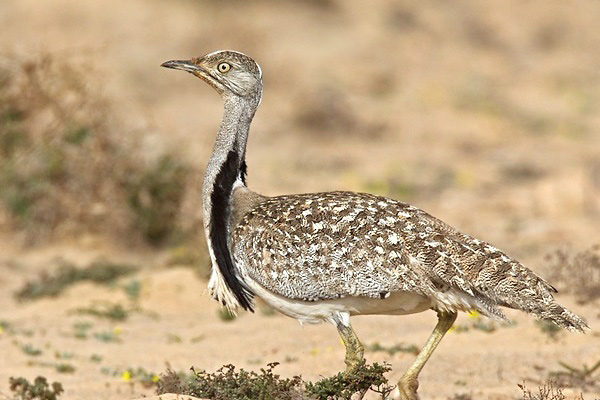
The Canary Islands is still a good place to see African Houbara Bustard. The image of this one was taken on Fuerteventura by Lars Petersson.
Cape May, New Jersey - USA
See USA - Cape May, below.
Cape Verde Islands
This windy volcanic archipelago of mainly desert and mountains about 350 miles (570 km) west of Senegal, West Africa, is in the Macaronesia ecoregion
along with the Azores, Canary Islands and Madeira, and therefore in the Western Palearctic. It supports just 36 breeding bird species but of the nine
seabirds four are endemic breeding species; Cape Verde (Band-rumped/Madeiran) Storm-petrel, Cape Verde (Fea’s) Petrel, and Boyd’s (Audubon's/Little) and
Cape Verde (Cory's) Shearwaters, while almost all of the landbirds are endemic species or subspecies, the five endemics being Alexander’s Swift, the very
rare Cape Verde (Common) Buzzard, Raso Lark, Cape Verde Swamp-warbler and Cape Verde (Iago) Sparrow, and the endemic subspecies including Purple (Bourne's)
Heron, Common (Alexander's and Neglected) Kestrel, and (Western) Barn-owl. Other birds present include Bulwer's Petrel, (Cramp's) White-faced Storm-petrel
(which can be seen during an overnight stay on Ilheu dos Passeros, off Boa Vista), Red-billed Tropicbird, Western Reef-egret, Brown Booby, Helmeted
Guineafowl, Cream-coloured Courser, Grey-headed Kingfisher (which occurs nowhere else in the Western Palearctic), Greater Hoopoe-lark, Bar-tailed Lark,
Black-crowned Sparrow-lark, Brown-necked Raven and Spectacled Warbler. The best islands to visit are: Santiago, the most bird rich island, mainly for
'Bourne's' Heron, Cape Verde Buzzard (in the mountainous centre of the island overlooking Sierra Malagueta), Grey-headed Kingfisher and Cape Verde
Swamp-warbler, although Praia cliffs is a good place for Red-billed Tropicbirds; Sao Nicolau, mainly for 'Neglected' Kestrel, boat trips to Raso Island for
Raso Lark (which has to be looked for from a boat because only researchers are allowed to land on the island which has colonies of Red-billed Tropicbirds
and Brown Boobies and sometimes attracts roosting Red-footed Boobies), the crossing which is good for Bulwer's and Cape Verde Petrels, Cape Verde
Storm-petrel, and Boyd's and Cape Verde Shearwaters, as well as Atlantic and Pantropical Spotted Dolphins, and Short-finned Pilot Whale, and Ponta do
Barril, one of the best places for seawatching in the archipelago, good for the aforementioned seabirds along with Red-billed Tropicbird and Brown Booby,
with a chance of White-faced Storm-petrel; and Boa Vista, where the Ilheu de Curral Velho, just offshore, supports a breeding colony of Brown Boobies (and
once the last breeding pair of Magnificent Frigatebirds in the Western Palearctic), and Ponta da Varadinha (with a 4WD) where it is possible to see
Red-billed Tropicbirds. The best time to visit is during the driest time of the year, December to June, especially March-April, when Humpback Whales can
also be seen on whale-watching trips.
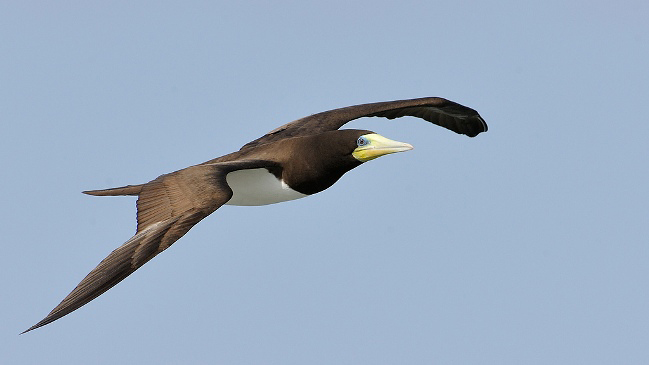
A great image of a Brown Booby captured in the Cape Verde Islands by Steve Rogers.
Caroline Islands
See Micronesia, below.
Cayman Islands
Grand Cayman Bullfinch is the only endemic bird species on these three islands south of Cuba but they do also support Vitelline Warbler which otherwise
occurs only on the Swan Islands off Honduras. There are many endemic subspecies, including two of Cuban Amazon (caymanensis on Grand Cayman and hesterna
on Cayman Brac) and Vitelline Warbler (vitellina on Grand Cayman and crawfordi on Little Cayman). Other specialities include West Indian Whistling-duck,
Antillean Nighthawk, West Indian Woodpecker (Grand Cayman), Loggerhead Kingbird, Caribbean Elaenia, La Sagra's Flycatcher, (Western) Red-legged Thrush,
Thick-billed Vireo, Yucatan Vireo (Grand Cayman), Bananaquit (sharpei), Western Spindalis (Grand Cayman) and Greater Antillean Grackle, while more
widespread spectacular species include White-tailed Tropicbird, Red-footed Booby (one of the largest breeding colonies on Earth (about 3500 pairs) is on
Little Cayman), Magnificent Frigatebird (which also has a breeding colony on Little Cayman), and passage migrant and wintering warblers such as
Black-throated Blue. Most resident breeding species nest from late May to July. The endemic fauna includes the Grand Cayman Blue Iguana while rich coral
reefs, calm seas and warm, clear water make snorkelling and scuba-diving delightful, the most notable larger species being Blacktip and Whitetip Reef
Sharks, Southern Stingray, Spotted Eagle Ray, Green Turtle and Atlantic Tarpon.
Central African Republic
Lowland Gorilla, African (Forest) Elephant, African (Forest) Buffalo, Red River Hog, monkeys and spectacular birds such as Grey-necked Rockfowl ...
but this was a troubled country around 2020 so best check with the relevant consulate/embassy/foreign office and travel company/companies before
travelling, and/or check out the facebook page and/or website of Sangha Lodge, the best place
to visit.
Chad
After decades of civil war the deserts, arid plains and mountains of Chad were becoming increasingly accessible to foreign visitors in search of somewhere
new, remote, beautiful and exciting around 2020 but best check with the relevant consulate/embassy/foreign office and travel company/companies before
travelling. In 2017 the bird tour company Birdquest enjoyed a successful trip in search of Nubian Bustard, the near-endemic Niam-niam Parrot,
Black-breasted Barbet, Dunn's and Rusty Larks, Heuglin's Wheatear and Kordofan (Rufous) Sparrow, and they also saw Scissor-tailed Kite, Arabian Bustard,
Black Crowned Crane, Egyptian Plover, Bronze-winged Courser, Abyssinian Roller, Cyprus Wheatear, Blackstart, Brown-tailed Chat, Black Scrub-robin, River
Prinia, Pygmy Sunbird, Chestnut-bellied Starling, Desert and Sudan Golden Sparrows, and Sahel Paradise-whydah, some of which are northern Sahel
specialities. Zakouma National Park in the southeast where Black Crowned Crane, Black-breasted Barbet and millions of Red-billed Queleas occur is one of
the last vestiges of the Sahel despite having being decimated by poaching in the late 20th century, and supports Wild Dog (mainly to the west of the park
in Siniaka-Minia), Cheetah (rare), Lion, Leopard, Spotted Hyaena, Giraffe (the rare Kordofan subspecies), Tiang, Buffalo, Honey Badger, Pallid Fox,
Red-fronted Gazelle, (Western) Greater Kudu and the world’s largest Elephant herd which was about 550 strong in 2018. This park is normally subject to
heavy rains between June and October but at the end of the very dry season impressive numbers of birds and mammals gather around any remaining waters. In
the northeast Addax, Dama Gazelle and Scimitar-horned Oryx are being reintroduced to reserves such as the Ouadi Rime and Ouadi Achim Faunal Reserve where
Nubian Bustard and Dunn's Lark occur. Visiting areas where Kordofan Lark and the near-endemic Chad Firefinch (rare in adjacent north Cameroon) have
been recorded requires special permission. There are hotels and lodges but to see the best birds in the best places it is necessary to camp with the help
of local tour companies equipped with 4x4s during the dry season, especially December to February.
Chatham Islands, New Zealand
This remote archipelago about 800 km east of the main islands of New Zealand supports eight endemic birds; Chatham Pigeon, Chatham Shag, Pitt (Island)
Shag, Chatham Oystercatcher, Chatham Snipe, Chatham Parakeet, Chatham Gerygone and Black Robin, as well as Chatham (White-capped) Albatross which breeds
only on Pyramid Rock (mostly Sep-Apr), Chatham Petrel which breeds mainly on Rangatira (mostly Jan-May) and Magenta Petrel, also known as Taiko. It
is possible to see some of these birds by volunteering to help out with ongoing management and research projects on small islands such as Mangere, a strict
nature reserve where Chatham Snipe, Chatham and Red-fronted Parakeets, hybrids between the two, and Black Robin occur, as well as Shore Plover, the endemic
race of Tomtit, and Tui. Another way to see some of the birds of the Chatham Islands is to go on a cruise from New Zealand to the Subantarctic Islands of
Australia and New Zealand during which it is possible, in Zodiacs, to get close enough to Rangatira (also known as Southeast Island, where landings are not
permitted) to see Pitt Shag, Chatham Oystercatcher and Shore Plover, as well as Tomtit and Tui. On the main Chatham Island it is possible to see Chatham
Shag, Chatham Pigeon and Chatham Gerygone, as well as Little Penguin.
Chile
The best country in the world to see Puma, a chance of Blue Whale, and a fine country in which to look for ten mainland endemic birds, nearly 50 species
shared only with Argentina, and other, more widespread spectacular species such as Magellanic Penguin, Andean Condor, three species of flamingo, Diademed
Plover and Inca Tern, from the rich offshore waters to the high Andes.
China - Beidaihe and Happy Island
One of the best places to experience bird migration on the planet, just 280 km east of Beijing. The passage migrants, many in summer plumage during
spring, include many species which are rarities in Europe and Alaska, notably cuckoos, pipits, thrushes, flycatchers, warblers and buntings, some of
which turn up in astonishing numbers when there has been a fall (for example, 250 Siberian Blue Robins in one day on Happy Island!). Regular other
species include Chinese Egret, Schrenck’s Bittern, Pied Harrier, Amur Falcon, Baillon’s Crake, shorebirds such as Asian Dowitcher and Grey-tailed
Tattler, Relict and Saunders’s Gulls, White-throated Needletail, Black-capped Kingfisher, Black-naped Oriole, Chestnut-flanked White-eye, Siberian
Rubythroat, Rufous-tailed Robin and Forest Wagtail. A lot of good habitat has been destroyed around the expanding seaside resort of Beidaihe, which is
not as good as it used to be, but Happy Island, about 4 km by 2km and accessible via a 20-minute ferry ride, is still an exciting place to bird, and
arguably the best to find many of the most exciting migrants. The first half of May is the peak time for species diversity during spring but spring
passage begins in March when four species of crane pass over. The peak time in autumn is late September-early October although the cranes pass over
south from mid-October to early November.
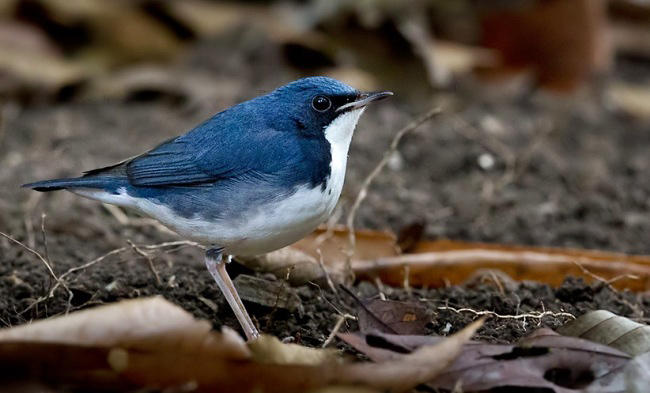
The superb Siberian Blue Robin by Lars Petersson (in Cat Tien National Park, Vietnam, in February).
China - Central
The rare Asian Crested Ibis and Golden Snub-nosed Monkey, as well as a slim chance of Giant Panda, Temminck's Tragopan, Golden Pheasant, Indian Blue Robin
and Blackthroat.
China - Eastern (Poyang Hu)
The 'Birds of Heaven', that is cranes, lots of wintering cranes, including Siberian, White-naped and Hooded, at Poyang Hu, one of the world’s greatest
wetlands where tens, sometimes hundreds, of thousands of waterbirds spend the northern winter, notably Swan Geese and Oriental Storks.
China - Hong Kong
Arguably the best shorebird show on Earth, involving about 10,000 birds of over 30 species, passing through during spring in full summer plumage, including
Asian Dowitcher, Spotted (Nordmann’s) Greenshank, Great Knot and possibly Spoon-billed Sandpiper, alongside the likes of Chinese Egret, Black-faced
Spoonbill and Saunders’s Gull.
China - Sichuan
Very little chance of seeing Giant Panda in the wild but one of the few places where there is a chance of Red Panda, and a long list of fabulous birds,
such as Golden and Lady Amherst’s Pheasants, Temminck’s Tragopan, Chinese Monal, Ground Tit, Sichuan Jay, Grandala, Firethroat, Crested and
White-browed Tit-warblers, Golden-breasted Fulvetta and Gould's Sunbird, all in some stunning mountainous terrain.
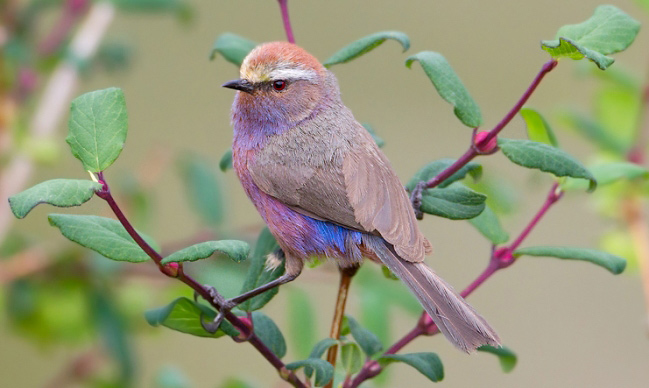
A beautiful White-browed or Severtzov's or Stoliczka's Tit-warbler at Kanda Shan, a mountain pass in Qinghai province adjacent to Sichuan in China by Dubi Shapiro.
China - Yunnan
The richest province for birds in China with about 40 of the 72 mainland Chinese endemics and many species restricted to Yunnan, northern Myanmar and
northeastern India, including Lady Amherst’s Pheasant, Ward's Trogon, Purple Cochoa, lots of laughingthrushes, Himalayan Cutia, Fire-tailed Myzornis, and
Giant and Yunnan Nuthatches, as well as the very rare Black-crested and Hoolock Gibbons, and Yunnan Snub-nosed Monkey.
Christmas Island
Millions of migrating Red Crabs, giant Coconut Crabs, coral reef fish, Whale Sharks, Manta Rays, ‘golden’ White-tailed Tropicbirds, two endemic breeding
seabirds (Christmas Frigatebird and Abbott’s Booby), and four endemic landbirds; an imperial-pigeon, a swiftlet, a boobook and a white-eye.
Colombia
More bird species than any other country, over 1900 of them, with over 90 endemics including 12 hummingbirds, and nearly 250 species shared with Panama
(27), Venezuela (81), Ecuador (100), and Ecuador and Peru (40), plus many more widespread spectacular species such as Scarlet Ibis and Oilbird, so many
birds in fact that on a wide-ranging trip taking in the Choco region in the west, the Andes in the middle and the Amazonia region in the east it is
possible to record an incredible 1000 species in a month!
Colorado - USA
See USA - Colorado, below.
Comoros and Mayotte
There are 30 endemic bird species on the volcanic Comoro Islands and nearby Mayotte that lie between Mozambique and Madagascar, including a green-pigeon,
four scops-owls, Humblot’s Flycatcher which is in a unique genus and occurs only on Grande Comore, a Blue Vanga, four sunbirds and two fodies. In order to
see Grand Comoro Scops-owl and Mount Karthala White-eye it is necessary to camp out near the top of Mount Karthala on Grand Comoro which has the largest
crater of any of the world’s active volcanoes. Also on this island are an endemic subspecies of Madagascar (Malachite) Kingfisher and forms of Frances’s
Sparrowhawk, Cuckoo Roller, Madagascar Spinetail and Madagascar Paradise-flycatcher. Around the coasts of the two main islands of Mayotte it is possible to
see White-tailed Tropicbird, Sooty and Bridled Terns, and Brown Noddy, and off the coast of Moheli the endemic temptator form of Persian
(or Arabian) Shearwater, Lesser Frigatebird and Masked Booby. The dry season usually lasts from May to November and the end of this period is the best time
for birds.
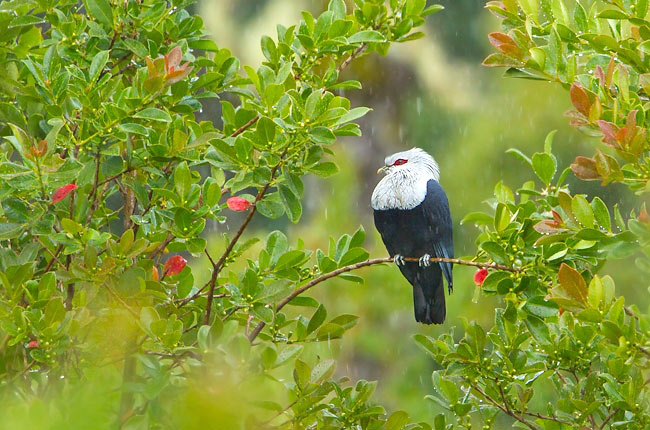
A great image of the rather fancy Comoro Blue-pigeon taken on Mount Karthala on the island of Grand Comoro by Dubi Shapiro. This species occurs only on the Comoros and Aldabra.
Congo, Democratic Republic of (formerly Zaire)
See Democratic Republic of the Congo (formerly Zaire), below.
(Republic of the) Congo
In the remote northwest of this country it is possible to see Western Lowland Gorillas near Ngaga Camp in Odzala-Kokoua National Park, accessible by air
from Brazzaville the capital. Around other camps such as M’boko, visitors can see Forest Elephants and Forest Buffalos. Eleven diurnal primates live in
the park and other mammals include Allen's Swamp Monkey (Lango Camp), Red River Hog, Hammer Bat, Africa’s largest fruit bat, Angwantibo and Potto.
Nearly 450 species of bird have been recorded, 330 breeding, including Congo Serpent-eagle, Red-chested Owlet, Black-collared Lovebird, White-bellied
Kingfisher, Blue-headed Bee-eater, Grey-headed Broadbill, Angola and West African Batises, Eastern Wattled Cuckooshrike, Black-throated Apalis,
Black-collared Bulbul, many greenbuls including Falkenstein’s, and Yellow-capped Weaver. Congo is a low-lying country on the equator between Gabon and
the Democratic Republic of the Congo where over 50% of the land surface is still covered by rainforest and another national park in the far north,
Nouabale-Ndoki, which is contiguous with Dzanga-Ndoki National Park in the Central African Republic, supports the likes of Sandy Scops-owl, Brown Nightjar,
Zenker’s Honeyguide and Preuss’s Weaver. In the far south birds characteristic of the flooded forests in the Kouilou region include White-crested
Tiger-heron, Maned Owl and Vermiculated Fishing-owl while other species present in the Lower Kouilou Basin bordered by the Atlantic coast include Damara
Tern, Black-headed Bee-eater, African River Martin (September-November) and Loango Weaver. The river martin and Rosy Bee-eater breed in Conkouati National
Park in the extreme southwest and the Lefini Faunal Reserve on the Teke Plateau in the southeast next to Gabon supports Finsch’s Francolin, Congo Moor-chat
and Black-chinned Weaver with Brazza’s Martin in neighbouring localities. There are two rainy seasons, usually from March to May, and from September to
November, when Forest Elephants visit bais more often, and two drier seasons, normally from December to February, and from June to September, when ripe
fruits, especially in February and August, attract Gorillas, making them more mobile but once located easier to see as they leave the thick ground
vegetation and take to the trees.
Cook Islands
It is only necessary to visit three of the 15 widely scattered Cook Islands to see the six endemic bird species: the island of Atiu for Atiu Swiftlet
(which can be seen at the nest in Anatakitaki Cave, one of several spectacular caves on the islands) and Rarotonga Fruit-dove (which also occurs on
Rarotonga but is much scarcer there), as well as the introduced Kuhl's Lorikeet (which is otherwise endemic to remote Rimatara in the Austral (Tubuai)
Islands), Chattering Kingfisher (the range of which extends to the Society Islands), and the more widespread Pacific Imperial-pigeon; the island of
Rarotonga for Rarotonga Monarch in Takitumu Conservation Area (a species which has been introduced to Atiu) and Rarotonga Starling; and the island of
Mangaia for Mangaia (Mewing) Kingfisher and Cook Reed-warbler. In addition, Blue Lorikeet (which also occurs in the Society Islands and Tuamotu
Archipelago) can be seen on the island of Aitutaki where there is also a chance of Bristle-thighed Curlew, mainly from November to March. Seabirds
present throughout the Cook Islands include Herald Petrel (most likely on and around Rarotonga), Red-tailed and White-tailed Tropicbirds, Great and Lesser
Frigatebirds, Red-footed Booby, Black and Brown Noddies, and Common White Terns. It is usually dry and cool from June to October, the best time to visit,
with most rain falling during the cyclone season between December and May.
Corsica
This scenic, sparsely populated, French island nearer the northwest coast of Italy than France supports the endemic Corsican Nuthatch, and five
near-endemics; Marmora's Warbler, Moltoni's (Subalpine) Warbler, Mediterranean (Spotted) Flycatcher, Italian Sparrow and Corsican Finch (which also occurs
only Sardinia). In addition, there are several endemic subspecies, including the corsa race of Eurasian Treecreeper. More widespread species include
Lammergeier (rare and most likely at Haut Asco), Red Kite, Golden Eagle (scarce), Eurasian Hoopoe, Yellow-billed (Alpine) Chough, Dartford and Sardinian
Warblers, Common Firecrest and Spotless Starling, with summer visitors such as European Bee-eater and Woodchat Shrike (the badius subspecies which breeds
on Corsica, Sardinia and the Balearic Islands). Around the coast and on some etangs it is possible to see a few Audouin's Gulls and offshore, Scopoli's
(Cory's) and Yelkouan (Balearic) Shearwaters. The few mammals include Mouflon (most likely at Haut Asco) but there is a rich flora which includes many
orchids and those usually in flower during early May (the best time to look for birds) include Sword-leaved Helleborine, Violet Limodore, Yellow Ophrys,
Heart-flowered Serapias, and Barton’s, Man, Milky, Pink Butterfly and Tongue Orchids.
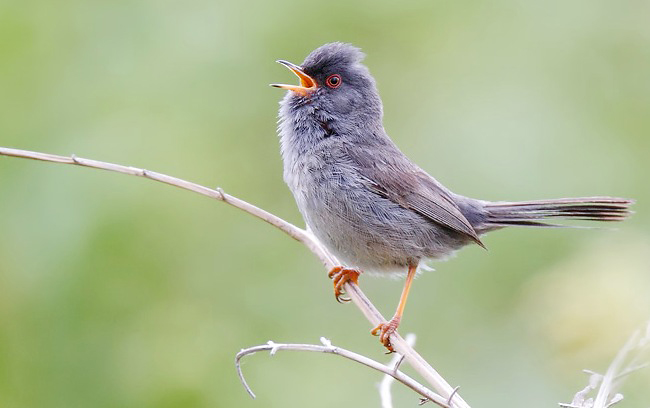
A singing male Marmora's Warbler by Michael McKee, endemic to the western Mediterranean.
Costa Rica
Over 900 bird species in 50,000 sq km including one of the best selections of the world's most spectacular birds, not least Agami Heron, Sunbittern,
Scarlet Macaw, Resplendent Quetzal, Turquoise-browed Motmot, Keel-billed Toucan, Three-wattled Bellbird, Bare-necked Umbrellabird, Lovely Cotinga,
Orange-collared and Red-capped Manakins, Wrenthrush and Long-tailed Silky-flycatcher (one of 74 species shared only with Panama), together with sloths,
howler and spider monkeys, nesting turtles, Red-eyed Tree Frogs, giant dragonflies and numerous butterflies. Costa Rica's got the lot!
Croatia
The limestone islands, cliffs, gorges and craggy mountains of Croatia support Scopoli’s (Cory’s) and Yelkouan (Balearic) Shearwaters, Rock Partridge (Pag
Island near Paklenica and Biokova Nature Park are good sites), Pygmy Cormorant (Lake Vrana is the Croatian stronghold), Griffon Vulture
(colony/rehabilitation centre on the island on Cres), Golden, Lesser Spotted, Short-toed and White-tailed Eagles, Eleonora’s Falcon (Vis Island), European
Bee-eater, Collared Flycatcher, Yellow-billed (Alpine) Chough, Sombre Tit, Western Rock Nuthatch, Olive-tree and Eastern Orphean Warblers, Lesser Grey
Shrike, Rufous-tailed Rock-thrush, Alpine Accentor (near Veti Jure in Biokova NP), (Black-headed) Western Yellow Wagtail, and Black-headed and Rock
Buntings. The rich flora, including lots of orchids, is a fine sight in April and May. The best time for birds is May-June and early June is usually the
peak time for butterflies, 190 species of which have been recorded including a wide variety of ‘blues’ and rarities such as Balkan Copper.
Cuba
A big island, home to one of the world’s smallest bats, possibly the dinkiest frog and the smallest bird; the Bee Hummingbird, one of 30 endemics
which also include Blue-headed and Grey-headed Quail-doves, the very rarely seen Zapata Rail, Bare-legged Screech-owl, Cuban Trogon, Cuban Tody,
Fernandina’s Flicker, Zapata Wren, Zapata Sparrow, and Oriente and Yellow-headed Warblers (both now in their own family), all joined by wintering warblers
such as Black-throated Blue, Cape May and Prairie.
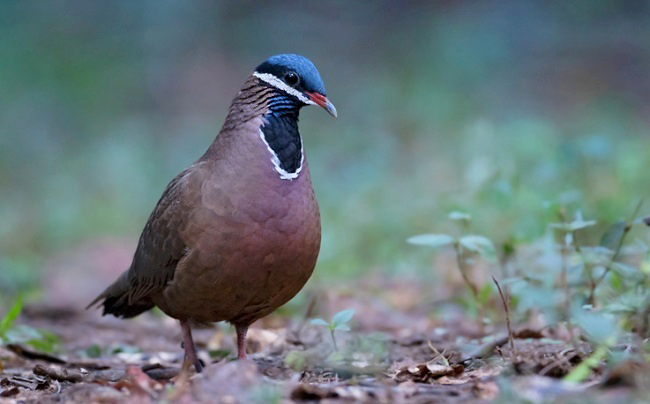
There are a lot of rather spectacular endemic birds on the island of Cuba, not least the Blue-headed Quail-dove. This fine image was captured at Bermejas near Zapata by Dubi Shapiro.
Czech Republic
It is possible to see ten European woodpeckers in the Czech Republic. The best three areas for birds are: (i) the Sumava Mountains on the border
with Germany, which, together with neighbouring Bavaria, support the most extensive forest remaining in Central Europe, home to some great but scarce
and very elusive birds such as Black and Hazel Grouse, Eurasian Pygmy-owl, Ural Owl, and Black, Eurasian Three-toed and White-backed Woodpeckers, most
of which are best looked for on Mount Boubin where Ring Ouzel (alpestris) and Northern (Eurasian) Nutcracker also occur; (ii) the five hundred fish ponds
in the Trebon area which support White-tailed Eagle, as well as a few White Storks, Red-crested Pochard, Red Kite, Bluethroat, Collared Flycatcher and
Eurasian Penduline-tit; and (iii) South Moravia where there is a possibility of seeing Barred Warbler, as well as Saker Falcon and Eastern Imperial Eagle
(both most likely in the Hohenau area just across the border in Austria). The best time to look for birds is the middle of May when most of the summer
migrants have usually arrived and some owls and woodpeckers are still nesting.
Cyprus
Situated to the south of Turkey and north of the Nile delta in the eastern Mediterranean the coastal rocky promontories and wetlands on the rugged island
of Cyprus are a great place to see migrating birds especially during the northern spring (mainly late March to mid April) when species passing through
include Pallid Harrier, Little Crake, Slender-billed Gull, Red-throated Pipit, (Black-headed) Western Yellow Wagtail, Isabelline Wheatear and Rüppell's
Warbler, with 'regular' vagrants such as Caspian Plover. Good sites include Cape Greco near Larnaca in the far southeast which has hosted rarities such as
Hypocolius and Cinereous Bunting; the vast salt lake at Akrotiri (for flocks of Greater Flamingos) and the dry plain known as the Akrotiri Gravel Pits, one
of the best areas for migrant passerines, which in turn attract Pallid Harriers; and Paphos (Pafos) Headland in the far southwest, a classic migration site
also famous for its Roman ruins. There are three widespread endemic breeding species; a scops-owl, a wheatear and a warbler, and four endemic subspecies;
Coal Tit (cypriotes), 'Dorothy's' Short-toed Treecreeper (dorotheae), Eurasian Jay (glaszneri) and Red Crossbill (guillemardi),
all of which occur in the Troodos Mountains. Other breeding species include Chukar, Black Francolin, Griffon Vulture, Eleonora's Falcon, Spur-winged
Lapwing, Audouin’s Gull, Great Spotted Cuckoo, Masked Shrike, Spectacled Warbler and Cretzschmar’s Bunting. During the autumn, usually from late August to
early September, Demoiselle Cranes stopover at Akrotiri Salt Lake where thousands of Greater Flamingos spend the northern winter and other wintering
species include Ruddy Shelduck and Finsch's Wheatear (Oct-Mar). There are also 50 species and forms of orchid in the northern Turkish half of the island,
of which about 30 flower together in March-April, including Anatolian, Cyprus Bee, Early Mammose and Eastern Tongue.
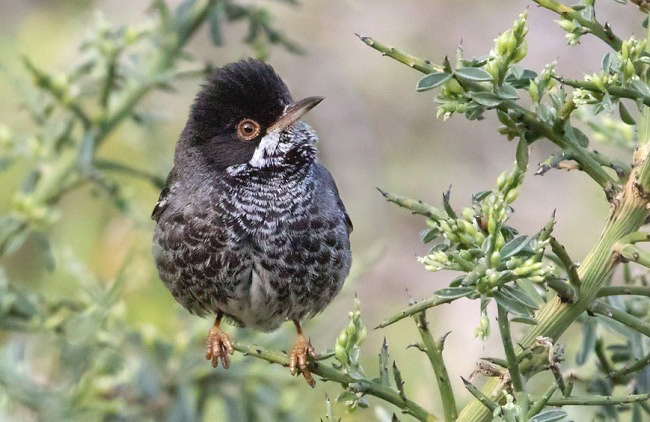
Cyprus Warbler by Lars Petersson.
D
Dakota, North - USA
See USA - North Dakota, below
Damar
See Indonesia - Lesser Sundas, below.
Democratic Republic of the Congo (formerly Zaire)
This huge country supports a tremendous variety of wildlife but it is a very difficult place in which to see much of it, especially since it was a troubled
country around 2020 so best check with the relevant consulate/embassy/foreign office and travel company/companies before travelling. One place it is
sometimes possible to visit is Lomako-Yokokala Faunal Reserve deep in the heart of the Congo where it is possible to see the mythical Congo Peafowl, one of
the shyest and most difficult birds to see on planet Earth. In contrast, our closest next of kin, the rare Bonobo, which also occurs here, is easy to see
thanks to researchers habituating several groups. Getting there is not easy. Once permits (‘ordres de mission’) have been obtained from different ministries
it will probably be necessary to charter a plane for the 700 km flight to Basankusu in the province of Equateur then a dugout for a 170 km river trip then
it is a 12 km trek to a clearing where there is no accommodation so all camping gear, food etc. will need to be factored into what is in effect an
expedition, or you could just contact the tour company Birdquest who visited in 2015 and 2017. They also saw Congo Serpent-eagle, Forbes’s Plover,
Yellow-throated Cuckoo, Sladen’s Barbet, Blue Cuckooshrike, Bates’s Paradise-flycatcher, Congo Sand Martin, Congo and Violet-tailed Sunbirds, Cassin’s
Malimbe, Bob-tailed Weaver, Woodhouse’s Antpecker and Grant’s Bluebill, as well as Black Mangabey, Angolan Pied Colobus, Wolf’s Monkey and Red River Hog.
September is the time to go even though the wet season in the north of the country usually lasts from April to October. Congo Peafowl is one of 17 endemic
birds, the others being Prigogine’s (Itombwe) Nightjar (small range in east), Congo Bay-owl (small range on Itombwe Massif in east), Grauer’s Cuckooshrike
(east), Yellow-crested Helmetshrike (west Albertine Rift in east), Bedford’s Paradise-flycatcher (east), Lendu (White-browed) Crombec (east), Kabobo Apalis
(east), Prigogine’s Greenbul (small range in east), Chapin’s Mountain-babbler (east), Itombwe (Chapin’s) Flycatcher (east), Prigogine’s Double-collared
(Marungu Highlands in far southeast) and Rockefeller’s (east) Sunbirds, Lufira Masked (southeast), Upemba Masked (southeast) and Yellow-legged (Ituri
Forest in northeast) Weavers, and Black-lored Waxbill (southeast).
Seeing an Okapi in the wild is another matter altogether although there is an Okapi Fauna Reserve run by The Okapi Conservation Project based at Epulu in the northeast. The reserve encompasses 13,700 square kilometers of the Ituri Forest which also supports the largest populations of Chimpanzees and Forest Elephants in the country as well as 13 primates including Owl-faced monkey, Bongo, and birds such as Spot-breasted Ibis, Chocolate-backed Kingfisher, Blue-throated Roller, Yellow-footed Flycatcher and Blue-billed Malimbe.
Djibouti
Despite its small size, just 20,000 square km or so, and often intense heat, Djibouti, a former French colony with a continued French military presence,
has a bird list of over 360 species, thanks mainly to its location at the mouth of the African Rift Valley, the narrowest point along the Red Sea (the Bab
el Mandeb straits) and close to the Arabian Peninsula, just 28 km away. It therefore has a fascinating mix of African and Middle Eastern species and is on
a major migration flyway to boot. The 370 km long coastline has areas of mangrove bordered by large mudflats while inland mountains rise to about 2000 m
above semi-desert, acacia bush land, savannas and patches of Juniper forest where the birds include the endemic Djibouti Francolin and restricted-range
specialities such as White-eyed Gull, White-cheeked Tern, Somali Bulbul, Gambaga Flycatcher, Somali Starling, Arabian Golden and Somali Sparrows, an odd
sunbird tentatively named Toha Sunbird and a yellow-breasted and yellow-tailed form of Green-winged Pytilia that may prove to be a distinct species. Other
birds present at various times of the year include Persian Shearwater, Greater Flamingo, Abdim’s Stork, Goliath Heron, Pink-backed Pelican, Verreaux’s
Eagle, Crab Plover, Sooty Gull, Blue-cheeked Bee-eater, Hemprich’s Hornbill, Nubian Woodpecker, Greater Hoopoe-lark, Grey-headed Batis, Ethiopian Boubou,
Blackstart, Black Scrub-robin, White-crowned (Black) Wheatear, Graceful Prinia, Basra Reed-warbler, Brown Woodland-warbler, Arabian, Menetries’s and
Upcher’s Warblers, Nile Valley Sunbird and Rüppell's Weaver. There are quite a lot of mammals too, including Hamadryas Baboon, Speke's Pectinator, Dorcas
and Soemmerring's Gazelles, Salt's Dik-dik and Klipspringer. The best time for birds is arguably December to February when birds which breed far to the
north spend the northern winter in the country.
Dominica
This small, steep Caribbean island supports two endemic parrots, and near-endemic Blue-headed Hummingbird, Brown Trembler and Plumbeous Warbler but is
perhaps more famous for being one of the best places in the world to see Sperm Whales, along with other whales, and dolphins.
Dominican Republic
Three bird families endemic to the island of Hispaniola which the Dominican Republic shares with Haiti, are represented here by the monotypic Palmchat, the
two Chat Tanagers and three of the four Hispaniolan Tanagers; Black-crowned Palm-tanager, and Green-tailed and White-winged Warblers, 33 of the 34
Hispaniolan endemics in total, also including a parrot, a trogon and two todies. Many visitors head for the nearby Silverbank though, one of the few places
in the world where it is possible to swim with Humpback Whales.
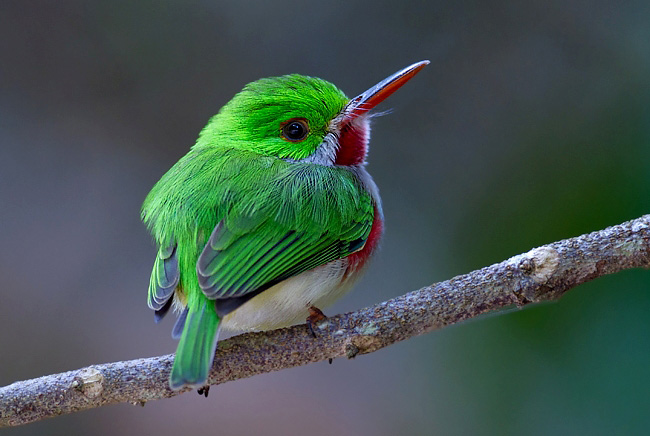
Birds do not come much cuter than todies which are endemic to the Caribbean. This is a Broad-billed Tody on the Sierra de Bahoruco in the Dominican Republic by Dubi Shapiro.
E
East Timor
See Timor/Timor-Leste, below.
Ecuador - Northern
More birds per square mile than any other country in the world including many parrots, macaws, hummingbirds, trogons, quetzals, jacamars, toucans,
antbirds, cotingas, manakins, tanagers and spectacular localized birds such as Zigzag Heron, Rufous-bellied Seedsnipe, Oilbird and Black-necked Red
Cotinga, hence it is possible to see over 850 species in three to four weeks, as well as some mammals, maybe even Pygmy Marmoset and Spectacled Bear.
Ecuador - Southern
Five of Ecuador's eight endemic birds occur in the south; Blue-throated Hillstar, Violet-throated Metaltail, El Oro Parakeet, Ecuadorian Tapaculo and
Pale-headed Brush-finch but it is some of the 109 birds shared only with Peru that many birders wish to see, including Jocotoco Antpitta, Black-crested
Tit-tyrant, White-tailed Jay and Orange-throated Tanager, as well as birds shared only with Colombia, such as Long-wattled Umbrellabird.
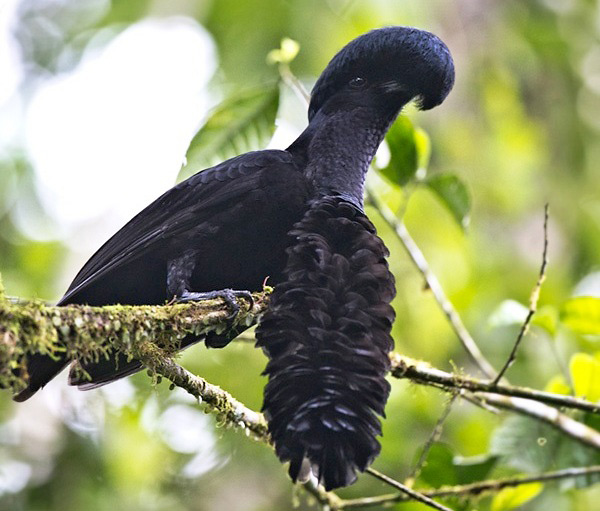
The truly extraordinary Long-wattled Umbrellabird at the Jocotoco Foundation's Buenaventura Reserve in Southern Ecuador by Lars Petersson.
Egypt
The main tourist attractions in Egypt are the Great Pyramids and Sphinx of Giza, the Egyptian Museum which hosts Tutankhamun’s treasures, the
Temples of Karnak and Luxor, and the tombs of the Valley of the Kings, but visitors interested in birds may wish to turn their eyes elsewhere,
especially those interested in birds which are difficult or impossible to see elsewhere in the Western Palearctic, birds such as White-eyed Gull
(which is difficult to see anywhere else in the world!), Goliath and Striated Herons, Yellow-billed Stork, Brown Booby, Pink-backed Pelican,
Sooty Falcon, Greater Painted-snipe, Senegal Thick-knee, Crab, Kittlitz’s and African Three-banded Plovers, Sooty Gull, Saunders's Tern (at a
colony near Ras Sedr on the Sinai Peninsula), African Skimmer, Chestnut-bellied and Lichtenstein's Sandgrouse, African Collared and Namaqua Doves,
Senegal Coucal, Desert Tawny Owl, Hooded Wheatear, African Pied Wagtail, Nile Valley and Palestine Sunbirds, and Sinai Rosefinch. There is even an
outside chance of seeing the elusive Yellow Bitterns which were discovered breeding in mangroves along Egypt's southern Red Sea coast at Lahami
south of Marsa Alam in 2012-2013 and were still present in 2017. One hour south is the site for Lappet-faced Vulture, at El Shalateen on the border
with Sudan. The spring (especially mid-April to early May) and autumn (September-October) migration periods are the best times to visit, with the
possibility of large numbers of storks, raptors, shorebirds and passerines, especially at the migration bottlenecks of Suez, Hurghada and Zaranik.
The Red Sea is rich in marine life and there are many places where scuba-diving and snorkelling can be spectacular experiences.
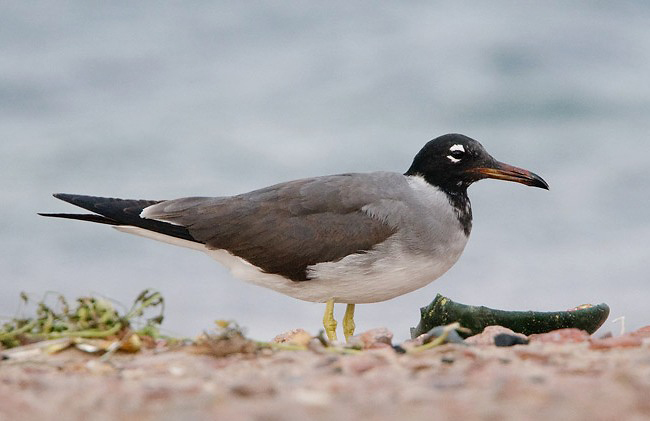
Egypt is the best place in the world to see White-eyed Gull. Image by Michael McKee.
El Salvador
The smallest country in Central America has the highest human population density hence there ain’t a lot of forest left. However, all the birds of the
dry tropical forest belt that ranges along the Pacific coast from southern Mexico to northern Costa Rica and many species endemic to the highlands between
southern Mexico and northern Nicaragua are present including Rufous Sabrewing, and Black-throated, Bushy-crested and Unicoloured Jays. The best birding
sites include El Imposible National Park (Long-tailed Manakin), Los Volcanes National Park (Green-throated Mountain-gem, Rufous-browed Wren, Bushy-crested
Jay and Cinnamon-bellied Flowerpiercer), Montecristo National Park (Highland Guan and Rufous-collared Thrush) and the Perquín area (Buffy-crowned
Wood-partridge and Bushy-crested Jay).
El Triunfo - Mexico
See Mexico - El Triunfo, below
Emperor Penguins - Antarctica
See Antarctica - Emperor Penguins, above.
Equatorial Guinea
This very small country in West Africa has a mainland area known as Rio Muni and five inhabited islands in the Gulf of Guinea including Bioko (see above),
where the capital Malabo is situated, 34 km west of Cameroon, and Annobon which is 565 km southwest of Bioko and 340 km west of Gabon. In between these
two islands are São Tomé and Príncipe, a separate country (see below). One of the top birding areas on the mainland is around Djibloho where Sjostedt’s
Owlet, Yellow-throated Cuckoo, Fiery-breasted Bushshrike and Rufous-bellied Helmetshrike occur. In the middle of the mainland lies Monte Alen National Park
which supports Zenker’s Honeyguide, Gabon (Verreaux’s) Batis, Tessmann’s Flycatcher, Black-capped and Uganda Woodland-warblers, and Grey-necked Rockfowl
which also occurs in Nsork Highlands National Park in the southeast corner of the country. Chimpanzees, Gorillas, and Forest Elephants also live on the
mainland but the human population tripled after 1980 and the economic boom following the discovery of oil in the region financed the development of roads
and urban areas leading to the usual habitat loss and so on.
Eritrea
About half (17) of the 35 ‘Abyssinian' endemic birds, confined to Ethiopia and Eritrea, occur in this small country; White-collared Pigeon, Rouget’s Rail,
Wattled Ibis, Banded Barbet, Abyssinian Woodpecker, Black-winged Lovebird, Ethiopian Black-headed Oriole, White-backed Black Tit, Blanford’s Lark,
Ethiopian Cisticola, White-billed Starling, Ethiopian (Groundscraper) Thrush, Abyssinian Slaty-flycatcher, White-winged Cliff-chat, Ruppell’s Chat,
Rusty-breasted (Red-breasted) Wheatear and Yellow-rumped Seedeater. There are also many near-endemics, species restricted to the Horn of Africa (Eritrea,
Ethiopia, Somalia, Djibouti and easternmost Sudan) and they include Erckel's Francolin, White-cheeked Turaco, Thick-billed Raven, White-headed and
White-rumped Babblers, and Somali Starling, while Collared Kingfisher occurs in mangroves along parts of the 1000 km long Red Sea coastline (the only place
in Africa where this otherwise widespread Asian species occurs) and other notable species include Menetries’s Warbler (a passage migrant and winter
visitor), Pale Sparrow (a winter visitor) and Cinereous Bunting (an uncommon passage migrant). More widespread birds range from Crab Plover, White-eyed
Gull and White-cheeked Tern through Steppe and Tawny Eagles, several sandgrouse, Abyssinian Roller and Black Scrub-robin to Greater Hoopoe-lark. Mammals
include Abyssinian Wild Ass (on coastal plains), Caracal, Spotted Hyena, Greater Kudu, Dorca’s and Soemmering's Gazelles, and Hamadryas/Sacred Baboon,
while offshore there are Dugongs in the Gulf of Zuba and southern Dahlak Islands (along with three species of turtle), Whale Sharks, Manta Rays and a wide
variety of coral reef fish. The best times to visit are during the migration periods (February to April and September to November) although some species
are more likely to be seen during the June to October highland rainy season.
Estonia
Arguably the widest variety of birds in Europe, during migration and the breeding season when over 170 species are present including Lesser Spotted
Eagle, Black Stork and Great Snipe. During the northern autumn/fall millions of waterbirds and passerines, especially finches, pass through, and during
the depths of winter there may be hundreds of Steller's Eiders present.
Eswatini (Swaziland)
This landlocked, little kingdom between Mozambique and South Africa is one of the best places to look for the rare Blue Swallow, a few pairs of which
occur between late September and March in Malalotja NR on the edge of the Drakensberg Escarpment, and there and elsewhere in the western highlands it is
also possible to see Southern Bald Ibis (at colonies June to October), Striped Flufftail, Denham’s Bustard, Black-winged Lapwing, Ground Woodpecker,
Buff-streaked Chat, Cape and Sentinel Rock-thrushes, lots of cisticolas and Gurney’s Sugarbird, as well as Black Wildebeest, Blesbok and Oribi. In the
north and east at places like Hlane NP and its surrounding reserves it is possible to see Gorgeous Bushshrike, Rudd’s Apalis, Black-bellied Starling,
Purple-banded Sunbird and Pink-throated Twinspot. Mlawula NR on the northeastern border with Mozambique supports White-backed Night-heron, African
Finfoot, Bronze-winged Courser, Thick-billed Cuckoo and Retz’s Helmetshrike. A good place for mammals is Mbuluzi Game Reserve, part of the wider Lubombo
Conservancy, where there are Nile Crocodiles, Hippos, Giraffes, Zebras and Nyalas, and the birds include Purple-crested Turaco and Giant Kingfisher.
December to February is probably the best time to visit, certainly for Blue Swallow, although it is also the time when resident species and inter-African
migrants such as cuckoos, weavers and widowbirds are usually in full breeding plumage.
Ethiopia
18 endemic birds, 35 including Eritrea, birds such as Blue-winged Goose, Rouget's Rail, Ruspoli’s Turaco, Spot-breasted Lapwing, Ethiopian (Stresemann’s)
Bushcrow and Abyssinian Catbird, plus numerous near-endemics and other more widespread spectacular species including Vulturine Guineafowl, Arabian Bustard
and Golden-breasted Starling, as well as some amazing localized mammals such as Gelada and Sacred Baboons, Ethiopian Wolf, Beisa Oryx and Gerenuk, although
most classic African plains mammals are not likely to be seen.
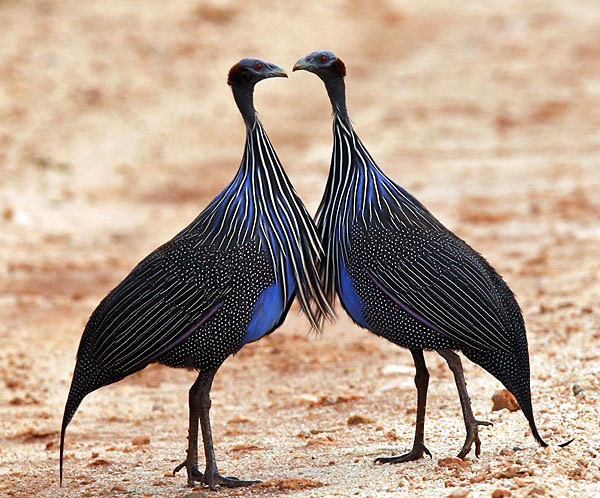
Vulturine Guineafowls in Ethiopia by Lars Petersson, a bird that occurs only in Ethiopia, Somalia, Kenya and northeast Tanzania.
Extremadura - Spain
The best place in western Europe for bustards and raptors, including Bonelli's and Spanish Imperial Eagles, and Black-shouldered Kite, as well as some of
Europe’s other most spectacular and localized birds such as White and Black Storks, White-rumped Swift, European Roller and Iberian Azure-winged Magpie,
all in one of the wildest and therefore birdiest places left in Europe.
F
Falkland Islands (Islas Malvinas)
King and other penguins, Black-browed Albatross colonies, Southern Elephant Seals, three endemic birds; Falkland Steamerduck, Blackish Cinclodes and Cobb’s
Wren, and a few birds difficult to see elsewhere including Ruddy-headed Goose, Striated Caracara and White-bridled Finch.
Fiji
Quintessential tropical islands with fantasy fish on the coral reefs and outrageous endemic birds with some of the 35 being Golden, Orange and Whistling
Doves, Crimson, Masked and Maroon Shining-parrots, Collared Lory, Azure-crested and Chestnut-throated Flycatchers, two silktails and Fiji Parrotfinch, as
well as spectacular seabirds including Red-tailed and White-tailed Tropicbirds, Red-footed Booby and Sooty Tern.
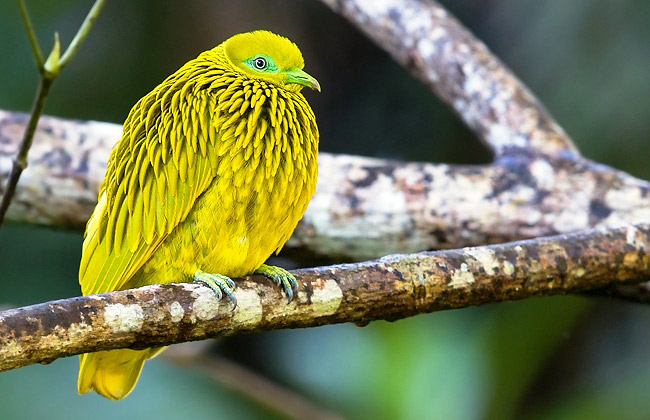
The astonishing Golden Dove is endemic to Fiji where this image was taken by Dubi Shapiro.
Finland and Arctic Norway
The greatest diversity of owls in Europe and an Arctic experience completed by King and Steller’s Eiders, and nesting shorebirds, as well as a good chance
of seeing Brown Bears from hides at night where there is also a chance of Wolverine.
Florida - USA
See USA - Florida, below.
France - Southern
A wonderful combination of wetland and mountain birds in the Camargue and Pyrenees, birds such as Greater Flamingo, Little Bustard, Pin-tailed Sandgrouse,
Lammergeier, Wallcreeper, Alpine Accentor, Citril Finch and White-winged Snowfinch, in some superb scenery.
French Guiana
Forest still covers about 90% of this sparsely populated overseas department of France which means the birding is fantastic. However, the ecotourist
infrastructure is relatively basic and many sites are accessible only by boat or plane. The long list of spectacular and special birds includes Agami
Heron (the world’s largest nesting colony with about 1500 pairs is at Reserve Naturelle des Marais de Kaw about 70 km from the capital Cayenne), Scarlet
Ibis, Hoatzin, (Cayenne) Cabot's Tern (Ile de Grand Connetable), Red-fan Parrot, Crimson Topaz, jacamars, trogons, toucans, Guianan and Spotted Puffbirds,
Painted Tody-flycatcher, White-plumed Antbird, Capuchinbird, Guianan Cock-of-the-rock, Guianan Red Cotinga, Pompadour, Purple-breasted and Spangled
Cotingas, Dusky Purpletuft, Crimson-hooded Manakin, Musician Wren, Blue-backed Tanager and Red-and-black Grosbeak, with additional species in the primary
forest (with trails) surrounding the small, isolated village of Saul in the heart of the country, arguably the top site in French Guiana with over 450
species recorded, accessible only by air, including Black Curassow, Zigzag Heron, Orange-breasted Falcon, Black-and-white Hawk-eagle, Crested and Harpy
Eagles, Red-and-green and Scarlet Macaws, all five Amazonian potoos, Fiery-tailed Awlbill, Tufted Coquette, Red-billed Woodcreeper, McConnell’s Spinetail,
White-throated Pewee, Band-tailed and Black-throated Antshrikes, Ash-winged, Rufous-rumped, Spot-tailed and Todd’s Antwrens, White Bellbird, Crimson
Fruitcrow, Cayenne Jay, Wing-banded Wren, Guianan Gnatcatcher, and possibly Sooty Barbthroat which is known only from French Guiana and the Brazilian state
of Amapa) and the single endemic, Cayenne Nightjar, known only from the type specimen collected at Saut Tamanoir in 1917 and a possible female caught in
1982. At the mouth of the Fleuve Maroni, Awala Yalimapo, in the extreme northwest, Les Hattes beach is a nesting ground for Leatherback Turtles which lay
their eggs their between April and July. Mammals include Red-handed (Golden-pawed) Tamarin and Guianan Squirrel Monkey. This is a wet country where the
driest months are usually August to October.
French Polynesia
Lots of seabirds including Polynesian Storm-petrel, Tahiti Petrel and Common White Tern, wintering Bristle-thighed Curlews, and 31 endemic birds including
Tuamotu Sandpiper, with eight on the Society Islands including Moorea and Tahiti Kingfishers, seven across the Tuamotu Archipelago also including
Polynesian Ground-dove and two fruit-doves, the 12 on the Marquesas Islands including Ultramarine Lorikeet and four monarchs, and the four on the remote
Austral (Tubuai) Islands being Rapa Fruit-dove, Rapa Shearwater, Rimatara (Kuhl’s) Lorikeet and Rimatara Reed-warbler.
G
Gabon
Lowland Gorilla, a chance of Chimpanzee and Mandrill, Red River Hog and lots of spectacular birds including Long-tailed Hawk, Grey Pratincole, Pel's and
Vermiculated Fishing-owls, Black-headed and Rosy Bee-eaters, African River Martin and Grey-necked Rockfowl, in a lovely, friendly, sparsely populated and
still largely forested country.
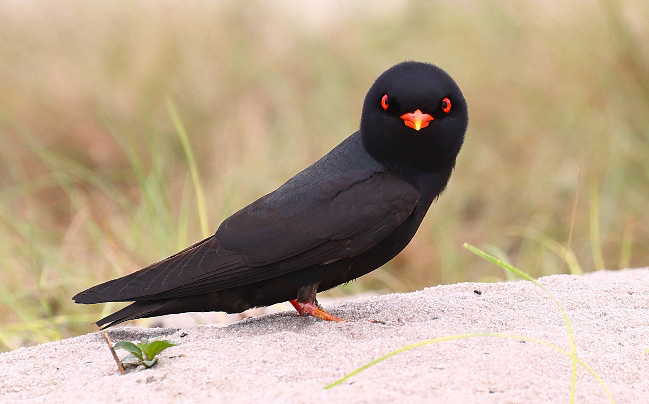
The remarkable African River Martin at Loango in Gabon by Paul Noakes.
Galapagos
Giant Tortoises, Marine Iguanas, Whale Sharks, Manta Rays, sealions, turtles, coral reef fish, tame nesting seabirds such as Waved Albatross, Red-billed
Tropicbird, Blue-footed, Red-footed and Nazca Boobies, Magnificent and Great Frigatebirds, and Swallow-tailed Gull, and over 30 endemic birds including
a penguin, a heron, a flightless cormorant, Lava Gull, four mockingbirds and 17 finches.
(The) Gambia
Easy birding in a small country with spectacular localized birds such as Egyptian Plover, White-backed Night-heron, and Abyssinian and Blue-bellied
Rollers amongst more widespread African icons including African Fish-eagle, Black and Goliath Herons, and Red-throated and Swallow-tailed Bee-eaters.
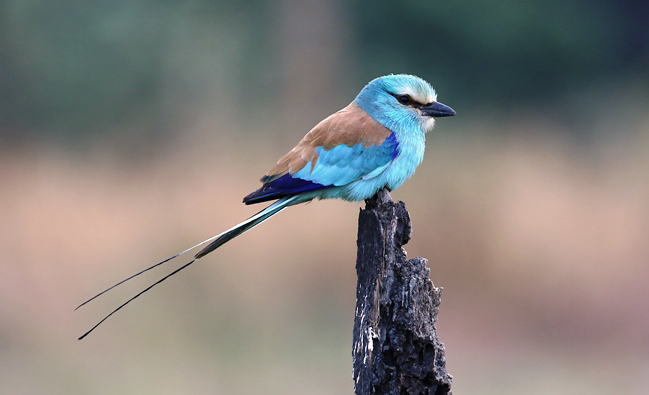
This stunning image of an Abyssinian Roller was taken in Gambia by Nick Cobb.
Georgia
Caucasian Grouse, Caucasian Snowcock, White-winged (Güldenstädt's) Redstart and 'Caucasian' Great Rosefinch, in the mountains with Lammergeier, Wallcreeper
and Red-fronted Serin, and Batumi, one of the best places in the world for visible raptor migration, involving over a million birds per autumn/fall, mainly
Honey and ‘Steppe’ Buzzards but also including Great Spotted, Lesser Spotted and Steppe Eagles, and Levant Sparrowhawk.
Germany
Perhaps the most famous birding site in Germany is the offshore island of Hel(i)goland in the North Sea, not just for its large seabird colonies which
include a gannetry but also for attracting an astonishing variety of migrating birds including many rarities, so many that the island list exceeds 430,
more than Fair Isle in Shetland, UK (where the list reached 392 in June 2019 with Franklin's Gull) but less than the Isles of Scilly, UK (447 at the end
of March 2018). On the mainland some of the few hundred Great Bustards left in Germany in 2019 (there were believed to be about 4000 present before the
Second World War) may be seen in the northeast region known as Brandenburg with the best area being around the village of Garlitz. Birds present on and
around Gulper See, also near Berlin, during October-November, include Greater White-fronted, Greylag and Tundra Bean Geese but the main attraction of the
area in autumn is the Common Cranes which usually occur in thousands, especially around Linum fishponds where it is possible to watch them go to roost.
Another area famous for Cranes is Landkreis Diepholz near Bremen in northwest Germany where up to 80,000 birds have been known to stopover between
Scandinavia and Spain during the autumn. At the other end of the country, down south, the scenic Bavarian Alps, especially in Berchtesgaden Alpine National
Park, support a wide range of flowers (usually best during the first half of June), butterflies and birds such as Golden Eagle, Black Woodpecker,
Yellow-billed (Alpine) Chough, Eurasian Crag Martin and Alpine Accentor.
Ghana
The easiest place in the world to see the extraordinary White-necked Rockfowl, one of the 12 out of 14 Upper Guinea Forest Endemics present, also
including White-breasted Guineafowl, Rufous Fishing-owl, Brown-cheeked Hornbill, Western Wattled Cuckooshrike, Black-headed Rufous-warbler, Green-tailed
Bristlebill, Yellow-bearded Greenbul, Rufous-winged Illadopsis, Copper-tailed Starling, Nimba Flycatcher and Red-fronted Antpecker, while other
spectacular species include Egyptian Plover, Blue-breasted and Chocolate-backed Kingfishers, Black, Blue-moustached and Rosy Bee-eaters, Abyssinian and
Blue-bellied Rollers, and Rufous-sided Broadbill.
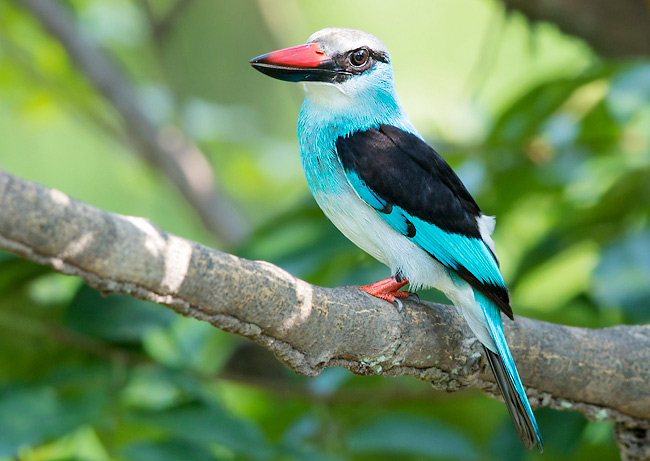
The stunning Blue-breasted Kingfisher occurs across west Africa to Uganda. This image was captured in Mole National Park in Ghana by Dubi Shapiro.
Goa - India
See India - Goa, below
Greece
Large numbers of Greater Flamingos, Pygmy Cormorants, and Dalmatian and Great White Pelicans, in a country also enlivened by Spur-winged Lapwings, Masked
Shrikes, Rüppell's Warblers and Cretzschmar’s Buntings. Also see Lesvos, below.
Greenland
See Canada - Arctic Canada, and Greenland, above.
Guatemala
Although Guatemala is little more than one-twentieth the size of Mexico it has a birdlist of over 750 and is one of the richest areas for birds on
Earth with many Central American endemics including 15 shared only with Mexico. In the south of this country which has some of the most active volcanoes
in the region specialities include Crested and Highland Guans, Spotted Wood-quail, Resplendent Quetzal, hummingbirds such as Rufous and Violet Sabrewings,
Blue-throated and Tody Motmots, Chestnut-sided Shrike-vireo, Bushy-crested and Unicoloured Jays, Pink-headed Warbler and the rare Azure-rumped Tanager,
mostly in patches of remnant forest in and around shade-coffee plantations, and on the highest, steepest slopes of the dramatic volcanic landscape, at
places such as Finca Los Andes. The best spot in the world for the stunning Goldman’s (Myrtle) Warbler, a virtual endemic that also occurs just across the
border in Mexico, is the high-elevation juniper and pine forests of Todos Santos Cuchumatan near Huehuetenango where there is also a chance of Ocellated
Quail, Olive Warbler and the Guatemalan subspecies of Yellow-eyed Junco. On the high slopes of Volcan San Pedro around the beautiful crater lake Lago de
Atitlan (where the endemic grebe became extinct in about 1985) it is also possible to see the localised, rare and spectacular Horned Guan, above 2500 m
(8,200 ft) on the notoriously steep El Sendero de Lagrimas (The Trail of Tears), as well as Amethyst-throated Mountain-gem, Sparkling-tailed Woodstar,
Wine-throated Hummingbird, Blue-throated Motmot and Hooded Grosbeak. Up north is the Classic Mayan site of Tikal where the birdlife includes several
Yucatan endemics such as Ocellated Turkey, Yucatan Poorwill and Grey-throated Chat, with numerous other spectacular birds, not least King Vulture and
Keel-billed Toucan, as well as Black (Yucatan) Howler Monkey, Central American (Geoffrey's) Spider Monkey and confiding White-nosed Coatis. The peak time
to look for birds is January to April.
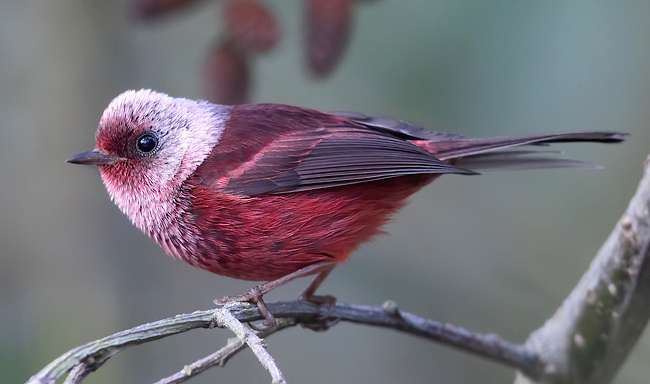
Pink-headed Warbler at Sibinal in Guatemala by Dubi Shapiro. This beauty occurs only in Guatemala and the adjacent highlands of eastern Chiapas in southern Mexico.
Guinea-Bissau
This low-lying former Portuguese colony is situated in West Africa between Guinea and Senegal with an Atlantic Ocean coastline of 350 km. While the tourist
infrastructure is basic this is a small, relatively safe, poor, sparsely populated country with large expanses of wild spaces where a rich variety of birds
that lives in the transition zone between Guinea forest and sub-Sahelian savanna and where, in 2017, more than 25% of the land was under conservation
management, thanks to the hard work of the Institute for Biodiversity and Protected Areas (IBAP). The huge areas of swamps that are sometimes drained for
intensive agriculture in the west are known as ‘Bolanhas’ (from Bissau Creole ‘rice paddies’) and they support many waterbirds, particularly during the
northern winter when millions of birds arrive in the country, more especially along the coasts and islands including the Bijagos Archipelago which also
supports a significant population of Timneh (Grey) Parrots (on the island of Joao Vieira), West African Manatee, Hippopotamus, Atlantic Hump-backed Dolphin
and five species of nesting turtles including the largest numbers of Green Turtles in the eastern Atlantic with 7000 to 29,000 nests laid annually. The
peak month is November when the hatchlings attract numerous Palm-nut Vultures. Other migrant and resident birds include the localised Turati’s Boubou, as
well as Scissor-tailed Kite, Black Crowned Crane (peak numbers in the Bolanhas between December and March), Egyptian Plover, Rock Pratincole, Abyssinian
and Blue-bellied Rollers, Ussher’s Flycatcher, Pied-winged Swallow and Bronze-tailed Starling. There are also Chimpanzees in Cantanhez National Park which
also supports Chattering Yellowbill, Western Piping and Yellow-casqued Hornbills, and White-tailed Alethe. The best time to visit is December to May
because the very wet West African monsoon (June to November) means that the Bijagos archipelago and some of the more interesting southern Protected Areas
are very difficult if not impossible to access.
Guyana
Many spectacular birds, including those with ranges confined to Venezuela, the Guianas and Brazil, birds such as Sun Parakeet, Guianan Toucanet, Red-banded
Fruiteater, Crimson Fruitcrow, Guianan Red Cotinga, White Bellbird, Dusky Purpletuft, Rose-collared Piha and Blue-backed Tanager, as well as more
widespread beauties such as Scarlet Ibis, Sunbittern, macaws, jacamars, toucans, yet more cotingas including Capuchinbird, Guianan Cock-of-the-rock,
and Pompadour and Purple-breasted Cotingas, and there is even a chance of the very rare Red Siskin, all together with Kaieteur Falls and a chance of Giant
Anteater, Giant Otter and several species of monkey in a sparsely populated, friendly and still largely forested country.
Guyane
See French Guiana, above.
H
Haiti
The island of Hispaniola supports over 30 endemic bird species although one, Grey-crowned Palm-tanager, is confined to Haiti, at the western end of the
island shared with the Dominican Republic. This rare endemic, known to the locals as ‘Quatre-yeux’ (Four-eyes) because of the white areas around the eyes,
can be seen around the Saut Mathurine waterfall in the last pristine cloudforest in the country in Pic Macaya National Park near Les Cayes, 196
km west of the capital Port-au-Prince. Also present in and around the park are West Indian Whistling-duck, Broad-billed Tody, Palmchat (both at the
botanical gardens) and many other species which also occur in the Dominican Republic. As for the rest of Haiti well this is the poorest, most
environmentally degraded country in the Caribbean, a country composed mainly of rugged highlands rising to 2674 m at Pic La Selle in the southeast. The
slopes of these mountains were once cloaked in beautiful forests but only tiny fragments remain and therefore few tree-dwelling birds, but the peaks do
support the only known significant breeding populations of Black-capped Petrel. The best time to visit is mid-March to mid-April when many resident birds
start to breed and wintering species are joined by spring migrants heading to North America.
Halmahera (and Sulawesi) - Indonesia
See Indonesia - Halmahera (and Sulawesi), below.
Hange Tham - Nepal
See Nepal - Hange Tham, below.
Hawaii
About 30 endemic landbirds, 26 on the main islands, including three elepaios (small monarch flycatchers), three solitaires (Olomao, Omao and Puaiohi), and
16 'honeycreepers' (now in the finch family) which occur only on the islands of Hawaii, seabirds such as Laysan Albatross, Red-tailed and White-tailed
Tropicbirds, Great Frigatebird, Common White Tern, Red-footed Booby and Hawaiian Petrel, Bristle-thighed Curlew and the Hawaiian form of Black-necked
Stilt, Spinner Dolphins, Manta Rays, Green Turtles, coral reef fish, Humpback Whales and the chance to see rivers of molten lava pouring out of one of the
most consistently active volcanoes in the world.
Hawk Mountain Sanctuary - Pennsylvania
See USA - Pennsylvania, below.
Hebrides (Outer) - Scotland
See Scotland - Outer Hebrides, below.
Holland
Tens of thousands of geese, with a good chance of Lesser White-fronted, as well as swans and Smews in winter, and hundreds of thousands of shorebirds
during late summer.
Honduras
Many Central American endemic birds including the sole endemic, Honduran Emerald, Spot-bellied Bobwhite, Red-throated Parakeet, the near-endemic
Green-breasted Mountain-gem, Snowcap, Blue-throated, Keel-billed and Turquoise-browed Motmots, Bushy-crested Jay, Snowy Cotinga, Three-wattled Bellbird and
Grey-headed Piprites, as well as coral reef fish and one of the best places in the world to swim with Whale Sharks.
Hong Kong - China
See China - Hong Kong, above.
Hungary
Eastern Imperial and Lesser Spotted Eagles, Red-footed and Saker Falcons, Great Bustards, and Aquatic Warblers during the summer, and tens of thousands of
Common Cranes in November.
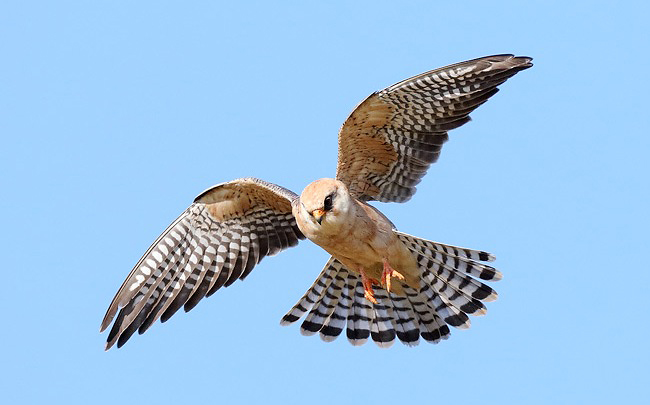
A great shot of a female Red-footed Falcon by Michael McKee.
I
Ibiza
Birds recorded on and around this small Balearic island in the Mediterranean include Balearic Shearwater (also possible on the short ferry ride between
Ibiza and the rather barren island of Formentera to the south), Scopoli's (Cory's) Shearwater, Booted Eagle, Eleonora’s Falcon, Audouin’s Gull, Greater
Short-toed and Thekla's Larks, Balearic Warbler, Blue Rock-thrush, Eurasian Crag Martin, Common Firecrest, 'Balearic' Red Crossbill and a wide range of
passage migrants during spring and autumn.
Iceland
Harlequin Duck and Barrow's Goldeneye, both of which nest nowhere else in Europe, shorebirds such as Grey (Red) and Red-necked Phalaropes, spectacular
seabird cliffs with Brunnich's Guillemots (Thick-billed Murres), Gyr Falcon and a chance of Blue, Humpback and Killer Whales, in some of the wildest
scenery in the world.
Idaho - USA
See USA - Idaho, below.
India - Goa
Goa is India’s smallest state, just 130 km (80 miles) from north to south and 80 km (50 miles) wide. Situated on the tropical west coast, the white,
palm-fringed beaches are a major tourist attraction, but the state is also a great place for birds, from the coast where the lakes, marshes, mudflats
and mangroves support a wide range of waterbirds to the foothill forests of the Western Ghats at the eastern end of the state where it is possible to
see some of the 33 Southern India endemics and 31 species shared with Sri Lanka. Water and open-country birds along the coast include Oriental Darter,
White-bellied Sea-eagle, Brahminy Kite, Greater and Indian Spotted Eagles, Indian Peafowl, Bronze-winged and Pheasant-tailed Jacanas, Yellow-wattled
Lapwing, Small Pratincole, Greater Painted-snipe, Pallas's (Great Black-headed) Gull, Plum-headed Parakeet, Black-capped and Stork-billed Kingfishers,
Asian Green Bee-eater, Indian Roller, Wire-tailed Swallow, Asian Paradise-flycatcher, Orange-headed Thrush and Long-tailed Shrike. To see the specialities
however it is necessary to spend at least a few days in the Western Ghats, at places such as the famous Backwoods Camp for example, where it is possible
to see Grey Junglefowl, Malabar Parakeet, Malabar Grey Hornbill, Malabar and White-cheeked Barbets, Indian Scimitar-babbler, Flame-throated Bulbul,
White-bellied Blue-flycatcher and Malabar Whistling-thrush, as well as near-endemic Blue-faced Malkoha, Sri Lanka Frogmouth, Malabar Trogon, Malabar Pied
Hornbill and Orange Minivet, and other spectacular species such as Chestnut-headed Bee-eater, Indian Pitta (also possible elsewhere), Heart-spotted
Woodpecker, Forest Wagtail, Golden-fronted Leafbird (also possible elsewhere), Indian Blue Robin, White-rumped Shama, Velvet-fronted Nuthatch, Asian
Fairy-bluebird and Greater Racquet-tailed Drongo. The best time to look for birds is during the northern winter and in two weeks it is possible to see
well over 250 species.
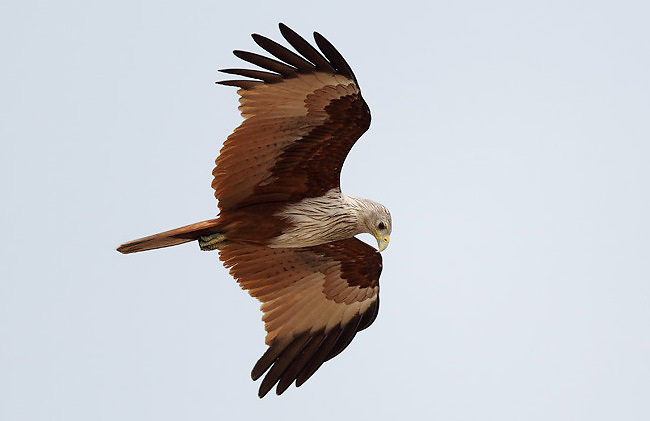
Brahminy Kite. One of the many spectacular birds easily seen at Goa. Image by Michael McKee.
India - Northern
Tiger, as well as spectacular birds such as Black-necked and Painted Storks, Indian Peafowl, Sarus Crane, Indian Skimmer, and Brown and Tawny Fish-owls,
especially at Bharatpur, one of the best birding sites in the world, and other animals including Asian Elephant and Gharial.
India - Northeastern
Seven Indian endemics restricted to this region, including Black-breasted Parrotbill, three wren-babblers and Bugun Liocichla, numerous near-endemics shared
with Nepal, Bhutan, China and Myanmar, including Ward's Trogon and Fire-tailed Myzornis, and other more widespread spectacular birds such as Himalayan
Monal, Rufous-necked Hornbill, Grandala, Himalayan Cutia and Beautiful Nuthatch, as well as Indian Rhinoceros, Asian Elephant, Hoolock Gibbon, Ganges River
Dolphin and even Tiger.
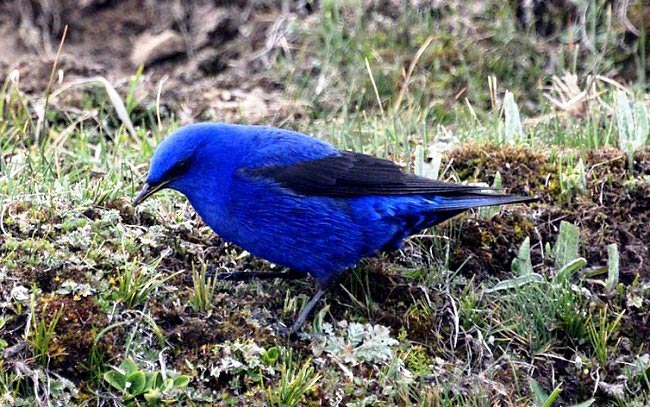
The beautiful Grandala, one of a flock which these birds usually occur in, by Jon Hornbuckle.
India - Northwestern
The best place in the world to look for Snow Leopards, in the high mountains of Ladakh.
India - Southern
Over 30 endemic birds based on the Western Ghats, including White-bellied Treepie, Flame-throated Bulbul, five laughingthrushes, two sholakilis (blue
robins), Black-and-orange Flycatcher and Crimson-backed Sunbird, over 30 birds shared only with Sri Lanka, such as Sri Lanka Frogmouth, Blue-faced Malkoha,
Sri Lanka Bay-owl, Malabar Trogon, Orange Minivet, Jerdon’s Leafbird and Loten’s Sunbird, and more widespread avian wonders like Indian Pitta and Indian
Blue Robin, as well as monkeys including Lion-tailed Macaque.
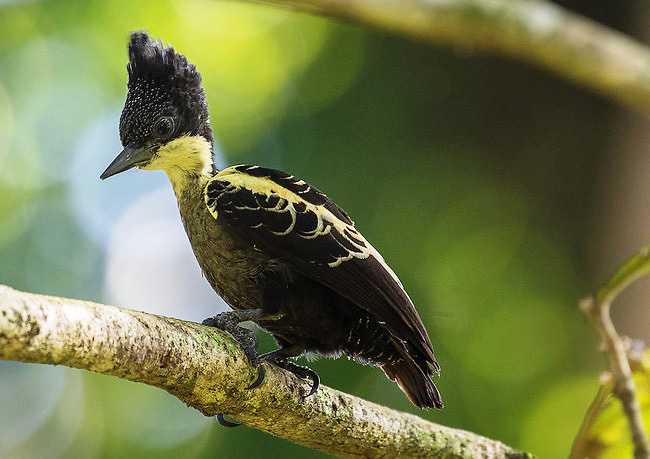
The tiny (16 cm (6 inches)) and extraordinary Heart-spotted Woodpecker at Thattekad in Southern India, by Francesco Veronesi.
India - Western
'Asiatic' Lion, Wild Ass, Blackbuck, a good chance of Leopard and Striped Hyaena, thousands of wintering Demoiselle Cranes, the largest harrier roost in
the world, flamingos, Crab Plover, Cream-coloured and Indian Coursers, and localized birds such as Hypocolius, White-bellied Minivet and Green
Avadavat.
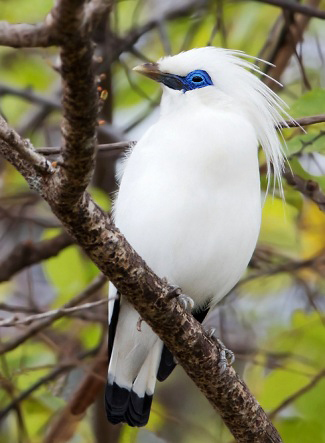
Bali Myna in Bali Barat National Park by Dubi Shapiro.
Indonesia - Bali
The numerous top birding destinations of Indonesia include the island of Bali, just across the narrow Bali Strait to the east of Java, where the very
rare and very beautiful white Bali Myna is being reintroduced (not very successfully) to Bali Barat National Park, where remnant open lowland deciduous
forest and coastal habitats also support Grey-rumped (Black-winged) Myna, Great-billed Heron, Javan Plover and Javan Banded Pitta.
Indonesia - Java
An extraordinary 40 endemic birds including a trogon, a broadbill and a cochoa, and another 28 species shared only with Sumatra and Bali, including Javan
Woodcock, Javan Kingfisher, Javan Banded Pitta and Java Sparrow, as well as Green Peafowl, Christmas Frigatebird and Blue Nuthatch, and some beautiful
mammals such
as Javan Gibbon, and leaf monkeys.
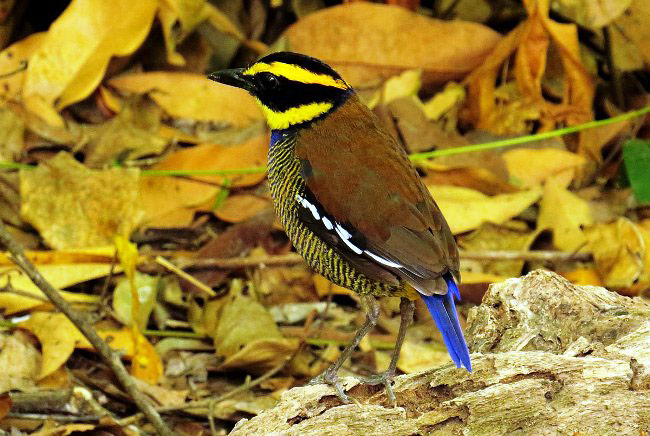
A Javan Banded Pitta by Mark Harper.
Indonesia - Komodo
Komodo Dragons, rich coral reefs with Green Turtles and birds such as Yellow-crested Cockatoo and Flame-breasted Sunbird.
Indonesia - Lesser Sundas (Nusa Tenggara)
East of Bali, the islands of Lombok, Sumbawa, Komodo (where the world's largest lizard lives), Sumba, Flores, Alor, Wetar, Timor
(for East Timor see Timor/Timor-Leste, below) etc. in Wallacea support 95 endemic bird species,
including Sumba Buttonquail, Cinnamon-banded and White-rumped Kingfishers, Chestnut-backed and Orange-banded Thrushes, Black-banded Flycatcher,
Bare-throated Whistler and Flame-breasted Sunbird. The islands with the most endemics are Flores (6), Sumba (13), Timor (9), Wetar (5) and Rote (4). More
widespread spectacular species include Lesser Frigatebird, Green Junglefowl, Javan and Malay Plovers, Rainbow Bee-eater, Elegant Pitta and Pygmy Cupwing,
while the waters of the Flores and Banda Seas these islands lie in support Brown and Red-footed Boobies, Bridled and Sooty Terns, and Brown Noddy, as well
as cetaceans such as Blue, Bryde’s and Sperm Whales, and Bottlenose, Risso’s and Spinner Dolphins. The best time to look for birds is mid-August to
October.
At the far eastern end of the Lesser Sundas not far from Australia are the Tanimbar Islands in the Southern Moluccas (Maluku) where the 15 endemic birds include a scrubfowl (most likely on a small satellite island), a monarch and two thrushes. The main island Yamdena is accessible by air from Ambon.
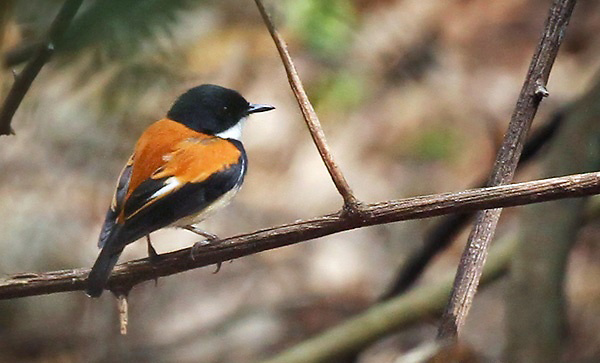
Black-banded Flycatcher, by Lars Petersson, a striking bird which occurs only on the island of Timor.
Indonesia - Moluccas (Maluku)
There are more than 100 endemic bird species in the Moluccas, of which 46 occur in the north on Halmahera and nearby islands, and 49 in the centre mainly
on Buru and Seram. North of Halmahera is the island of Morotai with three endemics; a pitta, a friarbird and a white-eye.
Halmahera is the best place to see most of the North Moluccas endemics including Azure Dollarbird (Purple Roller), Blue-and-white and
Sombre Kingfishers, White Cockatoo, Ivory-breasted Pitta, Halmahera Paradise-crow and Wallace's Standardwing but has only four single-island endemics;
Drummer (Invisible) Rail, Halmahera Oriole, Halmahera Cicadabird and Halmahera Golden Bulbul. For more information see
Indonesia - Sulawesi and Halmahera. To the south are the islands of Bacan with one endemic
and Obi with seven; an imperial-pigeon, a fruit-dove, a myzomela, a whistler, a fantail, a paradise-crow and a bulbul, although the island
races of Variable Goshawk, Spangled Drongo, Moluccan Monarch, Cream-throated White-eye and Common Cicadabird may all be considered to be full species one
day. However, Obi’s star avian attraction for many is the woodcock known only from Obi and a single specimen collected on Bacan.
In the Central Moluccas the island of Buru supports 20 endemics including a racquet-tail and a very strange bird called Madanga. Formerly known as Rufous-throated Dark-eye it is now placed in the pipit family although it lives in montane elfin forest and climbs up and down tree trunks! The rare Buru endemics, including Madanga, survive in remnant mountain forests as usual and include a mountain-pigeon, a lorikeet, a parrot, a honeyeater and a thrush. To the east is the long island of Seram with a forested mountainous spine within the Manusela National Park which supports the vast majority of the 17 endemics including a masked-owl and the rare Purple-naped Lory (also possibly on Ambon), while other species present on the island include Salmon-crested Cockatoo, Lazuli Kingfisher and Papuan (Blyth’s) Hornbill. The small mountainous island of Ambon next to Seram is the regional hub for visiting the Central and Southern Moluccas including the adjacent island of Haruku which has one of the best protected breeding sites for Moluccan Scrubfowl. At the southeastern corner of the Moluccas west of the Aru Islands near New Guinea are the Kai Islands where remnant forest patches hold four endemics; a coucal, a fantail, and Pearl-bellied (Great Kai) (on Kai Besar) and Golden-bellied (Little Kai) (on Kai Cecil and Dulah) White-eyes. The peak time to look for the birds of the Moluccas is August.
Indonesia - Sulawesi and Halmahera
Some of the world’s most spectacular birds occur on these islands where there are 86 endemics on Sulawesi and its satellites, and over 50 North Moluccas
endemics on Halmahera, including, on Sulawesi, Maleo, Heinrich’s (Diabolical/Satanic) Nightjar, Yellow-billed Malkoha, Blue-faced and Snoring Rails,
Sulawesi Woodcock, six owls, the colourful Knobbed Hornbill, Purple-bearded Bee-eater, Purple-winged Roller, six kingfishers, two racquet-tails, a pitta,
Piping Crow, Malia, Geomalia, six starlings and mynas, two thrushes, two hylocitreas (formerly a whistler, now in a family of their own) and three
flowerpeckers, and on Halmahera, Azure Dollarbird (Purple Roller), Sombre Kingfisher, White Cockatoo, Ivory-breasted Pitta, Halmahera Paradise-crow and
Wallace's Standardwing. These islands, especially Sulawesi, also support several striking mammals, not least macaques and tarsiers, and are surrounded by
some of the richest coral reefs on Earth.
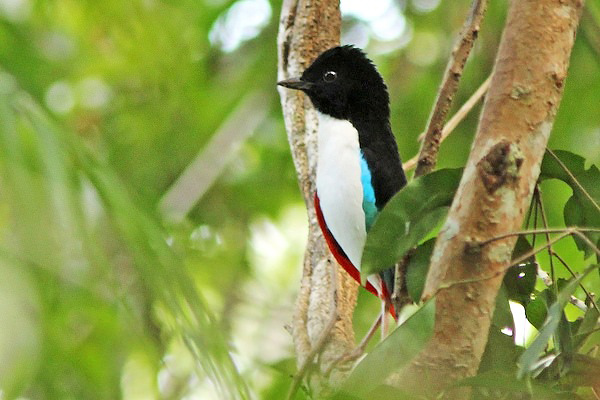
The amazing Ivory-breasted Pitta at Foli on the island of Halmahera by David Beadle.
Indonesia - Sulawesi's satellites
The largely deforested island of Sangihe lies in the Celebes Sea between Sulawesi and the island of Mindanao in the Philippines.
Accessible from Manado on Sulawesi, it supports eight endemic birds; some, like the scops-owl, hanging-parrot and sunbird, are widespread but it is
necessary to climb Gunung Sahendaruman to stand a chance of seeing the very rare Cerulean Paradise-flycatcher, as well as the whistler, the critically
endangered Sangihe Golden Bulbul and the virtually unknown endemic white-eye. Ruddy Kingfisher, a race of Western Hooded Pitta and Sangihe Tarsier also
occur on this island. To the east is the island of Talaud where there are five endemics; a rail, a bush-hen, a kingfisher, a lory and
a pitta, which occur along with Philippine Scrubfowl, Nicobar Pigeon, Malay Night-heron, Southern Rufous Paradise-flycatcher and three of the world's
four Tanygnathus parrots; Great-billed, Blue-naped and Blue-backed (the other one, Black-lored, is endemic to Buru). The best time to visit these islands
is April to September.
At Bunta on the north coast of Sulawesi’s ‘middle arm’ it is possible to charter a boat out to the island of Batudaka, the largest of the Togian (Togean) Islands, where it is possible to see the three endemics; a boobook, a golden bulbul and a white-eye.
The island of Peleng in the Banggai Islands south of Sulawesi’s ‘middle arm’ is accessible by boat from Luwuk, reached by air from Makassar (Ujung Pandang) at the south end of Sulawesi. All five Banggai endemics occur on this island; the fruit-dove, scops-owl, crow, golden bulbul and jungle-flycatcher, and the seven species restricted to Banggai and Sula; Sula Scrubfowl, Sula Cuckoo-dove, Sula Hanging-parrot, Sula Pitta, Slaty Cuckooshrike, Helmeted Myna and Red-and-black Thrush, as well as a possible new species of leaf-warbler and Peleng Tarsier. From Peleng it is possible to charter a boat to get to the well-forested island of Taliabu in the Sula Islands where, apart from the species shared with the Banggai Islands, there are ten endemics: Sula Fruit-dove, Taliabu Masked-owl, Sula Scops-owl, Sula Dwarf-kingfisher, Yellow-and-green Lorikeet, Sula Cicadabird, Taliabu Fantail, Sula Golden Bulbul, Bare-eyed Myna and Sula Jungle-flycatcher, as well as potential new species of locustella and leaf warblers in the high mountains. The peak time to visit the islands above is mid-November to mid-December.
Indonesia - Sumatra
The 30 mainland endemic birds include three partridges, two pheasants, a frogmouth, a ground-cuckoo, a trogon, two pittas, two wren-babblers, a mesia, a
cochoa and two leafbirds, and there are 12 more endemics on offshore islands. Other spectacular birds include White-winged Duck, Fire-tufted Barbet,
Malay Banded Pitta, Blue Nuthatch and Temminck's Sunbird, and there is a wide variety of mammals too, including Siamang, White-handed Gibbon and a chance
of Orang-utan off the beaten birding track.
Indonesia - West Papua
Fantastic birds-of-paradise including Magnificent, Red, Wilson's, Western Parotia and Black Sicklebill, all displaying, mostly at close range, many other
spectacular New Guinea birds such as Palm Cockatoo, Victoria and Western Crowned-pigeons and Papuan (Blyth's) Hornbill, not forgetting some of the other
68 endemics such as Vogelkop Bowerbird, Vogelkop Lophornia (once known as Superb Bird-of-paradise), Arfak Astrapia, a chance of Long-tailed Paradigalla,
and, on offshore islands, in the richest tropical seas on Earth, Biak, Kofiau and Numfor Paradise-kingfishers.
Iran
Iran is a largely hot, dry and barren country but the Zagros Mountains rise to 12,000 ft (3600 m) and the highest peaks are permanently snow covered. The
many great birds include the endemic Iranian (Pleske's) Ground-jay which can be seen in the Dasht-e-Kavir Desert in the northeast. There are also a few
regional endemics and specialities such as Socotra Cormorant (south), Sind Woodpecker (southeast), Hypocolius (southwest), (Mesopotamian) Hooded) Crow
(southwest), Afghan (Common) (south) and Iraq (southwest) Babblers, Caspian Tit (north), Black-headed Penduline-tit (north) and Basra Reed-warbler
(southwest), plus White-headed Duck, Indian Pond-heron, Caspian Snowcock, See-see Partridge, Crab Plover, White-tailed Lapwing, Great Thick-knee,
Cream-coloured Courser, Indian Roller, several larks and wheatears, White-throated Robin, Eversmann's Redstart, Bay-backed Shrike, Asian Desert and
Menetries's Warblers, Streaked Scrub-warbler, Radde's Accentor, Purple Sunbird, Dead Sea Sparrow and Eurasian Crimson-winged Finch, as well as a chance of
Asian (Macqueen's) Houbara Bustard. The best time to look for birds is April-May. Mammals include Asian Wild Ass, Mouflon, Ibex (Wild Goat), Golden Jackal,
Goitered Gazelle, Chinkara (Indian Gazelle), Afghan Pika, various jerboas, Indo-Pacific Humpback (Plumbeous) Dolphin (from boat trips to and from Hormoz
Island in the Persian Gulf) and Black Finless Porpoise. About fifty (Asiatic) Cheetahs are thought to survive in the deserts, mainly around Dasht-e Kavir
in the northeast, but like (Persian) Leopard, Caracal, Striped Hyaena, Wolf, (Syrian) Brown Bear, Pallas's and Sand Cats, and Blanford's and Ruppell’s
Foxes, they are rarely seen by visitors. The 'flower fields' near Chelgerd with their vast swathes of wild Crown Imperials are famous amongst botanists as
are the country's colourful Dionysias and irises, amongst a fine flora best viewed during the middle two weeks of April.
(Republic of) Ireland
Most British and many other European birders have heard of places such as Tacumshin, Ballycotton, Galley Head, Cape Clear and Bridges of Ross, all of which
are in Southern Ireland. Tacumshin is a great wetland for shorebirds, including those from North America, and once there was an incredible record flock of
26 Buff-breasted Sandpipers there, on the 27th September 2011, the same day as two Semipalmated Sandpipers, a White-rumped Sandpiper and an American Golden
Plover! Ballycotton is another famous place to look for shorebirds which have included a Long-toed Stint in 1996 and a Red-necked Stint in 2002. Galley
Head is one of several prominent headlands along the southern and western coasts of Ireland from which there is a reasonable chance of birds like
Fea’s-type Petrels in the right weather conditions, usually deep lows during the summer and early autumn, as well as rare landbirds from North America.
Many such rarities have landed on the island of Cape Clear, such as a Blue-winged Warbler in 2000 and Ruby-crowned Kinglet in 2013. Around on the west
coast is another great place to seawatch from, Loop Head, especially Bridges of Ross where Fea’s-type Petrels, Leach’s and Wilson’s Storm-petrels, and
Sabine’s Gulls are all seen on a regular basis and rare American landbirds have included, mostly at Kilbaha, a Canada Warbler in 2006 and a Philadelphia
Vireo in 2008. Farther north at the mouth of Galway Bay are the three Aran Islands including Inishmore (Eastern Kingbird 2012). Another hotspot for North
American vagrants as is an island farther north called Inishbofin (Eastern Kingbird 2013). On the nearby mainland are the vertical 650 ft (198 m) high
Cliffs of Moher where Atlantic Puffins, Guillemots and Razorbills raise their young. These cliffs lie next to The Burren, a huge limestone pavement
beloved by botanists in search of rare and beautiful flowers such as Bloody Cranesbill, Burnet Rose and Columbine. On the northwest coast of Ireland there
is yet another superb seawatching site called Kilcummin Head where after a northwesterly blow one September day in 1998 some fortunate seawatchers saw over
60 Sabine’s Gulls, 1000 Leach’s Storm-petrels and 3600 Sooty Shearwaters. To the north, the other side of Donegal Bay, is the fishing harbour of Killybegs,
famous for possible American Herring, (Kumlien’s) Iceland and Thayer’s Gulls amongst the regular high numbers of Iceland and Glaucous. Other birds present
in Ireland include Red Grouse (Willow Grouse/Ptarmigan), (White-throated) Dipper and Hooded Crow while notable absentee breeding species, present just
across the water on mainland Britain, include Tawny Owl, woodpeckers, Marsh Tit and (Eurasian) Nuthatch. The best time to seawatch is from mid-July to
October, and the time to look for nearctic shorebirds and passerines is from mid-August to October with the shorebird season usually peaking in
mid-September and the very best time for vagrant American passerines being the second week of October.
Ireland - Northern
See Northern Ireland, below.
Israel
A migration bottleneck for millions of birds, especially storks, raptors, shorebirds, pipits and warblers, and many localized Western Palearctic rarities
such as Asian Houbara (Macqueen’s) Bustard, Pallas's (Great Black-headed) Gull, Blackstart, Tristram’s Starling and Dead Sea Sparrow, with a chance of
others including Desert Tawny (Hume’s) Owl and Arabian Warbler.
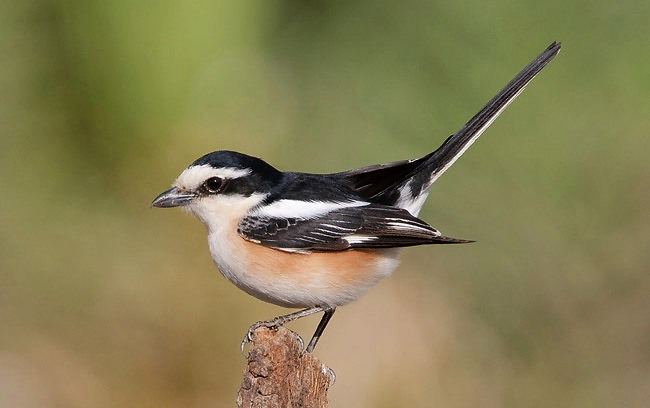
The smart Masked Shrike is a regular spring migrant in Israel. Image by Michael McKee.
Italy - Abruzzo National Park
'Marsican' Brown Bears, a chance of birds such as Rock Partridge and White-backed Woodpecker, and a superb selection of alpine flowers including many
orchids.
Italy - Gargano Peninsula
Situated on the southeast coast this is arguably ‘The Orchid Capital of Europe’, home to around 70 species and subspecies and where in April it is
possible to see about 40 in a week including Bertoloni's Bee, Pink Butterfly, Roman, Small-patterned, Sparse-flowered and many localised varieties of
Late Spider Orchid.
Italy - Sicily
See Sicily, below.
J
Jamaica
This small tropical island supports a staggering 31 endemic bird species (not including Jamaican Oriole which occurs only on Jamaica and the remote
island of San Andres), many of which are widespread. They include a quail-dove, two superb streamer-tailed hummingbirds, a tody, two parrots, two vireos,
two thrushes, a euphonia, a warbler and a spindalis. The quail-dove is most likely to be seen, like several other endemics, along Ecclesdown Road in the
John Crow Mountains, although the lizard-cuckoo and blackbird are most likely at Hardwar Gap in the Blue Mountains. Other, more widespread, Caribbean
endemics present include West Indian Whistling-duck, Vervain Hummingbird and Rufous-throated Solitaire, and other spectacular species include White-tailed
Tropicbird (at Hector's River), Magnificent Frigatebird, Northern Potoo (the endemic jamaicensis race) and wintering warblers from North America,
including Black-throated Blue, Cape May and Prairie. There are some spectacular butterflies too, not least the rarely reported endemic Giant Swallowtail
(Papilio homerus) which with a wingspan of up to 15 cm is the largest swallowtail butterfly in the Americas. The best time to look for birds is
February to early May, later for butterflies.
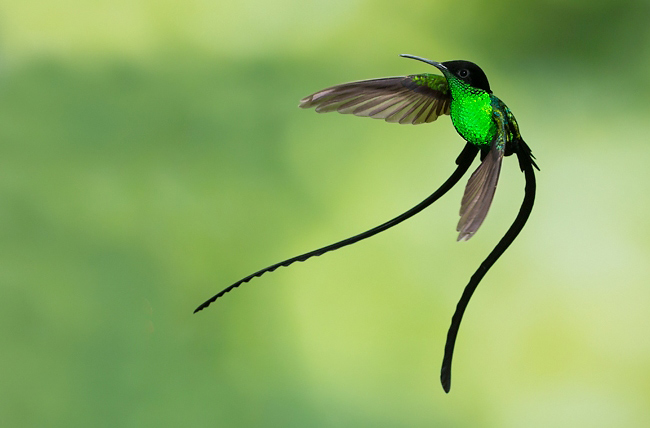
A wonderful image of a Black-billed Streamertail at Port Antonio in Jamaica by Dubi Shapiro.
Japan
‘Snow Monkey’ (Japanese Macaque), hundreds of Steller’s Sea-eagles, Red-crowned Cranes ‘dancing’ in the snow, thousands of Hooded and White-naped Cranes,
Baikal Teal and Blakiston's Fish-owl in the depth of the snowy northern winters, and, on the smaller southern islands, 17 of the 20 endemics, including
Okinawa Rail, Amami Woodcock, Amami (Lidth's) Jay, Ryukyu Robin, Iriomote Tit and Izu Thrush, as well as summer visitors such as Ruddy Kingfisher, Fairy
Pitta and Japanese Paradise-flycatcher.
Java
See Indonesia - Java, above.
Jordan
Like Israel to the west Jordan lies on a migration bottleneck which sees the passage of an estimated 500 million birds of about 300 species, especially
raptors, storks and passerines, and supports some localised landbirds and Western Palearctic rarities such as Sand Partridge, White-eyed Gull, Namaqua Dove,
Desert Tawny (Hume's) Owl (most likely at the famous ancient city of Petra), Blackstart, Buff-rumped, Desert, Hooded, Mourning and White-crowned Wheatears,
Arabian Babbler, Greater Hoopoe-lark, Arabian (Dunn's), Bar-tailed and Temminck’s Larks, Masked Shrike, Arabian Warbler, Streaked Scrub-warbler,
White-spectacled Bulbul, Tristram’s Starling, Palestine Sunbird, Desert Finch, Dead Sea Sparrow, Syrian Serin, Sinai Rosefinch and Striolated Bunting, with
a chance of Brown Booby, Pharaoh Eagle-owl and Cyprus Wheatear, as well as more widespread birds including Spur-winged Lapwing, Little Crake,
White-breasted (Smyrna) Kingfisher, Arabian Green Bee-eater, Pale Rock Martin, Graceful Prinia, Moustached Warbler, and Brown-necked and Fan-tailed Ravens.
Mammals include Nubian Ibex. Spring bird migration usually lasts from March to May and peaks from mid-March to early April which also happens to usually be
the best time for most flowers including the national flower the Black Iris. Actually there are five black Irises, as well as Blue, Purple and White ones,
and other spectacular flowers include blue and lilac-pink Lupins.
K
Kai Islands
See Indonesia - Moluccas, above.
Kamchatka, and the Kuril and Commander Islands - Russia
See Russia - Kamchatka, and the Kuril and Commander Islands, below.
Kazakhstan
There are some very special birds to be seen on a trip to Kazakhstan combined with Turkmenistan and Uzbekistan in the Central Asian area known as Turkestan,
including Himalayan Snowcock, Yellow-eyed Pigeon, Asian Houbara (Macqueen’s) Bustard, Demoiselle Crane, Sociable Lapwing, Black-winged Pratincole,
Ibisbill, Pallas’s Sandgrouse, White-winged Woodpecker, Turkestan (Pander's) Ground-jay, Azure Tit, Black and White-winged Larks, White-browed Tit-warbler,
Eversmann's Redstart, Himalayan Rubythroat, Black-throated Accentor, Saxaul and Zarudny's (Desert) Sparrows, Red-mantled Rosefinch and Red-headed Bunting,
as well as mammals such as Great Gerbil.
Kenya
The best overall wildlife experience in the world and therefore A Top Ten Destination, thanks to the presence of so many of
Africa's and the world's most spectacular mammals, birds and coral reef fish, the birds including vast flocks of flamingos, ostriches, African Fish-eagle,
Secretary Bird, Saddle-billed Stork, Kori Bustard and numerous East African specialities such as Vulturine Guineafowl, Crab Plover, Sokoke Scops-owl,
Somali Bee-eater, Golden-winged Sunbird, Golden-breasted Starling and Golden Pipit, so many easy-to-see birds it is possible to see over a hundred species
in a day at several locations, well over 500 in just two weeks and over 800 in a month, along with over 60 species of mammal, all in some wonderful
settings.
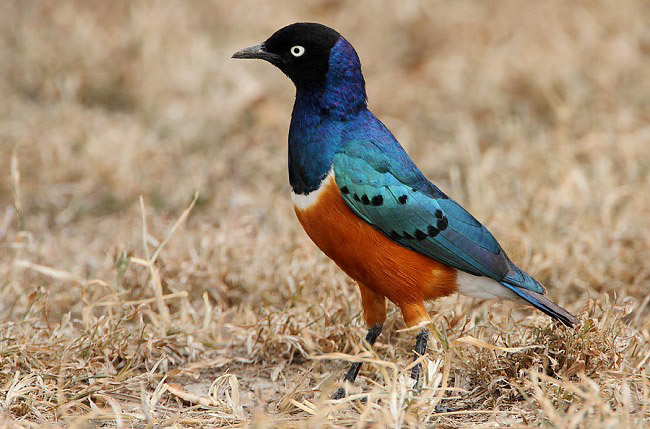
An aptly-named Superb Starling in Kenya by Steve Garvie.
Komodo - Indonesia
See Indonesia - Komodo, above.
Korea - South
See South Korea, below.
Kuwait
This tiny land of sand lies on a migrant flyway where the passage of birds usually peaks from mid-March to early May (especially early April) and in
November and can be good enough at least as far as passerines are concerned during the spring to rival more famous destinations for observing migrating
birds such as Eilat in Israel. In addition, Kuwait is situated at the south-eastern extremity of the Western Palearctic and, depending on the season, the
best place in the region for Western Palearctic listers to look for the likes of Socotra Cormorant (spring), Red-wattled Lapwing, Indian Roller (winter),
Basra Reed-warbler (spring), Afghan Babbler and Hypocolius (winter, when there are regular roost sites or pre/post-roost gatherings). During the spring it
is also possible to see Levant Sparrowhawk, Shikra, White-cheeked Tern, Egyptian Nightjar, Blue-cheeked Bee-eater, Arabian (Dunn’s) Lark, Black-crowned
Sparrow-lark, Menetries’s and Upcher’s Warblers, Semi-collared Flycatcher, Pale Sparrow and Cinereous Bunting. During the winter there are usually good
numbers of waterbirds in Sulaibikhat Bay including Greater Flamingo, Crab Plover, Broad-billed and Terek Sandpipers, and Greater and Lesser Sandplovers,
while in the desert some ‘oases’ such as Jahra Pools Reserve support Greater Spotted and Eastern Imperial Eagles, Grey-headed Swamphen, White-tailed
Lapwing, Pallas's (Great Black-headed) Gull, Pied and White-breasted (Smyrna) Kingfishers, Oriental Skylark, Red-tailed (Persian) Wheatear, White-eared
Bulbul, Clamorous Reed-warbler and Moustached Warbler. Unfortunately it is necessary to obtain permission well in advance to visit some of the best sites,
something best organised by a local, and a lot of people shoot birds, particularly during spring and autumn. June to August is not a good time to visit,
the summer being uncomfortably
hot.
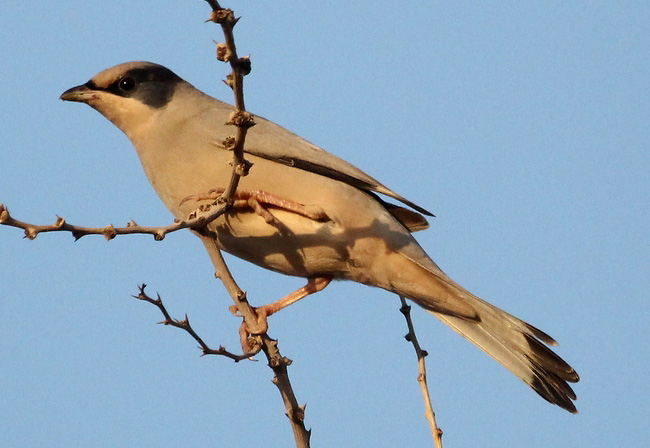
The unique Hypocolius in Kuwait in December by Spider.
Kyrgyzstan
This landlocked, open, wild country to the south of Kazakhstan dominated by the Tien Shan mountain range rising to 7439 m (24,406 ft) supports Himalayan
Snowcock, Lammergeier, Ibisbill, Hill Pigeon, White-winged Woodpecker, Isabelline Wheatear, Himalayan Rubythroat, Blue-capped, Eversmann’s and White-winged
(Güldenstädt's) Redstarts, Blue Whistling-thrush, Rufous-tailed Rock-thrush, White-browed Tit-warbler, Sulphur-bellied and Sykes’s Warblers, Rufous-naped
and (Yellow-breasted) Azure Tits, White-crowned Penduline-tit, Wallcreeper, Alpine, Altai, Black-throated and Brown Accentors, Rosy Starling, White-winged
Snowfinch, White-winged Grosbeak, Red-fronted Serin, Red-mantled Rosefinch, Mongolian Finch, Brandt’s (Black-headed) and Plain Mountain-finches, and
Grey-necked, Red-headed and White-capped Buntings. The best time for birds is the northern summer and the best birding sites include Ala-Archa National
Park, the May-Saz Valley area and Arslanbob.
L
Ladakh - Northwestern India
See India - Northwestern, above.
Laos
In this impoverished country, the only landlocked one in South East Asia, many birds, especially large ones, and other animals, are hunted and, as a
consequence, very shy. However, it is possible to see the sole endemic, Bare-faced Bulbul, near the village of Ban Na Hin in the karst limestone hills of
the Annamite mountain range in central Laos, as well as the near-endemics Red-collared Woodpecker and Sooty Babbler, plus Orange-breasted and
Red-headed Trogons, Black-capped and Ruddy Kingfishers, Blue-bearded Bee-eater, Green-eared Barbet, Pale-headed Woodpecker, Great Iora, Sultan Tit and
Black-browed Fulvetta, and there is a chance of Silver Pheasant, Spot-bellied Eagle-Owl, Long-tailed Broadbill, Blue-naped and Eared Pittas, Green Cochoa,
White-tailed Flycatcher and Rufous-throated Fulvetta, and an outside chance of Limestone Leaf-warbler and the endemic Lao Langur. There is virtually no
chance however of seeing Tiger, Leopard, Clouded Leopard, Asian Golden Cat and White-cheeked Gibbon which have also been recorded in this region, known as
the Nakai–Nam Theun National Biodiversity Conservation Area. Along the Mekong upstream from the capital Vientiane is a good area for Jerdon’s Bushchat, as
well as River Lapwing. For waterbirds head south to the Xe Pian area where Green Peafowl, White-winged Duck, Giant Ibis, Masked Finfoot and Sarus Crane
have been recorded, although more likely species include Cinnamon Bittern, Chinese Pond-heron, Pied Harrier, Bronze-winged and Pheasant-tailed Jacanas, and
Black-capped Kingfisher. At Don Khon, Small Pratincole, Chestnut-headed Bee-eater, Mekong Wagtail and Irrawaddy Dolphin are possible.
Latvia
Ancient forests and marshes in this small sparsely populated country means lots of birds such as (Western) Capercaillie, Hazel Grouse, Black Stork,
Montagu’s Harrier, Lesser Spotted and White-tailed Eagles, Corn Crake, Common Crane, lekking Ruffs, all three marsh terns, European Roller and eight
woodpeckers, as well as mammals including Beaver and Elk. The best area is arguably Kemeri National Park although the forested dunes of Cape Kolka in the
Baltic are the best location in spring to see passerine migrants such as Bluethroats and Golden Orioles, with divers and ducks offshore. Peak birding time
is around mid-May when it is also possible to see Ural Owl in adjacent and easily accessible Lithuania.
Lesotho
The tiny, landlocked, mountain Kingdom of Lesotho is a good place to look for the highland Drakensberg avian specialities of southern Africa. The most
accessible site in the region for these birds is Sani Pass which although technically in South Africa is a major route into Lesotho and a good place for
Drakensberg Rockjumper, Gurney's Sugarbird and Drakensberg Siskin, as well as Grey-winged Francolin, Southern Bald Ibis, Cape Vulture, Lammergeier, Cape
Eagle-owl, Ground Woodpecker, Sentinel Rock-thrush, Buff-streaked Chat, Barratt's Warbler, Bush Blackcap and Mountain Pipit, some of which can also
be seen at Liqobong on the Mechachaneng Ridge where there is a Cape Vulture colony and other cliff-nesting birds such as Jackal Buzzard (the most numerous
raptors at high altitudes, probably due to the abundance of prey in the form of endemic Sloggett's Ice Rats), and at Mafika-Lisiu Pass in the Maluti
Mountains, below which lies Bokong NR where there is an ossuary, an area of large slabs of flat rock used by Lammergeiers to drop and break large bones on.
Below Bokong look out for Malachite Sunbirds nectaring on red-hot pokers (Kniphofia). In the east of the country Yellow-breasted Pipit occurs in
Sehlabathebe NP which is contiguous with South Africa’s Ukhahlamba-Drakensberg Park.
Lesser Sundas
See Indonesia - Lesser Sundas, above.
Lesvos
The Greek island of Lesvos is situated in the Aegean Sea to the east of mainland Greece, although it is actually next to the west coast of Turkey. It
is a very popular destination with birders during the northern spring when large numbers of a wide variety of birds migrate through the island,
including herons, Pallid Harriers, Eleonora's and Red-footed Falcons, Little Crakes, shorebirds including Collared Pratincoles, Whiskered and
White-winged (Black) Terns, European Rollers, Red-throated Pipits, Collared Flycatchers, warblers and shrikes. The numbers of passage migrant birds
usually peak in the second half of April which coincides with the usual arrival period of breeding summer visitors such as Short-toed Eagle, European
Bee-eater, Isabelline Wheatear, Rufous-tailed Scrub-robin (Rufous Bush Chat), Masked Shrike, Olive-tree, Eastern Orphean and Rüppell's Warblers, and
Black-headed, Cinereous and Cretzschmar's Buntings. These join resident species such as Ruddy Shelduck, Greater Flamingo, White and Black
Storks, Long-legged Buzzard, Sombre Tit, and Krueper's and Western Rock Nuthatches to make a fine selection of birds which may also include rarer
migrants such as Levant Sparrowhawk, Baillon's Crake, Spur-winged Lapwing and Great Snipe, while around the coast there is a chance of Audouin's Gull
(a rare resident) and offshore a better chance of Scopoli's (Cory's) and Yelkouan (Balearic) Shearwaters.
Leti
See Indonesia - Lesser Sundas, above.
Liberia
After many years of civil wars, military coups, ‘blood diamonds’ - supporting the insurgency in neighbouring Sierra Leone with weapons and training in
exchange for diamonds - this small West African country was at peace again in the mid-2010s. Along the 600 km Atlantic coastline are mangroves, sandbars
and lagoons. Inland the coastal plains rise to rolling plateaux and low mountains and as recently as the early 2000s rich forest still covered some 40%
of the land, enough to support all 14 Upper Guinea Endemic Bird Area species and 184 species of the Guinea Congo forest biome, birds which occur at
places such as Mount Nimba where large scale ongoing iron ore mining continues to reduce the height of the mountain (from 5748 ft (1752 m)), and remove
and degrade much of the remaining forest. Another top birding site is Sapo National Park, Liberia's first and only fully protected area at the heart of
the largest remaining block of Upper Guinean Forest in west Africa, providing habitat for species that need to range over large areas such as ‘Forest’
Elephants. The 14 Upper Guinea specialities are White-breasted Guineafowl, Rufous Fishing-owl, Brown-cheeked Hornbill, Western Wattled Cuckooshrike,
White-necked Rockfowl, Sierra Leone Prinia, Sharpe's Apalis, Black-headed Rufous-warbler, Green-tailed Bristlebill, Yellow-bearded Greenbul, Rufous-winged
Illadopsis, Copper-tailed Starling, Nimba Flycatcher and Gola Malimbe. Recent research suggests Liberian (White-winged) Greenbul may merely be an aberrant
form of Icterine Greenbul. With so much forest intact Liberia also supports the last remaining viable populations of Pygmy Hippopotamus and ‘West
African’ Chimpanzee. Wet summers usually last from April to November making birding difficult and dust-laden harmattan winds which often blow across the
country from the Sahara between December and March don't help much either.
Lithuania
It is possible to see nearly 200 species on a short trip during the second half of May to the picturesque meadows, bogs, woods, river valleys and lake
systems of Lithuania if led by local guides, including, in Nemunas Delta Regional Park, Greater Spotted Eagle, Great Snipe and Aquatic Warbler, in
Curronian Spit National Park, Blyth’s Reed-warbler, and in the east, Black Stork, Lesser Spotted and White-tailed Eagles, Hazel Grouse, Eurasian Pygmy,
Tengmalm’s (Boreal) and Ural Owls, White-backed Woodpecker and Northern (Eurasian) Nutcracker. Lithuania is easily accessible from Latvia – there are no
border restrictions – and would make a great combination with that country. The peak time to observe autumn migration along the Baltic Flyway is the first
week of October. Millions of birds, especially geese, ducks, divers, raptors and shorebirds, pass through the Baltic states at this time of the year with
Lithuania at the narrowest point hence Vente Cape has the largest bird banding/ringing station in the world. Up to 800,000 birds have been known to fly
over the cape each day while at Curronian Spit National Park, another migration hot-spot, mainly for raptors and passerines, up to 1.5 million migrants
have been counted passing on peak days!
Louisiana - USA
See USA - Louisiana, below.
M
(Republic of North) Macedonia
This small, landlocked, mountainous country next to Bulgaria and Greece is a good place to see Rock Partridge as well as a wide range of raptors
including Egyptian and Griffon Vultures (both at Vitachevo vulture feeding station), Eastern Imperial and Lesser Spotted Eagles, Levant Sparrowhawk and
Lesser Kestrel, European Roller, Lesser Grey Shrike, Eurasian Golden Oriole, Northern (Eurasian) Nutcracker, Rock Bunting and species confined to southeast
Europe during the breeding season, such as Olive-tree Warbler and Black-headed Bunting. The best places for waterbirds such as Dalmatian Pelicans and Pygmy
Cormorants are the two huge lakes, Megali Prespa and Ohrid, in the southwest corner of the country. Pelister National Park to the northeast, along with the
Galicica Plateau and the Vardar Valley which runs across Macedonia are the top places for butterflies in a country where over 200 species have been
recorded including Apollo, Clouded Apollo, coppers, and lots of blues and fritillaries. The peak time for most butterflies is usually the second half of
June which is also a good time to look for most birds.
Madagascar
Nearly 120 endemic birds and 12 shared only with the Comoros, some belonging to four endemic families; three mesites, five ground-rollers, four asities and
11 tetrakas, and some others including 11 couas, 17 vangas, a sandgrouse, two flufftails, an ibis, a jacana, a fish-eagle, a lovebird, three rock-thrushes,
two fodies, two weavers and a wagtail, as well as over 100 species of lemur including the beautiful sifakas, the loud Indri and the confiding Ring-tailed Lemur, all
in some of the strangest habitats on the planet.
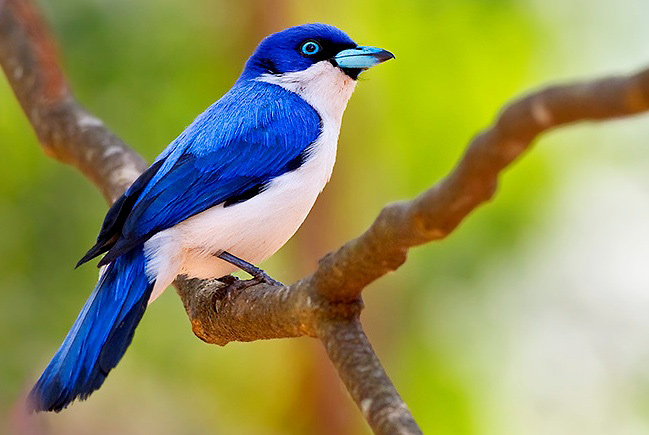
Madagascar Blue Vanga by Dubi Shapiro, one of many unique and stunning birds on the island of Madagascar.
Madeira
Two endemic breeding seabirds; Desertas (Fea's) Petrel and the very rare Zino's Petrel, as well as Bulwer's Petrel, (Madeiran) Band-rumped and White-faced
Storm-petrels, and Barolo Shearwater, make Madeira a great place for seabirds and they can be seen very well on Zodiac boat trips during which there
is also a chance of a wide range of cetaceans. There are also two endemic landbirds; Madeira (Trocaz) Laurel-pigeon and Madeira Firecrest, near-endemic
Plain Swift, Berthelot's Pipit and Island Canary, and some endemic subspecies.
Maine - USA
See USA - Maine, below.
Malawi
This small, densely-populated country is surprisingly birdy and a good place to see the likes of Lesser Jacana, African Skimmer, Pel’s Fishing-owl,
Pennant-winged Nightjar, Lilian's Lovebird, Böhm's Bee-eater, Racquet-tailed Roller, Green-headed Oriole, White-winged Apalis, Blue Swallow, Boulder Chat,
Babbling Starling, Red-tufted Sunbird and Vincent's (Cape) Bunting. There are many Miombo woodland specialists and one endemic; Yellow-throated Apalis, as
well as a fine range of mammals, not least African Elephant, Hippopotamus, Sable and Roan.
Malaysia - Borneo
See Borneo, above.
Malaysia - Malay Peninsula
A long list of fabulous South-East Asian birds, especially trogons, kingfishers, bee-eaters, barbets, broadbills, hornbills, pittas and leafbirds with a
chance of Rail-babbler, primates such as Siamang and White-handed Gibbon, and even Malayan Tapir, in possibly the oldest lowland rainforest on Earth, at
Taman Negara.
Maldives
A great diversity of whales and dolphins with very large numbers of some dolphins, as well as over a thousand fish species including Whales Sharks and
Manta Rays which can be seen while snorkeling, along with Green and Hawksbill Turtles.
Mali
This large, mainly flat, land-locked country is most famous in wildlife circles for the Niger floodplain which lies in the middle of the country between
the historic cities of Djenne and Timbuktu. The extent of the flood varies considerably from year to year but when it is very wet it is a paradise for
birds, being a very important breeding area for African waterbirds and wintering ground for migrant Palearctic waterbirds which have included estimates of
half a million Garganeys, 200,000 Northern Pintails, 150,000 Ruffs and 20,000 Glossy Ibises. The richest area in such years is often Lac Debo near Mopti.
To the north almost half of the country is dominated by the Sahara whereas the south is savanna country where the near-endemic Mali Firefinch occurs in
suitable habitat (rocky outcrops) in and around the capital Bamako and at Dogon Cliffs, a tourist attraction near the town of Sanga, along with
Fox Kestrel, Mocking Cliff-chat and Neumann’s (Red-winged) Starling. Some other special Mali birds include Scissor-tailed Kite, Egyptian Plover, Grey
Pratincole, Cream-coloured Courser, Red-necked Nightjar, Red-throated Bee-eater, Abyssinian and Blue-bellied Rollers, Sahelian (Little Grey) Woodpecker,
Sun Lark, Black Scrub-robin, and Desert and Sudan Golden Sparrows. In the south the dry season normally lasts from November to April and February is the
best time to be in the Niger floodplain because the birds are concentrated on the remaining water.
Mallorca
The largest Balearic Island has a wide range of habitats ranging from one of the largest freshwater marshes in the Mediterranean to mountains that rise
to over 1000 m. Speciality birds include Balearic and Scopoli’s (Cory’s) Shearwaters, Eleonora’s Falcon, Audouin’s Gull, ‘Balearic’ Woodchat Shrike
(badius), Balearic (Marmora’s) (at its highest density on Isla de Cabrera), Moltoni’s (Subalpine) (also on Isla de Cabrera) and Moustached Warblers,
Mediterranean (Spotted) Flycatcher, Spotless Starling and 'Balearic' Red Crossbill, while more widespread species include Purple and Squacco Herons,
Cinereous (Eurasian Black) and Griffon Vultures, Bonelli’s and Booted Eagles, Eurasian Scops-owl, Pallid Swift, Eurasian Hoopoe, Thekla's Lark, Zitting
Cisticola, Western Bonelli’s, Sardinian and Spectacled Warblers, and Common Firecrest. Amongst over 30 endemic plants are a relic from the ice age,
Hypericum balearicum, and orchids like Bug and Loose-flowered. The main birding site is S’Albufera de Mallorca National Park with a bird list of over 270
species including Marbled Teal, Red-crested Pochard (reintroduced), Little Bittern, Western (Purple) Swamphen (reintroduced), Red-knobbed Coot
(reintroduced), and Great Reed, Moustached and Savi’s Warblers. Spring migration usually peaks in mid-April, autumn passage in mid-October.
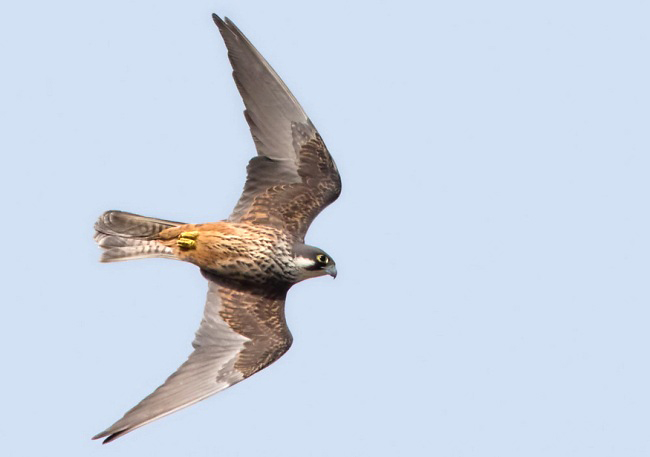
Eleonora's Falcon at Sa Dragonera, Mallorca, by Lars Petersson.
Manitoba - Canada
See Canada - Manitoba, above.
Manu (Southern Peru)
See Peru - Southern, below.
Mariana Islands
See Micronesia, below.
Massachusetts - USA
See USA - Massachusetts, below.
Mauritania
This large country to the north of Senegal is about two thirds Sahara one third Sahel but the most important site for birds is the Banc d’Arguin National
Park which protects 40% of the 750 km long Mauritanian Atlantic coastline between Nouakchott and Nouadhibou and has been known to support more than two
million migrant shorebirds, the largest concentration of such birds in Africa. However, most visiting birders are after adding several species that have
restricted ranges in the Western Palearctic (WP) to their WP lists. Using the epic nine-volume Handbook of the Birds of Europe, the Middle East, and North
Africa the definition of the WP means that these species must be seen north of 21°N and, bizarrely, in the air above the islands and maritime areas of the
Banc d’Arguin. Along the coast the WP specialities are Long-tailed (Reed) and White-breasted (Great) Cormorants, Grey-headed Gull and West African Crested
(Royal) Tern, while other species include Brown Booby and Western Reef-egret. Inland the WP goodies are African Collared and Namaqua Doves, (African) Grey
Woodpecker, Dunn’s Lark, Cricket, Isabelline (Western Olivaceous) and Western Orphean Warblers, and Sudan Golden Sparrow while other possibilities include
Blue-naped Mousebird and other birds present are Lanner Falcon, Lichtenstein’s Sandgrouse, Speckled Pigeon, Laughing Dove, Greater Hoopoe-lark, Bar-tailed
and Desert Larks, Black-crowned Sparrow-lark, Pale Rock Martin, White-crowned Wheatear, Fulvous Babbler, African Desert Warbler, Chestnut-bellied Starling,
Desert Sparrow and House Bunting, and mammals include Fennec Fox. Two of the best wadis are north of the settlement of Ouadane, a green oasis in the
otherwise barren landscape to the east of the town of Atar where it is possible to arrange the required 4WD with driver.
Mauritius, Reunion and Rodrigues
Since Mauritius was discovered by modern man in the late 1500s all but 3% of the natural vegetation has been destroyed and several species have become
extinct, notably the Dodo which was wiped out by the 1660s. Most of the surviving endemic birds are endangered too, especially the Pink Pigeon, the
kestrel and the Echo Parakeet, while the other five endemics are all declining; a cuckooshrike, a bulbul, a rare white-eye, a relatively 'common' white-eye
and a fody. Other birds present on the island include Mascarene Swiftlet, Mascarene Martin, the rare Mascarene Paradise-flycatcher (which also occurs on
Reunion) and several introduced species. One of the best places to see the endemic landbirds is Black River Gorges National Park although Bras d'Eau
National Park is better for the paradise-flycatcher. Seawatching is arguably best from La Roche qui Pleure on the south coast where the possibilities
include Barau's, Herald/Trindade and Mascarene Petrels. From the north coast it is possible to telescope Gunner's Quoin Island although it is better to
hire a boat to visit the island and the surrounding waters in order to see Red-tailed and White-tailed Tropicbirds, and Masked Booby. Other possible
seabirds around the island include Wedge-tailed Shearwater, Brown and Lesser Noddies, and Sooty Tern. Offshore, Round Island, which can be viewed by boat,
supports nesting Herald/Trindade Petrels, the largest colony of Red-tailed Tropicbirds in the Indian Ocean (2000-2500 pairs), lesser numbers of
White-tailed Tropicbirds and large numbers of Wedge-tailed Shearwaters, as well as an endemic boa and skink.
The heavily degraded island of Rodrigues supports two endemic landbirds; a warbler and a fody, both of which are rare in some high vegetated gulleys, as well as Rodrigues (Golden) Flying Fox.
The forested volcanic mountains of Reunion are where Barau’s and Mascarene Petrels nest, and they also support six endemic landbirds; a harrier, a cuckooshrike, a bulbul, two white-eyes and a stonechat, all of which can be seen in remnant natural forest along the trail from La Roche Ecrite, about half an hour by road from St Denis. Other landbirds present there include Mascarene Paradise-flycatcher, while seawatching near dusk from the the St. Etienne rivermouth area may reveal Barau's and Mascarene Petrels, and Tropical Shearwaters, massing before flying inland to their nesting sites high among the volcanic peaks. The best time to visit these islands is October-November.
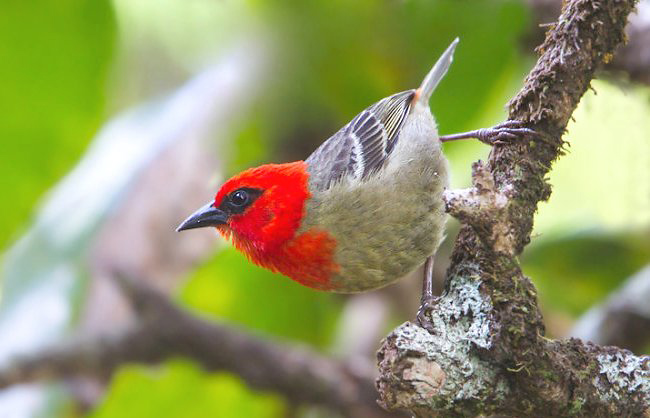
Mauritius Fody by Dubi Shapiro.
Mayotte
See See Comoros and Mayotte, above
Menorca
The greenest Balearic Island is noted for its wild flower displays, especially orchids, in late April, and Europe’s only sedentary population of
Egyptian Vultures with other birds present during the spring at least including Balearic and Scopoli’s (Cory’s) Shearwaters, Purple and Squacco Herons,
Ferruginous Duck, Red Kite, Booted Eagle, Audouin’s Gull, Eurasian Hoopoe, European Bee-eater, ‘Balearic’ Woodchat Shrike (badius), Thekla's Lark, Tawny
Pipit, Blue Rock-thrush, Sardinian Warbler, Mediterranean (Spotted) Flycatcher and Spotless Starling. There is also a chance of Moustached Warbler
at sites such as the Tirant Marshes near Platages/Playa de Fornells.
Mexico - Baja California
Whales and dolphins galore, including Blue Whale and confiding Grey Whales, and a few seabirds such as Red-billed Tropicbird, Blue-footed and Masked
Boobies, Black and Least Storm-petrels, and Craveri's and Scipps's Murrelets, while, on land live six endemic landbirds; Xantus’s Hummingbird, Baja
Pygmy-owl, Grey Thrasher, San Lucas Robin, Baird’s Junco and Belding’s Yellowthroat.
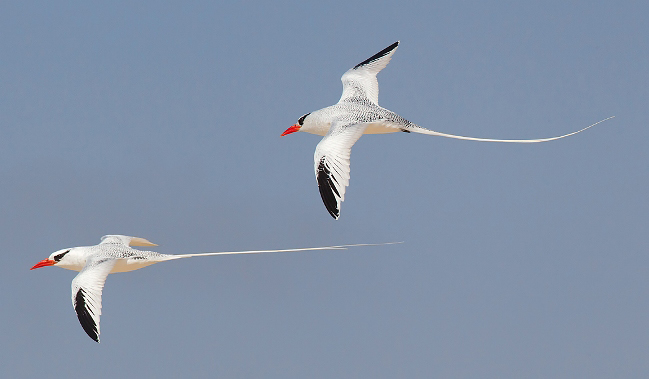
Baja's not all about whales. The birds include Red-billed Tropicbirds. Image by Dave Barnes.
Mexico - Central (Michoacan)
A Top Ten Destination thanks to millions of Monarch butterflies at their winter roosts, many more beautiful butterflies, some
superb Mexican and Central American endemic birds such as San Blas Jay, Aztec Thrush, Chestnut-sided Shrike-vireo, Orange-breasted Bunting and many
colourful warblers, as well as Humpback Whales and Red-billed Tropicbirds along the Pacific coast.
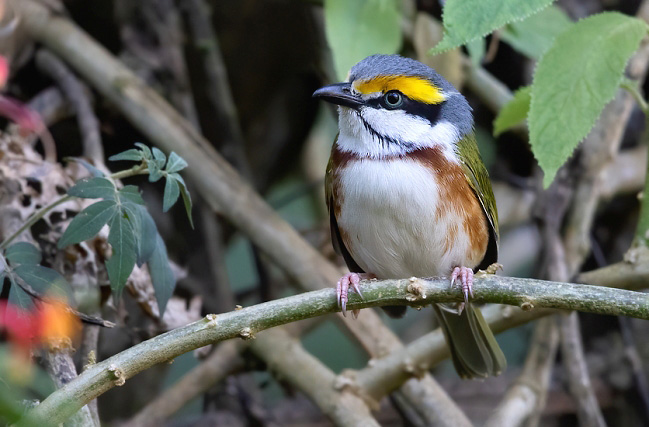
The one-and-only Chestnut-sided Shrike-vireo, in Guatemala, by Dubi Shapiro.
Mexico - El Triunfo
The cloud forest in this reserve in the Sierra Madre de Chiapas is one of the few accessible sites in Chiapas and neighbouring Guatemala where Horned
Guan occurs, and this is also a good place to see other range-restricted highland specialities such as Highland Guan, White-breasted Hawk, Fulvous Owl,
Resplendent Quetzal (the subspecies with the longest tail), Blue-throated Motmot, Green-throated Mountain-gem, Emerald-chinned Hummingbird, Black-throated
Jay, Blue-crowned Chlorophonia and Hooded Grosbeak. At lower altitudes the major speciality is Azure-rumped (Cabanis's) Tanager (most likely at Canada
Honda), while others include Rufous Sabrewing, Sparkling-tailed Woodstar, Tody Motmot, Giant Wren (Tapachula area) and Grey-crowned Ground-sparrow. Other
birds include Turquoise-browed Motmot (Paval area), Black-crested Coquette, Grey Silky-flycatcher and Long-tailed Manakin, and mammals present include
Central American (Geoffrey's) Spider Monkey, Collared Peccary and Southern Ringtail (Cacomistle). Visitors must have permission from the Instituto de
Historia Natural in Tuxtla Gutiérrez which can also help with the logistics in reaching the basic bunkhouse, which involves an uphill hike of about 11
km (6.5 miles), camping lower down, food and so on. The best time to visit is March when Horned Guans are usually calling.
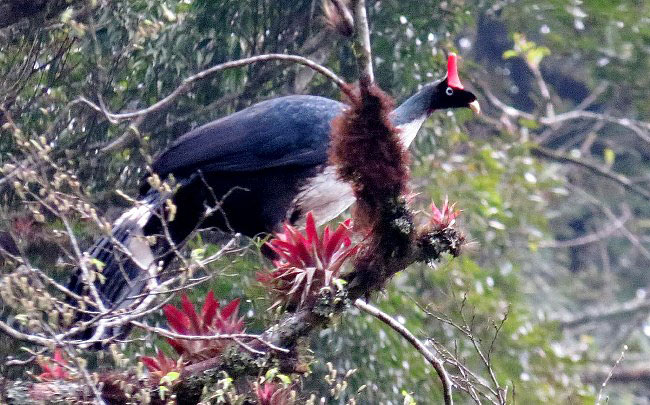
The extraordinary Horned Guan at El Triunfo, Mexico by Jon Hornbuckle. It is only possible to see this bird at remote El Triunfo in southern Mexico or in adjacent Guatemala.
Mexico - Oaxaca
There are probably more bird species in Oaxaca than any other Mexican state; nearly 700, and about a hundred of these are regional endemics. The area around
the city of Oaxaca is also one of the richest regions in Mexico for endemic birds and many of these occur: on Cerro San Felipe (La Cumbre), notable for
Dwarf Jay and lots of warblers including Red; along Route 175 North (the striking Slaty Vireo and, nearer the town of Valle Nacional, Tody Motmot); and
at Monte Alban, home of the skulking Ocellated Thrasher. Other great birds around the city include Grey Silky-flycatcher and Chestnut-sided Shrike-vireo,
with a chance of Aztec Thrush. Further afield, the Sierra Madre del Sur near Puerto Angel on the Pacific coast supports more endemics and Red-breasted Chat
(most likely in Parque Nacional Huatulca), and on pelagic boat trips out of places such as Huatulca and Puerto Angel it is possible, on good days, to see
Townsend’s Shearwater, as well as Galapagos and Pink-footed Shearwaters, Black and Least Storm-petrels, and Nazca (Masked) Booby. At the far eastern end of
the state, live two fantastic endemic birds; Orange-breasted and Rose-bellied (Rosita’s) Buntings, which can be seen side-by-side in the Tapanatepec
Foothills along with such birds as Citreoline Trogon, Russet-crowned Motmot and White-throated Magpie-jay. The endemic Giant Wren (a real giant!) occurs
not far away, near the small town of Puerto Arista in the state of Chiapas, and beyond there in Chiapas lies the Biosphere Reserve Selva el Ocote (Nava's
Wren), El Sumidero Canyon (Belted Flycatcher and a chance of Slender Sheartail) and the warbler-filled woods of San Cristobal de las Casas (Golden-cheeked
and Pink-headed Warblers, and a chance of Blue-throated Motmot and Black-throated Jay). The best time to look for birds is January to April.
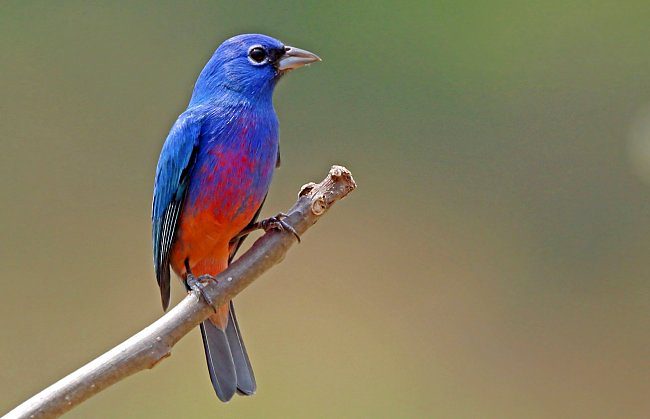
Blue, blue, electric blue, that's the colour of a Rose-bellied or Rosita's Bunting. The superb image of this one was captured in the Tapanatepec Foothills of Oaxaca, Mexico, by Nigel Voaden, the same place the very colourful Orange-breasted Bunting occurs, both species being endemic to Mexico.
Mexico - Southern (Yucatan-Chiapas)
Yucatan bird specialities such as Ocellated Turkey, Mexican Sheartail and Yucatan Jay, more widespread spectacular birds such as Keel-billed Toucan and
Turquoise-browed Motmot, and one of the best places in the world to swim with Whale Sharks.
Mexico - Veracruz
The best place to watch migrating raptors in the world, with 4-6 million birds passing over each autumn/fall in what is known as the ‘Río de Rapaces’
or ‘River of Raptors' and with the 30 or so species of raptor there are sometimes over a million butterflies and dragonflies per day.
Mexico - Western (including the Durango Highway, San Blas, and Colima and Jalisco)
The spectacular endemic Tufted Jay can be seen in the Sierra Madre Occidental, accessible along the Durango Highway, along which also occur the rare
Sinaloa Martin, Red-headed Tanager and Mexico's famous flocks of warblers which here contain Crescent-chested, Olive, Red and Red-faced. Lower down,
specialities include Military Macaw, Purplish-backed Jay and wintering Black-capped Vireos. At the coast, on the Gulf of California, rocky islets
viewable (with telescopes) from Mazatlan support breeding Red-billed Tropicbirds and Blue-footed Boobies. Further south along the Pacific coast lies
the small holiday resort of San Blas where it is possible to see 250 species in a week, less than a thousand miles south of the U.S. border, including
about 30 endemics (such as Citreoline Trogon and San Blas Jay), as well as Rufous-necked Wood-rail, Bare-throated Tiger-heron, Boat-billed Heron, Collared
Forest-falcon, Northern Potoo, Military Macaw, Russet-crowned Motmot, Fan-tailed Warbler and the unique Rosy Thrush-tanager. Humpback Whales spend the
northern winter in Banderas Bay, Puerto Vallarta, where on organised whale-watching trips it is also possible to see Bottlenose and Spotted Dolphins. Not
much further south is the small state of Colima which together with parts of neighbouring Jalisco supports about 40 endemics including San Blas Jay, Aztec
Thrush, Red Warbler and Orange-breasted Bunting, as well as Grey Silky-flycatcher, Chestnut-sided Shrike-vireo, many warblers including Colima and
Golden-browed, and Red-breasted Chat. The smoking Volcan de Fuego is one of the best sites, although the vast flocks of Yellow-headed Blackbirds winter on
the Ciudad Guzman Marshes. At the coast, boat trips can be arranged out of Manzanillo to a big rock called Piedra Blanca where Red-billed Tropicbirds
breed. The best time to bird Western Mexico is January-February.
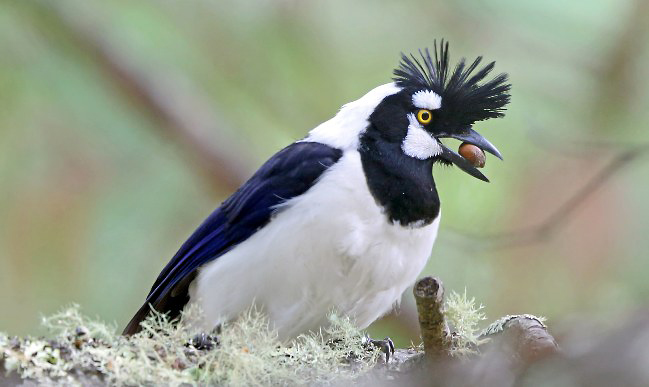
The striking Tufted Jay at Reserva Chara Pinta by Nigel Voaden.
Michigan - USA
See USA - Michigan, below
Micronesia
About fifty endemic birds including Palau (13) and the Northern Marianas (8) with 21 on the islands of Chuuk, Kosrae, Pohnpei and Yap in actual Micronesia,
including fruit-doves, ground-doves, kingfishers, monarchs and white-eyes, along with seabirds such as Red-tailed and White-tailed Tropicbirds, Red-footed
Booby and Common White Tern, and some of the best places in the world to snorkel or scuba-dive with Manta Rays.
Minnesota - USA
See USA - Minnesota, below
Missouri - USA
See USA - Missouri, below
(Republic of) Moldova
A small country near the Danube Delta between Romania and Ukraine with woods, forests, farmland, orchards, vineyards, river valleys and some fine
wetlands. A place where many species in steep decline elsewhere in Europe are still present in reasonable numbers, for example European Turtle-dove,
Common Cuckoo, Eurasian Hoopoe, European Bee-eater, European Roller, Eurasian Golden Oriole, Red-backed Shrike, Eurasian Tree Sparrow and Corn Bunting.
There are also plenty of raptors including Red-footed Falcon and waterbirds such as Pygmy Cormorant, Great White Pelican, Squacco Heron, Little Bittern
and Whiskered Tern. On the steppes in the far south Saker Falcon is possible, along with Long-legged Buzzard, Short-toed Eagle and Levant Sparrowhawk. It
is possible to see about 140 species in a week. Few people visit but one tour company does, Oriole Birding, in late June.
Mongolia
Bird specialities such as Altai Snowcock, Black-billed Capercaillie, Demoiselle and White-naped Cranes, Pallas’s Fish-eagle, Oriental Plover, Relict Gull,
Pallas’s Sandgrouse, Mongolian (Henderson's) Ground-jay and Mongolian Accentor, and mammals including Siberian Ibex, Great Gerbil and an outside chance of
Snow Leopard, in vast grass steppes, the Gobi Desert and the Altai Mountains.
Montana - USA
See See USA - Montana, below
Montenegro
Boka Kotorska Bay, southern Europe’s longest and deepest fjord, is on the Adriatic coast of this small country but elsewhere along the coast there are
beaches, sand dunes, saltpans and the delta of the River Bojana, important migration stopovers for shorebirds such as Marsh Sandpiper. Inland, Levant
Sparrowhawks nest in woodlands while open country with olive groves and rocky outcrops is good for Rock Partridge, European Bee-eater, European Roller,
Eastern Black-eared Wheatear, Eastern Olivaceous and Eastern Orphean Warblers, Western Rock Nuthatch, Lesser Grey Shrike and Black-headed Bunting.
Between the mountains lies Lake Skadar, the largest freshwater lake in Europe, westernmost nesting site of Dalmatian Pelicans and home to thousands of
Pygmy Cormorants as well as Whiskered Terns. The coniferous forests and open slopes of the relatively unspoilt rugged mountains, in Durmitor National Park
for example, support Golden Eagle, Black and Eurasian Three-toed Woodpeckers, Northern (Eurasian) Nutcracker, Yellow-billed (Alpine) Chough, Sombre Tit,
Rufous-tailed Rock-thrush and Rock Bunting. Birding is best April-May but the later the better for a chance of Olive-tree Warbler.
Morocco - Southern
All of North Africa's endemic birds except for Algerian Nuthatch, including Moussier’s Redstart, as well as Northern Bald Ibis, Cream-coloured Courser,
Blue-cheeked Bee-eater, a dozen larks, several wheatears and Desert Sparrow.
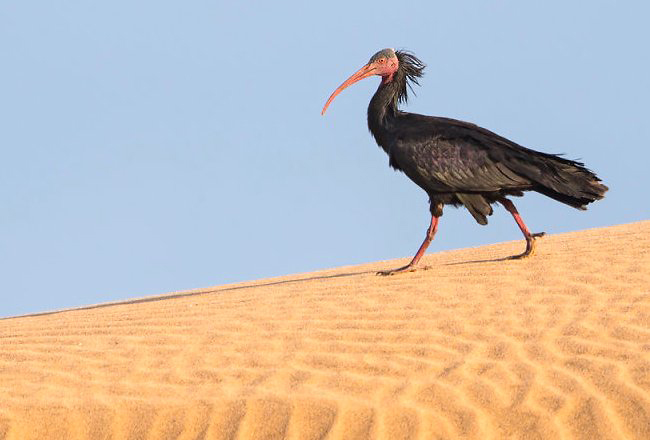
Northern Bald Ibis in Tamri National Park, Morocco, by Dubi Shapiro.
Morotai
See Indonesia - Moluccas, above.
Mozambique
African Pitta, Green-headed Oriole and Miombo woodland specialities, as well as some mammals, mostly reintroduced after a slaughter, and a long coast
with Crab Plovers, Manta Rays, Whale Sharks and numerous colourful other fish on some of the most pristine coral reefs in the world.
Mull (and Scottish Highlands) - Scotland
See Scotland - Highlands to Mull, below.
Myanmar (Burma)
Myanmar (Burma) has 13 endemic bird species not including Gurney's Pitta which is almost extinct in Thailand; Burmese Collared-dove, Irrawaddy
(Black-and-red) Broadbill, Jerdon’s Minivet, Hooded Treepie, Burmese Bushlark, Burmese Prinia, Ayeyarwady, Grey-crowned and Pale-eyed Bulbuls, Burmese
(Black-browed) Tit, Naung Mung Wren-babbler, White-throated Babbler and White-browed Nuthatch. The minivet, treepie, lark and babbler occur on the plains
along the banks of the Irrawaddy River (‘the road to Mandalay’) near Bagan (along with the rare White-rumped Pygmy-falcon), and the tit and nuthatch not
far away in Natmataung (Mount Victoria) National Park near Kanpetlet in the Chin Hills, steep mountains which form a southern extension of the Himalayas,
where other birds very difficult to see elsewhere include (Buff-breasted) Black-throated and Spot-breasted Parrotbills, Mount Victoria (Chinese) Babax,
Spot-breasted Scimitar-babbler, Chin Hills (Long-tailed) Wren-babbler, Assam, Blue-winged, Brown-capped and Striped Laughingthrushes, Red-faced Liocichla,
Rusty-capped Fulvetta, Rusty-fronted and Streak-throated Barwings, Grey Sibia, White-bellied Redstart, Grey-sided Thrush (during the northern winter),
Black-bibbed Tit, Crested Finchbill and Brown Grasshopper-warbler, and more widespread goodies occur, such as Hodgson's Frogmouth, Black-eared,
Black-headed and Green Shrike-babblers, Himalayan Cutia, Red-tailed Minla, and Fire-tailed and Gould's Sunbirds. In the east the near-endemic Burmese
Yuhina can be seen near Kalaw in the hills of Shan State along with Black-tailed Crake, Pin-tailed Green-pigeon, Slender-billed Oriole, Sapphire Flycatcher,
Black-breasted Thrush, Martens’s Warbler (northern winter), Dark-backed Sibia and Collared Myna while Jerdon's Bushchat and Chinese Grass-babbler occur by
the huge, 45 square mile, shallow Inle Lake. Down south it is possible to see Spoon-billed Sandpipers on their wintering grounds; most of the remaining
population (perhaps less than 200) probably winters on the Myanmar coast. Another very rare bird, Gurney's Pitta, occurs in Tenasserim in the far south,
along with Blue-winged, Garnet and Malay Banded Pittas, and Plain-pouched Hornbill. The best time to search for pittas is mid-March to mid-April when they
are normally at their most vocal but seeing them will involve a organising a mini camping expedition from the coastal town on Myiek. Back in Yangon there
is a roost of half a million or so Asian Wrinkle-lipped Bats at the spectacular Shwedagon Pagoda. The best time for most birds 'up north' is November to
March.
N
Namibia
Only one endemic bird; Dune Lark, but 16 shared only with Angola including the unique Ground Batis (White-tailed Shrike), Rockrunner, Angola Cave-chat and
Cinderella Waxbill, and 25 shared only with South Africa including Blue Crane, Karoo Bustard, African (Jackass) Penguin, Hartlaub’s Gull, Black Harrier and
seven larks, as well as many of Africa's classic mammals, such as Lion, Leopard, Cheetah, African Elephant, Giraffe, Gemsbok and Black Rhinoceros, all in
some stunning, mainly desert, scenery.
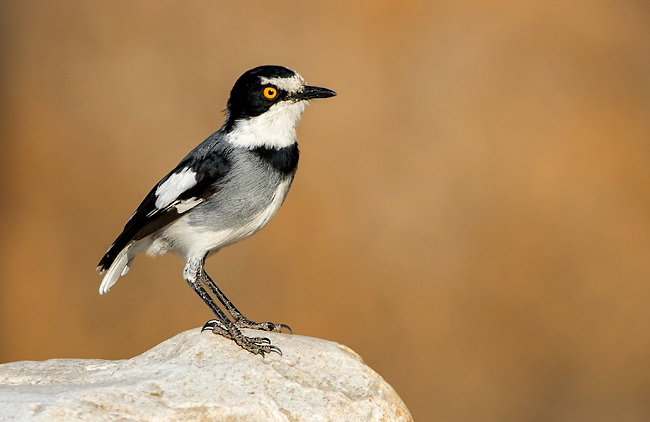
The striking Ground Batis or White-tailed Shrike by Dubi Shapiro. This unique species occurs only in Namibia and Angola where this image was captured at Renato Grade.
Nebraska (Platte River) - USA
See USA - Nebraska, below.
Nepal
A small country packed with birds, more than any other region of comparable size in Asia, including Himalayan Monal, Satyr Tragopan, Ibisbill, the sole
endemic, Spiny Babbler, Slender-billed Babbler, the near-endemic Nepal Cupwing, Himalayan Cutia, Fire-tailed Myzornis, Grandala, Pied Thrush and Finn's
Weaver, as well as Indian Rhinoceros, Gharial and a chance of Tiger, in some of the most spectacular scenery on Earth.
Nepal - Hange Tham
Beautiful Himalayan oak-rhododendron forests where Red Panda is probable not possible!
Netherlands
Tens of thousands of geese, with a good chance of Lesser White-fronted, as well as swans and Smews in winter, and hundreds of thousands of shorebirds
during late summer.
New Brunswick-Nova Scotia (Eastern Canada)
See Canada - Eastern, above.
New Caledonia
Nearly 20 mainland endemic birds include some of the strangest birds in the world not least Kagu, Cloven-feathered Dove and a tool-using crow. Other
endemics include Horned Parakeet, Crow Honeyeater and Red-throated Parrotfinch, and there is the chance of some seabirds such as Great and Lesser
Frigatebirds, Red-footed Booby and Tahiti Petrel.
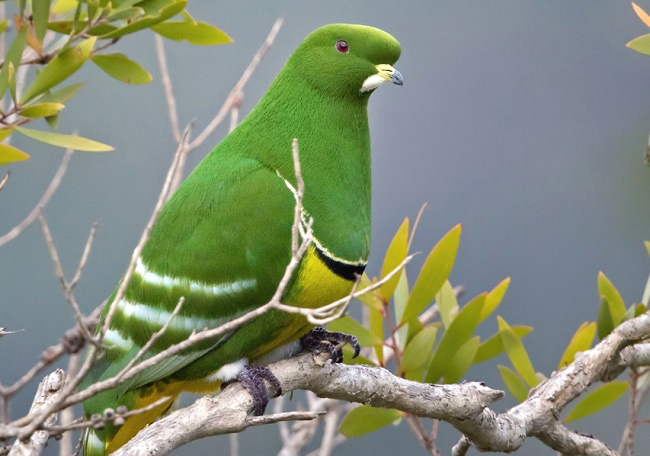
The strange Cloven-feathered Dove occurs only on the island of New Caledonia where this fine image was taken by Lars Petersson.
Newfoundland - Canada
See Canada - Newfoundland, above.
New Mexico (Bosque del Apache) - USA
See USA - Bosque del Apache, below.
New Zealand
Six endemic bird families; five kiwis, three parrots, three wrens, three mohouas, four wattlebirds and Stitchbird, and 54 endemic bird species, also
including Blue Duck, Black Stilt, Wrybill, Tui, Takahe and Weka, as well as the breeding endemic, New Zealand Storm-petrel, and the islands are
just as famous for Sperm Whales and a superb selection of seabirds such as Wandering, Royal and several other albatrosses, petrels, shearwaters and
White-faced Storm-petrel, many of which can be seen at close range on boat trips.
New Zealand - Subantarctic Islands
See Subantarctic Islands, below.
Nicaragua
Although the largest country in Central America has long been overshadowed by its southern neighbour Costa Rica as far as birding goes it still has swathes
of good forest, especially in the Caribbean lowlands where the Indio Maiz Reserve and Rio Indio Lodge are situated. Elsewhere there are Pacific slope
forests, highland forests and the huge Lake Cocibolca (Lake Nicaragua) which together support the near-endemic Green-breasted Mountain-gem (El Jaguar
private reserve), Nicaraguan Seed-finch and the virtually endemic Nicaraguan Grackle, as well as Great Curassow, Agami Heron, Bare-throated Tiger-heron,
Green Ibis, Great Green and Scarlet Macaws, Resplendent Quetzal, trogons, Black-crested Coquette, Snowcap (Refugio Bartola), Turquoise-browed Motmot,
Keel-billed Toucan, Ocellated Antbird, Bare-necked Umbrellabird, Three-wattled Bellbird, Long-tailed and Red-capped Manakins and Golden-cheeked Warbler,
while mammals include Mantled Howler and Geoffrey’s Spider Monkeys, and Brown-throated Three-toed Sloth. Some of the best birding sites are Montibelli
private reserve near Managua, Refugio Bartola on the Rio San Juan and El Jaguar private reserve. The rainy season normally runs from May to November when
hurricanes are also possible. Hurricane Otto made landfall in November 2016 and affected the forests around Refugio Bartola and in the Indio Maiz
Reserve.
North Carolina - USA
See USA - North Carolina, below.
North Dakota - USA
See USA - North Dakota, below.
Northern Ireland
Northern Ireland's largest seabird colony is on Rathlin Island off the north coast where there is a Seabird Centre, accessible by boat from Ballycastle.
Breeding birds from late April to July include Manx Shearwater, Northern Fulmar, (Black-legged) Kittiwake, (Common) Guillemot (Murre), Razorbill and
Atlantic Puffin. On the mainland nearby is the famous Giant's Causeway where there are about 40,000 hexagonal basalt columns up to 1.8 m (6 ft) high on the
coast of County Antrim and where birds include Purple Sandpiper and Red-billed Chough. There is a Bird Observatory on Copeland Island, accessible, with
prior permission, by boat from Donaghadee, where rare North American birds recorded include a Red Fox-sparrow in 1961. The largest sea lough in the British
Isles, Strangford Lough, is of international importance to wildfowl (25,000) and waders (50,000) during the winter, including (Pale-bellied) Brent Geese,
the numbers of which usually peak at about 12,000 in October. Breeding species include Arctic Tern. Inland is the largest freshwater lake in the British
Isles, Lough Neagh, which with Lough Beg and associated wetlands is another important wetland in winter when the enormous rafts of birds include the
largest concentrations of diving ducks in Britain and Ireland. Bird numbers may reach up to 100,000, including six per cent of the world's Whooper Swans
and internationally significant numbers of Bewick's (Tundra) Swans. In the nearby Sperrin Mountains there are Red Grouse (Willow Grouse/Ptarmigan).
Northwest Territories - Canada
See Canada - Northwest Territories, above.
Norway (Arctic) and Finland
The greatest diversity of owls in Europe, an Arctic experience completed by King and Steller’s Eiders, and nesting shorebirds, and a good chance of seeing
Brown Bears from hides at night where there is also a chance of Wolverine.
Nova Scotia-New Brunswick (Eastern Canada)
See Canada - Eastern (Nova Scotia-New Brunswick), above.
Nunavut - Canada
See Canada - Nunavut, above.
O
Oaxaca - Mexico
See Mexico - Oaxaca, above.
Obi
See Indonesia - Moluccas, above.
Ohio - USA
See USA - Ohio, below.
Oman
A chance of Hypocolius, and other localized birds such as Jouanin's Petrel, Sooty Falcon, Omani Owl, Hume's Wheatear, Arabian (Golden-winged) Grosbeak and
Yemen Serin, as well as more widespread spectacular birds including Red-billed Tropicbird, Lappet-faced Vulture, Steppe and Verreaux’s Eagles, Crab Plover,
Indian Roller, all in a country with a long coastline, deserts and the highest mountain in the Middle East.
Ontario (Point Pelee) - Canada
See Canada - Point Pelee (Ontario), above.
Oregon - USA
See USA - Oregon, below.
Outer Hebrides - Scotland
See Scotland - Outer Hebrides, below.
P
(Western) Pacific Odyssey
See Western Pacific Odyssey, below.
Pakistan
Pakistan would surely be a popular birding destination without so many mainly political and religious troubles, and what a country to go birding in,
especially the north where the Pamirs, Hindu Kush, Himalayas and Karakoram Ranges meet and numerous spectacular mountains rise to 8611 m (28,251 ft)at K2,
the second highest mountain on Earth, just 237 m (778 ft) lower than Everest. The barren scree slopes, high meadows, coniferous and mixed forests, and
rushing rivers support an exciting range of Western Himalayan Endemic (or breeding-endemic) specialities such as Brooks’s and Tytler’s Leaf-warblers,
White-throated Tit, Kashmir Nuthatch, Spectacled Finch and Orange Bullfinch, as well as Indian Blue Robin, Blue-capped, Blue-fronted and White-bellied
Redstarts, Streaked Laughingthrush, Yellow-billed Blue Magpie, Rufous-breasted Accentor, rosefinches and White-capped Bunting. A good place to look for
these birds is the scenic Kaghan Valley which runs north from the town of Balakot, north of Abbottabad. North of there, along the Karakoram Highway to
Gilgit roadside birds include Hume’s and Variable Wheatears, Tickell’s Thrush and the migratory bactrianus race of House Sparrow. Near Gilgit lies the
Naltar Valley which supports breeding Long-billed Grasshopper-warbler, Sulphur-bellied Warbler, Larger-spotted Nutcracker and Blyth’s Rosefinch, as well as
White-browed Tit-warbler. Back south the virtually endemic White-cheeked Tit can be seen in the Margalla Hills near Islamabad. One of the country’s star
birds, Western Tragopan, has its stronghold in the remote Palas Valley northwest of Abbottabad, and it also occurs in the Neelum Valley of Azad Kashmir
next to northwest India, along with Cheer and Koklass Pheasants, Kashmir Flycatcher, Kashmir and White-cheeked Nuthatches, Black-headed Jay and Orange
Bullfinch. Through the mountainous north from Tibet flows the mighty Indus and it continues south through the whole of the country to near Karachi on the
south coast, providing water for the Punjab’s agricultural plains, and lakes of great importance to waterbirds including Greater Flamingos and Pallas’s
Fish-eagles. In the deserts of the southwest there seven species of sandgrouse; Black-bellied, Chestnut-bellied, Crowned, Lichtenstein's, Painted,
Pin-tailed and Spotted. Wetlands near Karachi support breeding Pallas’s Fish-eagle, and wintering Dalmatian and Great White Pelicans, and at Hab Dam and
Valley about 30 km north of the city it is possible to see Hypocolius. The best time to visit the north is between May and September, early June for the
majority of breeding species. It is hot all year round in the centre and south, especially in June and July.
Palau
See Micronesia, above.
Panama
Nearly a thousand bird species including nine endemics, 74 species shared with Costa Rica and 27 species shared with Colombia, a multitude of birds that
includes Harpy Eagle, many hummingbirds, Resplendent Quetzal, Sapayoa, Black-crowned Pittasoma, Black-tipped, Blue, Turquoise and Yellow-billed Cotingas,
Long-tailed Silky-flycatcher, Golden-browed and Yellow-collared Chlorophonias, and Wrenthtrush, with a rich offshore life too where there are Manta Rays
and turtle cleaning stations.
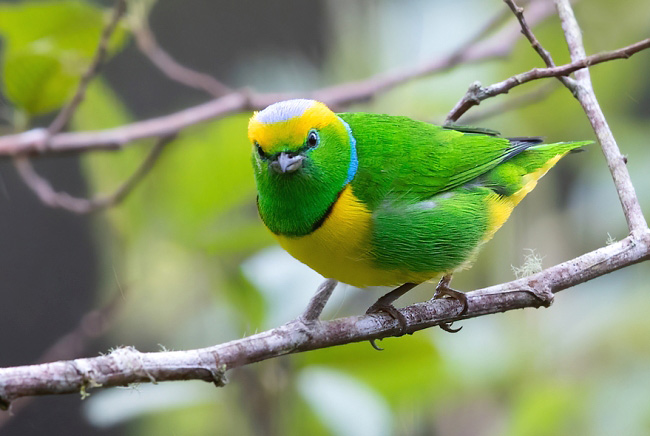
Golden-browed Chlorophonia, Cabanas Los Quetzales, Panama, by Dubi Shapiro. This beauty occurs only in Panama and Costa Rica.
Pantanal (Southern Brazil)
See Brazil - Southern, above.
Pantar
See Indonesia - Lesser Sundas (Nusa Tenggara), above.
Papua New Guinea
Nearly 500 birds are endemic to the main island of New Guinea and its offshore islands including 68 that are endemic to West Papua (the western half of the
island) and 136 that are endemic to Papua New Guinea (the eastern half) although only 33 of those are endemic to the mainland. They include Eastern, Lawes’s
and Wahnes's Parotias, Growling Riflebird, Ribbon-tailed and Stephanie’s Astrapias, Blue, Emperor and Raggiana Birds-of-paradise, and Lesser Lophornia
(Superb Bird-of-paradise), the fabulous birds-of-paradise that help make this A Top Ten Birding Destination, along with many other extraordinary creatures,
such as Palm Cockatoo, Sclater's Crowned-pigeon, Rufous-bellied and Shovel-billed Kookaburras, Red Satinbird, Flame Bowerbird, Painted Quail-thrush, four
jewel-babblers and Eastern Crested Berrypecker, to name a few. Offshore there is just as much crazy variety thanks to the fishes and other creatures living
on some of the richest coral reefs on the planet.
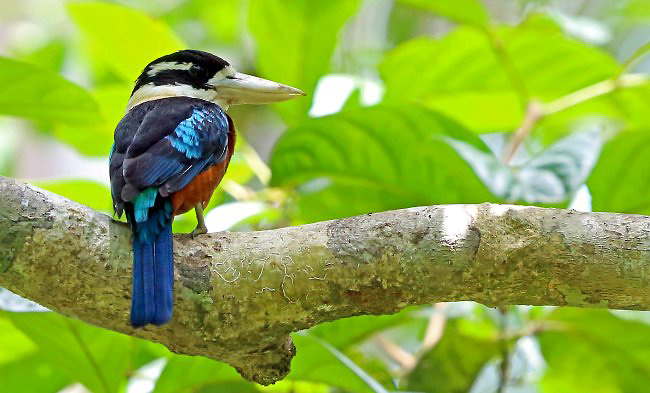
New Guinea is home to so much more than birds-of-paradise. The widespread Rufous-bellied Kookaburra for example is one of numerous spectacular endemics. Both males and females have massive white bills but males have blue tails and females rufous. This male was captured by Nigel Voaden.
Paraguay
The vast plains of arid chaco (which make up more than 60% of the land area yet support less than 2% of the human population), cerrado and flooded
grasslands together with pantanal wetlands and remnant Atlantic Forest of Paraguay support many rare and restricted-range species notably the 20 or so
virtually endemic to the chaco and they include (Chaco) Spotted Nothura, Quebracho Crested Tinamou, Bare-faced Curassow, Spot-winged Falconet,
Rufous-faced and Red-and-white Crakes (the latter at San Rafael, a very birdy area where about 430 bird species have been recorded), Black-legged and
Red-legged Seriemas, Giant Snipe, Chaco, Rusty-barred and Tawny-browed Owls, Scissor-tailed, Sickle-winged, Silky-tailed and White-winged Nightjars,
Nacunda Nighthawk, Violet-crowned Plovercrest, Saffron and Spot-billed Toucanets, Toco Toucan, lots of woodpeckers including Black-bodied and Helmeted,
lots of woodcreepers including Great Rufous, Crested Gallito, Lark-like Brushrunner, Cock-tailed, Sharp-tailed, Strange-tailed and Streamer-tailed Tyrants,
Straneck's Tyrannulet, Greater Wagtail-tyrant, Bearded Tachuri, Crested and Dinelli's Doraditos, Russet-winged Spadebill, Rufous Gnateater, Collared and
(Chaco) Olive-crowned Crescentchests, Sharpbill, Bare-throated Bellbird, Red-ruffed Fruitcrow, Band-tailed Manakin, Wing-barred Piprites, Curl-crested Jay,
seedeaters, and Saffron-cowled and Scarlet-headed Blackbirds. This is a hard country to see mammals in - thick bush, few tracks - but persistence may pay
off with Brazilian Tapir, Chaco Peccary, Plains Viscacha, Chaco Mara, Black Howler, Black-tailed Marmoset, Great Hairy Armadillo and even Jaguar, Puma,
Maned Wolf, Giant Anteater, Giant Otter, Margay and Geoffroy's Cat. The best time to visit Paraguay is mid-September to the end of October.
Peleng
See Indonesia - Sulawesi's satellites, above.
Pennsylvania - Hawk Mountain Sanctuary
See USA - Pennsylvania, below.
Peru - Central
Spectacular birds in spectacular mountain scenery, with a chance of 50 highland endemics and specialities including the flightless Junin Grebe, Andean
Ibis, Junin (Black) Rail, Diademed Sandpiper Plover (Marcapomacocha), Andean Lapwing, Puna Plover, Andean and Puna Snipes, Grey-breasted and Rufous-bellied
Seedsnipes, Oilbird (thousands in cave near Tingo Maria), hummingbirds such as Bronze-tailed Comet (Santa Eulalia Valley), Black-breasted Hillstar,
Fire-throated Metaltail and Olivaceous Thornbill, Golden-headed Quetzal, Grey-breasted Mountain-toucan, White-bellied Cinclodes (Marcapomacocha and Ticlio
Bog/Pass), Striated Earthcreeper, canasteros, Eye-ringed Thistletail, antpittas, tapaculos, chat-tyrants, ground-tyrants, tit-tyrants, Many-coloured
Rush-tyrant (Lake Junin), Bay-vented (Bosque Unchog) and White-cheeked (Andamarca Valley via Santa Eulalia Valley) Cotingas, Band-tailed, Barred,
Green-and-black (Huanaco) and Masked Fruiteaters (all four along Paty Trail), White-eared Solitaire, White-collared Jay, brush-finches, mountain-tanagers
including the endemic Golden-backed Mountain-tanager (Bosque Unchog), Golden-collared, Grass-green, Huallaga and Yellow-scarfed Tanagers, Rufous-browed
Hemispingus (Bosque Unchog), Pardusco (Bosque Unchog), Giant Conebill, Tit-like Dacnis, sierra-finches, Plain-tailed and Rufous-breasted Warbling-finches,
and Great and Rufous-backed Inca-finches. Not so many mammals though, probably Northern Viscacha and possibly Andean Fox, Andean Huemul and Vicuna. The
best time to look for birds is June-July.
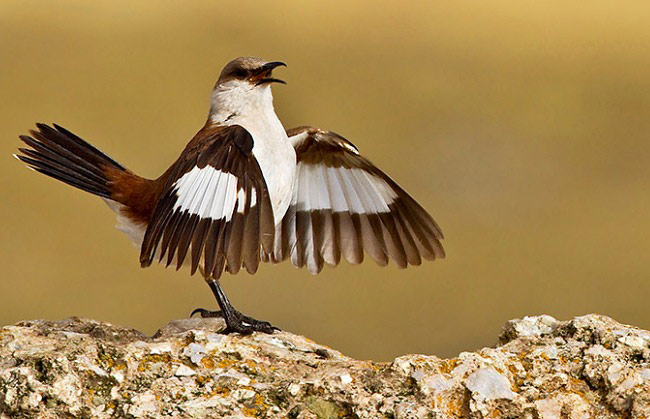
A great photograph of a displaying White-bellied Cinclodes at Marcapomacocha by Dubi Shapiro. This photograph won the Critically Endangered Birds category in the 2013 international photo competition run by The World’s Rarest Birds project which aims to support BirdLife International’s Preventing Extinctions Programme.
Peru - Southern (including Manu)
The richest region for birds on Earth with a tenth of the world's species, about a thousand, including macaws and parrots visiting clay licks, hummingbirds,
quetzals, jacamars, toucans, cotingas including Andean Cock-of-the-rock, manakins and multicoloured tanagers, as well as Giant Otters and monkeys, all in
some of the most pristine habitats left on Earth.
Peru - Northeastern (Iquitos)
A very rich area of Amazonia for birds including Nocturnal and Wattled Curassows, Collared and Rufous-necked Puffbirds, Black Bushbird, White-plumed and
many other antbirds, Black-necked Red Cotinga, and Orange-crested and Wire-tailed Manakins, as well as Uakari, Pygmy Marmoset, tamarins and Pink River
Dolphins.
Peru - Northern
About 45 regionally endemic birds including such extraordinary creatures as White-winged Guan, Grey-bellied Comet, Marvellous Spatuletail, Long-whiskered
Owlet, Scarlet-banded Barbet, Pale-billed Antpitta, Peruvian Plantcutter, Rufous Flycatcher, Lulu’s Tody-flycatcher, and Buff-bridled, Grey-winged and
Little Inca-finches, another large number of species shared only with Ecuador, including Royal Sunangel, Rainbow Starfrontlet, Black-crested Tit-tyrant,
Tumbes Tyrant, White-tailed Jay and Bar-winged Wood-wren, and more widespread specialities such as Torrent Duck, Oilbird, Grey-breasted Mountain-toucan,
Andean Cock-of-the-rock, Scaled Fruiteater, Olivaceous Piha, Chestnut-crested Cotinga and numerous tanagers including Flame-faced, Grass-green, Paradise,
Vermilion and White-capped, in awesome arid canyons and east Andean slope cloud forests with swirling flocks of multicoloured tanagers and other birds.
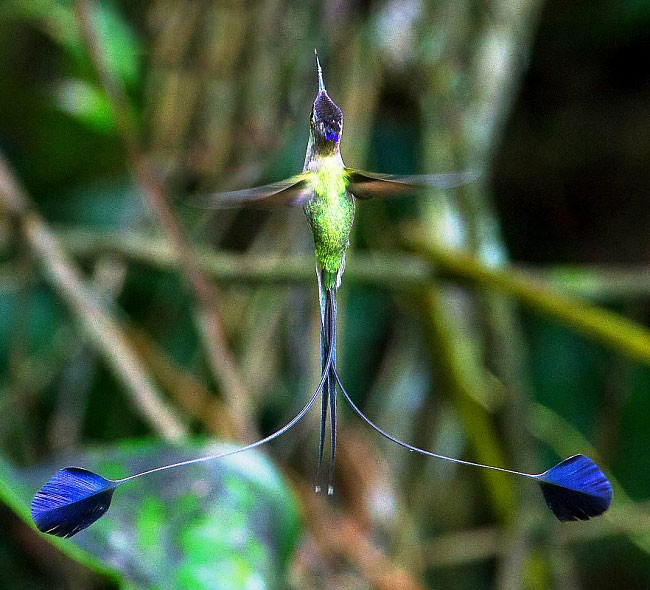
Marvellous Spatuletail by Ian Merrill, arguably the world's most spectacular hummingbird, found only in a few places in Northern Peru.
Philippines
Over 260 endemic birds in a country archipelago slightly smaller than the British Isles, including Palawan Peacock-pheasant, Philippine (Monkey-eating)
Eagle, Philippine Trogon, 11 kingfishers, 11 hornbills, two broadbills, three pittas, four rhabdornises (a unique genus in the starling family), 13
sunbirds and 15 flowerpeckers,a s well as Philippine Tarsier, and the chance to swim with Dugongs, Manta Rays, Whale Sharks and numerous coral reef
fish.
Platte River (Nebraska) - USA
See USA - Nebraska, below.
Point Pelee (Ontario) - Canada
See Canada - Point Pelee (Ontario), above.
Poland
Ancient lowland forest with woodpeckers and bison, and the largest inland wetland left in Europe where White-winged Terns and Aquatic Warblers nest.
Polynesia
Over 35 endemic birds including the unique Tuamotu Sandpiper, as well as lorikeets, fruit-doves, kingfishers, monarchs and reed-warblers, as well as
Bristle-thighed Curlew, lots of seabirds, including Polynesian Storm-petrel, and Common and Little White Terns, in true tropical paradises, from low-lying
atolls to high volcanic islands.
Portugal
Greater Flamingos and Western (Purple) Swamphens in the Algarve, and Iberian Azure-winged Magpies, Cinereous (Eurasian Black) Vultures, bustards and
Black-shouldered Kites in the Alentejo.
Poyang Hu - China
See China - Eastern (Poyang Hu), above.
Prince Edward Islands
This remote, rarely visited archipelago over 1000 miles southeast of South Africa in the subantarctic Indian Ocean has two main islands; Marion and Prince
Edward which support Crozet Shag (also present on nearby Crozet Islands), Black-faced Sheathbill and Kerguelen Tern, as well as possible Gentoo, King,
Macaroni and Southern Rockhopper Penguins. A South African ‘Special Nature Reserve’, activities on the islands are restricted to research and conservation
management and the only human inhabitants are the staff of a research station although it is possible to visit the islands on very occasional
cruises.
Puerto Rico
This small island supports an endemic monotypic bird family (Puerto Rican Tanager) and 15 other endemic birds; a nightjar, two hummingbirds, a
lizard-cuckoo, a tody, a woodpecker, a parrot, a vireo, a euphonia, an oriole, a blackbird, two warblers, a spindalis and a bullfinch, as well as two
species shared with the Virgin Islands only; Puerto Rican Screech-owl and Puerto Rican Flycatcher. The parrot is very rare and unlikely to be seen even
where most of the wild and released birds are, in the Caribbean National Forest (El Yunque) in the Sierra de Luquillo, particularly at Rio Abajo. Other
Caribbean endemics include two more hummingbirds and Eastern Red-legged Thrush while other spectacular species present include White-tailed Tropicbird,
Magnificent Frigatebird and wintering warblers from North America such as Prairie. It is possible to see all of the endemics except the parrot in a few
days hence many birders combine a trip to this island with the Dominican Republic. Other natural wonders include the karst country of the northwest where
there are many similar sized and shaped 100 ft (30 m) high hillocks or mogotes; the Rio Camuy Caves, also in the northwest, one of the largest cave systems
on the planet covering 268 acres (110 ha); and Mosquito Bay on the island of Vieques which at night all year round glows blue-green thanks to the presence
of millions of microscopic phosphorescent dinoflagellates, best experienced while swimming on a cloudy moonless night. The best time to look for birds is
March-April.
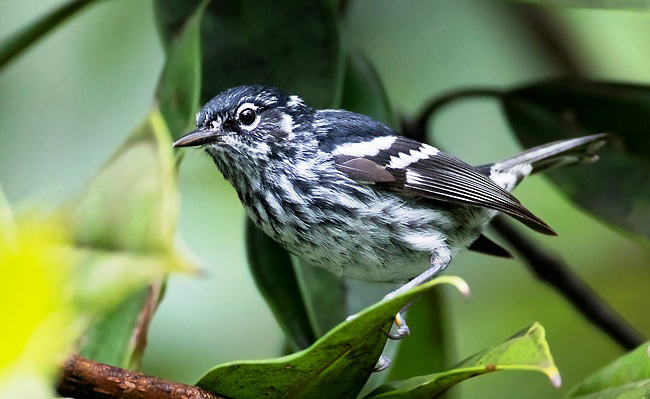
Elfin Woods Warbler at El Yunque by Dubi Shapiro.
Q
Quebec - Canada
See Canada - Quebec, above.
Queensland (Eastern Australia)
See Australia - Eastern, above.
R
Republic of the Congo
See See (Republic of the) Congo, above
Republic of North Macedonia
See Macedonia, above.
Reunion
See Mauritius, Reunion and Rodrigues, above
Rodrigues
See Mauritius, Reunion and Rodrigues, above
Romania
Waterbirds galore in the Danube Delta and along the rest of the Black Sea coast, during summer and on migration, including pelicans and Pygmy Cormorants,
with Wallcreepers and Brown Bears in the Carpathian Mountains.
Russia - Arctic
The richest tundra in the world where hundreds of thousands of swans, geese, ducks, shorebirds, seabirds and other waterbirds nest including Spoon-billed
Sandpiper, Siberian Crane, Ross’s and Sabine’s Gulls, Emperor Goose, and Spectacled and Steller’s Eiders, as well as Gyr Falcon, and Hawk and Snowy
Owls.
Russia - Kamchatka, and the Kuril and Commander Islands
Some of the world's most spectacular seabird colonies, with Horned and Tufted Puffins, and Crested, Parakeet and Whiskered Auklets, other spectacular
birds such as Laysan Albatross and Steller's Sea-eagle, numerous fur seals and sealions, forming one of the greatest concentrations of marine mammals on
Earth, Brown Bears and the chance of Blue, Killer and Sperm Whales.
Rwanda
Read Gorillas in the Mist, the wonderful book by Dian Fossey who carried out most of her research here, try to get some sleep, meet the rangers in
the morning, join a small group of fellow trekkers and head up the switchback trails through the lush, damp, sometimes misty, forest. One to five hours
later you may meet some Mountain Gorillas and the first to emerge from the undergrowth is often the magnificent silverback, and seeing him for the first
time and watching him and his family for the allotted hour, just a few paces away, may well turn out to be your best wildlife experience ever. Birders
may also be interested in the 25 (out of 36) Albertine Rift Endemics present, including Rwenzori Turaco, Neumann’s (Short-tailed) Warbler, Red-collared
Mountain-babbler and Purple-breasted Sunbird.
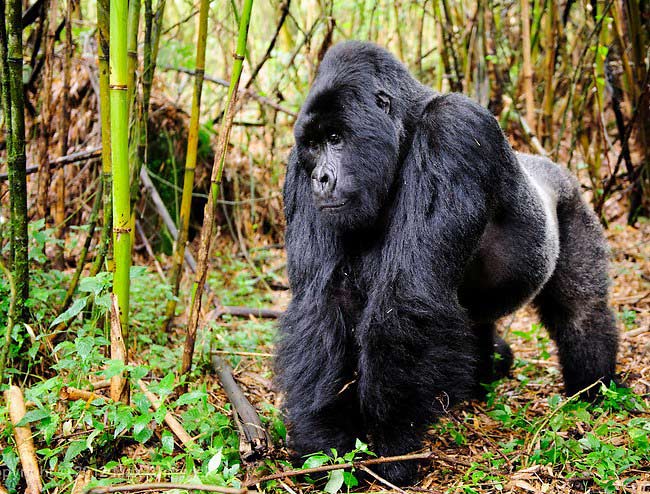
A magnificent silverback Mountain Gorilla in Rwanda by Max Chiswick. Sometimes even fanatical birders have to admit the 'bird-of-the-day' is a mammal.
S
St Lucia
This Caribbean island is just 43 km (27 miles) long and 23 km (14 miles) wide. Its forested slopes support the richest avifauna in the Lesser Antilles
including four endemic bird species; a parrot, an oriole, a warbler and a black finch, with three more possibles; the island forms of Rufous Nightjar,
House Wren and Lesser Antillean Pewee. The last reliable sighting of another endemic, Semper’s Warbler, was in 1961 and there have been no unconfirmed
reports since 2003 so it may be extinct although areas of suitable habitat remain. There are also several Lesser Antillean endemics; Lesser Antillean Swift,
Purple-throated Carib, Lesser Antillean Flycatcher, Scaly-breasted and White-breasted Thrashers, Grey Trembler, Lesser Antillean Euphonia, Lesser Antillean
Saltator and Lesser Antillean Bullfinch, and four more widespread Caribbean endemics; Bridled Quail-dove, Green-throated Carib, Antillean Crested
Hummingbird and Rufous-throated Solitaire. Other spectacular species include Red-billed Tropicbird (most likely at Cape Moule à Chique at the southern tip
of the island), Magnificent Frigatebird and Mangrove Cuckoo. The Des Cartiers Trail in Quilesse Forest Reserve, about two hours south of Anse Chastanet,
is arguably the best forest trail on the island. On boat trips off Soufriere, Fraser's, Spinner and Pantropical Spotted Dolphins are possible and also
offshore there are many coral reef fishes, and Green and Hawksbill Turtles. The best time to look for birds is February-April.
Samoa (Western)
Samoa consists of two large islands (Upolu and Savai’i) and eight islets and supports nine endemic bird species; Tooth-billed Pigeon (which is very rare
and unlikely to be seen), Flat-billed Kingfisher, a honeyeater known as Mao, a whistler, a triller, a fantail, a flycatcher, a white-eye and a parrotfinch,
with three more, Samoan (Crimson-crowned) Fruit-dove, Samoan (Cardinal) Myzomela and Samoan Starling, confined to (Western) Samoa and American Samoa (see
above). Samoan Moorhen is probably extinct. All surviving endemics and near-endemics except the white-eye occur on Upolu where White-tailed Tropicbirds,
Common White Terns and Brown Noddies grace the skies and other landbirds include Pacific Imperial-pigeon, Blue-crowned Lorikeet, Many-coloured Fruit-dove,
Polynesian Wattled Honeyeater, Pacific Robin and Polynesian Starling. Several endemics can be seen at the botanical gardens and in Mount Vaea Scenic
Reserve where Robert Louis Stevenson, author of Treasure Island, is buried. To see the rare white-eye it is necessary to hike high up Mount Silisili from
the village of A'opo on the island of Savai'i. All of the other endemics occur here too. Seawatching may produce Grey-backed Tern, as well as Red-footed
Booby, Great Frigatebird and Black-naped Tern. The best time to look for the endemics is July to September.
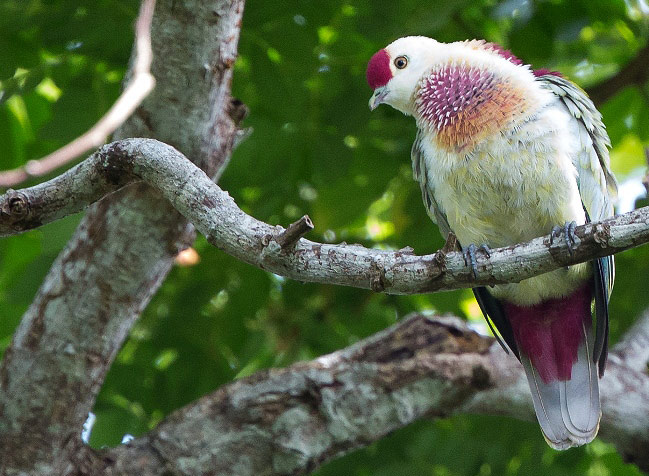
The pretty Many-coloured Fruit-dove can be seen on Samoa, Tonga and Fiji. Image by Simon Colenutt.
Sangihe
See Indonesia - Sulawesi's satellites, above.
São Tomé and Príncipe
These two small islands in the Gulf of Guinea, often included in, or offered as an extension to, tours to Gabon, support 28 endemic bird species and it is
possible to see all of them during a short visit although some are very rare. The hardest to see on São Tomé are Dwarf Ibis, the short-tail and, especially,
the fiscal and grosbeak. All four are most likely to be seen on a camping trip with local guides to the best remaining forest on Monte Carmo/Carvo in the
remote south of the island. The other 14 of the 18 endemics on São Tomé are an olive pigeon (most likely high up on the trail to Lagoa Amelia), a
green-pigeon, a scops-owl, a kingfisher, an oriole, a paradise-flycatcher, a prinia, a white-eye, a speirops, a thrush, two sunbirds and two weavers. Some
taxonomists believe the island forms of Lemon Dove and Chestnut-winged Starling are also endemic, bringing the total for the island to 20. Other birds
present on São Tomé include São Tomé Spinetail and Príncipe Seedeater, both of which are endemic to the two islands, as well as São Tomé (Bronze-naped)
Pigeon which also occurs on the nearby island of Annobon. Príncipe supports eight single-island endemics six of which can be seen around the luxurious
Bom Bom Island Resort which caters mainly for scuba diving and Marlin fishing; a kingfisher, a warbler (thrush-babbler), a speirops, a starling, a sunbird
and a weaver. The tricky ones to see are the white-eye and the thrush and it is necessary to travel by boat to the south of the island to look for these.
Other species present on Principe include the dryas race of Blue-breasted Kingfisher and Grey Parrot, both of which are still relatively 'common', as well
as a possible new species of scops-owl. Boat trips can be arranged to look for seabirds on offshore islets and volcanic plugs, including White-tailed
Tropicbird and Brown Noddy. The best time to visit the islands for birds is July-August. The best time for Green and Leatherback Turtles nesting on the
beaches is December to March.
Sardinia
The coastal lagoons, forests, limestone hills and mountains of this island in the Mediterranean support Barbary Partridge, Audouin’s Gull (Laguna di
Nora in the south hosts the largest breeding colony in Italy), Marmora’s (in low scrub usually above 800 metres) and Moltoni’s (Subalpine) Warblers,
Spotless Starling and Corsican (Citril) Finch (on Monte Albo), as well as Red-crested Pochard, Scopoli’s (Cory’s) and Yelkouan Shearwaters, Greater
Flamingo, Eurasian Griffon, Golden Eagle, Eleonora’s Falcon, Slender-billed Gull, Alpine and Pallid Swifts, European Bee-eater, European Roller,
Dartford and Sardinian Warblers, Common Firecrest, Mediterranean (Spotted) Flycatcher (tyrrhenica), Woodchat Shrike (badius) and Rock Sparrow (on Monte
Sa Pittada). Other wildlife includes the unique endemic cave salamanders with different species in separate mountain ranges, about 35 species of
dragonfly including the endemic Island Bluetail, Copper Demoiselle, and Violet Dropwing, and 25 orchids. The best time for orchids is early April, for
dragonflies early June and for birds late April - early May when migrants pass through.
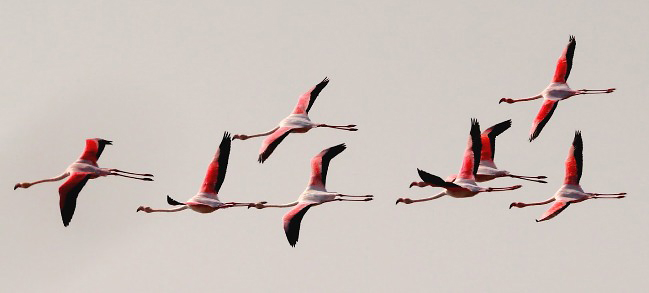
A superb image of flying Greater Flamingoes by Spider.
Saskatchewan - Canada
See Canada - Saskatchewan, above.
Saudi Arabia
The Kingdom of Saudi Arabia is on a migratory flyway and serves as an important resting and refueling stopover for birds moving between Europe, Asia and
Africa. In the east spring migration occurs between mid-February and mid-May usually peaking in April and autumn migration occurs between mid-August and
early November but is less heavy than the spring migration. In the southwest 15 of the 16 Arabian endemic bird species are present; Arabian (Red-legged)
and Philby's Partridges, Arabian (African) Scops-owl, Arabian Woodpecker, Asir Magpie, Yemen Warbler, Yemen Thrush, Arabian and Buff-breasted Wheatears,
Arabian (Shining) Sunbird, Arabian Golden-winged Grosbeak, Arabian Waxbill, Arabian and Yemen Serins, and Yemen Linnet. The only one missing is Yemen
(Radde's) Accentor which is endemic to Yemen. All 15 can be seen in the Abha area of the Asif mountains, connected by air to both Jeddah and Riyadh. Also
present in this region are Arabian Green Bee-eater, Streaked Scrub-warbler, Arabian Warbler, Blackstart, Arabian Golden Sparrow, and Nile Valley and
Palestine Sunbirds, mainly Afrotropical species such as Hamerkop, Spotted Thick-knee, Sooty Gull, Bruce’s Green-pigeon, Grey-headed Kingfisher,
White-throated Bee-eater, Abyssinian Roller, African Paradise-flycatcher and Black Scrub-robin, and, along the Red Sea coast, Crab Plover, and Saunders’s
and White-cheeked Terns.
Scotland - Highlands to Mull
Golden and White-tailed Eagles on the same island of Mull, one of the best places in Britain to see Otters as well, and where it is possible to see
White-tailed Eagles at very close range on boat trips, while the nearby highlands of mainland Scotland support Osprey, Western Capercaillie, Black and
(Red) Willow Grouse, (Rock) Ptarmigan, Eurasian Dotterel and Crested Tit.
Scotland - Outer Hebrides
Corn Crake, Golden and White-tailed Eagles, Hen Harrier, nesting shorebirds and a chance of Otter on some wild islands which are also famous for the
many rare British birds that appear there, especially on the island of Barra.
Scotland - Shetland
Some of the world's most spectacular seabird cliffs, the best place in Britain for nesting Red-necked Phalaropes, other nesting shorebirds, Great Skuas,
Otters and a chance of Killer Whales. During the spring and especially the autumn/fall these islands also host a great variety of rare British birds, some
from America but most from Europe and northern Asia.
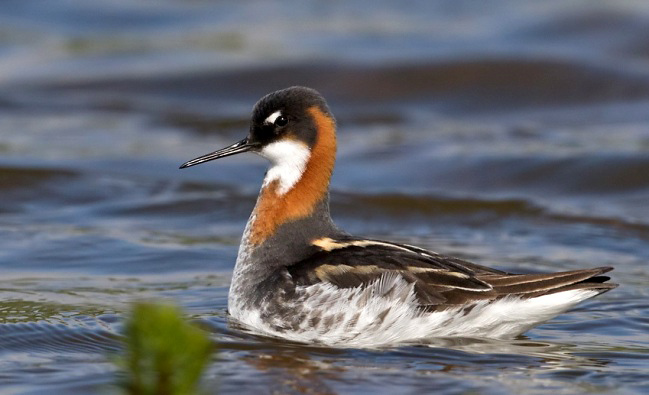
The exquisite Red-necked Phalarope by Lars Petersson.
Scotland - Wester Ross and Handa
The wild northwest region of the Scottish Highlands in the Scourie-Clachtoll-Lochinver-Gairloch area supports Black-throated Diver (Arctic Loon) and
Red-throated Diver (Loon), Golden and White-tailed Eagles, Merlin, Otter and Red Deer, and offshore are the seabird cities of Handa, an island with 123
metre high cliffs accessible by boat from Tarbet with Atlantic Puffins, Common Guillemots (Murres) (over 50,000 birds during the last count in 2016),
Razorbills, (Northern) Fulmars, (Red-legged) Kittiwakes, Arctic Terns and incredibly nearly 300 pairs of Great Skuas. June is the best time to go but
prepare to meet millions of midges.
Senegal
Sahel specialities and other localised spectacular birds such as Quail-plover, Egyptian Plover, Arabian and Savile’s Bustards, Black Crowned Crane, African
Finfoot, Golden Nightjar, Blue-bellied Roller, Sudan Golden Sparrow and the near-endemic Mali Firefinch, huge roosts of Lesser Kestrels and Scissor-tailed
Kites, a great wetland with a colony of Great White Pelicans, and a few large animals including Nile Crocodile, Hippopotamus and a chance of West African
Manatee.
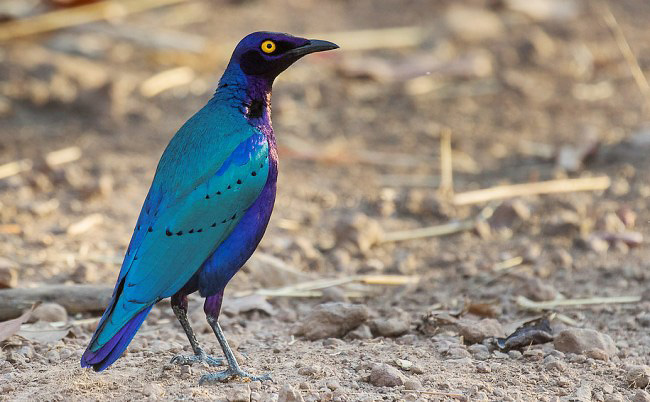
A 'scary dinosaur' Purple Starling by Francesco Veronesi, a bird of the sub-Saharan African savanna belt, from Senegal and The Gambia east to Uganda and far west Kenya.
Seram
See Indonesia - Moluccas, above.
Serbia
This small country about the size of Portugal is mainly flat north of the capital Belgrade where large rivers including the Danube flow slowly across the
Pannonian Plain while to the south there are hills and mountains. The best wetlands include Slano Kopovo NR (20,000 Common Cranes on passage, mostly March
and November, and roosting geese during the winter); Rusanda Nature Park in Melenci (shorebirds and Red-footed Falcon); Beljarica floodplain of the Danube
in Belgrade (nesting Black Stork and White-tailed Eagle); and fish farms along the River Tamis (breeding and migrant waterbirds, and possible wintering
Greater Spotted Eagle). In gorges in the west of the country there are about 140 pairs of Eurasian Griffons (Tresnjica Gorge NR is the nearest
colony to Belgrade and can be visited within a day). In the east Djerdap (Iron Gates) NP along the Danube supports Black and White-backed Woodpeckers,
Eurasian Crag Martin, Sombre Tit, and Ortolan and Rock Buntings. However, perhaps the most famous site for birds in Serbia is the town of Kikinda where in
some winters over 700 Long-eared Owls roost! The best times to visit Serbia are April to May and November to January. In spring/early summer it is also
possible to see Ferruginous Duck, Squacco Heron, Little Bittern, European Bee-eater, European Roller, Collared Flycatcher, Savi’s Warbler, Lesser Grey
Shrike, Rosy Starling (every few years) and Black-headed Bunting. During the winter tens of thousands of geese overwinter, twice as many when the Danube
area is frozen solid, mostly Greylag and Greater White-fronted Geese (half of them at the Labudovo okno Ramsar site at the Danube) with the odd Lesser
White-fronted and Red-breasted Geese. Other winter highlights include Pygmy Cormorant which can be seen year-round but in some winters the Belgrade
population reaches up to 7000, 10% of the regional population.
Seychelles
Twelve endemic birds; a blue-pigeon, a swiftlet, a scops-owl, a kestrel, a parrot (Praslin and Curieuse), a paradise-flycatcher (mainly La Digue and
Denis), a warbler, a bulbul, a white-eye (Mahe and Conception), a magpie-robin, a sunbird and a fody, some of which are very rare and the subject of
long-standing captive-breeding, release and introduction projects, as well as Common White Terns, some large seabird colonies with frigatebirds,
tropicbirds and Sooty Terns, and stunning coral reefs.
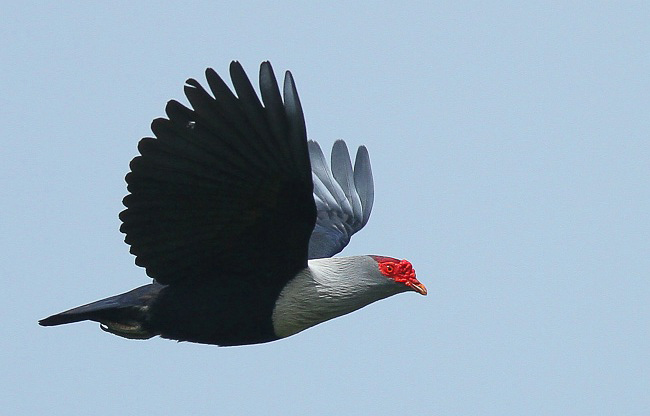
Seychelles Blue-pigeon, one of several endemic landbirds on the Seychelles, by Brian Field.
Shetland - Scotland
See Scotland - Shetland, above.
Sichuan - China
See China - Sichuan, above.
Sicily
This sunny, scenic, rugged island with smouldering Mount Etna, Europe’s largest active volcano which rises to 3350 m (10,991 ft), plateaus, plains,
orchards and coastal marshes is perhaps most famous amongst birders for the spring passage of migrant raptors across the Strait of Messina between Sicily
and mainland Italy. Birds move through from mid-March to May, as many as 40,000 or more of them, mostly European Honey-buzzards, Western Marsh-harriers and
Black Kites but also Pallid Harriers and Red-footed Falcons (mostly late April-early May) and rarities which have included Amur Falcon and Steppe Eagle. The
island also supports the resident endemic whitakeri race of Rock Partridge and a distinctive form of Long-tailed Tit. These birds occur in the interior
Madonie Mountains along with Lanner Falcon, Lesser Kestrel, Rock Sparrow and Rock Bunting. During the second half of April it is possible to see a wide
variety of passage migrant passerines especially on east coast headlands where migrant hot-spots include Capo Murro di Porco where the garrigue-covered
cape provides refuge for birds such as Collared Flycatchers. Seawatching from such places and along the south coast may reveal Scopoli’s (Cory's) and
Yelkouan Shearwaters, and Audouin’s Gull whereas coastal lagoons support a wide variety of waterbirds including Greater Flamingos, Ferruginous Ducks and
passing shorebirds. Common birds include Spotless Starling. Endemic plants include several orchids, such as Archimedes’ Ophrys, Brancifort’s and
Small-flowered Tongue Orchids, and the rare Pale Ophrys, all best looked for in May.
Sierra Leone
All 14 of the Upper Guinea Forest Endemics; White-breasted Guineafowl, Rufous Fishing-owl, Brown-cheeked Hornbill, Western Wattled Cuckooshrike,
White-necked Rockfowl, Sierra Leone Prinia, Sharpe's Apalis, Black-headed Rufous-warbler, Green-tailed Bristlebill, Yellow-bearded Greenbul, Rufous-winged
Illadopsis, Copper-tailed Starling, Nimba Flycatcher and Gola Malimbe, other spectacular birds such as Long-tailed Hawk, Egyptian Plover, Blue-moustached
Bee-eater, Fiery-breasted Bushshrike and Emerald Starling, lots of monkeys, a chance of Chimpanzee and an outside chance of Pygmy Hippopotamus.
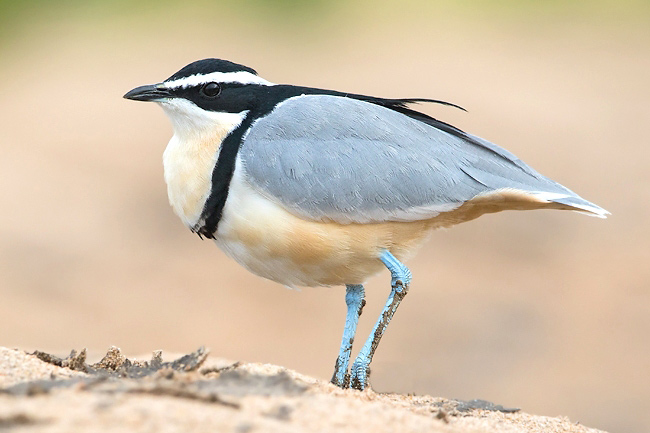
The superb Egyptian Plover by Dubi Shapiro.
Singapore
Singapore is an island city and country, the second most densely populated (behind Monaco) on the planet and yet it is possible to see some very good
birds in this metropolis. Changi International Airport is a massive transit point for people travelling between Southeast Asia, Indonesia and Australasia
and any birders with more than a couple of hours to spare may wish to consider visiting Pasir Ris Park and the Botanic Gardens. Pasir Ris is a small park
with a mangrove boardwalk and bird-viewing tower where it is possible to see, in season, Mangrove Pitta, Black-capped and Collared Kingfishers,
Blue-throated Bee-eater, Laced Woodpecker, Asian Glossy Starling and Copper-throated Sunbird. The botanic gardens are usually very busy with people but it
is still possible to see birds such as Red-legged Crake, Stork-billed Kingfisher and Lineated Barbet, as well as Yellow Bittern, Pink-necked Green-pigeon
and Crimson Sunbird. Not far from the botanic gardens is Bukit Batok Nature Park where Straw-headed Bulbul occurs. In order to leave the airport during
transit passengers will need (i) to request a landing card on-board and present it to immigration on arrival, and (ii) some Singaporean dollars to pay for
taxis, trains and so on. Many birders stay longer, to visit Panti Forest Reserve, 90 minutes or so north in peninsular Malaysia, lowland dipterocarp
rainforest which supports Rail-babbler, as well as Blyth’s Frogmouth, Malay Eared Nightjar, malkohas, Whiskered Treeswift, Rufous-collared Kingfisher,
trogons, hornbills, woodpeckers, Siberian Blue Robin, babblers, broadbills, bulbuls, White-handed Gibbon, and Banded and Dusky Leaf
Monkeys.
Slovakia
This land-locked country of scenic meadows, mountains, forests, canyons, gorges, rivers and waterfalls at the heart of Europe supports Black Grouse,
Black and White Storks, Golden, Eastern Imperial, Lesser Spotted and White-tailed Eagles, Saker Falcon, Corn Crake, marsh terns, nine European
woodpeckers and Eurasian Wryneck, Barred and River Warblers, Northern (Eurasian) Nutcracker and Citrine Wagtail. There is also a chance of seeing Eurasian
Eagle-owl, Eurasian Pygmy-owl, Tengmalm’s (Boreal) and Ural Owls (all especially during the first half of May), as well as Hazel Grouse, Lesser Grey
Shrike, Collared Flycatcher and Wallcreeper.
Slovenia
Slovenia is a small, relatively unspoiled country lying where the Alps meet the Mediterranean with an array of natural wonders including the 21 km
(13 miles) of passages, galleries and halls in the karst limestone Postojna Cave where in a small pool live pink Olms (Proteus anguinus), cave salamanders
endemic to the Dalmatian coast. Breeding birds include White Stork, Golden Eagle, Corn Crake, Ural Owl, Black Woodpecker, Rufous-tailed Rock-thrush,
Northern (Eurasian) Nutcracker, Yellow-billed (Alpine) Chough, Alpine Accentor, White-winged Snowfinch and Rock Bunting, and there is a chance of seeing
Rock Partridge, Rock Ptarmigan, Black and Hazel Grouse, Eurasian Pygmy-owl, Eurasian Three-toed and White-backed Woodpeckers, Wallcreeper and Common
Rosefinch. The alpine mountain slopes and steep-sided valleys thick with pine forests also support a rich flora of over 2900 species, many of which are
restricted to the Julian Alps and include Edelweiss, Illyrian Gladiolus and Transylvanian Orchid. June is the best time to look for birds, flowers and
some of the 181 butterflies recorded in the country such as Common Glider and Spotted Fritillary. In the southern Dinaric Alps region it is possible to
visit specially designed photography hides to view and photograph Brown Bears, most likely in May.
Socotra
This island in the Arabian Sea off the Horn of Africa supports some superb Dragon Tree forests in spectacular scenery where 43 bird species are known to
breed, ten of which are endemic; a scops-owl, a buzzard, a warbler, a cisticola, a starling, a sunbird, two sparrows, a grosbeak and a bunting
(Dixcem Plateau only). Other special birds which occur on and around the island include Jouanin’s Petrel, Persian Shearwater, Socotra Cormorant,
Cream-coloured Courser, Sooty Gull, Saunders’s Tern, Bruce’s Green-pigeon, Nubian Nightjar, Forbes-Watson’s Swift, Socotra (Abyssinian) White-eye (which
also occurs in Somalia), Somali Starling and Cinnamon-breasted Bunting.
Solomon Islands
There are more restricted-range bird species, that is species with ranges of less than 50,000 square kilometres, in the Solomon Islands than anywhere
else on Earth. The number of endemics varies according to taxonomist but there are probably at least 70 and potentially lots more due to the presence
of many subspecies, as well as at least 20 species which otherwise occur only on other islands in Melanesia, notably Bougainville with which The Solomons
shares the likes of Fearful Owl, Sanford’s Sea-eagle, Ultramarine Kingfisher, Solomons (Ducorps’s) Cockatoo and Black-faced Pitta. To stand a chance of
seeing these and all the endemics, visitors will need to take many internal flights and be prepared to sail several times in order to visit Guadalcanal
(where the capital Honiara is situated and there are about ten single-island endemics including a rail and a moustached Kingfisher, the first male of which
was controversially 'collected' in 2015), Rennell (about eight endemics including a parrot and a shrikebill), Makira (16), Malaita (8), Santa Isabel
(an endemic rail as well as several species shared only with Bougainville), the New Georgia Islands including Kolombangara (11 including the flightless
Roviana Rail), and the Santa Cruz Islands at the southeastern end of the long archipelago (seven including Nendo Shrikebill). Three species shared only
with Vanuatu are Santa Cruz Ground-dove, Palm Lorikeet and Rusty-winged Starling. As well as birds, the Arnavon Islands to the northwest of Santa Isabel
support one of the most important rookeries in the west Pacific for Hawksbill Turtle and coral reefs surrounding many smaller islands are rich in marine
life. The best time to look for birds is July to September.
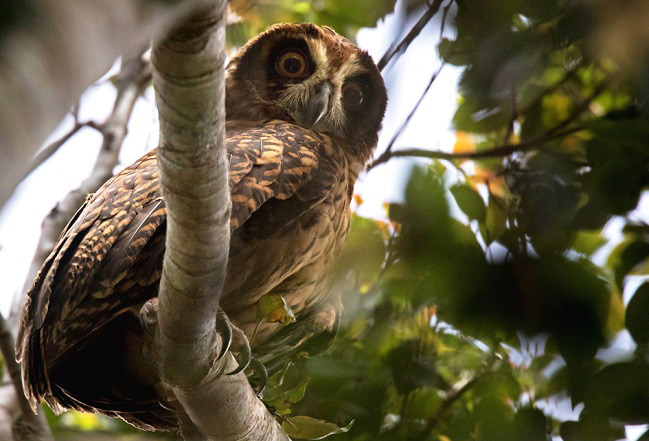
The mythical Fearful Owl on the island of Santa Isabel by Lars Petersson.
Somaliland (Somalia)
The British Foreign and Commonwealth Office usually advise against all travel to Somalia and yet some tour companies insist Somaliland
in northwest Somalia, a former British colony which has since 1991 been separated from the rest of Somalia as the (internationally unrecognized) ‘Republic
of Somaliland’ is a largely peaceful pro-western Muslim country, a largely uninhabited wilderness of beaches, volcanic deserts and juniper forests,
relatively safe to travel in and therefore making it possible to see many birds with restricted ranges even in the Horn of Africa, including Little Brown
Bustard, Collared Lark, Somali Wheatear, Philippa’s (Short-billed) Crombec, Somali Thrush and Somali Starling, as well as Arabian and Heuglin’s Bustards,
Somali Courser, White-cheeked Tern, Somali Bee-eater, Yellow-breasted Barbet, Rufous-capped (Blanford's), Short-tailed and Somali Short-toed Larks,
Red-naped Bushshrike, Somali Fiscal, Abyssinian Wheatear, Dodson’s Bulbul, Arabian Warbler, Somali Crombec, Yellow-vented Eremomela, Nile Valley Sunbird,
Golden-breasted, Magpie, Shelley’s and White-crowned Starlings, Somali Sparrow and Northern Grosbeak-Canary, while mammals include Beira Antelope, Gerenuk,
Dorcas, Soemmering’s and Speke’s Gazelles, Speke’s Pectinator, Caracal, Desert Warthog and Somali Elephant Shrew.
Somalia as a whole has a bird list of 660 or so species of which about 300 are resident and 10 are endemic; Somali Pigeon, Archer’s (Augur) Buzzard, Lesser Hoopoe-lark, Sharpe’s (Rufous-naped) Lark, Somali (Long-billed) Lark, Ash’s Lark, Obbia Lark, Somali Thrush, Somali (Golden-winged) Grosbeak and Warsangli Linnet. Like the rest of the birds and other wildlife, especially those which live in the woods and forests, many are likely to be suffering heavy losses since one environmental group warned, in 2002, that Somalia would be a country without trees if they were cut down at the then rate. Near-endemic birds not listed under Somaliland above include Fischer’s Turaco, Forbes-Watson's Swift, Mombasa Woodpecker, Gillett’s Lark, Malindi Pipit, Pangani Longclaw, Little Yellow Flycatcher, Violet-breasted Sunbird, Long-tailed Fiscal, Arabian Golden and Swainson’s Sparrows, Juba Weaver, Fire-fronted Bishop and Donaldson-Smith’s Sparrow-weaver.
South Africa - Eastern
About 26 of the 38 birds endemic to South Africa, Lesotho and Eswatini including Southern Bald Ibis, Blue Bustard, Knysna Turaco and Drakensberg Rockjumper,
many more of the 140-150 species endemic to Southern Africa such as Bokmakierie, Fairy Flycatcher, Rudd's Apalis and Gurney's Sugarbird, other spectacular
localized birds including Wattled Crane, Taita Falcon and Blue Swallow, many mammals including Lion, Leopard, Cheetah, White and Black Rhinoceroses,
Meerkat and a chance of African Wild Dog, and Whale Sharks, Manta Rays and the Sardine Run offshore.
South Africa - Western
About 27 out of 38 birds endemic to South Africa, Lesotho and Eswatini including Cape Rockjumper, Cape Sugarbird and Orange-breasted Sunbird, other
specialities including many more of the 140-150 species endemic to Southern Africa such as African Penguin, Black Harrier, Blue Crane, Karoo and Ludwig's
Bustards, African Oystercatcher, Hartlaub's Gull and Cinnamon-breasted Warbler, as well as seabirds from pelagic boat trips, Southern Right Whales and
land mammals including a good chance of Aardvark, Aardwolf, Gemsbok and Meerkat, although classic African mammals such as Lion, Leopard and Cheetah are a
long way off the beaten track.
South Georgia
See Antarctica, South Georgia and the Falklands, above.
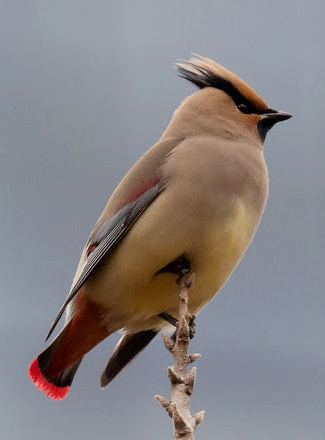
Japanese Waxwing is a winter visitor to South Korea where this image was taken by Simon Colenutt.
South Korea
This small country - slightly smaller than England - is almost as exciting for birds during the cold winters as Japan to the east what with such rare and
range-restricted species as Swan Goose, Falcated and Mandarin Ducks, Baikal Teal (not always present but sometimes in huge flocks), Scaly-sided Merganser,
Oriental Stork, Steller's Sea-eagle, Hooded, Red-crowned and White-naped Cranes, Solitary Snipe, Relict and Saunders's Gulls, Spectacled Guillemot, Ancient
and Long-billed Murrelets, Japanese Pygmy Woodpecker, Japanese Wagtail, Japanese Waxwing, Red-throated Thrush, Varied Tit and lots of buntings including
Pallas's. The best area for cranes is usually Cheorwon where the vast majority forage in the Civilian Control Zone, an area used for farming only and
accessible only with local guides or on local organized tours since it is next to the completely undeveloped Demilitarized Zone on the border with North
Korea. During the summer, after late May-early June, it is possible to see Fairy Pitta in South Korea.
Spain - Extremadura
The best place in western Europe for bustards and raptors, including Great and Little Bustards, Spanish Imperial Eagle, Cinereous (Eurasian Black),
Egyptian and Griffon Vultures, and Black-shouldered Kite, as well as Black-bellied and Pin-tailed Sandgrouse, European Roller and Iberian Azure-winged
Magpie, in some splendid scenery.
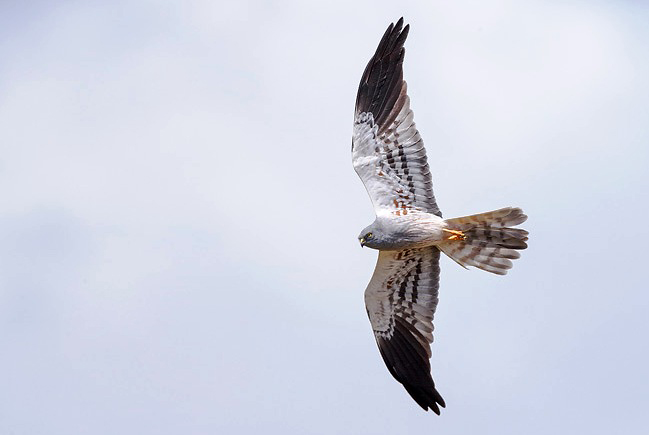
Montagu's Harrier by Michael McKee, one of the many raptors in Spain and a feature of Extremadura.
Spain - Northern
Lammergeier, Wallcreeper, Citril Finch and White-winged Snowfinch in the beautiful Pyrenees.
Spain - Northwestern
A chance of Brown Bear, Wild Cat and Wolf, as well as birds such as Great Bustard, Wallcreeper and White-winged Snowfinch.
Spain - Southern
Waterbirds galore in and around the Coto Donana, the spectacular autumn/fall migration of storks and raptors from Iberia to Africa, and a good chance of
Iberian Lynx.
Spitsbergen (Svalbard)
Polar Bear, Walrus and birds such as Ivory Gull in spectacular settings.
Sri Lanka
Over 30 endemic birds and over 30 shared only with Southern India, including a junglefowl, a frogmouth, two malkohas, a trogon, two flameback woodpeckers,
a blue magpie, a scimitar-babbler, two thrushes and a leafbird, some fabulous wintering birds hard to see elsewhere such as Indian Pitta, Pied Thrush,
Indian Blue Robin and Kashmir Flycatcher, Leopards, lorises, monkeys and a good chance of 'Pygmy' Blue Whale, all based on an island just 434 km (270 miles)
by 225 km (140 miles).
Subantarctic Islands (of New Zealand and Australia)
Millions of marine birds and mammals including King and endemic Royal Penguins, Wandering and Light-mantled Albatrosses, and elephant and fur seals, as
well as endemic ducks, shags and snipes on the Snares, Auckland, Campbell, Antipodes and Bounty Islands.
Sula Islands
See Indonesia - Sulawesi's satellites, above.
Sulawesi and Halmahera
See Indonesia - Sulawesi and Halmahera, above.
Sulawesi's satellites
See Indonesia - Sulawesi's satellites, above.
Sumatra
See Indonesia - Sumatra, above.
Suriname
The largest known lek of gorgeous Guianan Cock-of-the-rocks in the world, the easiest place to see Grey-winged Trumpeters, lots of other spectacular birds
such as Scarlet Ibis, Crimson and Ruby Topazes, Guianan Red Cotinga, Capuchinbird and Blue-backed Tanager, and monkeys and sloths in a small,
sparsely-populated country with a lot of its vast forests remaining.
Swaziland
See Eswatini, above.
Sweden
Sweden is a sparsely populated country so a lot of good habitat remains intact and over 50% of the country is still forested. Conifers dominate the
north but to the south and east there are mixed forests with beech, birch and oak. In south-central Sweden during the cold, snowy winters (especially
early February) and in early spring (mid-April) it is possible to see Great Grey, Northern Hawk, Eurasian Pygmy, Tengmalm's (Boreal) and Ural Owls (all
only likely with local guides), Black, Grey-faced and Eurasian Three-toed (where dying spruce trees harbour Spruce Bark Beetles) Woodpeckers, Siberian Tit,
Siberian Jay and Northern (Eurasian) Nutcracker (both at feeding stations), as well as large numbers of Long-tailed Ducks and Smews along the Baltic coast,
Western Capercaillie, displaying (in spring) Black Grouse, white-headed caudatus Long-tailed Tits, white-breasted and bellied europaea
Eurasian Nuthatches, and Parrot Crossbill, with the additional possibility of Bohemian Waxwings, Arctic (Hoary) Redpolls and Pine Grosbeaks in influx
years, while mammals may include Moose (European Elk) and a darker variant of Red Squirrel.
Most people in search of owls (and bears) visit Finland where Wolverine and Red-flanked Bluetail are also possible but if it's Cranes visitors are after then Sweden is the place to go. During the first half of April 20,000 or so gather at Lake Hornborga (Hornborgasjon) a few hours from Stockholm and in early September the same number come together at Bergslagen, along with up to 20,000 Taiga Bean Geese. This is also a good time to see Elk (Moose) because the bulls have a full rack of antlers ready for the autumn rut. Each autumn about 500 million birds migrate from Scandinavia to Europe and Africa, and four million are recorded annually at Falsterbo, a migration bottleneck at the southern tip of Sweden, a particularly good place to watch migration in action, involving, on good days, usually when a southwest wind blows, big numbers of raptors, (Common) Wood Pigeons and Blue Tits. Birds occurring in smaller numbers include Greater and Lesser Spotted Eagles, and Northern (Eurasian) Nutcrackers. The best time to be at Falsterbo is from late August to October. Up north in southern Lapland the best time to look for Reindeer and birds such as lekking Great Snipe, Long-tailed Skua (Jaeger) and Lapland Bunting (Longspur) is late May-early June. It is also possible to see Brown Bears in Sweden, at night in July, from luxurious purpose-built hides.
The large limestone island of Gotland is a favourite summer holiday destination amongst the Swedish people but it remains remarkably unspoilt. During June it is possible to see Barnacle Goose, Red-necked and Slavonian (Horned) Grebes, Golden and White-tailed Eagles (Gotland has the densest eagle population in Sweden), Montagu’s Harrier, Corn and Spotted Crakes, Common Crane, Ruff, Arctic and Caspian Terns, Thrush Nightingale, Barred, Greenish and River Warblers, Collared and Red-breasted Flycatchers, and Red-backed Shrike, as well as 40-50 species of butterfly in a week, especially on the limestone pavements, and 15-20 dragonflies while the spectacular flora includes 37 of Sweden’s 40 orchids including all three Cephalanthera orchids; Long-leaved, Red and White Helleborines. Half an hour by boat offshore is the one kilometer square Stora Karlsö, an island with the Baltic Sea's largest seabird cliffs where 17,000 pairs of Common Guillemots (Murres), 10,000 pairs of Razorbills, Black Guillemots and fuscus ‘Baltic’ Lesser Black-backed Gulls raise their young. Gotland is also the home of one of if not thee best bird artists, Lars Jonsson, who has a public gallery/museum at Vamlingbo Prästgård in the south of the island.
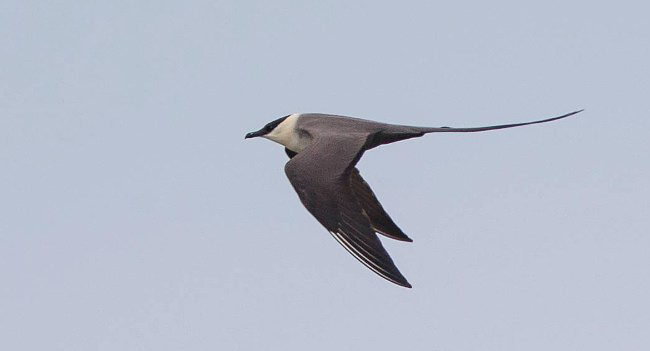
The elegant Long-tailed Skua or Jaeger by Simon Colenutt.
Switzerland
One of the best areas for birds and butterflies in this beautiful country is the Valais region bordering Italy where based in the Val d’Hérens, a Parc
Regional, it is possible to see nearly a hundred butterflies in a week during the second half of June including lots of blues, and birds such as Lammergeier
(Derborence Valley), Golden Eagle, Alpine Swift, European Bee-eater, Northern (Eurasian) Nutcracker, Yellow-billed (Alpine) Chough (tame at the Gornergrat
glacier at 3000m, reached via mountain railway up from Zermatt, where, if visibility is good, the spectacular views include the Matterhorn), Eurasian Crag
Martin, Wallcreeper (Grande Dixence Dam), Red-backed Shrike, White-winged Snowfinch, Alpine Accentor (Gornergrat and Grande Dixence), Citril Finch
(Derborence) and Rock Bunting. Many of these birds occur throughout the country of course along with mammals such as Alpine Marmot, Alpine Chamois and
Alpine Ibex (Grande Dixence). Also in Valais is the Grosser Aletsch Glacier, the largest glacier in the Alps. Other birds present in Switzerland include
the shy and rarely seen Rock Partridge and Rufous-tailed Rock-thrush, with waterbirds at Lac de Neuchatel and the Swiss Bodenssee (Lake Constance)
bordering Austria and Germany. The best place in the Swiss Alps for plants is the Upper Engadine in the far southeast where, in July, there are such
wonders as Globe, Short-spurred Fragrant, Dark Vanilla and Red Vanilla Orchids. Another good places for orchids, especially in late June, is around the
car-free village of Wengen where the mountain pastures contain Burnt, Bird’s-nest and Lady’s Slipper Orchids.
T
Taiwan
This small, mountainous, subtropical island, less than 400 km (250 miles) long and 150 km (100 miles) wide, in the South China Sea, supports 30 endemic
bird species and rising, as taxonomists continue to split island forms of widespread species into full species and on Taiwan there are over 50 more
endemic subspecies! The endemics are Taiwan Partridge, Taiwan Bamboo-partridge, Mikado and Swinhoe’s Pheasants, Taiwan Barbet, Taiwan Blue Magpie,
Chestnut-bellied (Varied) and Yellow Tits, Taiwan Cupwing, Taiwan Grasshopper-warbler, Styan’s Bulbul, Taiwan Yuhina, Black-necklaced and Taiwan
Scimitar-babblers, Grey-cheeked and Taiwan Fulvettas, Taiwan Hwamei, Rufous-crowned, Rusty and White-whiskered Laughingthrushes, White-eared Sibia, Taiwan
(Steere’s) Liocichla, Taiwan Barwing, Taiwan Thrush, Small Vivid Niltava, Taiwan Shortwing, Collared Bush-robin, Taiwan Whistling-thrush, Flamecrest and
Taiwan Rosefinch, while the endemic subspecies include Northern (Eurasian) Nutcracker (owstoni), Maroon Oriole (ardens), Golden Parrotbill (morrisoniana)
and Collared Finchbill (cinereicapillus). Other notables are headlined by the beautiful Fairy Pitta (in the western lowlands) but they also include Malay
Night-heron (which like the pitta is easier to see on Taiwan than anywhere else, even in Taipei Botanical Gardens), Chinese Egret, Black-faced Spoonbill
(hundreds winter in the lowland wetlands of the southwest and many stay on until April) and Japanese Paradise-flycatcher (most likely on the island of
Lanyu). Mammals such as Taiwanese (Rock) Macaque, Taiwan Serow, and Indian Giant Flying and Red-and-white Flying Squirrels are also possible, and other
natural wonders include Taroko Gorge, a narrow chasm with vertical marble walls. The peak time to visit is the second half of April when newly-arrived
Fairy Pittas are most likely to be located although rain and mist are to be expected at this time of the year. July is the peak time to try and see the
endangered Chinese Crested Tern in the Matsu Archipelago accessible by air from Taipei. Due to the rapidly increasing popularity of bird photography across
Asia, be prepared to see some birds in zoo-like conditions, at photographers' 'stake-outs' often complete with screens and many photographers.
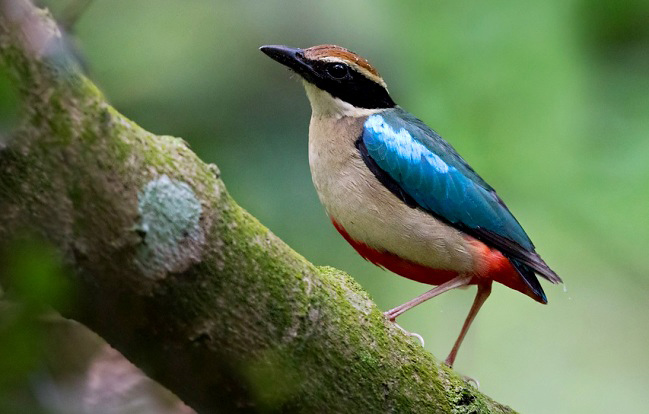
The rare Fairy Pitta near the village of Huben on the island of Taiwan by Lars Petersson.
Tajikistan
This landlocked country, the smallest in central Asia, lying north of Afghanistan, dominated by the Pamir mountain range and rising to 7495 m (24,590 ft)
is sprinkled with spectacular anemones, irises, tulips and so on during the first half of April, not the best time for birds which is late May to early
June when it is possible to see Himalayan Snowcock, Lammergeier, Hill Pigeon, White-winged Woodpecker, Streaked Laughingthrush, Rusty-tailed Flycatcher,
Himalayan Rubythroat, Blue-capped and White-winged (Güldenstädt's) Redstarts, Plumbeous Water-redstart, Variable Wheatear, White-browed Tit-warbler,
Large-billed Reed-warbler (riparian scrub along Panj River near Khorog, the main town in the Pamir mountain range), Sulphur-bellied Warbler,
(Yellow-breasted) Azure Tit, Eastern Rock Nuthatch, Wallcreeper, Great Rosefinch, Plain Mountain-finch, White-winged Grosbeak and White-capped Bunting.
Good birding sites include Iskender Kul, a large alpine lake at 2195 m (7200 ft) north of the capital Dushanbe in the Fann mountain range. Farther
afield the Pamirs are home to Markhor (Darwaz Mountains near border with Afghanistan), Marco Polo Sheep, Ibex, Urial Sheep and Snow Leopard which is most
likely to be seen during the winter when they venture lower down, but all large animals are very shy due to hunting.
Talaud
See Indonesia - Sulawesi's satellites, above.
Taliabu
See Indonesia - Sulawesi's satellites, above.
Tanimbar Islands
See Indonesia - Lesser Sundas, above.
Tanzania - Northern
The greatest diversity and numbers of large mammals on Earth make this A Top Ten Destination, with over a million Blue Wildebeest,
over a quarter of a million Thomson's Gazelles and about 200,000 Burchell's Zebras, as well as their predators, including Lion, Leopard, Cheetah, Spotted
Hyaena and, possibly, African Wild Dog, at the right time of year, and lots of iconic open-country African birds, in landscapes to match, not least the
Serengeti and Ngorongoro Crater.
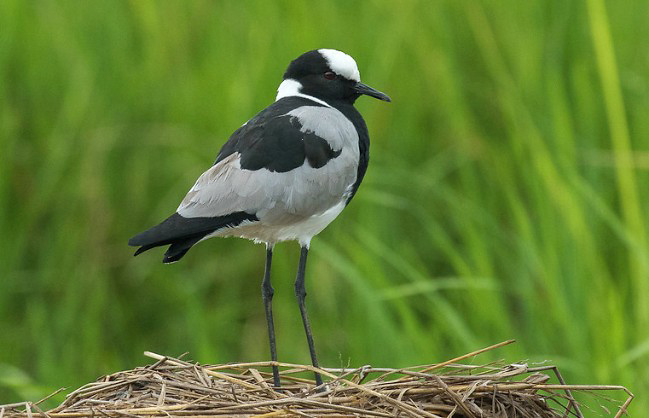
The noisy Blacksmith Plover, widespread in Africa south from Kenya, by Francesco Veronesi.
Tanzania - Southern
Many mammals including African Wild Dogs in some of the most extensive wildest places left on Earth.
There are 35 endemic bird species on mainland Tanzania, with four more on Pemba Island. Widespread endemics include Grey-breasted Francolin (Spurfowl), Tanzanian Red-billed Hornbill, Emin's (D'Arnaud's) Barbet, Yellow-collared Lovebird and Ashy Starling, while Beesley's Lark and Kilimanjaro White-eye have more restricted ranges in the north. The most endemics (20) occur off the beaten track in isolated mountain ranges of Eastern Tanzania known as the Eastern Arc Mountains and they are Rubeho and Udzungwa Forest-partridges, Usambara Eagle-owl, Uluguru Bushshrike, Usambara Hyliota, Long-billed Forest-warbler (Tailorbird) (east Usambaras), Rubeho (Rubeho-Ukaguru Mountains) and Winifred’s (Udzungwas and Ulugurus) Warblers, Uluguru and Yellow-throated (Udzungwas, Ukagurus and Ngurus) Mountain Greenbuls, Montane Tiny (Usambara) Greenbul (Usambaras, Ngurus and Nguus), Usambara Thrush, Iringa, Rubeho and Usambara Akalats, Banded, Loveridge’s (Ulugurus), Moreau's and Rufous-winged (east Udzungwas) Sunbirds, and Usambara Weaver (Usambaras, Ulugurus and Udzungwas). To look for these birds it is best to head for Chome Forest Reserve in the South Pare Mountains; the forest above Lushoto in the West Usambara Mountains; Amani Forest Camp and Kihuwi-Sigi Nature Reserve in the East Usambara Mountains where Usambara Eagle-owl, the rare Dapple-throat, Green-headed Oriole, Usambara Hyliota, Long-billed Forest-warbler, Kretschmer's Longbill, and Banded and Uluguru Violet-backed Sunbirds occur; the Uluguru Mountains where White-winged Apalis, Green Barbet, Uluguru Bushshrike, Uluguru Mountain Greenbul, Chapin’s Apalis, Winifred's Warbler, Orange Ground-thrush, Loveridge’s Sunbird and Bertram’s Weaver occur; and the Udzungwa Mountains National Park for White-winged Apalis, Bar-tailed and Narina Trogons, Yellow-throated Woodland-warbler, Iringa and Sharpe’s Akalats, Rufous-winged Sunbird, Kipengere Seedeater and Oriole Finch, with a chance of Dapple-throat, Swynnerton’s Robin and White-chested Alethe, as well as Iringa Red Colobus, Sanje Mangabey, and Gentle and Kipunji Monkeys.
Tasmania
See Australia - Southeastern, above.
Texas
See USA - Texas, below.
Thailand - Northern
Northern Thailand is very different from the rest of the country. Mountain ranges support a more Himalayan avifauna and montane specialities at sites such
as Doi Chiang Dao, Doi Ang Khang, Doi Inthanon and Doi Lang include Mrs Hume’s Pheasant and Giant Nuthatch, as well as Rufous-naped Pitta, Crested
Finchbill, Scarlet-faced Liocichla and Spot-breasted Parrotbill. There is even a chance of Black-tailed Crake, Hodgson's Frogmouth (most likely in April)
and Green Cochoa while other spectacular species present include Collared Falconet, Blossom-headed Parakeet, Black-headed Woodpecker, Long-tailed and
Silver-breasted Broadbills, Rufous Treepie, Common Green Magpie, Slaty-bellied Tesia, Silver-eared Mesia, Pygmy Cupwing, Spot-winged Grosbeak, and Gould's
and Green-tailed Sunbirds (endemic angkaensis subspecies on Doi Inthanon). Some birds, especially shy, skulking, ground-dwelling, forest birds are much
easier to see than they once were thanks to the popularity of bird photography in East Asia; the photographers have set up 'feeding stations' where
mealworms are provided. In the lowlands nearby it is possible to see the rare Green Peafowl at Huai Hong Khrai. December to March is the best time to
visit, when resident species are joined by wintering birds from northeast Asia.
Thailand - Southern
Spectacular localized birds such as Siamese Fireback, Coral-billed Ground-cuckoo, Nicobar Pigeon, Malay Banded Pitta and Rail-babbler, wintering shorebirds,
not least Spoon-billed Sandpiper and Spotted Greenshank, and a long list of fabulous South-East Asian birds including trogons, kingfishers, bee-eaters,
barbets, broadbills, pittas, hornbills, leafbirds, babblers and sunbirds, as well as the chance of White-handed Gibbon.
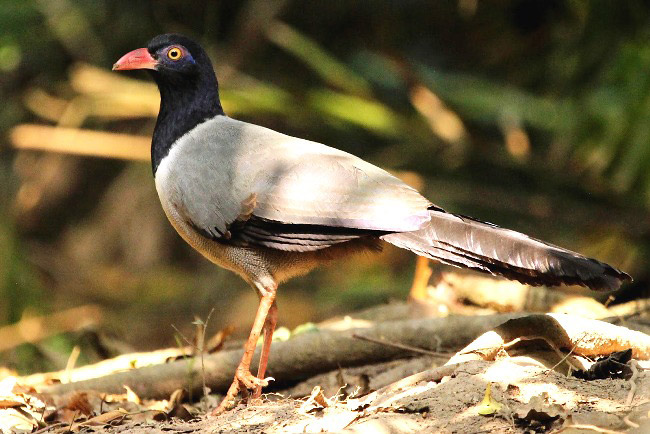
An extraordinary Coral-billed Ground Cuckoo in Khao Yai National Park, Southern Thailand, by Spider.
Tibet
Rare high-altitude birds including Przevalski’s Rosefinch or Pinktail, which is in a family all of its own, Blue and Tibetan Eared-pheasants, Black-necked
Crane, Tibetan Sandgrouse, Snow Pigeon, Ala Shan Redstart, Crested and White-browed Tit-warblers, Ground Tit, Giant Babax, snowfinches, rosefinches and
Tibetan Bunting, with more widespread spectacular species such as Bar-headed Goose, Lammergeier, Ibisbill, Pallas’s Sandgrouse and Wallcreeper, and mammals
such as Tibetan Wild Ass and a chance of wild Yak and 'Tibetan' Wolf, all in some phenomenal scenery, on and around the rolling plains of the Tibetan
Plateau, average height 4500 m (15,000 ft)!
Timor/(Democratic Republic of) Timor-Leste
The island of Timor is the largest and geographically most ancient of the Lesser Sundas islands of eastern Indonesia although the lowland forests and
scrub resemble northern Australia which is not far away to the south. There are nine birds endemic to this island; a boobook, two honeyeaters, a friarbird,
a myzomela, a bushbird, a white-eye, a flycatcher and a flowerpecker, and a lot more shared with neighbouring islands such as Alor, Rote and Wetar
including a stubtail, a blue-flycatcher, a bushchat and a thrush. It is usually possible to see most endemics and near-endemics in West Timor (Indonesia)
but Timor Green-pigeon and Iris Lorikeet are more likely to be seen in the east because they are so heavily hunted in the west, and the endemic race of
Pheasant Coucal occurs only in East Timor. The lorikeet occurs in the hills above the capital Dili along with Olive-headed Lorikeet, Yellow-crested
Cockatoo, Timor Imperial-pigeon, Timor Stubtail, Buff-banded Bushbird, Flame-eared Honeyeater, Black-breasted Myzomela, Spot-breasted and Warbling
White-eyes, and Timor Flowerpecker. Nino Konis Santana National Park at the far eastern end of the island is the place for Timor Green-pigeon and Pheasant
Coucal, as well as Yellow-crested Cockatoo (the park probably supports the largest remaining population of this critically endangered bird), Black
Cuckoo-dove, Timor Boobook, Cinnamon-banded Kingfisher, Black-banded Flycatcher, Timor Blue-flycatcher, Timor Stubtail, Timor Oriole, Timor Figbird and
Flame-breasted Sunbird. Water bodies such as Lake Iralalaro support many Australasian species such as Australasian Darter, Pied Heron and Rainbow
Bee-eater, as well as Saltwater Crocodiles.
Togian (Togean) Islands
See Indonesia - Sulawesi's satellites, above.
Tonga
Tonga is one of the few places in the world where it is possible to swim with Humpback Whales. Several operators run carefully organized tours within
the Vava'u Islands when the whales are usually present from mid-July to late October, during the dry season. The endemic Tongan Whistler occurs only
in the same island group, on A'a, 'Euakafa, Kapa, Pangaimotu, ‘Utungake and 'Uta Vava'u, as well as on the island of Late in northern Tonga. To see the
other endemic bird, Tongan (Niuafoou) Scrubfowl, it is necessary to fly to the northernmost island of all, Nuiafo'ou, where the birds can be seen at
communal nesting grounds. Neither of the two endemic birds occur on the main island, Tongatapu, but birds such as Many-coloured Fruit-dove, Polynesian
Wattled Honeyeater, Polynesian Triller and Polynesian Starling can be seen in and near the capital Nuku'alofa. From the main island it is possible to travel by ferry to the island of
'Eua where seabirds such as White-tailed Tropicbirds, Common White Terns and Grey Noddies nest. The best time to look for birds is July to
September.
Trinidad and Tobago
Some fine birds including the endemic Trinidad Piping-guan and Trinidad Motmot, the near-endemic White-tailed Sabrewing, and more widespread species such
as Red-billed Tropicbird, Magnificent Frigatebird, a large roost of Scarlet Ibises, a cave colony of Oilbirds, Ruby Topaz and Bearded Bellbird, as well as
nesting turtles and coral reef fish.
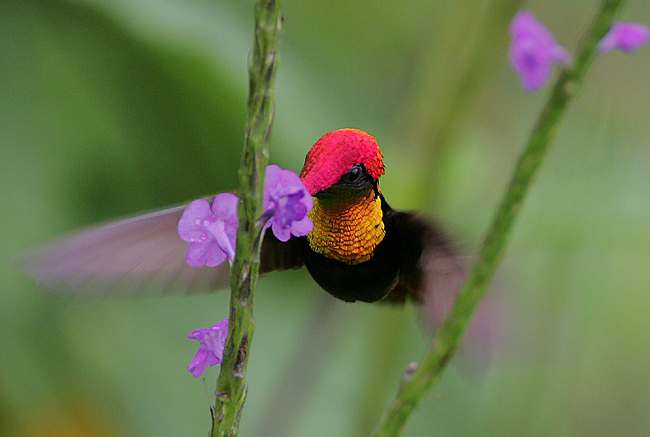
A male Ruby Topaz hummingbird on the island of Trinidad by Steve Garvie.
Tunisia
This is one of Africa’s most wealthy and developed countries, and one with a wide range of habitats despite being only about 800 km from north to south and
300 km from west to east, with coastal wetlands, vast olive groves, central steppes and mountains, and Sahara Desert, in a climate which is hot and dry
from May to September but rather cold and wet from November to March, the best month to visit to search for species such as Yelkouan (Balearic) Shearwater
(Cap Bon), Barbary Partridge, Marbled Teal, White-headed Duck, Greater Flamingos (two thirds of the Mediterranean population winters in Tunisia, mainly in
the Gulf of Gabes), Long-legged Buzzard, Peregrine (Barbary) Falcon, Eurasian Dotterel (wintering in Jebil NP), Cream-coloured Courser, Audouin’s Gull
(Cap Bon), Black-bellied, Crowned, Pin-tailed and Spotted Sandgrouse, Egyptian and Red-necked Nightjars, Maghreb (Levaillant’s) Green Woodpecker,
Greater Hoopoe-lark, Bar-tailed, Temminck’s and Thick-billed Larks, Black-crowned Tchagra, Moussier’s Redstart, Black, Buff-rumped and White-crowned
Wheatears, African Desert, Spectacled and Tristram’s Warblers, Fulvous Babbler, Spotless Starling and Desert Sparrow (Jebil NP). Endangered North African
mammals include Addax, Scimitar-horned Oryx, Dama and Dorcas Gazelle, and the hamster-like Gundi, all of which occur in Bou Hedma NP.
Turkey
Some of the most exciting birding in the Western Palearctic, but Turkey is a huge country and to see all of its best birds it would be necessary to
travel hundreds of miles, so most visitors opt to cover certain areas. The Bosphorus, especially in September, is a great place to watch the visible
migration of tens of thousands of raptors including Lesser Spotted Eagles and Levant Sparrowhawks, along with huge numbers of White Storks and some
Black Storks, on their way from Eurasia to Africa. The narrow strait between Europe and Asia is also regularly traversed by Yelkouan (Balearic)
Shearwaters. In southwest (as well as southern and eastern) Turkey it is possible to see the likes of Dalmatian Pelican (Lake Karine near Bafa),
Spur-winged Lapwing, White-breasted (Smyrna) Kingfisher (scarce in the Dalyan Delta), Finsch’s Wheatear (Pamukkale area), White-throated Robin,
Olive-tree (Pamukkale area), Eastern Orphean and Rüppell's Warblers, Sombre Tit, Krueper's and Western Rock Nuthatches, Masked Shrike, Black-headed,
Cinereous (Pamukkale area) and Cretzschmar's Buntings, and Red-fronted Serin (Gulubeli Pass, east of Dalaman). The south coast is famous for the
(Western) Brown Fish-owls at Oymapinar Barrage/Reservoir near Antalya and the chance of seeing the very elusive 'Lilford's' White-backed Woodpeckers
at Akseki. East from there is where most of the regionally-endemic (or breeding-endemic) Western Palearctic specialities are though, including
Caspian Snowcock, Radde's Accentor and Eurasian Crimson-winged Finch at Mount Demirkazik (along with Wild Goat (Bezoar Ibex) and Asia Minor Souslik).
Caspian Snowcock and Caucasian Grouse occur in the far northeast near Sivrikaya and to the south it is possible to see Grey-necked Bunting and
Mongolian Finch at Dogubeyazit.
The British Foreign and Commonwealth Office usually advise against travelling to areas near the border with Syria and parts of southeast Turkey, a dangerous region and Western Palearctic birding hotspot which includes the Birecik area. It was once a good place to see See-see Partridge, Pallid (Striated) Scops-owl, Pied Kingfisher, Blue-cheeked Bee-eater, Menetries's Warbler, Iraq Babbler, Desert Finch, Dead Sea and Pale Sparrows, and Chestnut-shouldered Bush-sparrow (Yellow-throated Sparrow), along with a feral colony of Northern Bald Ibises, and Red-wattled Lapwing near Batman to the east. The best time to look for most birds in Turkey is May.
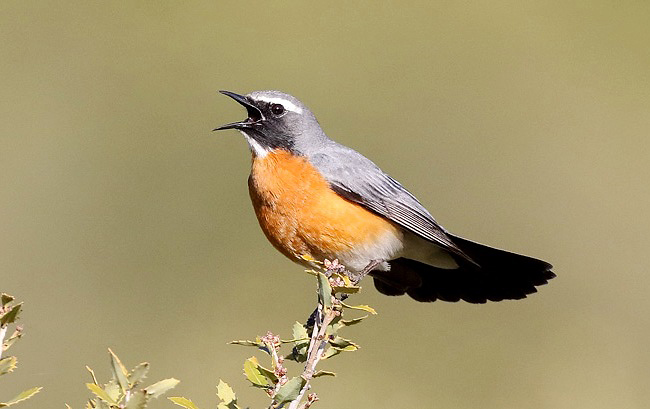
A singing male White-throated Robin at Seki in Turkey by Michael McKee.
Turkmenistan
This country of mainly black sand desert east of the Caspian Sea between Kazakhstan to the north and Afghanistan and Iran to the south, supports the
near-endemic Turkestan (Pander's) Ground-jay and Zarudny’s (Desert) Sparrow (both in the Turkmenabat region), as well as Caspian Snowcock, See-see
Partridge, Lammergeier, Asian Houbara (Macqueen’s) Bustard, White-tailed Lapwing, Black-winged Pratincole, Yellow-eyed Pigeon, Pallid Scops-owl,
Egyptian Nightjar, Blue-cheeked Bee-eater, White-winged Woodpecker, Pied Bushchat, Finsch’s, Red-tailed and Variable Wheatears, Streaked Scrub-warbler,
Asian Desert, Menetries’s and Sykes’s Warblers, Plain Leaf-warbler, Black-headed and White-crowned Penduline-tits, Eastern Rock Nuthatch, Bimaculated
Lark, Radde’s Accentor, Rosy Starling, Saxaul Sparrow, Pale Sparrow, White-winged Grosbeak, and Grey-necked and Red-headed Buntings. May is a good
time for birds and some of the best sites are the Karakum (Black Sand) Desert, the Amu-Darya, Murgab and Tejen river valleys, the Kopet Dag ('Many
Mountains'), and the Kugitang Mountains in the Tien Shan.
Turks and Caicos Islands
This UK Overseas Territory is a small archipelago of low-lying islands and cays south of the Bahamas in the Caribbean. It supports 58 native breeding
birds including important colonies of gulls, terns and other seabirds (mainly April to July) such as White-tailed Tropicbird, Magnificent Frigatebird
and Brown Noddy. For example, Big Sand Cay has a colony of Sooty Terns, as well as Hawksbill Turtles. Other birds present include West Indian
Whistling-duck, Reddish Egret, Greater Flamingo, Key West Quail-dove, Antillean Nighthawk (mainly May-Aug), the near-endemic Bahama Woodstar, Thick-billed
Vireo, Bahama Mockingbird, Pearly-eyed Thrasher, Cuban Crow, Western Spindalis and Greater Antillean Bullfinch, while 110 regular passage migrants and
winter visitors include Piping Plover and Kirtland’s Warbler. Humpback Whales migrate south through the islands in January to March, on their way to the
Silver Bank, north of the Dominican Republic.
U
Uganda
This small country is packed with people and wildlife, and a A Top Ten Destination where it is possible to spend an hour with
Mountain Gorillas, possibly the ultimate wildlife experience, another hour with Chimpanzees, also possibly the ultimate wildlife experience, see lots
of monkeys and many birds in what is, for its size, the richest country in Africa for birds, over a thousand species in all, including Shoebill,
Green-breasted Pitta and 24 of the 36 Albertine Rift Endemics, including Grauer's Broadbill, Black-faced Apalis, and Blue-headed, Purple-breasted and Regal
Sunbirds.
Ukraine
Demoiselle Cranes, Great Bustards, and Red-footed and Saker Falcons on feather grass steppes, and waterbirds in the Danube Delta region, including
Dalmatian and Great White Pelicans, Pygmy Cormorant, Pallas's (Great Black-headed) Gull, and passage migrant shorebirds and terns.
United Arab Emirates
A midwinter trip to the city parks, dairy farms, fodder fields, deserts, rocky mountain ridges, coastal mudflats and beaches of this safe, accessible
Middle Eastern country offers a fine selection of birds that includes Arabian and Sand Partridges, Socotra Cormorant, Indian Pond-heron, Eastern Imperial
Eagle, Grey-headed Swamphen, White-tailed Lapwing, Crab Plover, Cream-coloured Courser, Great Knot, Pallas's (Great Black-headed) and Sooty Gulls,
Chestnut-bellied and Lichtenstein’s Sandgrouses, Pallid Scops-owl, Pharoah Eagle-owl, Egyptian Nightjar, ('Arabian' kalbaensis) Collared Kingfisher,
Arabian Green Bee-eater, Indian Roller, Black-crowned Sparrow-lark, Greater Hoopoe-lark, Bar-tailed and Bimaculated Larks, Oriental Skylark, Pale Rock
Martin, Hooded, Hume’s, Red-tailed (Persian) and Variable Wheatears, Streaked Scrub-warbler, Plain Leaf-warbler, Arabian Babbler, Long-billed Pipit and
Striolated Bunting with a chance of Hypocolius. During the 'summer', mainly April to August, Persian Shearwater, and Bridled, Saunders's and White-cheeked
Terns may be seen.
Uruguay
This country’s coastal wetlands, grasslands and forested low mountains support a wide range of birds, the rarest in global terms being Greater Rhea,
Buff-breasted Sandpiper, Straight-billed Reedhaunter, Black-and-white Monjita, Chestnut, Dark-throated and Marsh Seedeaters, Yellow Cardinal,
Pampas Meadowlark and Saffron-cowled Blackbird although the wider list includes Spotted Nothura, Great Grebe, Black-necked and Coscoroba Swans, Chilean
Flamingo, Maguari Stork, Southern Screamer, Cinereous and Long-winged Harriers, Red-legged Seriema, Giant Wood-rail, Wattled Jacana, Snowy-crowned Tern,
Nacunda Nighthawk, Guira Cuckoo, Gilded and White-throated Hummingbirds, White and White-spotted Woodpeckers, Sulphur-bearded Spinetail, Firewood-gatherer,
Curve-billed Reedhaunter, Streamcreeper, Southern Rufous-capped Antshrike, Spectacled Tyrant, White Monjita, Glaucous-blue Grosbeak, Black-and-rufous
Warbling-finch, Long-tailed Reed-finch and Scarlet-headed Blackbird, many of which can be seen within a day or two of the capital Montevideo along the
coast of the Rio de la Plata and Atlantic, especially at Laguna de Rocha which has the highest known wintering population of Buff-breasted Sandpipers in
South America, and the far eastern coastal strip and wetlands in a Ramsar Site known as Banados del Este where Black-and‐white Monjita, Yellow Cardinal,
Saffron-cowled Blackbird and several species of seedeater occur. Lying south of the equator the best time to visit is probably during October-November;
the southern spring. Most rain usually falls during the autumn and winter.
USA - Alaska
Millions of seabirds and fur seals on the Pribilof Islands; one of the greatest concentrations of birds and mammals in the world, as well as the endemic
McKay's Bunting, other spectacular localised birds such as Emperor Goose, Spectacled and Steller's Eiders, Red-faced Cormorant, Red-legged Kittiwake,
Aleutian Tern, and nesting shorebirds such as Bristle-thighed Curlew and Rock Sandpiper, as well as Grizzly Bears, Killer Whales, Musk Ox, Moose and Sea
Otters, with a chance of Polar Bear at Barrow where, in autumn/fall, it is also possible to see many Ross's Gulls.
USA - Southeast Alaska
A chance to see Humpback Whales bubble-net feeding, as well as Grizzly Bears fishing, and Black Bears, amongst the mountains, glaciers, fjords and
temperate rainforests of wild northwest America.
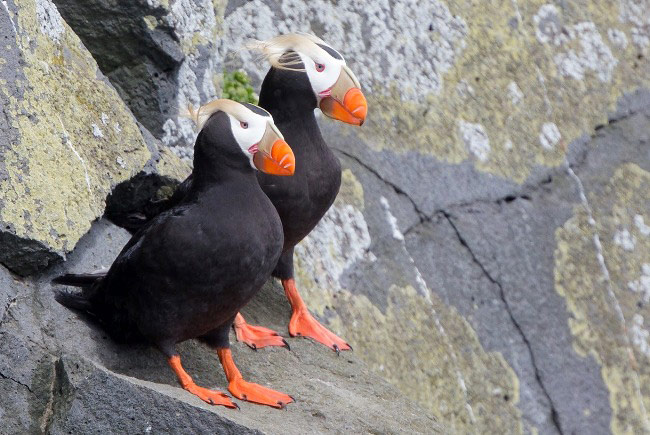
Tufted Puffins are easy to see on the Pribilof Islands of Alaska. Image by Simon Colenutt.
USA - Arizona (Southeast)
A greater variety of breeding birds than any other area of comparable size in the United States; about 190 species in total including over ten species of
owl, lots of hummingbirds, Coppery-tailed (Elegant) Trogon, Painted Redstart, and Grace's, Olive and Red-faced Warblers, mostly replaced in winter by
Sandhill Cranes, Mountain Plovers, raptors and sparrows, all half a day by road from Tucson.
USA - Arkansas
The small state of Arkansas, north of Louisiana, is home to birds such as Red-cockaded Woodpecker, Brown-headed Nuthatch and Bachman’s Sparrow, all
three of which occur together at some sites in the southern half of the state including the Ouachita National Forest near Waldron where other breeding
birds include Greater Roadrunner, and Kentucky, Pine and Prairie Warblers. In the far north of the state next to Missouri are the limestone hills and
mountains of the Ozarks which support 18 species of breeding warblers, most of which are best looked for when they are singing, especially during the
middle two weeks of May. One of the best areas is the upper Buffalo River near Harrison from Lost Valley to the springs at Mountain View where the
bottomlands and valleys support Cerulean, Hooded and Kentucky Warblers, as well as Bald Eagle and Wood Thrush. Another good birding site in the far north
is Mammoth Spring State Park near Hardy where Wood Duck, Red-headed Woodpecker and Warbling Vireo occur.
USA - Bosque del Apache, New Mexico
Up to and sometimes above 20,000 wintering Snow Geese and thousands of Sandhill Cranes in one of the most impressive gatherings of birds in the world.
USA - California (Northern)
The best chance of Bobcat in the world, a good chance of Blue and Humpback Whales, as well as Northern Elephant Seal and Sea Otter, with the fine
selection of birds including Black-footed Albatross, the reintroduced California Condor, the state endemic Yellow-billed Magpie, the near-endemic Allen's
Hummingbird, and California Thrasher, all in one of the most scenic places on Earth, not least Yosemite Valley, with the tallest trees in the world (Coast
Redwoods), the largest trees in the world (Giant Sequoias) and the oldest trees in North America (Bristlecone Pines).
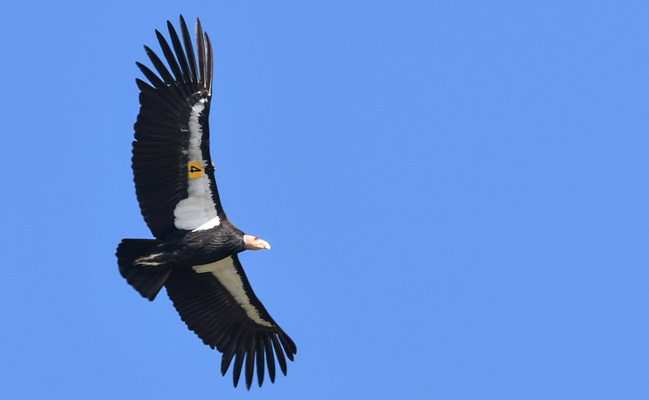
The USFWS recorded a population of 268 California Condors living in the wild in December 2015, many of them in California where they are being reintroduced into the mountains north of Los Angeles and the Big Sur area of the central coast. Image by Chris Townend.
USA - California (Southern)
A wide range of habitats in a small, often scenic, area means Southern California is a top birding destination. Mountains, pine-oak woods, chaparral,
deserts, shoreline and ocean combine to support a great diversity of birds including two endemics (Island Scrub-jay and Yellow-billed Magpie) and
several specialities; Black-vented Shearwater (off La Jolla Cove), Brown Booby (on cliffs at La Jolla - now breeding on Los Coronados Islands south of
San Diego), Scripps’s (Xantus's) Murrelet, Yellow-footed Gull, Allen’s Hummingbird, Nuttall’s Woodpecker, California Thrasher, California Gnatcatcher
(San Elijo Lagoon Ecological Preserve), Wrentit, the nomadic Lawrence's Goldfinch, California Towhee and Tricoloured Blackbird, while other spectacular
species include Heermann's Gull, Black Skimmer, Burrowing Owl and Greater Roadrunner. The best times to look for these birds are late April-early May and
during the winter when there are thousands of Snow Geese (with Ross's Geese), hundreds of Sandhill Cranes and lots of Mountain Plovers around the southern
end of the Salton Sea which is the only regular location for Yellow-footed Gull in the United States, although they are rare in winter (numbers usually
peak during late summer). 'Desert' Bighorn Sheep occur in Anza-Borrego SP along with Dulzura and Merriam's Kangaroo Rats.
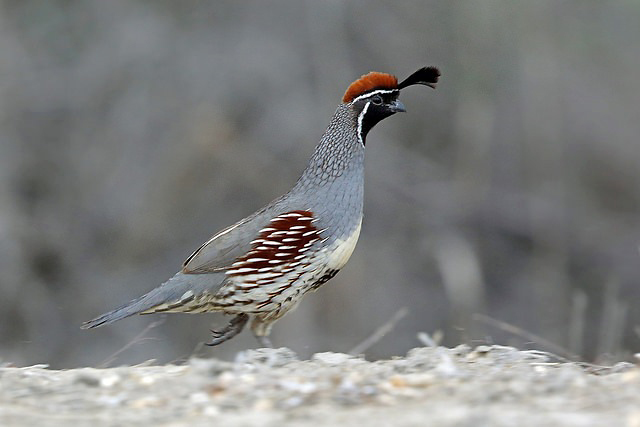
Gambel's Quail at Grand Junction, Colorado, by Nigel Voaden. This great bird can be seen in the desert scrublands of Colorado, Utah, Nevada, California, Arizona, New Mexico, Texas and northwestern Mexico.
USA - Cape May, New Jersey
Cape May is one of the best places on Earth to experience visible bird migration. During the autumn/fall birds from a huge area of northern North America
pass through this peninsula at the southern end of the state of New Jersey, 160 miles south of New York, before continuing south. Small bird migration
usually peaks during the middle two weeks of September and the main period of migration for all species usually lasts between mid-September and
mid-October and includes waterbirds, shorebirds, raptors, warblers, vireos, sparrows and buntings. They may occur in astonishing numbers if there has been
a 'fallout', usually after wet cold fronts sweep across the cape from the northwest. During such times there are also likely to be lots of Yellow-shafted
Flickers, Blue Jays and Tree Swallows, and plenty of Belted Kingfishers, while the freshwater and saltwater marshes and beaches also support a few Bald
Eagles and hundreds of Black Skimmers. The best sites, crowded with birders during peak season, are Higbee Beach WMA (especially for passage migrant
passerines early morning, in what is known as the 'morning flight' when nocturnal migrants flit north and west over the dike in search of roosting and
foraging sites for the day), Cape May Point SP (for waterbirds, shorebirds, migrating raptors (the Cape May Bird Observatory's hawk watch platform is
here) and the 'morning flight' over the dunes), and Edwin B. Forsythe (formerly Brigantine) NWR, about 50 miles north of Cape May (for waterbirds,
shorebirds and raptors).
Although most famous for the autumn/fall migration it is also worth considering visiting Cape May during the spring, when: the spawning of tens of thousands of Horseshoe Crabs in Delaware Bay takes place, their eggs in turn providing food for thousands of passage migrant shorebirds (the spawning usually peaks during the last week of May); over 20 species of warbler may be seen, with nesting and passage migrant species both singing (the greatest variety of warblers and other small migrants usually occurs during the first half of May, especially on overcast days with southwesterly winds); and freshwater and saltwater marshes and beaches support the rare Piping Plover, as well as Bald Eagle and Black Skimmer.
For information on Cape May Bird Observatory, the annual Cape May Autumn Birding Festival (usually held in late October) and the annual 24-hour fundraising birdrace known as the World Series of Birding (usually held in early May) see the New Jersey Audubon website.
USA - Colorado
Seven species of displaying grouse in spring, other birds including Mountain Plover, Lewis’s Woodpecker and Pinyon Jay, and a chance of Elk, Bighorn
Sheep and Pronghorn.
USA - Florida
Localized North American birds such as Magnificent Frigatebird, Wood Stork, Snail and Swallow-tailed Kites, Short-tailed Hawk, Red-cockaded Woodpecker and
the endemic Florida Scrub-jay, lots of waterbirds, alligators and West Indian Manatees.
USA - Hawaii
About 30 endemic landbirds, 26 on the main islands, including three elepaios (small monarch flycatchers), three solitaires (Olomao, Omao and Puaiohi), and
16 'honeycreepers' (now in the finch family) which occur only on the islands of Hawaii, seabirds such as Laysan Albatross, Red-tailed and White-tailed
Tropicbirds, Great Frigatebird, Common White Tern, Red-footed Booby and Hawaiian Petrel, Bristle-thighed Curlew and the Hawaiian form of Black-necked
Stilt, Spinner Dolphins, Manta Rays, Green Turtles, coral reef fish, Humpback Whales and the chance to see rivers of molten lava pouring out of one of the
most consistently active volcanoes in the world.
USA - Hawk Mountain Sanctuary, Pennsylvania
See Pennsylvania, below.
USA - Idaho
From the Snake River to the Sawtooth mountains Idaho supports a fine range of western American birds, best looked for during the second half of May.
The Snake River Canyon Birds of Prey National Conservation Area just outside Boise includes an 80-mile-long section of the river where the cliffs
provide nesting sites for more than 500 pairs of 15 species of eagles, hawks, falcons and owls including Golden Eagle, Ferruginous Hawk and Prairie
Falcon while the surrounding woods and shrub-steppe desert support Calliope Hummingbird, Lewis's Woodpecker, Lazuli Bunting and Black-headed Grosbeak.
In contrast the Camas National Wildlife Refuge has numerous nesting waterbirds such as grebes, ducks, Trumpeter Swans, White-faced Ibises, Bald Eagles,
Sandhill Cranes and Franklin's Gulls. For mountain birds head up to McCall where Williamson's Sapsucker, MacGillivray's Warbler and Western Tanager
occur.
USA - Louisiana
Many taiga and prairie pothole breeding species winter in the rice-growing region of southwest Louisiana; geese, ducks, sparrows and, best of all, Yellow
Rails. Thanks to the rice-harvesting schedule of Cajun farmers there is a better chance of seeing these secretive little birds here than virtually
anywhere else. During early November when the annual Yellow Rails and Rice Festival is held the rice combine harvesters collect the lagniappe (extra)
autumn crop and flush the birds as they spiral inwards, along with other rails, American Bitterns and sparrows. The rice fields were formerly coastal wet
prairie where prairie-chickens and Whooping Cranes nested; both have gone although between 2011 and 2017 ten to 16 hatched juvenile cranes were released
annually in a reintroduction scheme which by 2016 had resulted in five pairs making nine nesting attempts one of which included the first successful
wild-hatched Whooping Crane in Louisiana since 1939. In addition, pine woods support resident southeastern specialties Red-cockaded Woodpecker,
Brown-headed Nuthatch and Bachman's Sparrow, and the coastal marshes, beaches and cheniers (tree islands) provide food and shelter for numerous resident
waterbirds, wintering species and migrants, and during the spring the sometimes spectacular migration associated with the adjacent Texas coast can be
just as good in little-known Louisiana where summer breeding species include Swallow-tailed Kite and Swainson’s Warbler.
USA - Maine
From late May to late June in Maine, the peak of the breeding season where many species reach their northernmost or southernmost limits, it is possible
to see thousands of seabirds such as Great Shearwater, and Leach's and Wilson's Storm-petrels, all three of which, as well as Fin Whales, occur in
'the Ballpark', a rich area of upwelling, accessible, along with Petit Manan Island where breeding Arctic Terns, Atlantic Puffins, Razorbills, Common
Murres (Guillemots) and Black Guillemots can be seen at close quarters, on half-day boat trips out of Bar Harbor. On land there are Ruffed and Spruce
Grouse, Bald Eagle, 'Eastern' Willet, Upland Sandpiper (Kennebunk Plains), Blue-headed Vireo, lots of flycatchers, Blue and Grey Jays, Boreal Chickadee,
several thrushes including Bicknell’s (on Mount Washington in the White Mountains just across the state border in New Hampshire) and up to 25 species of
warbler including Blackburnian, Black-throated Blue, Chestnut-sided and Magnolia, as well as, possibly, American Woodcock displaying, Piping Plover and
Black-backed Woodpecker.
USA - Massachusetts
Large numbers of Humpback Whales and seabirds such as Great Shearwaters and Wilson's Storm-petrels on the nutrient rich Stellwagen Bank during the
summer.
USA - Michigan
The rare Kirtland’s Warbler winters on the Bahamas and summers in the young jack pine forests on Michigan’s lower peninsula along with Cape May,
Golden-winged and Mourning Warblers, as well as Upland Sandpiper, Henslow’s Sparrow and Evening Grosbeak. Kirtland’s Warbler is strictly protected and
the best way to see it is on tours usually conducted by the Michigan Audubon Society in mid-May to early July. To look for migrant warblers and other
passerines head to Tawas Point, a sandy spit on the shores of Lake Huron where many birds may seek food and shelter after a cold front in spring.
Another famous Michigan ‘point’ is Whitefish at the southeast end of Lake Superior ten miles north of Paradise. Tens of thousands of migrant birds pass
through, by or over in spring (mostly April when owls including Boreal and Northern Saw-whet may drop in) and autumn/fall. Lake Erie Metropark, about
20 miles south of Detroit, is one of the best Hawkwatch Sites in North America. Raptor numbers usually peak in mid-September but the greatest diversity
occurs in October. The seasonal average of over 250,000 raptors was surpassed on the 17th of September 1999 when 547,000 flew over including over half
a million Broad-winged Hawks!
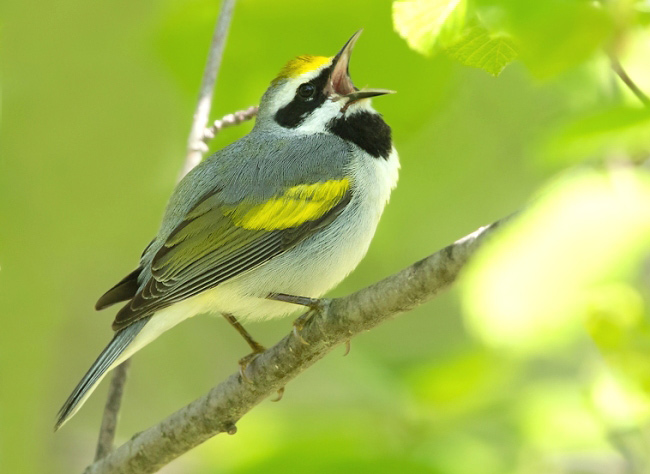
A beautiful singing male Golden-winged Warbler, Grayling, Michigan, by Dubi Shapiro.
USA - Minnesota
The boreal bogs and forests of northern Minnesota, especially Sax-Zim Bog and the Superior National Forest north of Duluth, are famous for Great Grey Owls,
although there are not many of them and they can be difficult to find. It is probably easier to find them during the extremely cold winter months when it
is also possible to see Boreal, Northern Hawk and Snowy Owls, Evening and Pine Grosbeaks, and Hoary (Arctic) Redpoll, as well as white Short-tailed Weasel
(Stoat) at some of the several feeding stations. Looking for them in early June it is also possible to see over 20 species of warbler including
Blackburnian, Canada, Cape May, Connecticut, Golden-winged, Magnolia and Mourning, all in full song and breeding plumage, as well as Sandhill Crane and
Blue-headed Vireo. Resident species include Ruffed Grouse, Black-backed Woodpecker, Grey Jay and Boreal Chickadee. Elsewhere in the state Maplewood State
Park is a particularly good place for Golden-winged Warbler and out west in the Felton prairies Greater Prairie-chicken is possible. To the west lies
North Dakota, described below.
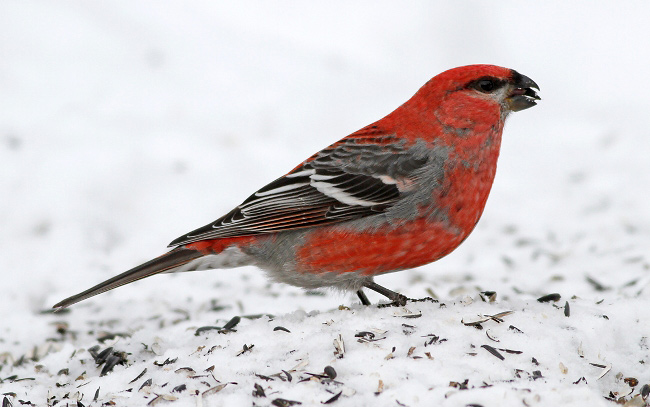
Pine Grosbeak in a snowy Minnesota winter by Chris Townend.
USA - Missouri
Missouri lies just east of the central United States. Rolling farmland and tiny remnants of prairie cover the north and west, and flat plains and the
forested limestone hills and mountains of the Ozarks the south and southeast with the Mississippi River running south along the state’s eastern border
with Illinois. In the Americas over 95% of tall-grass prairies have been cleared to make way for agricultural land and less than three percent of what
once existed in Missouri remains. The largest and finest remnant is in Prairie State Park near Springfield in the southwest which supports Scissor-tailed
Flycatcher, Henslow’s Sparrow and Dickcissel, as well as Bison. Greater Prairie-chicken used to occur here. Up to 18 species of warbler including
Cerulean, Kentucky and Nashville spend the northern summers in the Ozarks, most of which are best looked for when they are singing, especially during the
middle two weeks of May which are also a good time to see the wide range of wild flowers. For breeding and migrant warblers head for Roaring River State
Park or the Ruth and Paul Henning Conservation Area (formerly White River Balds Natural Area) just west of Branson where the ‘balds’, forest glades, are
good for warblers and Yellow-breasted Chat.
USA - Montana
The sparsely populated (six to seven people per square mile) plains, rivers, lakes, marshes and mountains of the fourth largest of the United States
support a wide range of birds and mammals. Prairie pot holes are an especially rich habitat, particularly at Freezeout Lake State Waterfowl Management
Area and Benton Lake National Wildlife Refuge where there are many ducks, White-faced Ibis, American White Pelican, Wilson's Phalarope, American Avocet,
Black-necked Stilt and Yellow-headed Blackbird with Long-billed Curlew, Marbled Godwit, Chestnut-collared and McCown's Longspurs, Bobolinks and Lark
Buntings in the surrounding grasslands. As for mountains they don’t get much more scenic than in Glacier National Park where Harlequin Duck, Varied
Thrush, MacGillivray's, Townsend’s and Wilson’s Warblers, Grey-crowned Rosy-finch and Black Bears occur. Outside the park ‘Goat Lick’, a steep cliff
and natural mineral lick above the Flathead River is where Mountain Goats gather during the spring. Grizzly Bears may be seen out on the prairie at
Pine Butte Swamp and other mammals abound in the National Bison Range, particularly American Bison which roam among some of the last Palouse Prairie
in western Montana. Other Montana mammals include Pronghorn, Elk, Bighorn Sheep and Black Bear, and other birds are Lewis' Woodpecker and Mountain
Bluebird. The peak time to visit is the first week of June during the late spring when there is up to 15 hours of daylight.
Montana also has the largest number (14) of breeding owl species of any U.S. state; American Barn-owl, Barred, Boreal, Burrowing, Flammulated, Great Grey, Great Horned, Long-eared and Short-eared Owls, Eastern and Western Screech-owls, Northern Hawk-owl, Northern Pygmy-owl and Northern Saw-whet Owl, while Snowy Owl is a regular winter visitor. The breeding species are best searched for during the second half of April.
USA - Nebraska (Platte River)
One of the most impressive gatherings of birds in the world with about half a million Sandhill Cranes at their staging area in March along with Ross's
and Snow Geese.
USA - New Mexico
See USA - Bosque del Apache, above.
USA - North Carolina
During the summer, especially late May to early June, up to 40 miles off Cape Hatteras, where the warm waters of the Gulf Stream meet the cool waters of
the Labrador Current, there is a considerable upwelling of nutrients which in turn provide a rich food supply for a wonderful selection of seabirds.
Regular species are Black-capped Petrel, Audubon's, Cory’s and Great Shearwaters, Band-rumped (Grant's), Leach's and Wilson’s Storm-petrels, Bridled Tern
and Pomarine Jaeger (Skua), less regular species include Manx Shearwater, South Polar Skua, Long-tailed Jaeger (Skua) and Sooty Tern, and rare species
include Bermuda, Cape Verde (Fea's), Desertas (Fea's) and Trinidade Petrels. Whales, dolphins, turtles, flying fish and even Blue Marlin are also possible.
The all-day pelagics are run by Seabirding. Along the coast and inland there are some great
birds too, including Brown Pelican, a wide variety of herons, Clapper Rail, shorebirds including Piping Plover, Black Skimmer, Blue Jay and Seaside
Sparrow, as well as Southeastern United States specialities such as Wilson’s Plover, Red-cockaded (Croatan NF) and Red-headed Woodpeckers, Brown-headed
Nuthatch, Swainson’s and Prothonotary Warblers, Summer Tanager, Bachman’s Sparrow and Painted Bunting.
USA - North Dakota
The rolling grasslands and wetlands in prairie-pothole country near Jamestown in Kidder County on the Great Plains of eastern North Dakota are famous for
nesting waterbirds, especially ducks (the region is often referred to as the 'Duck Factory' of North America), but also Western Grebe, American White
Pelican (one of the continent's largest breeding colonies is at Chase Lake NWR), American Bittern, Upland Sandpiper, Marbled Godwit, American
Avocet, Wilson's Phalarope, California and Franklin’s Gulls, and Black and Forster's Terns. The grasslands support the rare Sprague's Pipit and Baird's
Sparrow, as well as Sharp-tailed Grouse, Ferruginous Hawk, Dickcissel, Grasshopper and Vesper Sparrows, Chestnut-collared Longspur, Bobolink and
Yellow-headed Blackbird. Just to the east is Minnesota, described above. The peak time for birding is early June.
USA - Ohio
Crane Creek and Magee Marsh Wildlife Area, along the Lake Erie shoreline about 15 miles east of Toledo, make up one of the best places in North America to
see warblers during the spring, especially the middle two weeks of May when over 30 species may be seen and the
The Biggest Week in American Birding, an annual event, is held. The birds stop to
rest and refuel in the tiny stretch of woods here before making the 30-mile crossing to Ontario and often allow close-up views along with cuckoos,
flycatchers, thrushes, vireos, tanagers and orioles. At nearby Ottawa National Wildlife Refuge it is possible to see a good variety of ducks, herons and
shorebirds. Cerulean, Hooded and Yellow-throated Warblers, as well as birds such as Acadian Flycatcher and Wood Thrush more typical of the southern
Appalachians can be seen in eastern Ohio in Cuyahoga Valley National Park.
USA - Oregon
Because there are so many habitats in such a small area in Oregon there is a greater diversity of birds than in any other similar-sized area in the world
at a similar latitude. The range of birds is impressive, whether it is the second half of May, the peak spring period when songbirds are singing and in
spring plumage or the first two weeks of September when huge numbers of birds are passing through on southward migration, and includes Harlequin Duck,
Mountain Quail, Bald Eagle, Ferruginous Hawk, Prairie Falcon, Sandhill Crane, American Avocet, Wilson's Phalarope, several owls, Calliope and Rufous
Hummingbirds, lots of woodpeckers and flycatchers, Clark's Nutcracker, Wrentit, Mountain Bluebird, Varied Thrush, Lazuli Bunting and Evening Grosbeak,
with trickier species including Yellow Rail (Klamath Marsh NWR), Tufted Puffin (Cape Kiwanda SNA), Great Grey Owl (sometimes nesting on known nesting
platforms in the Blue Mountains near La Grande) and Tricoloured Blackbird. Mammals include several chipmunks and ground-squirrels, Bighorn Sheep, Elk,
Pronghorn and Yellow-bellied Marmot. In addition, on full-day pelagic trips out of Newport in September it is possible to see Black-footed Albatross,
Pink-footed Shearwater, Fork-tailed Storm-petrel and other seabirds such as Laysan Albatross.
USA - Pennsylvania (including Hawk Mountain Sanctuary)
Every autumn/fall mainly September-October an average of 18,000 raptors pass over Hawk Mountain Sanctuary on the Kittatinny Ridge in the Appalachians
about 25 miles north of Reading. Species with peak times in parentheses include Western Osprey (September), Bald Eagle (first half of September), Northern
Harrier (October), Sharp-shinned Hawk (mid-September to the end of October), Cooper’s Hawk (October), Northern Goshawk (November), Red-shouldered Hawk
(mid-October to mid-November), Broad-winged Hawk (September), Red-tailed Hawk (October-November), Rough-legged Hawk (November to mid-December), Golden
Eagle (mid-October to mid-November), American Kestrel (September), Merlin (October), Peregrine Falcon (October-November). The Annual Autumn Hawk Watch
takes place daily from mid-August to mid-December 9 am to 5 pm at North Lookout when an official counter and interpreters are on hand to point out and
identify birds. There may not be many birds if the weather conditions are unsuitable though; it is best to visit on days immediately following the passage
of a cold front when the wind blows from the northwest.
An impressive diversity of flycatchers, vireos, warblers and sparrows breed in central Pennsylvania. Singing usually peaks in late May when males arrive and establish territories. There may be as many as five species of Empidonax flycatchers, Henslow's Sparrow is the star of the sparrows, the possible 25 species of warbler include Blackburnian, Black-throated Blue, Canada, Cerulean, Golden-winged, Magnolia, Mourning and Prothonotary, and Yellow-breasted Chat is also possible.
USA - Platte River, Nebraska
See USA - Nebraska, above.
USA - Texas
Bird migration in action with, in the right spring weather, huge 'kettles' of Broad-winged and Swainson's Hawks, flocks of shorebirds stopping off on
their way north, and thousands of small birds including warblers, tanagers and buntings, all in dazzling summer plumage, and all vying for attention
alongside wintering Whooping Cranes, resident Greater Roadrunners and summer visitors such as Swallow-tailed Kites and Scissor-tailed Flycatchers.
Down south there are over 20 birds more or less restricted to southern Texas in the United States and best looked for in the Lower Rio Grande Valley area, birds such as Plain Chachalaca, Common Pauraque, Green and Ringed Kingfishers, Great Kiskadee, Green Jay, Tropical Parula, and Altamira and Audubon's Orioles.
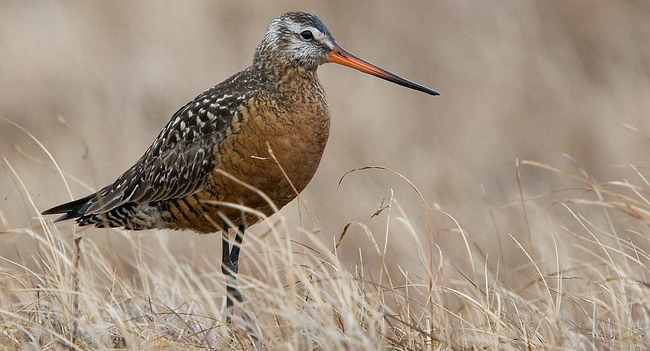
The numerous shorebirds migrating through Texas during the spring include Hudsonian Godwits, some of them in summer breeding plumage like this male by Michael McKee.
USA - Virginia & West Virginia
Possibly the greatest range of breeding warblers for such a small area of North America occurs from the rolling Piedmont and Blue Ridge Mountains of
Virginia across the Shenandoah Valley to the Allegheny and Cheat Mountains of West Virginia. At the end of May and early June the forested mountains
resound with the songs of over 25 species of warbler including Blackburnian, Canada, Cerulean (especially in the oak woods of the Blue Ridge, Virginia),
Chestnut-sided, Kentucky, Magnolia, Mourning, Prothonotary and Yellow-throated.
USA - Washington
This west coast state supports an impressive range of birds, whether it is the second half of May, the peak spring period when songbirds are singing and
in spring plumage or the first two weeks of September when huge numbers of seabirds, shorebirds and songbirds are passing through on southward migration.
The list includes Harlequin Duck, Bald Eagle, White-tailed Ptarmigan (Mount Rainier NP, along Skyline Trail near Panorama Point above Paradise, and along
Mt Fremont Lookout Trail above Sunrise), Sandhill Crane, Calliope and Rufous Hummingbirds (these, as well as Cassin's Finch, and Black-headed and Evening
Grosbeaks, are attracted to the feeders at Mt Adams Lodge), Tufted Puffin (on Protection Island NWR, accessible via two-hour boat trips from Port Townsend
on the Olympic Peninsula), lots of woodpeckers, Clark's Nutcracker, Varied Thrush, Mountain Bluebird, Lazuli Bunting and Grey-crowned Rosy-finch (Mt
Fremont Lookout Trail above Sunrise in Mount Rainier NP). Mammals include Killer Whale (the waters around the San Juan Islands, accessible from Port
Townsend, are some of the best in the world for this species), Black Bear, Elk and various chipmunks and ground-squirrels. During September Washington is
not only a great place for rare shorebirds in North America it is where a wide range of seabirds gather offshore and on full-day pelagic trips out of
Westport Harbor it is possible to see lots of Black-footed Albatrosses, as well as Buller’s and Pink-footed Shearwaters, Fork-tailed Storm-petrel and
South Polar Skua. In addition, Laysan Albatross, Flesh-footed Shearwater and Tufted Puffin are seen on some trips and rarities have included the likes of
Murphy’s Petrel.
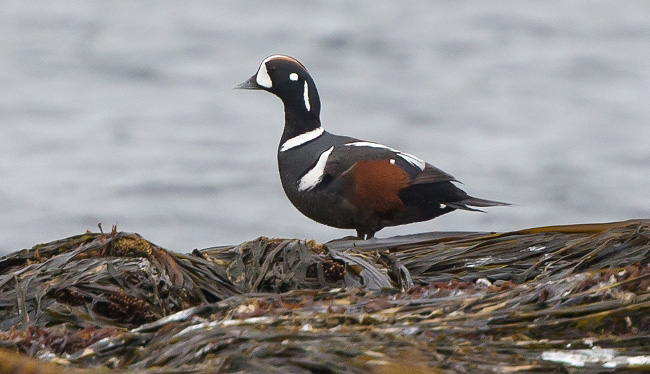
The beautifully patterned and coloured Harlequin Duck is widespread across northwestern North America, as far south as Washington and Oregon where they usually spend the summers inland and the winters along the Pacific coast. This superb image was taken by Simon Colenutt in Alaska.
USA - Wyoming (Yellowstone)
Wolf, Grizzly and Black Bears, Bison and Moose, as well as some spectacular birds including Bald Eagle and Clark's Nutcracker, in the superb settings of
the Grand Tetons and Yellowstone, complete with snowy mountains, hot springs and other geothermal phenomena such as geysers like Old Faithful.
Uzbekistan
The desert, steppe, many Mulberry trees (used to feed silkworms and produce silk on the ‘Silk Road’), mountain meadows and slopes covered in junipers and
coniferous forests below the snow-capped peaks of Uzbekistan support Turkestan (Pander's) Ground-jay (in the Kyzyl-Kum Desert), as well as Marbled Teal,
Asian Houbara (Macqueen’s) Bustard, White-tailed Lapwing, Little (Hutton’s) Owl, Blue-cheeked Bee-eater, White-winged Woodpecker, Asian Paradise-flycatcher,
Pied Bushchat, White-throated Robin, Blue-capped Redstart, Finsch’s and Variable Wheatears, Streaked Scrub-warbler, Asian Desert, Menetries’s, Moustached,
Sulphur-bellied, Sykes’s and Upcher’s Warblers, Azure (Yellow-breasted), Rufous-naped and Turkestan Tits, White-crowned Penduline-tit, Eastern Rock
Nuthatch, Hume’s Lark, Desert Finch, and Red-headed and White-capped Buntings. Good birding areas include the Chatkal range of mountains (outliers of the
Tien Shan near of the capital Tashkent), the Kyzyl-Kum Desert and wetlands around Bukhara. Mid-May is the peak time to look for birds.
V
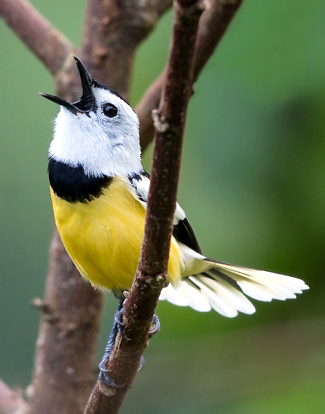
The Buff-bellied Monarch, endemic to Vanuatu, looks much better than it sounds as this superb image by Dubi Shapiro illustrates.
Vanuatu
The island of Efate is the gateway to Vanuatu but the island where all of the endemic bird species occur is Espiritu Santo. There are eleven endemics but
only five are relatively easy to see; Vanuatu Scrubfowl (especially at Palikulo Point but also in Loru Conservation Area), Vanuatu (Baker’s)
Imperial-pigeon, Tanna Fruit-dove, Vanuatu (Chestnut-bellied) Kingfisher (a difficult forest skulker), Vanuatu Honeyeater, Vanuatu Streaked Fantail,
Buff-bellied Monarch (a hyperactive forest skulker and sole member of its genus), Santo Thicketbird, Vanuatu (Yellow-fronted) White-eye, Mountain Starling
and Royal (Red-headed) Parrotfinch. The lowland forest birds are joined by Mackinlay's Cuckoo-dove, Red-bellied Fruit-dove, Pacific Imperial-pigeon, the
juliae subspecies of Pacific Kingfisher, Cardinal Myzomela, Long-tailed Triller, Melanesian (Vanuatu) Whistler and Southern Shrikebill. At the slightly
higher elevation reached via the Butmas Track the endemic imperial-pigeon and honeyeater become possible, but visitors must mount a mini-expedition with
porters and camping equipment to much higher forest to try and see the thicketbird, as well as Palm Lorikeet, Santa Cruz Ground-dove and Rusty-winged
Starling, all of which occur only in Vanuatu and the Santa Cruz Islands of the Solomon Islands. Mountain Starling is confined to the highest forests of
Espiritu Santo and Royal Parrotfinch is rare and/or nomadic on Santo but apparently more numerous on the islands of Emae and Tongoa. Two other rare birds
are the magnificens subspecies of Collared Petrel and White-necked Petrel, both of which can be seen at sea around Mota Lava and Vanua Lava in the Banks
Islands. The coral reefs around the low-lying Maskelyne Islands are some of the best for scuba-diving and snorkelling and Mt Yasur, an active volcano on
Tanna Island, is yet another natural wonder. The best time to look for the endemic birds is July to September.
Venezuela - Eastern (Rio Grande-Escalera)
A chance of Harpy Eagle, a cave with thousands of Oilbirds, lots of cotingas including Guianan Cock-of-the-rock, Capuchinbird, Pompadour, Purple-breasted
and Spangled Cotingas, Bearded and White Bellbirds, and Handsome and Red-banded Fruiteaters, lots of other Guiana Shield Endemics such as Scarlet-horned
Manakin, and many other spectacular birds including macaws, hummingbirds, jacamars, toucans, antbirds and tanagers.
Venezuela - Western (Llanos)
One of the world's top bird spectacles, in the wetlands of the Llanos where numerous waterbirds include Scarlet Ibises and Sunbitterns, and the landbirds
Scarlet Macaws and Yellow-knobbed Curassows, as well as a superb selection of mountain forest birds, along the coast and in the Andes, including Andean
Cock-of-the-rock, over 30 of Venezuela's 58 endemics including White-bearded Helmetcrest and Ochre-browed Thistletail, and mammals such as Three-toed
Sloth, Red Howler Monkey and river dolphins.
Veracruz - Mexico
See Mexico - Veracruz, above.
Vietnam
Eleven endemic birds; Tonkin Partridge, Edward’s Pheasant, Annam Prinia, Annam Grasshopper-warbler, Black-crowned Fulvetta, White-throated Wren-babbler,
Collared, Golden-winged and Orange-breasted Laughingthrushes, Grey-crowned Crocias and Vietnamese Greenfinch, nearly 20 near-endemics shared with Cambodia
and Laos, including Germain’s Peacock-pheasant and Vietnamese Cutia, a superb selection of other classic fabulous South-East Asia birds such as trogons,
hornbills, broadbills, pittas, babblers and leafbirds, and some of the most beautiful primates in the world, including Buff-cheeked Gibbon and douc
langurs.
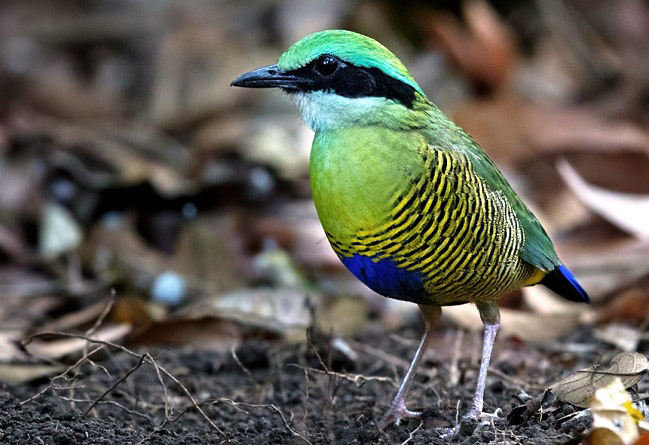
The best place in the world to see the beautiful Bar-bellied Pitta is Vietnam, where this image was taken by Lars Petersson.
Virginia & West Virginia - USA
See USA - Virginia & West Virginia, above.
W
Washington - USA
See USA - Washington, above.
Western Pacific Odyssey
An incredible selection of seabirds between New Zealand and Japan, from New Zealand Storm-petrel through Beck's Petrel and Heinroth's Shearwater to
Short-tailed Albatross, and many possible whales and dolphins, plus stopovers for endemic landbirds on New Caledonia and the Solomon Islands.
Western Sahara
In this part of northwest Africa currently administered by Morocco it is possible to see a few birds which are difficult or impossible to see elsewhere
in the Western Palearctic and a few mammals which are difficult or impossible to see anywhere else in the world. The main town Dakhla is accessible by air
or road (over 1200 km south of Agadir) from Morocco. Birds in the huge Dakhla Bay include West African Crested Tern and a few Atlantic Humpback Dolphins
survive in this bay. Inland, alongside the Dakhla-Aousserd Road it is possible to see Golden Nightjar (Oued Jenna) and Cricket Warbler (Oued Jenna), as
well as Crowned and Spotted Sandgrouse, Dunn's Lark, Black-crowned Sparrow-lark, Fulvous Babbler, African Desert Warbler and Desert Sparrow, and possibly
Pharoah Eagle-owl and Sudan Golden Sparrow (especially at Oued Jenna). The numbers of birds in the often windy desert seems to depend on winter rainfall,
with the highest numbers usually after plenty of rain. Mammals present alongside the same road include African Wild and Sand Cats, Golden Jackal, Fennec
and Ruppell's Foxes, (Saharan) Striped Polecat, Desert Hedgehog and Lesser Egyptian Jerboa, all of which are most likely to be seen while spotlighting at
night. The best time to visit is March to September.
West Papua - Indonesia
Fantastic birds-of-paradise including Magnificent, Red, Wilson's, Western Parotia and Black Sicklebill, all displaying, mostly at close range, many other
spectacular New Guinea birds such as Palm Cockatoo, Victoria and Western Crowned-pigeons and Papuan (Blyth's) Hornbill, not forgetting some of the other
68 endemics such as Vogelkop Bowerbird, Vogelkop Lophornia (once known as Superb Bird-of-paradise), Arfak Astrapia, a chance of Long-tailed Paradigalla,
and, on offshore islands, in the richest tropical seas on Earth, Biak, Kofiau and Numfor Paradise-kingfishers.
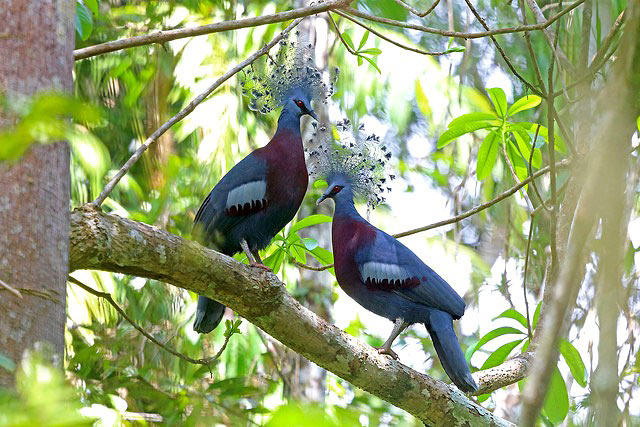
New Guinea is not all about birds-of-paradise. The numerous other spectacular endemics include three species of huge crowned-pigeons including Victoria Crowned-pigeon which inhabits the northern lowlands where this fantastic image was captured by Nigel Voaden at Nimbokrang in West Papua.
Wetar
See Indonesia - Lesser Sundas, above.
Wyoming (Yellowstone) - USA
See USA - Wyoming, above.
Y
Yap
See Micronesia, above.
Yellowstone (Wyoming) - USA
See USA - Wyoming, above.
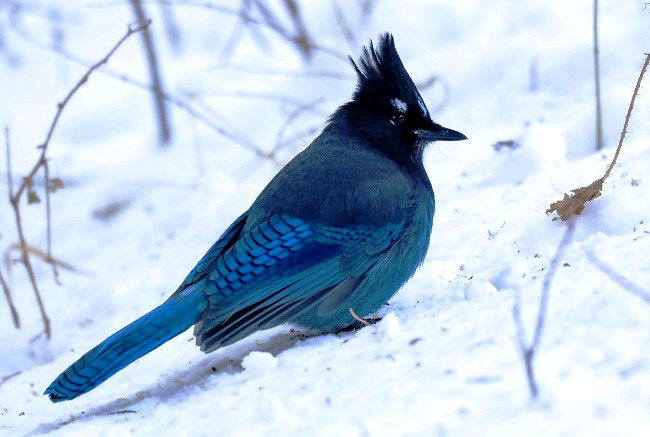
A beautiful image of a Steller's Jay in Yellowstone by Simon Colenutt.
Yucatan - Mexico
See Mexico - Southern, above.
Yukon - Canada
See Canada - Yukon, above.
Yunnan - China
See China - Yunnan, above.
Z
Zambia
Spectacular localized birds such as Black-cheeked Lovebird and African Pitta, many Miombo woodland specialities, a wide range of mammals including Leopards
in South Luangwa National Park and a roost of millions of Straw-coloured Fruit Bats, and Victoria Falls.
Zimbabwe
Zimbabwe is one of the few places where it is possible to see African Pitta; in riverine thickets near Masoka Camp in the Lower Zambezi Valley for example,
from mid-November to mid-December/early January, along with Nyasa (Lilian’s) Lovebird, Pennant-winged Nightjar, Eastern Nicator, Livingstone’s Flycatcher
and Arnot’s Chat. To the south, the wetlands around the capital Harare can be great for crakes and flufftails in January-February if there has been enough
rain, including Streaky-breasted Flufftail and Striped Crake. There are some good stretches of Miombo woodland nearby where specialities include Miombo
Rock-thrush, Boulder Chat and African Spotted Creeper. East of the Harare, remnant patches of montane evergreen forest amongst extensive banana, tea and
tobacco plantations on the Vumba (Bvumba) Mountains support three near-endemics; Swynnerton’s Robin, Chirinda Apalis and Briar (Roberts’s) Warbler, as well
as Eastern Bronze-naped Pigeon, Lemon Dove, Livingstone’s and Purple-crested Turacos, Orange Ground-thrush, Barratt’s Warbler, Black-fronted and Olive
Bushshrikes, Blue Swallow (Oct-Mar; the Chimanimani Mountains of Zimbabwe and Mozambique are a stronghold for this species), Red-faced Crimsonwing and
Red-throated Twinspot, while more rarely seen species include Buff-spotted and Striped Flufftails. The eastern lowlands support the rare and localized
Green (Zambezi) Indigobird. To the south is Matobo National Park where the high concentration of raptors includes the highest density of Verreaux’s Eagle
in the world and other birds include Freckled Nightjar and Boulder Chat. In the far west Hwange National Park supports Three-banded (Heuglin's) Courser,
Southern Carmine Bee-eater, Racquet-tailed Roller, Bradfield’s Hornbill and Crimson-breasted Gonolek, and a good variety of mammals such as Wild Dog, Black
Rhino, Elephant, Giraffe, Kudu and Sable. Not far from there is the famous Victoria Falls. Another good place for African mammals is Mana Pools NP where
Lion, Leopard, Cheetah, Elephant, Buffalo and Hippo may be seen.
- The 800-page book, A Mind-blowing Birding Trip to a Planet called Earth, is Nigel Wheatley's attempt to capture what birding, and life, is all about. It was published in September 2021 and is available from Amazon for under £20/$25.