
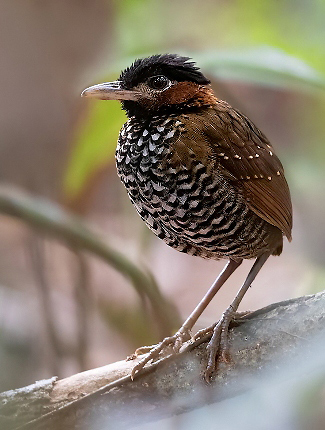
The rare Black-crowned Antpitta/soma near Burbayar Lodge in Panama by Dubi Shapiro.
- Birds, so many birds; nearly a thousand species recorded including many hummingbirds, trogons, motmots, antbirds and manakins
- As well as several endemics, Sapayoa and a good chance of Harpy Eagle
- Lots of near-endemics too, mainly those shared with Costa Rica in the western highlands, including Resplendent Quetzal, Fiery-billed Aracari, Flame-throated Warbler, Wrenthrush and Long-tailed Silky Flycatcher
- But also several birds confined to the Darien province of eastern Panama and inaccessible far northwest Colombia, including Beautiful Treerunner, Varied Solitaire and Viridian Dacnis
- Plus a wide variety of mammals, including sloths, monkeys and a tamarin
- All in some fine rain, cloud and elfin forests
- While offshore lie rich coral reefs with Manta Ray and turtle cleaning stations
- In addition to the birds mentioned above two to three million raptors pass over Panama City from late September to mid-November. Over three million were recorded during the 2013 season (the best total since coordinated counts began in 2004) and over two million (2,105,060) were counted on a single day in 2014, the 2nd of November, over double the previous day record of 900,000 or so in 2013. Most of the birds involved are Mississippi Kites (mostly early October), Broad-winged (mostly mid-October) and Swainson's (mostly late October) Hawks, and Turkey Vultures, and the greatest numbers can be seen over Cerro Ancon. Other raptors include (American) Swallow-tailed Kites (over a hundred on 4th of October 2010) and Zone-tailed Hawks, which may also be seen migrating from Canopy Tower and the Panama Rainforest Discovery Center near Pipeline Road in Soberania NP (see below). Counts are kept by Audubon Panama.
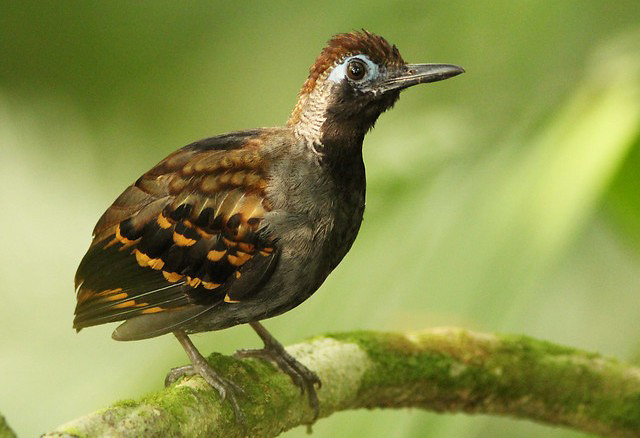
A superb image of the rare and strange Wing-banded or Buff-banded Antbird at Rancho Plastico in the Darien by David Beadle.
Best Birds and other wildlife in Panama
Birds
Endemics 9
Brown-backed (Azuero/Grey-headed) Dove, Azuero (Painted) Parakeet, White-throated Mountain-gem, Glow-throated Hummingbird, Stripe-cheeked Woodpecker (range
in Birds of Central America extends to Colombia), Coiba (Rusty-backed) Spinetail (on the island of Coiba where it can be seen along the Hot Spring
Trail, accessible by boat from Playa Arrimadero near Santa Catalina), Yellow-green (Panamanian) Tyrannulet, Orange-throated (Yellow-throated)
Bush-tanager (Caribbean slope montane forests from Volcán Chiriquí to Veraguas in the west) and Yellow-green Finch.
(Escudo Hummingbird on Escudo Island is considered a race of Rufous-tailed Hummingbird by most taxonomists)
Near-endemics
Panama and Costa Rica 74 (13 hummingbirds, two trogons, two cotingas and two silky-flycatchers) Black Guan, Black-breasted Wood-quail, Buff-fronted Quail-dove, Purplish-backed Quail-dove, Chiriqui Quail-dove, Dusky Nightjar, Costa Rican Swift, Veraguas Mango, White-crested Coquette, Garden Emerald, Black-bellied Hummingbird, White-tailed Emerald, Charming Hummingbird, Snowy-bellied Hummingbird, Talamanca (Magnificent) Hummingbird, Fiery-throated Hummingbird, White-bellied Mountain-gem, Magenta-throated Woodstar, Volcano Hummingbird, Scintillant Hummingbird, Costa Rican Pygmy-owl, Lattice-tailed Trogon, Baird’s Trogon, Fiery-billed Aracari, Prong-billed Barbet, Golden-naped Woodpecker, Red-fronted Parrotlet, Sulphur-winged Parakeet, Black-hooded Antshrike, Dull-mantled Antbird, Silvery-fronted Tapaculo, Southern Spot-crowned Woodcreeper, Buffy Tuftedcheek, Streak-breasted Treehunter, Chiriqui (Buff-throated) Foliage-gleaner, Ruddy Treerunner, Orange-collared Manakin, Turquoise Cotinga, Yellow-billed Cotinga, Olive-streaked Flycatcher, Black-capped Flycatcher, Dark Pewee, Ochraceous Pewee, Yellow-green (Scrub) Greenlet, Yellow-winged Vireo, Silvery-throated Jay, Ochraceous Wren (range also probably reaches Colombia), Timberline Wren, Riverside Wren, Isthmian (Plain) Wren, Black-faced Solitaire, Black-billed Nightingale-thrush, Sooty Thrush, Black-and-yellow Silky-flycatcher, Long-tailed Silky-flycatcher, Golden-browed Chlorophonia, Spot-crowned Euphonia, Sooty-capped Bush-tanager, Costa Rican Brush-finch, Yellow-thighed Finch, Large-footed Finch, Volcano Junco, Wrenthrush, Flame-throated Warbler, Chiriqui Yellowthroat, Black-cheeked Warbler, Black-eared (Three-striped) Warbler, Collared Whitestart, Black-thighed Grosbeak, Sulphur-rumped Tanager, Cherrie’s (Scarlet-rumped) Tanager, Peg-billed Finch, Slaty Flowerpiercer and Spangle-cheeked Tanager.
Panama, Costa Rica and Nicaragua 6 Purple-throated Mountain-gem, Vermiculated Screech-owl, Bare-necked Umbrellabird, Canebrake Wren, Yellow-crowned Euphonia and Nicaraguan Seed-finch.
Panama, Costa Rica and Colombia 5 Blue-throated (Emerald) Toucanet, Tawny-capped Euphonia, Sooty-faced Finch, Black-and-yellow Tanager and Blue-and-gold Tanager.
Panama and Colombia 27 Choco Tinamou, Tacarcuna Wood-quail, Russet-crowned Quail-dove, Pirre (Rufous-cheeked) Hummingbird, Violet-capped Hummingbird, Sapphire-throated Hummingbird (also recorded in Costa Rica), Dusky-backed Jacamar, Grey-cheeked Nunlet, Spot-crowned Barbet, Black Antshrike, Spiny-faced Antshrike, Tacarcuna (Pale-throated) Tapaculo, Beautiful Treerunner, Golden-collared Manakin, Southern Bentbill, Black-billed Flycatcher, White-headed Wren, Sooty-headed Wren, Varied Solitaire, Tacarcuna Bush-tanager (Chlorospingus), Pirre Bush-tanager, Black-headed Brush-finch, Black Oropendola, Pirre Warbler, Tacarcuna (Three-striped) Warbler, Viridian Dacnis and Green-naped Tanager.
Panama, Colombia and Ecuador 28 Tooth-billed Hummingbird, Greenish Puffleg, Humboldt’s Hummingbird (Sapphire), Purple-throated Woodstar, Choco Screech-owl, Black-breasted Puffbird, Barred Puffbird, Stripe-billed (Collared) Aracari, Splendid (Crimson-bellied) Woodpecker, Sapayoa, Pacific Antwren, Short-tailed (Chestnut-backed) Antbird, Choco Tapaculo, Double-banded Greytail, Choco (Green) Manakin, Blue Cotinga, Black-tipped Cotinga, Choco Grey Elaenia, Choco Sirystes, Slate-throated Gnatcatcher, Stripe-throated Wren, Dagua Thrush, Yellow-collared Chlorophonia, Fulvous-vented Euphonia, Pacific (Subtropical) Cacique, Lemon-spectacled Tanager, Scarlet-browed Tanager and Grey-and-gold Tanager.
Panama, Colombia and Venezuela 3 Saffron-headed Parrot, Russet-winged Schiffornis and Yellow-browed Shrike-vireo.
Other Specialities
Great Green Macaw, Resplendent Quetzal, Snowcap, Violet Sabrewing and Wing-banded Antbird. Also a chance of
Marbled, Black-eared and Spotted Wood Quails, Tawny-faced Quail, White-throated Crake and Rufous-vented Ground Cuckoo.
Others
Grey-headed Chachalaca, Crested Guan, Rufescent Tiger Heron, Boat-billed and Cocoi Herons, Magnificent Frigatebird, King Vulture, Red-throated Caracara,
Black, Black-and-white and Ornate Hawk-Eagles, Double-toothed, Plumbeous and Swallow-tailed Kites, Crane, Grey-lined, Semiplumbeous and White Hawks,
Northern and Wattled Jacanas, Blue Ground Dove, Great Potoo, Golden-headed Quetzal, Rufous-breasted, Green, Long-billed, Pale-bellied and Stripe-throated
Hermits, Rufous-crested Coquette, Purple-crowned Fairy, trogons, Blue-diademed, Broad-billed, Rufous, Tody and Whooping Motmots, Great and Rufous-tailed
Jacamars, puffbirds, Red-headed and Spot-crowned Barbets, Yellow-eared Toucanet, Collared Aracari, Keel-billed and Yellow-throated Toucans, Black-cheeked,
Crimson-bellied and Crimson-crested Woodpeckers, Brown-billed and Red-billed Scythebills, Bare-crowned, Ocellated and Spotted Antbirds, Streak-chested
Antpitta, Black-capped Pygmy Tyrant (the smallest passerine bird in the world along with Short-tailed Pygmy Tyrant), Southern Bentbill, Golden-crowned and
White-throated Spadebills, Rufous Piha, Purple-throated Fruitcrow, Golden-headed, Lance-tailed and Red-capped Manakins, Sharpbill, Northern Royal
Flycatcher, Green and Yellow-browed Shrike Vireos, Black-chested Jay, wrens, nightingale thrushes, euphonias, wintering warblers including Golden-winged,
Blue and Scarlet-thighed Dacnises, honeycreepers including Shining, and tanagers. Also a chance of Red-billed Tropicbird, Sunbittern, Sungrebe, Crested and
Spectacled Owls, and Great Potoo.
Mammals
Hoffmann's Two-toed and Brown-throated Three-toed Sloths, Geoffroy’s (Red-naped) Tamarin, Mantled Howler,
Grey-bellied (Lemurine) Night, Central American (Brown-headed) Spider and White-faced Capuchin Monkeys, (Lesser) Capybara (near Gamboa Rainforest
Resort, most likely very early morning), White-nosed Coati, Central American Agouti, Cacomistle, Bushy-tailed Olingo, Central American Woolly, Common and
Grey Four-eyed Opossums, and Orange Nectar Bat. Also a chance of Baird’s Tapir, Northern Tamandua, Humpback Whale (mostly May-Nov, Coiba NP), Bottlenose
and Pantropical Spotted Dolphins, Kinkajou and Greater Bulldog (Fishing) Bat. The endemic Pygmy Three-toed Sloth occurs only on Isla Escudo de Veraguas,
east of Bocas del Toro off the north coast, 1.5 hours by boat out of Chiriqui Grande or also by boat from Ngobe village. Boat trips are best tackled
between August and October when the sea is usually calmer. Between December and March it can be particularly rough.
Reptiles, Amphibians and Fish
Excellent scuba-diving and snorkeling, at places such as Bocas del Toro/Isla Bastimentos
Marine National Park and Coiba National Park where there are Manta Ray and turtle cleaning stations. On the mainland lizards include Striped Basilisk
and there are many frogs, such as Red-eyed and Rosenberg’s Gladiator Tree Frogs, Green-and-black Poison Dart Frog, Fleischmann’s and Reticulated Glass
Frogs, Talamanca Rocket Frog and Panama Humming Frog.
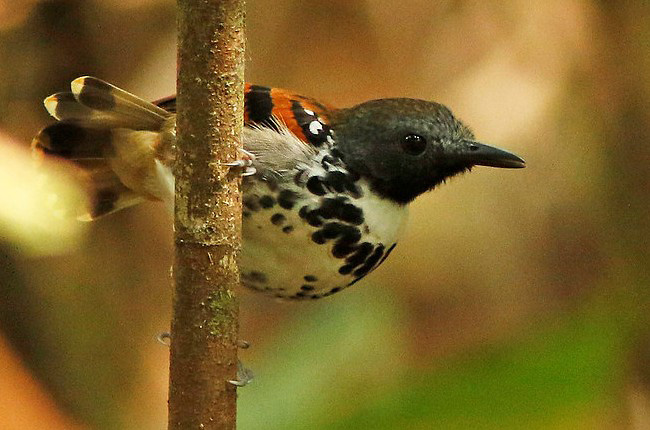
Another superb image by David Beadle, this time of a Spotted Antbird along the Pipeline Road.
Best Sites for Birds and other wildlife in Panama
- Central
- Metropolitan Park, Panama City Yellow-green Tyrannulet, Black-tailed Myiobius (Flycatcher) and Rosy Thrush Tanager, as well as Slaty-tailed Trogon, Whooping Motmot, White-bellied Antbird, Green Shrike Vireo, Lance-tailed Manakin and Geoffroy’s Tamarin.
- Panama Canal Corridor including Soberania NP, Canopy Tower on Semaphore Hill, Pipeline Road, Rainforest Discovery Center (with feeding platform and tower), Ammo Dump Ponds, Summit Ponds, Old Gamboa Road and Gamboa Rainforest Resort and area Boat-billed Heron (nesting at Summit Ponds/Old Gamboa Road), Tiny Hawk, Slaty-backed Forest Falcon, Scaled Pigeon, Pheasant Cuckoo, trogons, Rufous-crested Coquette (DC feeders), Broad-billed and Whooping Motmots, Great Jacamar, puffbirds, Chestnut-mandibled and Keel-billed Toucans, woodpeckers, antbirds including Ocellated and Spotted, Spectacled Antpitta, Purple-throated Fruitcrow, Blue Cotinga, Rufous Piha, Golden-collared and Red-capped Manakins, Russet-winged Schiffornis, Green Shrike Vireo, Hoffmann's Two-toed Sloth, Geoffroy's Tamarin, and Central American Woolly and Common Opossums. Also a chance of White-throated Crake (Ammo Dump Ponds), Sunbittern, Crested and Spectacled Owls, Rosy Thrush Tanager and Grey-bellied Night Monkey, and an outside chance of Rufous-vented Ground Cuckoo.
- Cerro Azul/Chagres NP Stripe-cheeked Woodpecker, as well as Purplish-backed Quail Dove, Rufous-crested Coquette, Violet-capped and Violet-headed Hummingbirds, Purple-crowned Fairy, Bronze-tailed Plumeleteer, White-tipped Sicklebill, Rufous Motmot, Keel-billed Toucan, Yellow-eared Toucanet, Blue Cotinga, Red-capped Manakin, Scarlet-thighed Dacnis, Shining Honeycreeper and Mantled Howler. Also a chance of Black-eared Wood Quail.
- San Francisco Private Reserve Black-crowned Antpitta/soma, Bicoloured, Ocellated and Spotted Antbirds, and Blue Cotinga.
- Cerro Jefe Violet-capped Hummingbird, Stripe-cheeked Woodpecker and Black-and-yellow Tanager. Also a chance of Black-eared Wood Quail.
- El Valle de Anton Area including Canopy Lodge, La Mesa (Candelaria Trail) and Los Altos del Maria Grey-headed Chachalaca, Veraguan Mango (Juan Hombron area), White-tipped Sicklebill (Cerro Gaital Reserve), Bronze-tailed Plumeleteer (Cerro Gaital Reserve), Broad-billed, Rufous (at bird feeders) and Tody (Cara Iguana) Motmots, Collared Aracari, Spot-crowned Barbet (La Mesa), Streak-chested Antpitta, Black-chested Jay, Scarlet-thighed Dacnis, Hoffmann's Two-toed and Brown-throated Sloths, and Central American Woolly, Common and Grey Four-eyed Opossums (at bird feeders at night at Canopy Lodge, with Orange Nectar Bats on hummingbird feeders). Also a chance of Crested Owl, Rufous-crested Coquette, Snowcap, Crimson-bellied Woodpecker, Black-crowned Antpitta, Rosy Thrush Tanager and Kinkajou.
- East - to The Darien
- Nusagandi Sapayoa, as well as Dull-mantled Antbird, Red-capped Manakin and Sulphur-rumped Tanager. Also a chance of Olive-backed and Purplish-backed Quail Doves, Speckled Antshrike and Black-crowned Antpitta/soma.
- Cerro Chucanti NR Tacarcuna Bush Tanager, Beautiful Treerunner, Varied Solitaire, Great Curassow and Ocellated Antbird. Also a chance of Russet-crowned Quail Dove, Brown-billed Scythebill and Black-crowned Antpitta.
- Meteti Area Red-rumped Woodpecker, Double-banded Greytail, Black Antshrike, White-headed Wren and Black Oropendola.
- Aligandi Area Great Green Macaw.
- Canopy Camp including nearby El Salto Road and Yaviza (near end of northern section of Pan-American Highway) White-throated Crake, Great Green Macaw, Spectacled Parrotlet, Barred Puffbird, Sooty-headed Tyrannulet, Double-banded Greytail, Golden-collared (lek) and Golden-headed (lek) Manakins, Black Oropendola (near Yaviza), Brown-throated Sloth and Mantled Howler. Also a chance of Harpy Eagle, Black-and-white and Striped Owls, and Dusky-backed Jacamar nearby.
- Rancho Frio Ranger Station (via boat, 4WD and 3.5 km walk from Yaviza) Semi-plumbeous Hawk, Red-and-green Macaw, Sapayoa, Dull-mantled Antbird, Golden-collared Manakin, Lemon-spectacled and Scarlet-browed Tanagers, and Viridian Dacnis. Also a chance of Great Curassow, Crested and Harpy Eagles, Red-throated Caracara, Crested Owl, Choco Screech Owl and Black-tipped Cotinga.
- Rancho Plastico Camp, Cerro Pirree (by foot from Rancho Frio) Tody Motmot, Slaty-winged Foliage-gleaner, Wing-banded Antbird and Black-crowned Antpitta/soma, as well as Black-tipped Cotinga, Yellow-browed Shrike Vireo, Grey-and-gold Tanager and Geoffroy's Tamarin. Also a chance of Choco Tinamou and Tawny-faced Quail.
- Cana, Darien NP Grey-cheeked Nunlet, Bare-crowned Antbird, Spectacled Antpitta, Sapayoa, Blue Cotinga, Golden-collared Manakin, Yellow-browed Shrike Vireo and Viridian Dacnis. Also a chance of Rufous-crested Coquette, Tody Motmot, Dusky-backed Jacamar, Black-crowned and Fulvous-bellied Antpittas, Black-tipped Cotinga and Baird's Tapir.
- Cerro Pirre, camping at 1100 metres, Darien NP Beautiful Treerunner and Pirre Warbler, as well as Black-eared Wood Quail, Russet-crowned Quail Dove, Golden-headed Quetzal, Pirre and Tooth-billed Hummingbirds, Greenish Puffleg, Violet-throated and Yellow-eared Toucanets, Dusky Leaftosser, Choco Tapaculo, Sapayoa, Sharpbill, Rufous Piha, Sooty-headed Wren, Varied Solitaire, Green-naped Tanager, Pirre Bush Tanager, Yellow-collared Chlorophonia and Grey-and-gold Tanager. Also a chance of Great Green Macaw.
- West
- Boquete Tree Trek mountain resort, near David Resplendent Quetzal and Prong-billed Barbet.
- Culebra Trail (on edge of Boquete town) Resplendent Quetzal, White-throated Mountain-gem, Black-faced Solitaire and Golden-browed Chlorophonia.
- Cerro Colorado Yellow-green Finch.
- Cerro Punta Area Resplendent Quetzal, Violet Sabrewing, Black-cheeked and Flame-throated Warblers, Collared Redstart, Wrenthrush, Black-and-yellow and Long-tailed Silky Flycatchers, and Golden-browed Chlorophonia.
- Sendero Los Quetzales (Quetzal Trail)/Volcan Baru National Park Black Guan, Bare-shanked Screech Owl, Dusky Nightjar, Sulphur-winged Parakeet, Resplendent Quetzal, White-throated Mountain-gem, Fiery-throated, Scintillant and Volcano Hummingbirds, Violet Sabrewing, Fiery-billed Aracari, Prong-billed Barbet, Dark and Ochraceous Pewees, Three-wattled Bellbird, Black-and-yellow and Long-tailed Silky Flycatchers, Black-cheeked and Flame-throated Warblers, Wrenthrush, Elegant Euphonia, Spangle-cheeked Tanager, Large-footed and Yellow-thighed Finches, Bushy-tailed Olingo and Cacomistle. Also a chance of Black-breasted and Spotted Wood Quails, Maroon-chested Ground Dove, Buff-fronted Quail Dove and Silvery-throated Jay.
- Finca Hartmann, Santa Clara Fiery-billed Aracari, Red-headed Barbet, Pale-billed Woodpecker and Turquoise Cotinga. Also a chance of Spotted Wood Quail and Chiriqui Quail Dove.
- Cerro Santiago Prong-billed Barbet, Buffy Tuftedcheek, Black-cheeked Warbler, Wrenthrush, Black-and-yellow Silky Flycatcher and Tacarcuna Bush Tanager.
- Lerida Farm Blue Ground Dove, Scintillant, Stripe-tailed and Volcano Hummingbirds, Violet Sabrewing, and Chesnut-capped and White-naped Brushfinches.
- La Fortuna area Black Guan, Purple-throated Mountain-gem, Yellow-eared Toucanet, Rufous-breasted Antthrush, Golden-bellied Flycatcher, Three-wattled Bellbird, Blue-and-gold Tanager and Golden-browed Chlorophonia. Also a chance of Bare-necked Umbrellabird.
- Michael’s House, Boqueron hummingbird feeders for Charming Hummingbird. Also nearby Smoky-brown Woodpecker and Orange-collared Manakin.
- Palo Seco Reserve Costa Rican Pygmy Owl and Snowcap. Blue-and-gold Tanager.
- (Off the beaten track in west Panama, Yellow-billed Cotinga occurs at El Chorogo on the Burica Peninsula)
- Bocas del Toro Archipelago
- Isla Bastimentos Red-capped Manakin. Also a chance of Three-wattled Bellbird (November), Stub-tailed Spadebill and Woolly Opossum.
- Humedal de San San Pond Sak Bare-throated Tiger Heron, all six American kingfishers, Keel-billed Toucan, White-collared Manakin and Nicaraguan Seed Finch.
- Swans Cay (accessible only in suitable weather) Red-billed Tropicbird colony.
- Isla Popa A chance of Snowy Cotinga.
- La Fortuna FR (on nearby mainland) Black Guan, Sulphur-winged Parakeet, Purple-throated Mountain-gem, Prong-billed Barbet, Golden-bellied Flycatcher, and Blue-and-gold, Silver-throated and Spangle-cheeked Tanagers. Also a chance of Snowcap and Three-wattled Bellbird (November).
- Changuinola area (on nearby mainland) Band-backed, Black-throated and Canebrake Wrens, Passerini's Tanager and Nicaraguan Seed Finch.
Best Times for Birds and other wildlife in Panama
The wettest season usually lasts from mid-April to December hence the best time to visit is between January and March, although any time between October and March is good for birds, with April being the best time for Darien.
Recommended Bird Books etc. for Panama
Birds of Central America by A C Vallely and D Dyer. PUP, 2018.
The Birds of Panama: A Field Guide by G R Angehr and R Dean. CUP, 2010.
Guide to the Birds of Panama by R A Ridgely and J A Gwynne. PUP, 1992 (Second Edition).
A Bird-Finding Guide to Panama by G R Angehr, and D and L Engleman. Comstock, 2008.
Birds of Costa Rica by R Garrigues and R Dean. Comstock, 2014 (Second Edition).
An Illustrated Field Guide to the Birds of Costa Rica by V Esquivel Soto. Incafo, 2008 (Second Edition).
A Field Guide to the Mammals of Central America and Southeast Mexico by F A Reid. OUP, 2009 (Second Edition).
A Swift Guide to the Butterflies of Mexico and Central America by J Glassberg. Sunstreak Books, 2007.
National Audubon Society Field Guide to Tropical Marine Fishes by C L Smith. Alfred A Knopf, 1997.
Apps etc.
Panama Birds Field Guide.
Where to watch birds in Central America & the Caribbean by N Wheatley and D Brewer. Helm, 2001.
Don’t know which country/countries/regions to visit in Central America? Then it may be worth considering taking a look at this book, written by this website’s author and David Brewer. It is many years old of course but it still provides a starting point, an overview and a guiding light to the best birds and the best places to look for them in the region, and could save hours of searching for similar information on the internet. However, it is important to check more up-to-date sources for sites which have been opened up, sites and species which have been discovered, lodges that have been built etc. since the book was published.
Birding and Wildlife Trip Reports for Panama
Many trip reports, some for Panama, are posted on the websites listed here. On some of these websites some reports are independent and some are posted by tour companies who organize tours to Panama. These tour companies and others also post their own reports on their websites, which are listed under 'Some Organized Tours to Panama' below.
- The best website for trip reports is CloudBirders
- but these are also worth a look
- Birdtours
- Fatbirder
- Jon Hornbuckle
- Mammal Watching
Local bird and wildlife guides in Panama
The costs of organized tours partly reflect the quality of the tour leaders. Some leaders are certainly better than others and many companies claim their leaders are the best but even the best rely at least to some extent on the exceptional skills of the local guides they employ. If you are travelling independently, employing such local guides will greatly increase your chances of seeing the wildlife you wish to see.
Accommodation for birders in Panama
Some Organized Tours for birds and other wildlife to Panama
There are many tour companies who organize tours to see mammals, birds, other wildlife and other natural wonders. The cost of these tours vary considerably according to such variables as the airlines used, the number of days the tours last, the number of sites visited, the number of people in the group (an important consideration if you wish to see such wildlife as rainforest mammals and birds), the number of tour leaders, the standard of accommodation and transport, and the percentage profit the company hopes to make. Generally, where the number of days tours last and the number of sites visited are similar, the cheapest tours are those that use the cheapest airlines, accommodation and local transport, that have the largest groups with the least number of leaders, and that make the least amount of profit. The most expensive tours tend to be those which are exceptionally long, use the most expensive accommodation (ridiculously lavish in some cases, even for single nights) and which make the most profit. Some tour costs partly reflect the quality of the tour leaders. Some leaders are certainly better than others and many companies claim their leaders are the best but even the best rely at least to some extent on the exceptional skills of the local guides they employ.
While tour companies organize tours with set itineraries many also organize custom tours for individuals and private groups who instead of taking a tour with a set itinerary want to follow their own itinerary to suit their own personal tastes, whether it be mammals, birds, other wildlife, other natural wonders or even man-made attractions, or a mixture of them all. Many organized tours with set itineraries are also fast-paced and target as many species as possible, whether they are mammals, birds or other wildlife or everything, which usually leaves little time to enjoy the best sites and individual species, but on a custom tour those taking part can specify the pace and the sites and species they wish to concentrate on. Custom tours also suit people who like to travel with people they already know, rather than with a group of strangers, and people with partners with different interests. Individuals and small groups will almost certainly have to pay more than the price of an organized tour with a set itinerary but a large group of friends may be able to travel for less than the price quoted for a set tour.
Tour companies who are running organized tours to Panama in the next couple of years include the following. Many of these also offer custom tours.
