
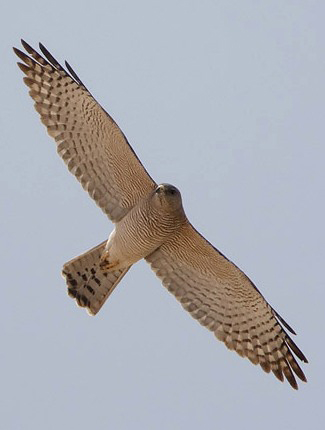
Levant Sparrowhawk by Michael McKee.
- Some of Europe's and the world's most spectacular birds including White-tailed Eagle, White and Black Storks, Great White and Dalmatian Pelicans, Nutcracker and Wallcreeper
- And many other waterbirds, including Pygmy Cormorant, herons and Glossy Ibis, along the Black Sea coast, especially in and around the Danube Delta which is larger than the Camargue and the Coto Donana combined and therefore easily the most extensive wetland in Europe
- Waterbirds, and other birds, which are particularly numerous during the northern spring and autumn when many species are migrating north and south
- As well as a chance of Brown Bear and many wild flowers, especially in the scenic Carpathian Mountains where there are over fifty species of orchid
- The Danube Delta is the largest remaining wetland and one of the last great refuges for wildlife left in Europe. The River Danube flows 2860 km from the Black Forest in Germany before splitting into three 90 km from the Black Sea in Romania. Between these three channels there is a 3500 km long squiggle of waterways, as well as ponds, lakes, islets and one of the largest reed-beds in the world, which support huge nesting colonies of fish-eating cormorants, egrets, herons, spoonbills and ibises, all of which have 75 species of fish to choose from! The birds most visitors want to see the most though are the pelicans and they can be seen on daily boat trips out of the villages within the delta and from floating hotels, or 'pontons' as they are known locally. These are pulled smoothly along by tug boats which make it possible to cruise in considerable comfort to the waters near the largest colony of Great White Pelicans outside Africa. Although the smelly melee of more than 2000 pairs is not accessible to visitors the flocks of pelicans travelling to and from the nesting island make a wonderful sight.
Best Birds and other wildlife in Romania
Birds
Many of the species listed are present during the spring, summer and autumn only.
Specialities
Yelkouan Shearwater, Great White and Dalmatian Pelicans, Pygmy Cormorant, White-tailed Eagle,
Levant Sparrowhawk, (Northern) Nutcracker, Sombre Tit and Wallcreeper.
Also a chance of Eastern Imperial Eagle, Great Black-headed Gull and Alpine Accentor. Also, during the usually very cold northern winters huge flocks of Red-breasted Geese normally gather along the Black Sea Coast.
Others
Ruddy Shelduck, Red-necked Grebe, Squacco Heron, (Black-crowned) Night-heron, Little Bittern,
Glossy Ibis, Eurasian Spoonbill, White and Black Storks, Booted, Lesser Spotted and Golden
Eagles, Red-footed Falcon, (Pied) Avocet, Black-winged Stilt, Collared Pratincole, Little and
Slender-billed Gulls, Caspian, Black, White-winged (Black) and Whiskered Terns, Alpine Swift,
(European) Bee-eater, (European) Roller, (Eurasian) Hoopoe, woodpeckers including Black,
Eurasian Three-toed and White-backed,
Great Grey and Lesser Grey Shrikes, (Eurasian) Golden Oriole, (Bearded) Reedling, Sombre, (Eurasian)
Penduline-tit, (White-throated) Dipper, Moustached and Paddyfield Warblers, Collared Flycatcher,
Eastern Black-eared, Isabelline and Pied Wheatears, Rufous-tailed Rock-thrush, (Black-headed)
Yellow Wagtail, Rock Bunting and Spanish Sparrow.
Also a chance of Ferruginous Duck, (Western) Capercaillie, Hazel Grouse, Short-toed Eagle, Little Crake, Red-necked Phalarope, Eurasian Pygmy-owl, Ural Owl and Shore Lark (balcanica).
Mammals
A chance of Brown Bear (mostly May-Sep), European Beaver
(reintroduced), (Carpathian) Chamois, European Souslik and Muskrat, and an outside chance of
Golden Jackal and Wild Cat (both especially in the Danube Delta).
In May 2014 seventeen European Bison were reintroduced to the Tarcu Mountains Reserve in the
southern Carpathians, with more to follow.
Reptiles, Amphibians and Fish
Fire Salamander.
Invertebrates
The wide variety of butterflies includes Clouded
Apollo and Scarce Swallowtail, and dragonflies include Broad Scarlet and Blue Featherleg.
Plants
The rich flora of the Carpathian Mountains includes over
50 orchid species (best mid-June to mid-July).
Best Sites for Birds and other wildlife in Romania
- Carpathian Mountains/Transylvania
- Turda NR Wallcreeper, Alpine Swift, Great Grey Shrike and Rock Bunting in and around an impressive steep-sided, 300 m (1000 ft) deep, limestone canyon.
- Grgnyi and Harghita Mountains in Desag/Zetelaka area Nutcracker, Wallcreeper (Bekas/Bicaz Gorge in Hasmas Mountains NP), Golden Eagle, and Eurasian Three-toed and White-backed Woodpeckers. Also a chance of Brown Bear (from hides), Capercaillie (at a lek), Hazel Grouse, Eurasian Pygmy-owl and Ural Owl.
- Zarnesti Area including Piatra Craului NP Brown Bear (from hides overlooking baited clearings), Chamois, Nutcracker, Wallcreeper (Damoviciora and Zarnesti Gorges), Golden and Lesser Spotted Eagles, Alpine Swift, Black Woodpecker, Collared Flycatcher, Rock Bunting and a rich flora including over 50 orchid species. Also a chance of Black Stork, Capercaillie, Hazel Grouse and Ural Owl, and an outside chance of Wolf and Eurasian Lynx.
- Black Sea Coast
- Danube Delta White-tailed Eagle, Black Stork, Great White and Dalmatian Pelicans, Red-necked Grebe, Pygmy Cormorant, Squacco Heron, Black-crowned Night-heron, Little Bittern, Glossy Ibis, Eurasian Spoonbill, Red-footed Falcon, terns, European Roller, Black Woodpecker, Lesser Grey Shrike, Golden Oriole, Reedling and Penduline-tit. Also a chance of Little Crake, and an outside chance of Golden Jackal and Wild Cat.
- Babadag Forest A chance of Eastern Imperial, Lesser Spotted, Short-toed and Booted Eagles, Levant Sparrowhawk, Black Woodpecker, Sombre Tit and Collared Flycatcher.
- Histria and Vadu White Stork, Great White and Dalmatian Pelicans, Ruddy Shelduck, Pygmy Cormorant, Little Bittern, Red-footed Falcon, shorebirds including Collared Pratincole, Little Gull, Reedling and Paddyfield Warbler. Also a chance of Black Stork and Red-necked Phalarope.
- Macin Mountains Lesser Spotted Eagle, Levant Sparrowhawk, and Eastern Black-eared, Isabelline and Pied Wheatears.
Best Times for Birds and other wildlife in Romania
The best times for Brown Bears are usually May to early June when they are fresh out of hibernation and hungry and therefore most likely to take advantage of any food put out for them within sight of hides (chocolate chips are a favourite), and the second half of September when they are fattening up before hibernation.
The best time for birds along the Black Sea Coast, including the Danube Delta, is from mid-April to October, with the peak times, when the majority of migrating birds are usually passing through, being the first three weeks of May and late August to mid-September. May is also when most of the birds in the delta are nesting.
The best time for flowers in the Carpathian Mountains is mid-June to mid-July.
Recommended Bird Books etc. for Romania
Bradt Travel Guides: Central and Eastern European Wildlife by G Gorman. Bradt, 2008.
Birding in Eastern Europe by G Gorman. WildSounds, 2006.
Collins Bird Guide by L Svensson et al. Collins, 2010 (Second Edition).
Birds of Europe by L Jonsson. Helm, 1999.
Mammals of Europe, North Africa and the Middle East by S Aulagnier et al. Helm, 2009.
Mammals of Britain and Europe by D McDonald and P Barrett. Collins, 2005.
Collins Butterfly Guide by T Tolman and R Lewington. Collins, 2009 (Third Edition).
Butterflies of Britain and Europe: A Photographic Guide by H Aarnio et al. A & C Black Publishers, 2009.
Apps etc.
Collins Bird Guide.
Where to watch birds in Europe & Russia by N Wheatley. Helm, 2000.
Don’t know which country/countries/regions to visit in Europe? Then it may be worth considering taking a look at this book, written by this website’s author. It is many years old of course but it still provides a starting point, an overview and a guiding light to the best birds and the best places to look for them in the region, and could save hours of searching for similar information on the internet. However, it is important to check more up-to-date sources for sites which have been opened up, sites and species which have been discovered, lodges that have been built etc. since the book was published.
Birding and Wildlife Trip Reports for Romania
Many trip reports, some for Romania, are posted on the websites listed here. On some of these websites some reports are independent and some are posted by tour companies who organize tours to Romania. These tour companies and others also post their own reports on their websites, which are listed under 'Some Organized Tours to Romania' below.
- The best website for trip reports is CloudBirders
- but these are also worth a look
- Birdtours
- Fatbirder
- Jon Hornbuckle
- Mammal Watching
Local bird and wildlife guides in Romania
The costs of organized tours partly reflect the quality of the tour leaders. Some leaders are certainly better than others and many companies claim their leaders are the best but even the best rely at least to some extent on the exceptional skills of the local guides they employ. If you are travelling independently, employing such local guides will greatly increase your chances of seeing the wildlife you wish to see.
Accommodation for birders in Romania
Some Organized Tours for birds and other wildlife to Romania
There are many tour companies who organize tours to see mammals, birds, other wildlife and other natural wonders. The cost of these tours vary considerably according to such variables as the airlines used, the number of days the tours last, the number of sites visited, the number of people in the group (an important consideration if you wish to see such wildlife as rainforest mammals and birds), the number of tour leaders, the standard of accommodation and transport, and the percentage profit the company hopes to make. Generally, where the number of days tours last and the number of sites visited are similar, the cheapest tours are those that use the cheapest airlines, accommodation and local transport, that have the largest groups with the least number of leaders, and that make the least amount of profit. The most expensive tours tend to be those which are exceptionally long, use the most expensive accommodation (ridiculously lavish in some cases, even for single nights) and which make the most profit. Some tour costs partly reflect the quality of the tour leaders. Some leaders are certainly better than others and many companies claim their leaders are the best but even the best rely at least to some extent on the exceptional skills of the local guides they employ.
While tour companies organize tours with set itineraries many also organize custom tours for individuals and private groups who instead of taking a tour with a set itinerary want to follow their own itinerary to suit their own personal tastes, whether it be mammals, birds, other wildlife, other natural wonders or even man-made attractions, or a mixture of them all. Many organized tours with set itineraries are also fast-paced and target as many species as possible, whether they are mammals, birds or other wildlife or everything, which usually leaves little time to enjoy the best sites and individual species, but on a custom tour those taking part can specify the pace and the sites and species they wish to concentrate on. Custom tours also suit people who like to travel with people they already know, rather than with a group of strangers, and people with partners with different interests. Individuals and small groups will almost certainly have to pay more than the price of an organized tour with a set itinerary but a large group of friends may be able to travel for less than the price quoted for a set tour.
Tour companies who run organized tours or can arrange custom tours to Romania include the following.
