
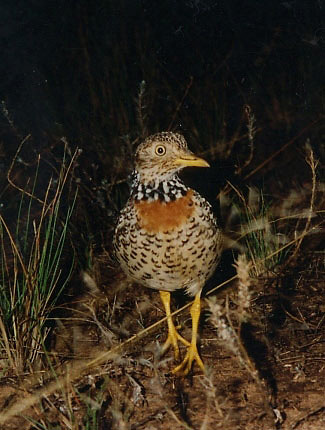
The unique Plains-wanderer can be seen only at night, when this female was photographed with an 'instamatic' camera by Nigel Wheatley near Deniliquin in 1993.
- A high percentage of endemic mammal species, seven endemic bird families and over 360 endemic bird species (about half of those which occur regularly) make Australia unique in the true sense of the word
- Endemic birds which in Southeastern Australia include Emu, Plains-wanderer, Superb Lyrebird, Satin Bowerbird, and Superb and White-winged Fairy-wrens
- While some more widespread spectacular birds which are also present include Little Penguin, Wedge-tailed Eagle, Australian Owlet-nightjar and Rainbow Bee-eater
- Along with lots of pretty parrots, cockatoos, honeyeaters and robins
- And endemic mammals such as Koala, Platypus, Tasmanian Devil, kangaroos, wombats and possums
- Some in exceptional scenery, from the Victoria coastline to remote Tasmania
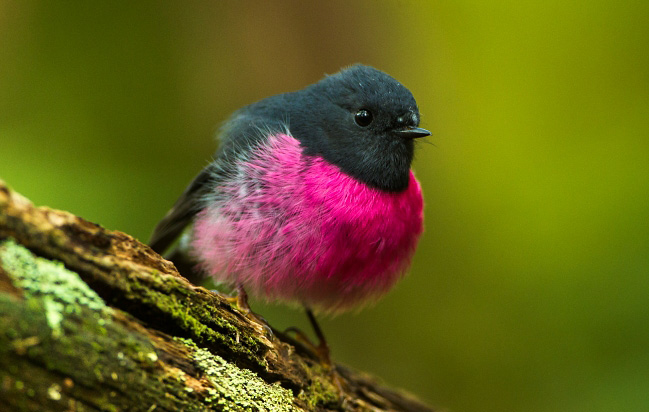
A superb image of a Pink Robin in Mount Field National Park, Tasmania, by Francesco Veronesi.
- Deep in the tall, temperate, ancient rainforests on the steep mountains of Tasmania there is a nature reserve with log cabins in a clearing by the River Leven called Mountain Valley. It is famous amongst mammal watchers for being one of the best places in the world to see the very rare Tasmanian Devil but it is also one of the most reliable sites on Earth for seeing a Platypus, the animal which is so strange that when a pelt and a drawing of one were sent to London in 1798 naturalists' there thought it was a hoax, a taxidermist’s trick, composed of parts from different creatures. While watching a Platypus diving in search of food in the still pools of the River Leven at dusk it is easy to understand their surprise, given that it is a furry mammal about 60 cm long with a tail like a beaver but a beak a bit like a duck. When it was later discovered that the male has venomous spurs on its hind feet and the female lays eggs instead of giving birth to live young it seemed like an even more unlikely creature, but there in Mountain Valley, in the river, is the real living thing!
- Australia is an island-continent not a small country and to look for all of its best wildlife in one go would involve a trip lasting several months. Therefore it is probably best to plan several visits, including ones to: nearby Eastern Australia where the wildlife includes Platypus and birds such as Southern Cassowary, Albert's Lyrebird, Paradise and Victoria's Riflebirds, and Regent Bowerbird; Outback Australia where it is possible to see Red Kangaroos and birds such as Malleefowl and Letter-winged Kite; Western Australia where the wildlife includes Manta Ray, Whale Shark, Dugong, Numbat and birds such as Red-capped Parrot; Northwestern Australia where the endemic Black Grasswren occurs on the Mitchell Plateau in the Kimberley; and Northern Australia where Hooded Parrot, Rainbow Pitta and White-throated Grasswren occur, along with the famous waterbirds and Saltwater Crocodiles of Kakadu.
Best Birds and other wildlife in Southeast Australia
Birds
Southeast Australia Endemics (including Tasmania) 20 Cape Barren Goose, Gang-gang Cockatoo, Long-billed Corella, Blue-winged Parrot, Superb Parrot, Striated Grasswren, Rufous Bristlebird, Crescent Honeyeater, Regent Honeyeater, Pilotbird, Chestnut-rumped Heathwren, Striated Fieldwren, Rockwarbler, Olive Whistler, Red-lored Whistler, Little Raven, Forest Raven, Pink Robin, Flame Robin and Beautiful Firetail.
Tasmania Endemics 14 Tasmanian Native-hen, Tasmanian Masked-owl, Tasmanian Boobook, Green Rosella, Black-headed Honeyeater, Strong-billed Honeyeater, Yellow-throated Honeyeater, Yellow Wattlebird, Forty-spotted Pardalote, Tasmanian Scrubwren, Scrubtit, Tasmanian Thornbill, Black Currawong and Dusky Robin.
Other specialities
Little Penguin, Black-faced Cormorant, Plains-wanderer, Banded Lapwing, Hooded Plover, Inland Dotterel, Fairy Tern, Eastern Ground Parrot, Superb Lyrebird
and Satin Bowerbird. Also a chance of Brolga Crane, Crimson and Orange Chats, Black, Painted, Pied and Regent Honeyeaters, Black-eared Miner and Eastern
Shrike-tit.
Two migratory parrots are most likely to be seen on Tasmania. Swift Parrot is present from September to February (it winters north to Queensland), and Orange-bellied Parrot, which winters north to the southeast mainland, is present from December to February, at the species' last breeding site at Melaleuca which is accessible only by very expensive flights that are cancelled frequently due to bad weather. Thanks to a captive breeding programme and the release of captive-bred birds to bolster the tiny wild population 51 adult parrots returned to Melaleuca in the 2020-2021 season, a significant increase on the 23 that appeared during 2019-20 and 18 in 2018-19. The number of breeding pairs also leapt from 23 to 30, with 2021's total of 88 fledged youngsters representing a 140% increase on the 2019-20 season's tally of 37.
Others
Emu, Stubble Quail, Black Swan, Australian Shelduck, ducks, Hoary-headed Grebe, Shy Albatross, Short-tailed Shearwater, Australasian Gannet, Australian
Pelican, White-faced and White-necked (Pacific) Herons, Brown and Grey Goshawks (including white morph), Little and Wedge-tailed Eagles, White-bellied
Sea-eagle, Spotted and Swamp Harriers, Black and Brown Falcons, Australian Hobby, Australasian (Purple) Swamphen, Red-capped Plover, Black-fronted and
Red-kneed Dotterels, Sooty Oystercatcher, Latham’s Snipe (mostly Sep-Mar), Little Buttonquail, Pacific Gull, Brush and Common Bronzewings, parrots such as
Superb and Turquoise, Australian King-parrot, Musk and Rainbow Lorikeets, Cockatiel, Crimson Rosella, Galah, Little Corella, Yellow-tailed Black-cockatoo,
Sulphur-crested Cockatoo, Fan-tailed and Pallid Cuckoos, Horsfield’s and Shining Bronze-cuckoos, Tawny Frogmouth, White-throated Nightjar (mostly Nov-Mar),
Australian Owlet-nightjar, Laughing Kookaburra, Azure, Red-backed and Sacred Kingfishers, Rainbow Bee-eater, Red-browed and White-throated Treecreepers,
Superb and White-winged Fairy-wrens, Southern Emu-wren, honeyeaters including Blue-faced, Eastern Spinebill, thornbills, White-browed Scrubwren, Southern
Whiteface, Grey-crowned and White-browed Babblers, Eastern Whipbird, woodswallows including White-browed, Grey and Pied Butcherbirds, Grey and Pied
Currawongs, White-winged Triller, Varied Sittella, Golden, Gilbert’s and Rufous Whistlers, Magpie-lark, White-winged Chough, Apostlebird, Red-capped, Rose
and Scarlet Robins, White-backed Swallow, Brown and Rufous Songlarks, Bassian Thrush and Diamond Firetail.
Also a chance of Freckled Duck, Australasian Bittern, Major Mitchell's (Pink) Cockatoo, Budgerigar, Powerful Owl and Ground Cuckooshrike.
Mammals
Koala, (Duck-billed) Platypus, Red, Eastern Grey and Western Grey Kangaroos, Black (Swamp) and Red-necked
(Bennett’s) Wallabies, Common and Southern Hairy-nosed Wombats, Short-beaked Echidna, Tasmanian Devil, Eastern Quoll, Greater, Squirrel and
Yellow-bellied Gliders, Common and Mountain Brushtail Possums, Common Ringtail Possum, Southern (Tasmanian) Bettong and Grey-headed Flying Fox.
Also a chance of Tiger (Spotted-tailed) Quoll, Brush-tailed Phascogale, Rufous-bellied (Tasmanian) Pademelon, Long-nosed Poteroo, Eastern Barred
Bandicoot, Southern Right Whale (mostly June to October, in Great Oyster Bay, Tasmania), Bottlenose Dolphin and Australian Fur Seal.
Invertebrates
Weedy Sea Dragons may be seen off Portsea Pier, at the end of the Mornington Peninsula south of Melbourne,
and at the dive site known as Studio One, Deep Glen Bay, Tasmania.
Other Natural Wonders of Southeast Australia
Twelve Apostles Limestone sea stacks off the coast of Victoria, southwest of Melbourne, which rise to 65 m (213 ft).
Best Sites for Birds and other wildlife in Southeast Australia
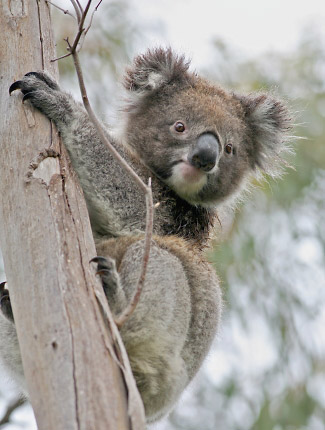
Koala by Michael Halliday.
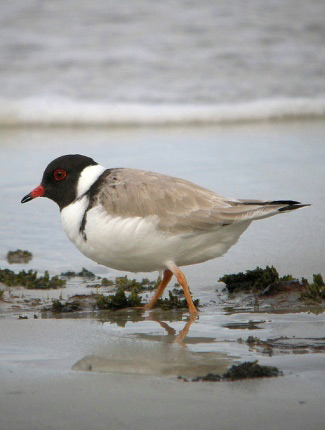
Hooded Plover by Mark Harper.
- Melbourne Area
- Wirrawilla Rainforest Track Superb Lyrebird, Pilotbird, and Flame, Pink and Rose Robins.
- Bunyip SF White-throated Nightjar (helipad), Superb Lyrebird and Red-browed Treecreeper (both Glen Nyook rainforest walk).
- Dandenong Ranges including Sherbrooke Forest Superb Lyrebird, Australian King-parrot, Red-browed Treecreeper, Superb Fairy-wren, Rose Robin, Crescent Honeyeater, Eastern Spinebill and Eastern Whipbird. Also a chance of Eastern Shrike-tit and Bassian Thrush.
- Toolangi SF Gang-gang Cockatoo and Pink Robin. Also a chance of Pilotbird.
- Badger Weir Superb Lyrebird and Rose Robin.
- Phillip Island Little Penguin and Hooded Plover (Woolamai Beach).
- Brisbane Ranges NP Koala.
- Geelong Area Fairy Tern, Latham's Snipe and other waterbirds.
- Anglesea area and Great Ocean Road Shy Albatross, Pacific Gull, Hooded Plover, Black-faced Cormorant, Blue-winged Parrot (Coalmine Road), Southern Emu-wren (Forest Road), Rufous Bristlebird (Airey's Inlet and Point Addis), Striated Fieldwren (Eumeralla Flora Reserve) and the Twelve Apostles (where Black-faced Cormorant can be seen).
- Otway Ranges/Great Otway NP Gang-gang Cockatoo, Koala (Cape Otway and Kennet River Road) and Platypus (Lake Elizabeth with Otway Eco Tours).
- Chiltern-Mount Pilot NP Turquoise Parrot, Black Wallaby and Squirrel Glider. Also a chance of Painted and Regent Honeyeaters.
- Deniliquin Emu, Stubble Quail, Wedge-tailed Eagle, Black Falcon, Plains-wanderer, Inland Dotterel, Little Buttonquail, Superb Parrot (including Gulpa Island SF), Tawny Frogmouth, Australian Owlet-nightjar, Ground Cuckooshrike, White-backed Swallow, Red-capped Robin, White-winged Fairy-wren, White-winged Chough, Apostlebird, and Eastern Grey and Red Kangaroos. Also a chance of Australasian Bittern, Major Mitchell’s Cockatoo, Budgerigar, Banded Lapwing, Eastern Shrike-tit, Crimson and Orange Chats, Black Honeyeater and Diamond Firetail (Gulpa Island SF).
- Tasmania
- Peter Murrell Conservation Area Yellow-throated Honeyeater, Yellow Wattlebird and Dusky Robin. Also a chance of Forty-spotted Pardalote.
- Bruny Island All Tasmanian endemic bird species, as well as Little Penguin, Short-tailed Shearwater, Yellow-tailed Black-cockatoo, Swift Parrot (along coast in Adventure Bay) and Hooded Plover.
- Eaglehawk Neck Little Penguin, Cape Barren Goose, Hooded Plover and Pacific Gull. Also a chance of Short-tailed Shearwater and Swift Parrot.
- Orford Hooded Plover and Fairy Tern.
- Maria Island Cape Barren Goose (introduced), Hooded Plover and Common Wombat. Also a chance of Tasmanian Devil and Short-beaked Echidna.
- Mount Field NP Platypus and Eastern Quoll. Also a chance of Eastern Barred Bandicoot.
- Cradle Mountain NP Pink Robin, Platypus, Common Wombat, Red-necked Wallaby and Rufous-bellied Pademelon. Also a chance of Spotted-tailed Quoll.
- Mountain Valley, Loongana Beautiful Firetail, Platypus, Tasmanian Devil, Tiger Quoll, Common Wombat and Rufous-bellied Pademelon.
- Strahan Area Eastern Ground and Swift Parrots, and Southern Emu-wren.
- Melaleuca, South West Wilderness Area Eastern Ground and Orange-bellied Parrots, as well as Southern Emu-wren and Beautiful Firetail.
- 'Devil Restaurant' Tasmanian Devil, visiting roadkill placed for them at a site on the northwest coast, accessible on King's Run Wildlife Tours.
- Narawntapu NP Common Wombat and Eastern Grey Kangaroo. Also a chance of Southern Bettong.
Best Times for Birds and other wildlife in Southeast Australia
The peak time to be in Southeastern Australia is October-November, when the southern spring usually begins, although Superb Lyrebird is most likely to be heard singing and seen displaying in the southern autumn and winter.
Recommended Bird Books etc. for Southeast Australia
The Australian Bird Guide by P Menkhorst. PUP, 2017.
The Slater Field Guide to Australian Birds by P, P and R Slater. Reed/New Holland, 2009 (Revised Edition).
The Field Guide to the Birds of Australia by G Pizzey and F Knight. Harper Collins, 2012 (Ninth Edition).
Birds of Australia by K Simpson and N Day. PUP, 2010 (Eighth Edition).
Field Guide to Australian Birds by Michael Morcombe: complete compact edition. Steve Parish Publishing, 2016.
Field Guide to Australian Birds by Michael Morcombe. Steve Parish Publishing, 2003.
The Complete Guide to Australian Birds (Photographic) by George Adams. Viking Australia, 2019.
Finding Australian Birds by T Dolby and R Clarke. CSIRO, 2014.
The Complete Guide to Finding the Birds of Australia by R Thomas et al. CSIRO, 2011 (Second Edition).
Field Companion to the Mammals of Australia by S Van Dyck et al. New Holland, 2012.
A Field Guide to the Mammals of Australia by P Menkhorst and F Knight. OUP, 2010 (Third Edition).
Field Guide to Australian Mammals by C Jones and S Parish. Steve Parish Publishing, 2006.
The Complete Guide to Finding the Mammals of Australia by D Andrew. CSIRO, 2015.
A Complete Guide to Reptiles of Australia by S Wilson and G Swan. New Holland, 2013 (Fourth Edition).
The Complete Field Guide to Butterflies of Australia by M Braby. CSIRO, 2004.
Wildlife of Australia: Princeton Pocket Guides by I Campbell and S Woods. PUP, 2013.
Wildlife of Australia by L Egerton and J Lochman. Allen and Unwin, 2009.
Bradt Travel Guides: Australian Wildlife by S Martin. Bradt, 2010.
Apps etc.
The Michael Morcombe and David Stewart eGuide to the Birds of Australia.
Pizzey and Knight Birds of Australia.
Where to watch birds in Australasia & Oceania by N Wheatley. Helm, 1998.
Don’t know which country/countries/regions to visit in Australasia? Then it may be worth considering taking a look at this book, written by this website’s author. It is many years old of course but it still provides a starting point, an overview and a guiding light to the best birds and the best places to look for them in the region, and could save hours of searching for similar information on the internet. However, it is important to check more up-to-date sources for sites which have been opened up, sites and species which have been discovered, lodges that have been built etc. since the book was published.
Birding and Wildlife Trip Reports for Southeast Australia
Many trip reports, some for Southeastern Australia, are posted on the websites listed here. On some of these websites some reports are independent and some are posted by tour companies who organize tours to Southeastern Australia. These tour companies and others also post their own reports on their websites, which are listed under 'Some Organized Tours to Southeastern Australia' below.
- The best website for trip reports is CloudBirders
- but these are also worth a look
- Birdtours
- Fatbirder
- Jon Hornbuckle
- Mammal Watching
Local bird and wildlife guides in Australia
The costs of organized tours partly reflect the quality of the tour leaders. Some leaders are certainly better than others and many companies claim their leaders are the best but even the best rely at least to some extent on the exceptional skills of the local guides they employ. If you are travelling independently, employing such local guides will greatly increase your chances of seeing the wildlife you wish to see.
Accommodation for birders in Southeast Australia
- Mountain Valley
- Mountain Valley eco retreat is situated in NW Tasmania on a ‘Private Nature Reserve’ covenanted to protect the habitat of Tasmanian mammals, birds and cave systems. Tasmanian Devils and quolls visit the log cabins at night to feed. Take part in a Platypus, cave and glow worm grotto tour.
Some Organized Tours for birds and other wildlife to Southeast Australia
There are many tour companies who organize tours to see mammals, birds, other wildlife and other natural wonders. The cost of these tours vary considerably according to such variables as the airlines used, the number of days the tours last, the number of sites visited, the number of people in the group (an important consideration if you wish to see such wildlife as rainforest mammals and birds), the number of tour leaders, the standard of accommodation and transport, and the percentage profit the company hopes to make. Generally, where the number of days tours last and the number of sites visited are similar, the cheapest tours are those that use the cheapest airlines, accommodation and local transport, that have the largest groups with the least number of leaders, and that make the least amount of profit. The most expensive tours tend to be those which are exceptionally long, use the most expensive accommodation (ridiculously lavish in some cases, even for single nights) and which make the most profit. Some tour costs partly reflect the quality of the tour leaders. Some leaders are certainly better than others and many companies claim their leaders are the best but even the best rely at least to some extent on the exceptional skills of the local guides they employ.
While tour companies organize tours with set itineraries many also organize custom tours for individuals and private groups who instead of taking a tour with a set itinerary want to follow their own itinerary to suit their own personal tastes, whether it be mammals, birds, other wildlife, other natural wonders or even man-made attractions, or a mixture of them all. Many organized tours with set itineraries are also fast-paced and target as many species as possible, whether they are mammals, birds or other wildlife or everything, which usually leaves little time to enjoy the best sites and individual species, but on a custom tour those taking part can specify the pace and the sites and species they wish to concentrate on. Custom tours also suit people who like to travel with people they already know, rather than with a group of strangers, and people with partners with different interests. Individuals and small groups will almost certainly have to pay more than the price of an organized tour with a set itinerary but a large group of friends may be able to travel for less than the price quoted for a set tour.
Tour companies who are running organized tours to Southeastern Australia in the next couple of years include the following. Many of these also offer custom tours.
