
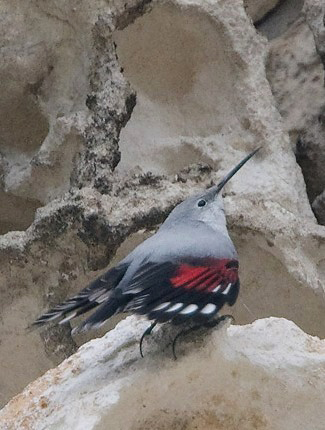
Wallcreeper by Michael McKee.
- A wonderful combination of wetland and mountain birds in the Camargue and Pyrenees
- Wetland birds which include Greater Flamingo, White Stork, herons, bitterns, Glossy Ibis, terns and shorebirds such as Black-winged Stilt
- Mountain birds which include Lammergeier, Black and Griffon Vultures, Wallcreeper, Alpine Chough, Alpine Accentor, Citril Finch and Snowfinch
- And some of Europe's and the world's other most spectacular birds including Eurasian Eagle-owl, Bonelli's, Golden and Short-toed Eagles, Little Bustard, Pin-tailed Sandgrouse, Bee-eater and Roller
- As well as a chance of Chamois, one of the highest diversities of butterflies in Europe and a rich flora which includes many orchids
- All in some superb scenery, not least the Pyrenees where the immense Cirque de Gavarnie is one of the top natural wonders of the world
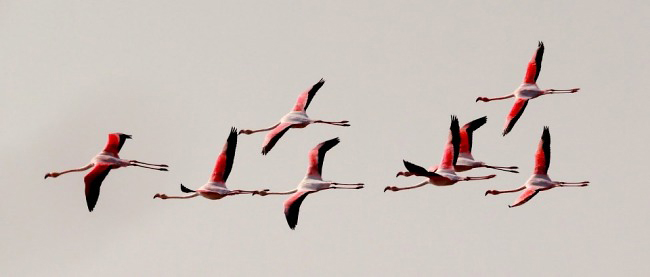
Greater Flamingoes by Spider.
- This account deals with the northern spring and summer. During the northern winter Wallcreeper is usually much easier to see. Clinging to a cliff-face this bird may appear quite plain with just its soft grey head and back showing but on taking flight it reveals flashes of gorgeous geranium-red and bright white spots in its big, broad, black wings as it flies like a giant butterfly from one precipice to another. Wallcreepers nest in the most inaccessible nooks and crannies of the highest Pyrenees but during the autumn some descend to much lower levels for the winter months where they are not averse to bridges and ruins, and even castles and cathedrals, but are more likely to be seen at traditional wintering sites. One such place, the most famous in France, is the easily accessible cliffs below the ruined castle of Les Baux in the low hills known as Les Alpilles near the Camargue, viewable from the footpath known as Chemin de Tremaie. Another good place to look is in the area around the Vierge Noire statue. The same hills support Bonelli's Eagle (especially from the Le Caume viewpoint), Eurasian Eagle-owl (behind the Hotel Mas de L'Oulivie) and Alpine Accentor, while birds present during the winter in the Camargue include thousands of ducks, Greater Flamingo, one or two Great Spotted and White-tailed Eagles, (Eurasian) Penduline-tit and Moustached Warbler, and at nearby Mont Ventoux the Chalet Reynard area is usually particularly good for Citril Finch and Snowfinch.
- This account does not deal with the French Alps where one of the few known reliable places to look for Rock Partridge, a European endemic, is the rocky slopes northeast of Modane. Citril Finch also occurs there.
- This account does not deal with the island of Corsica, easily accessible from Southern France. This scenic, sparsely populated, French island nearer the northwest coast of Italy than France supports the endemic Corsican Nuthatch, as well as Moltoni's (Subalpine) Warbler (summer), Marmora's Warbler, Mediterranean (Spotted) Flycatcher (summer), Italian Sparrow and Corsican (Citril) Finch. In addition there are several endemic subspecies, including the corsa race of Treecreeper, while more widespread birds include Lammergeier (rare and most likely at Haut Asco), Red Kite, Golden Eagle (scarce), Alpine Chough, Dartford Warbler and Spotless Starling, with summer visitors such as the badius subspecies of Woodchat Shrike which breeds on Corsica, Sardinia and the Balearic Islands. Around the coast and on some etangs it is possible to see a few Audouin's Gulls and offshore, Scopoli's (Cory's) and Yelkouan (Balearic) Shearwaters. The few mammals include Mouflon (most likely at Haut Asco) but there is a rich flora which includes many orchids and those usually in flower during early May (the best time to look for birds) include Sword-leaved Helleborine, Violet Limodore, Yellow Ophrys, Heart-flowered Serapias, and Barton’s, Man, Milky, Pink Butterfly and Tongue Orchids.
- (Moltoni's (Subalpine) Warbler breeds on Corsica and Sardinia, as well as around the Ligurian Sea (in northern Italy for example) and the Balearic Islands. It winters in Algeria and Sub-Saharan West Africa). Marmora's Warbler is resident on Corsica and Sardinia, and other islands in the Ligurian Sea next to northern Italy. It winters to northern Africa. Mediterranean (Spotted) Flycatcher breeds on Corsica, Sardinia and the Balearic Islands, and winters in west Africa. Italian sparrow occurs on Corsica, in northern Italy and neighbouring regions (with intermediates with House Sparrow in the Alps) and the rest of Italy including Sicily and other islands in the Mediterranean (with intermediates with Spanish Sparrow across central and southern Italy, and on Malta, Crete etc.)
Best Birds and other wildlife in Southern France
Birds
The birds listed here are usually present during the northern spring and summer.
Near-endemics
France, Spain and Portugal 2 Iberian Green Woodpecker and Iberian (Southern) Grey Shrike.
Other specialities
Greater Flamingo (14,000-15,000 pairs in the Camargue, down to about a quarter of this number during the northern
winter), Pin-tailed Sandgrouse, (Eurasian) Black (Cinereous) (reintroduced) and (Eurasian) Griffon Vultures,
Lammergeier, Western (Purple) Swamphen, Wallcreeper, Alpine Accentor, Rock Sparrow (Pont du Gard near Camargue),
(White-winged) Snowfinch and Citril Finch.
Others
(Black-crowned) Night, Purple and Squacco Herons, Great and Little Bitterns, Glossy Ibis, White Stork, Red-crested
Pochard, Montagu’s Harrier, Black and Red Kites, Bonelli’s, Booted, Golden and Short-toed Eagles, Lesser Kestrel,
Red-legged Partridge, Little Bustard, Stone Curlew (Eurasian Thick-knee), (Pied) Avocet, Black-winged Stilt,
Slender-billed Gull, Black, Gull-billed and Whiskered Terns, Great Spotted Cuckoo, Alpine Swift, (Eurasian) Hoopoe,
(European) Bee-eater, (European) Roller, Tawny Pipit, Calandra and (Greater) Short-toed Larks, (Eurasian) Crag
Martin, Western Black-eared Wheatear, Blue and Rufous-tailed Rock-thrushes, Zitting Cisticola (Fan-tailed
Warbler), Western Bonelli’s, Great Reed, Melodious, Moustached (this early breeder is easier to locate during the
winter and very difficult to see during the spring and summer), Sardinian, Spectacled and Western Subalpine Warblers,
Firecrest, Crested and Long-tailed Tits, Reedling (Bearded Tit), (White-throated) Dipper, Red-backed and Woodchat
Shrikes, (Eurasian) Golden Oriole, (Red-billed) Chough, Alpine Chough and Rock Bunting. Also a chance of Egyptian
Vulture, Collared Pratincole, White-winged (Black) Tern, (Eurasian) Scops-owl, Black Woodpecker, Western Orphean
Warbler and Lesser Grey Shrike.
Mammals
(Pyrenean) Chamois, Alpine Marmot (introduced), Red Squirrel and Coypu
(introduced).
Invertebrates
Over 100 butterfly species including Apollos and the Camargue is one of
the best sites in Europe for dragonflies, with over 30 species possible in July. Ant Lion also occurs there.
Plants
The rich flora includes many orchids. There are lots of unique plants in the Pyrenees, such as Pyrenean Saxifrage and
Ramonda, and the thousands of orchids include Pyramidal, Woodcock, Elder-flowered, Burnt and Broad-leaved Marsh Orchids. Early June, just before meadows
are cut, is the best time for orchids. May is the best time in the Cevennes when it is possible to see 25-30 orchids in a week, many in their thousands
including Early Purple, Green-winged, Military and even Lady Orchid, as well as two endemics; Aymonin’s Fly Orchid and Small Spider Orchid, a form of
Woodcock Orchid. (Farther east, in Vercors, the Delphine Alps is one of the richest regions in Europe for orchids with 64 species and subspecies including
the highly localized Ghost Orchid, as well as Bird’s-nest, Dense-flowered Fragrant and Globe Orchids, most of which can be seen around mid-July).
Other Natural Wonders in Southern France
Armand Cave
This cave near the Camargue is about 75 m (250 ft) below ground in a chamber
about 100 m (325 ft) long and 55 m (180 ft) wide. In it is an amazing ‘forest’ of ‘branched’ stalagmites, 400 in all,
rising to 30 m (100 ft).
Cirque de Gavarnie
This massive ice-carved cirque in the high French Pyrenees is 3.2 km
(2 miles) across with steep walls between 500 m and 700 m (1640 ft and 2297 ft) high, and a 422 m (1385 ft) high
waterfall. Along the rim is an impressive sheer-sided gap, known as the Breche-de-Roland, at 2800 m (9200 ft). Dominated
by three peaks over 3050 m (10,000 ft) the scene is completed by many wild flowers, butterflies such as Apollos,
beautiful birds such as the Wallcreeper and big birds for the big country, including Lammergeiers and Griffon Vultures.
Best Sites for Birds and other wildlife in Southern France
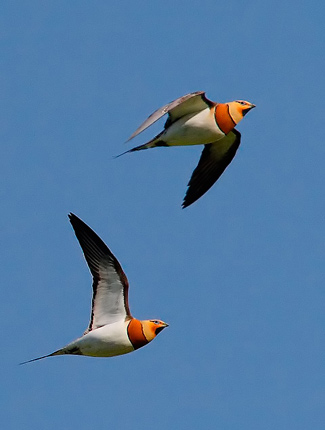
Look out for Pin-tailed Sandgrouses in La Crau. This cracking photo was taken by Steve Fletcher.
- Camargue Area
- Camargue Greater Flamingo, White Stork, Western Swamphen, Slender-billed Gull (especially on Salin de Giraud), Spectacled Warbler, herons, shorebirds and terns. Also a chance of Collared Pratincole.
- La Crau Little Bustard, Pin-tailed Sandgrouse, Lesser Kestrel, Roller and Iberian Grey Shrike.
- Les Alpilles including Les Baux Eurasian Eagle-owl (behind the Hotel Mas de L'Oulivie) and Blue Rock-thrush. Also a chance of Bonelli's Eagle (especially from the Le Caume viewpoint).
- Mont Ventoux Citril Finch and Rock Bunting. Also a chance of Black Woodpecker.
- Cevennes Raptors including Black and Griffon Vultures, butterflies (70-80 species possible in a week during the second half of June) and a rich flora including many orchids. Also a chance of Western Orphean Warbler and Rock Sparrow.
- Pyrenees Lammergeier, Griffon Vulture, Golden Eagle, Water Pipit, Alpine and Red-billed Choughs, Rufous-tailed Rock-thrush, Wallcreeper, Alpine Accentor, Citril Finch, Snowfinch (confiding around the ski station at Col du Tourmalet) and Rock Bunting, as well as Chamois, Alpine Marmot and many orchids. Also a chance of Bonelli’s Eagle and Black Woodpecker (La Lienz). Particularly good valleys around Gavarnie include Port de Boucharo and Valle D'Ossue.
Best Times for Birds and other wildlife in Southern France
The Greater Flamingo colony in the Camargue is usually at its most active during May and the second half of May is arguably the best time for birds in general around the Camargue. The best time for the greatest variety of butterflies in the Pyrenees is usually from mid-June to mid-July, and July is usually the best time for dragonflies in the Camargue. May is normally the best time for orchids in the Cevennes, early June in the Pyrenees.
Some flowers bloom in early September when many butterflies are still on the wing and numerous migrant birds pass through the Camargue and the Pyrenees.
Recommended Bird Books etc. for Southern France
Collins Bird Guide by L Svensson et al. Collins, 2010 (Second Edition).
Birds of Europe by L Jonsson. Helm, 1999.
Where to Watch Birds in France by J-Y Barnagaud, N Issa and S Dalloyau. Pelagic Publishing, 2019.
A Birdwatching Guide to France South of the Loire including Corsica by J Crozier. Subbuteo, 2007.
Where to Watch Birds in France edited by P Dubois. Helm, 2006 (Second Edition).
Mammals of Europe, North Africa and the Middle East by S Aulagnier et al. Helm, 2009.
Mammals of Britain and Europe by D McDonald and P Barrett. Collins, 2005.
Collins Butterfly Guide by T Tolman and R Lewington. Collins, 2009.
Butterflies of Britain and Europe: A Photographic Guide by H Aarnio et al. A & C Black Publishers, 2009.
Wild Flowers of the Mediterranean by M Blamey and C Grey-Wilson. A & C Black, 2004.
Apps etc.
Collins Bird Guide.
Where to watch birds in Europe & Russia by N Wheatley. Helm, 2000.
Don’t know which country/countries/regions to visit in Europe? Then it may be worth considering taking a look at this book, written by this website’s author. It is many years old of course but it still provides a starting point, an overview and a guiding light to the best birds and the best places to look for them in the region, and could save hours of searching for similar information on the internet. However, it is important to check more up-to-date sources for sites which have been opened up, sites and species which have been discovered, lodges that have been built etc. since the book was published.
Birding and Wildlife Trip Reports for Southern France
Many trip reports, some for Southern France, are posted on the websites listed here. On some of these websites some reports are independent and some are posted by tour companies who organize tours to Southern France. These tour companies and others also post their own reports on their websites, which are listed under 'Some Organized Tours to Southern France' below.
- The best website for trip reports is CloudBirders
- but these are also worth a look
- Birdtours
- Fatbirder
- Jon Hornbuckle
- Mammal Watching
Local bird and wildlife guides in Southern France
The costs of organized tours partly reflect the quality of the tour leaders. Some leaders are certainly better than others and many companies claim their leaders are the best but even the best rely at least to some extent on the exceptional skills of the local guides they employ. If you are travelling independently, employing such local guides will greatly increase your chances of seeing the wildlife you wish to see.
Accommodation for birders in Southern France
Some Organized Tours for birds and other wildlife to Southern France
There are many tour companies who organize tours to see mammals, birds, other wildlife and other natural wonders. The cost of these tours vary considerably according to such variables as the airlines used, the number of days the tours last, the number of sites visited, the number of people in the group (an important consideration if you wish to see such wildlife as rainforest mammals and birds), the number of tour leaders, the standard of accommodation and transport, and the percentage profit the company hopes to make. Generally, where the number of days tours last and the number of sites visited are similar, the cheapest tours are those that use the cheapest airlines, accommodation and local transport, that have the largest groups with the least number of leaders, and that make the least amount of profit. The most expensive tours tend to be those which are exceptionally long, use the most expensive accommodation (ridiculously lavish in some cases, even for single nights) and which make the most profit. Some tour costs partly reflect the quality of the tour leaders. Some leaders are certainly better than others and many companies claim their leaders are the best but even the best rely at least to some extent on the exceptional skills of the local guides they employ.
While tour companies organize tours with set itineraries many also organize custom tours for individuals and private groups who instead of taking a tour with a set itinerary want to follow their own itinerary to suit their own personal tastes, whether it be mammals, birds, other wildlife, other natural wonders or even man-made attractions, or a mixture of them all. Many organized tours with set itineraries are also fast-paced and target as many species as possible, whether they are mammals, birds or other wildlife or everything, which usually leaves little time to enjoy the best sites and individual species, but on a custom tour those taking part can specify the pace and the sites and species they wish to concentrate on. Custom tours also suit people who like to travel with people they already know, rather than with a group of strangers, and they are popular with people with partners with different interests. Individuals, partners and small groups will almost certainly have to pay more for a custom tour than an organized tour with a set itinerary but a large group of friends may be able to travel for less than the price quoted for a set tour.
Tour companies who run organized tours to Southern France include the following. Many of these also offer custom tours.
