
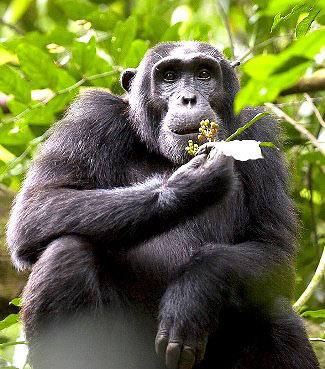
The Chimpanzees in the Kibale Forest can be intimidating at times, intriguing at others. This great image was taken there by Francesco Veronesi.
- A densely populated but mainly luxuriant green country without extensive areas of savanna and some of the classic animals of the African plains but ...
- In the mountain forests it is possible to spend an hour with Gorillas - possibly the ultimate wildlife experience
- And another hour ... with Chimpanzees - also possibly the ultimate wildlife experience
- There are also lots of monkeys including beautiful Black-and-white Colobuses
- And, taking into account its small size, Uganda is Africa's richest country for birds!
- Over a thousand bird species have been recorded and it is possible to see half of them in just two weeks, including some of Africa's and the world's most spectacular, not least African Fish-eagle, Goliath Heron, Saddle-billed Stork, Grey Parrot, Great Blue Turaco and Hamerkop
- As well as some of Africa's and the world's most spectacular localized birds, such as Shoebill, Brown-chested Lapwing and Green-breasted Pitta
- And including 24 Albertine Rift Endemics, such as Grauer's Broadbill, Black-faced Apalis, Blue-headed, Purple-breasted and Regal Sunbirds, and Dusky Crimsonwing
- All in some wonderful settings, from papyrus swamps along the Nile to luxuriant tropical forests
- Read Gorillas in the Mist, the wonderful book by Dian Fossey, try to get some sleep, meet the rangers in the morning, listen to their instructions carefully, join the small group of fellow trekkers and head off with high anticipation and overflowing adrenalin along the muddy and sometimes slippery switchback trails up through the lush, damp, sometimes misty, 'Impenetrable Forest' of Bwindi, in the deep, far southwest corner of Uganda next to the Congo. One to five hours later, the guides, having spoken on their radios to the trackers who have been out since dawn, will stop. The troop is near and more often than not the first one to emerge from the undergrowth will be the biggest, the magnificent silverback, and visitors seeing him for the first time will more likely than not stand open-mouthed in awe … not in fright … at his huge domed head, massive shoulders, great bare chest and peaceful all-consuming presence, just a few paces away. Then his family will appear and the allotted hour with Mountain Gorillas will pass in what seems like seconds, arguably the most awesome wildlife experience will be over and your life may have changed for ever.
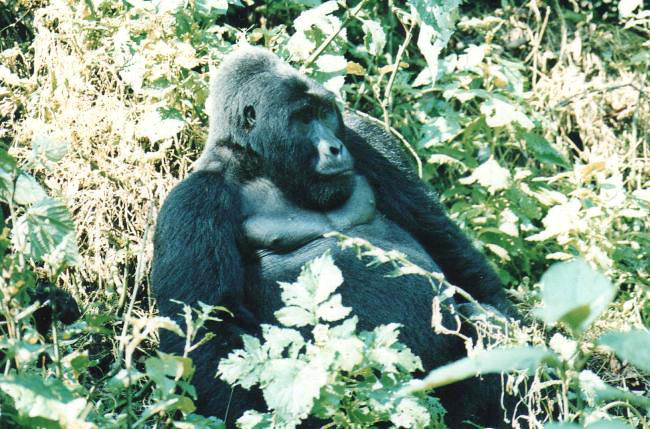
The magnificent silverback Mwirima of the Rushegura group sitting in the sunshine, not something he did very often, at Bwindi in 2005, by Alice Perry (Mwirima died in 2014).
- Deep in the heart of Africa, in the largest, remotest swamps, from South Sudan to Zambia, lives an extraordinary creature called a Shoebill, a big, long-legged bird with a massive, hooked, clog of a bill about 20 cm long, 10 cm wide and 10 cm deep. They may be big but these rare and shy loners like their habitation to be vegetation higher than a human, another reason why they are one of the hardest birds to see on Earth. The most easily accessible place where there is a good chance of finding one is Mabamba Swamp, a couple of hours from Entebbe, but the best place to see one is on the Nile, further north in Murchison Falls National Park. A boat trip upstream to the 40 m high falls is unlikely to be successful but a slow drift downstream past numerous Hippos, some of Africa’s largest crocodiles, African Fish Eagles, Goliath Herons and Giant Kingfishers takes visitors to the beautiful and bountiful inland delta formed where the Nile flows into Lake Albert. There a knowledgeable boatman can access the vast stands of papyrus and show you a ‘blue stone statue’ with pale eyes, a bird which is adept at standing stock still otherwise known as the Shoebill.
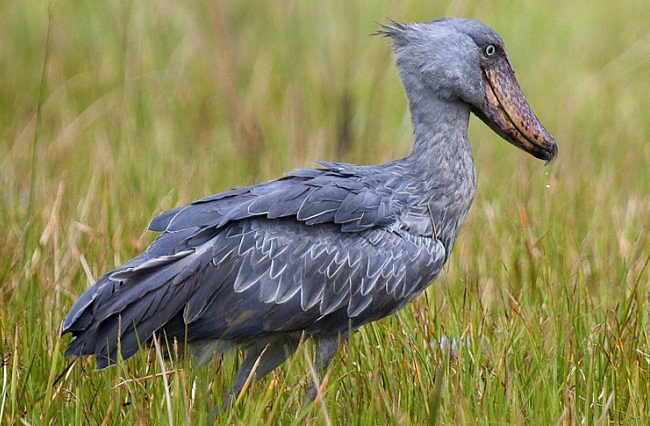
Shoebill at Mabamba in Uganda by Francesco Veronesi.
- As already mentioned it is possible to see over half of the thousand or so bird species recorded in Uganda in a couple of weeks on a well-planned and/or well-led tour. For example Rockjumper recorded 550 species (seeing 540 of them) in 19 days in July 2016 (as well as 40 mammal species) while Birdquest amassed 602 species (seeing 590 of them) in 24 days in 2014 (as well as 53 mammal species). This is impressive but not as good as neighbouring Kenya where Rockjumper recorded 823 species (seeing 806 of them) in 26 days in April 2011 including 5 endemics, 8 storks, 60 raptors (including 14 falcons), 6 bustards, 10 turacos, 9 owls, 10 bee-eaters, 10 hornbills, 28 sunbirds and 23 starlings (as well as over 80 mammal species) while Birdquest saw 812 and recorded 817 in 29 days in October-November 2012 including over 600 in the west of the country alone and nearly 600 in the north and east! However, there are two countries where it is possible to record even higher numbers of species than in Kenya on such short trips and they are Ecuador and Colombia. In Ecuador Birdquest recorded an astonishing 891 species (825 of which were seen) in 25 days in October 2016 including 720 during the first 16 days before the Amazonia section, a list which included 77 hummingbirds, 21 nightbirds, 22 woodpeckers, 14 toucans, 18 cotingas and 107 tanagers and allies! In Colombia though over 1000 species are possible in a month and Rockjumper have managed this on three occasions, including 2014 when they recorded an incredible 1044 species in 29 days in January-February! A list which included 63 endemics, 36 parrots, 9 owls, 11 nightjars, 86 hummingbirds, 10 trogons, 15 puffbirds, 16 toucans, 27 woodpeckers, 60 antbirds, 14 antpittas, 14 cotingas, 12 manakins and 113 tanagers and allies.
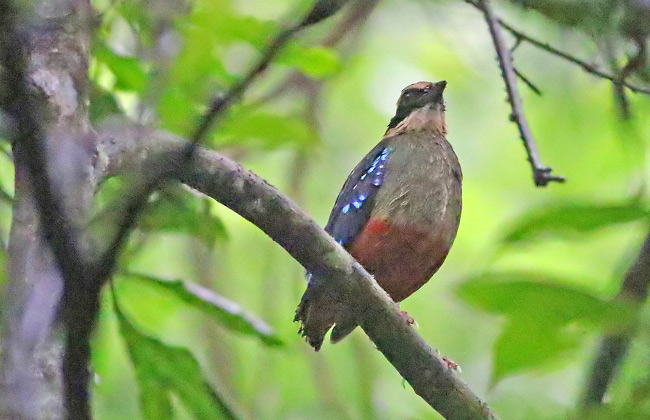
A rare and shy Green-breasted Pitta in Kibale Forest in July 2019 by Chris Townend.
Best Birds and other wildlife in Uganda
Birds
Endemics 1
Fox's Weaver.
Near-endemics
Uganda and Democratic Republic of Congo (DRC) 7 Nahan’s Partridge (Francolin), Chestnut (African Barred) Owlet, Grauer’s (Green) Broadbill, Ituri Batis, Sassi’s Olive Greenbul, Oberlander’s Ground-thrush and Golden-naped Weaver.
Uganda, DRC, Rwanda and Burundi 23 Handsome Francolin, Rwenzori Turaco, Dwarf Honeyguide, Rwenzori Batis, Albertine Sooty Boubou, Stripe-breasted Tit, Grauer’s Warbler, Rwenzori Apalis, Black-faced Apalis, Grauer’s Swamp-warbler, Red-faced Woodland-warbler, Neumann’s Warbler, Red-collared Mountain-babbler, Yellow-eyed Black-flycatcher, Archer’s Robin-chat, Red-throated Alethe, Blue-headed Sunbird, Purple-breasted Sunbird, Rwenzori (Stuhlmann’s) Double-collared Sunbird, Regal Sunbird (range also reaches Tanzania), Strange Weaver, Dusky Crimsonwing and Shelley’s Crimsonwing.
(The 36 Albertine Rift Endemic Birds are Handsome Francolin, Prigogine's Nightjar, Rwenzori Turaco, Congo Bay-owl, Albertine Owlet, Dwarf Honeyguide, Grauer's (Green) Broadbill, Grauer's Cuckooshrike, Yellow-crested Helmetshrike, Rwenzori Batis, Albertine Sooty Boubou, Stripe-breasted Tit, Lendu Crombec, Grauer's Warbler, Rwenzori (Collared) Apalis, Black-faced (Mountain Masked) Apalis, Kabobo Apalis, Kungwe Apalis, Grauer's Swamp-warbler, Prigogine's Greenbul, Red-faced Woodland-warbler, Neumann's (Short-tailed) Warbler, Red-collared Mountain-babbler, Chapin's Mountain-babbler, Chapin's Flycatcher, Yellow-eyed Black-flycatcher, Archer's Robin-chat, Red-throated Alethe, Blue-headed Sunbird, Purple-breasted Sunbird, Rwenzori (Stuhlmann’s) Double-collared Sunbird, Regal Sunbird, Rockefeller's Sunbird, Strange Weaver, Dusky Crimsonwing and Shelley's Crimsonwing)
Uganda, DRC, RC and CAR 1 Grey-capped Capuchin Babbler.
Uganda, DRC and Tanzania 2 Weyns’s Weaver and Jameson’s Antpecker.
Uganda, Rwanda, Burundi and Tanzania 1 Red-faced Barbet.
Uganda and Burundi 1 Willard’s Sooty Boubou.
Uganda and Kenya 1 Elgon (Moorland) Francolin.
Uganda, Kenya and DRC 1 Chapin’s Flycatcher.
Uganda, Kenya and Tanzania 1 Lynes’s (Wailing) Cisticola.
Uganda, Kenya, Ethiopia and South Sudan 1 Jackson’s Hornbill.
Uganda, Kenya, Ethiopia and Somalia 3 Yellow-vented Eremomela, Pale Prinia and Bristle-crowned Starling.
Other specialities
Hartlaub's Duck, Shoebill, Brown-chested Lapwing (mostly late July-Dec), Rufous-sided Broadbill, Green-breasted Pitta (mostly Jul-Sep), Jameson’s
Wattle-eye, Willard's (Mountain) Sooty Boubou, Papyrus Gonolek, Papyrus Yellow Warbler, White-winged Swamp-warbler, Kakamega Greenbul, Puvel's Illadopsis,
Black-lored Babbler, Banded and Black-faced (Banded) Prinias, Grey-headed Sunbird, Northern Brown-throated Weaver and Kandt's (Black-headed) Waxbill. Also
a chance of Nkulengu Rail and Blue Swallow (mostly May-Sep).
Others
African Pygmy Goose, Pink-backed Pelican, Hamerkop, Goliath Heron, Saddle-billed Stork, African Darter, vultures, African Fish-eagle, African Crowned and
Martial Eagles, African Finfoot, African Crake, Grey Crowned Crane, Black-bellied and Denham's Bustards, African and Lesser Jacanas, Temminck's Courser,
Rock Pratincole, African Skimmer, Verreaux's Eagle-owl, Pennant-winged (mostly May-Aug) and Standard-winged (mostly Sep-Apr) Nightjars, Grey Parrot,
Red-headed Lovebird, cuckoos including African Emerald and Dusky Long-tailed, mousebirds, Black-billed, Great Blue and White-crested Turacos, Bar-tailed
and Narina Trogons, kingfishers including Blue-breasted, Chocolate-backed and Giant, bee-eaters including Black, Blue-breasted, Cinnamon-chested,
Madagascar (mostly Apr-Sep), Red-throated and Swallow-tailed, Blue-throated and Lilac-breasted Rollers, Forest and White-headed Woodhoopoes, hornbills
including White-crested and White-thighed, Abyssinian Ground-hornbill, barbets, Vanga (Black-and-white Shrike) Flycatcher, Black-headed Gonolek, Bocage's,
Doherty's, Four-coloured, Luhder's and Sulphur-breasted Bushshrikes, African and Red-bellied Paradise-flycatchers, Piapiac, greenbuls, apalises including
Black-throated, Uganda Woodland-warbler, Silverbird, White-starred Robin, alethes, robin-chats, Rufous Flycatcher-thrush, starlings including Purple and
Splendid, Yellow-billed Oxpecker, sunbirds, weavers, malimbes, Brown and Dusky Twinspots, Red-headed Bluebill and Black-bellied Seedcracker. Also a chance
of White-backed Night-heron, Rufous-bellied Heron, Dwarf Bittern, Red-chested and White-spotted Flufftails, Yellow-throated Cuckoo and Grey
Ground-thrush.
Mammals
(Mountain) Gorilla, Chimpanzee, (Eastern) Black-and-white Colobus Monkey, Lion, African Elephant,
Giraffe, Hippopotamus, Spotted Hyaena, Burchell's Zebra, African Buffalo, Olive Baboon, (Eastern/Uganda) Red Colobus, Uganda Crested Mangabey and
Dent's, Gentle (Blue), L'Hoest's, Patas and Red-tailed Monkeys, Giant Forest Hog, Eland, (Uganda) Kob, Bushbuck, Klipspringer, Oribi, Waterbuck,
Impala, (Uganda) Topi, (Llewel) Hartebeest, Black-fronted Duiker and galagos. Also a chance of Leopard and Blotched Genet.
Reptiles, Amphibians and Fish
Nile Crocodile.
Other Natural Wonders of Uganda
River Nile The longest river in the world runs from Burundi through Lake Victoria, Uganda, Sudan (where it is joined, at Khartoum, by the Blue Nile which springs from Lake Tana in Ethiopia) and Egypt to the Mediterranean for 6695 km (4160 miles), draining about a tenth of the African continent in the process. Some scientists believe that the River Amazon is longer but most agree that it is 180 km (110 miles) shorter than the Nile at 6515 km (4050 miles).
Best Sites for Birds and other wildlife in Uganda
- Mabamba Shoebill. Also a chance of African Pygmy Goose, Lesser Jacana, Blue-breasted Bee-eater, Blue Swallow, Papyrus Gonolek, Red-chested Sunbird and Brown Twinspot.
- Mabira Forest Tit Hylia, as well as Grey Parrot, Forest Woodhoopoe, Yellow-spotted Barbet, Lowland Sooty Boobou, Chestnut Wattle-eye, Forest Robin, Rufous Flycatcher-thrush, White-throated Greenbul, Yellow-lored Bristlebill, Superb Sunbird, Weyn's Weaver, Red-headed Malimbe and Black-bellied Seedcracker. Also a chance of White-spotted Flufftail, Afep Pigeon, Shining-blue Kingfisher and Jameson's Wattle-eye.
- Budongo Forest including the Royal Mile track Chimpanzee, Nahan's Francolin, Afep Pigeon, Grey Parrot, Dusky Long-tailed Cuckoo, Black-billed Turaco, African Dwarf, Blue-breasted, Chocolate-backed and Shining Blue Kingfishers, Blue-throated Roller, White-thighed Hornbill, Ituri Batis (Busingiro section), Chestnut and Jameson's Wattle-eyes, Chestnut-capped and Forest Flycatchers, Fire-crested Alethe, Scaly-breasted Illadopsis, Grey Longbill, Green and Lemon-bellied Crombecs, Rufous-capped Eremomela and Uganda Woodland-warbler. Also a chance of White-spotted Flufftail and Puvel's Illadopsis (at Kaniyo Pabidi, the only known site for this species in East Africa).
- Murchison Falls NP Hippopotamus, Nile Crocodile, Hartebeest, Oribi, Patas Monkey, Olive Baboon, Shoebill, Heuglin's Francolin, Black-bellied and Denham's Bustards, Rock Pratincole, White-crested Turaco, Greyish Eagle-owl, Pennant-winged Nightjar (May-Aug), several kingfishers including Giant, bee-eaters including Blue-breasted, Red-throated and Swallow-tailed, Abyssinian Ground-hornbill, Papyrus Gonolek, Black-headed Batis, Spotted Palm Thrush, Silverbird, Chestnut-crowned Sparrow-weaver and Tsetse Flies! Also a chance of Standard-winged Nightjar (Sep-Apr).
- Kibale Forest NP Green-breasted Pitta and Chimpanzee, as well as African Crowned Eagle, Cassin’s Hawk-eagle, Afep Pigeon, Black and Red-chested Cuckoos, Sabine’s Spinetail, Black Bee-eater, Blue-throated Roller, White-headed Woodhoopoe, Speckled Tinkerbird, Willcocks’s Honeyguide, Petit’s Cuckooshrike, Dusky Tit, Red-tailed Bristlebill, Little and White-throated Greenbuls, Lowland Masked Apalis, Pale-breasted and Scaly-breasted Illadopsises, Purple-headed Starling, Brown-chested and Fire-crested Alethes, Blue-shouldered and Red-capped Robin-chats, Rufous Flycatcher-thrush, Vieillot’s Black Weaver, Red-headed Bluebill, monkeys and galagos. Also a chance of White-spotted Flufftail.
- Semliki Hartlaub’s Duck, Yellow-throated Cuckoo, White-bellied Kingfisher, Black-and-white-casqued, Black-casqued, Crowned, Piping, Red-billed Dwarf Hornbill and White-crested Hornbills, Rufous-sided Broadbill, Jameson’s Wattle-eye, Chestnut-capped Flycatcher, Dusky Crested-flycatcher, Yellow-throated Nicator, Forest Robin, White-tailed Ant-thrush, Lemon-bellied Crombec, Red-headed Bluebill, Black-bellied Seedcracker, Orange-cheeked Waxbill and monkeys. Also a chance of Nkulengu Rail and Grey Ground-thrush.
- Queen Elizabeth NP Over 600 bird species recorded including White-headed Vulture, Brown and Black-chested Snake-eagles, African Crake, Temminck's Courser, African Skimmer, Black Coucal, larks and Papyrus Gonolek, as well as mammals such as Lion (tree-climbing in Ishasha section), African Elephant, Hippopotamus, Spotted Hyaena, Giant Forest Hog, Kob and Topi, plus Nile Crocodile. Also a chance of Brown-chested Lapwing and Leopard.
- Buhoma - Bwindi Impenetrable Forest NP Gorilla, as well as African Emerald Cuckoo, Black-billed Turaco, Bar-tailed Trogon, Black and Cinnamon-chested Bee-eaters, Blue-throated Roller, Rwenzori Batis, Willard's Sooty Boubou, Bocage's, Luhder's and Four-coloured Bushshrikes, Grey-winged, Red-capped and White-bellied Robin-chats, Equatorial Akalat, Red-throated Alethe, Black-throated Apalis, greenbuls including Kakamega and Yellow-whiskered, Black-faced Rufous, Red-faced Woodland and Neumann's Warblers, Yellow-eyed Black-flycatcher, Blue-headed and Purple-breasted Sunbirds, Oriole Finch and Jameson’s Antpecker.
- 'The Neck' - Bwindi Impenetrable Forest NP Afep Pigeon, Dusky Long-tailed Cuckoo, Chestnut-throated Apalis, Black-faced Prinia and Red-tailed Ant-thrush.
- Ruhija/Mubwindi Swamp Trail - Bwindi Impenetrable Forest NP most of the Albertine Rift Endemics present including Grauer's Broadbill, Rwenzori Batis, Archer's Robin-chat, Yellow-eyed Black-flycatcher, Black-faced Prinia, Black-faced and Rwenzori Apalises, Grauer's, Grauer's Swamp and Red-faced Woodland Warblers, Stripe-breasted Tit, Blue-headed and Regal Sunbirds, Strange Weaver and Kandt's Waxbill, as well as African Olive-pigeon, White-headed Woodhoopoe, Doherty's Bushshrike, Chestnut-throated Apalis, Rwenzori (African) Hill Babbler, starlings and Dusky Twinspot. Also a chance of Montane (Rwenzori) Nightjar.
- Lake Bunyoni Papyrus Yellow Warbler and White-winged Swamp-warbler.
- Mgahinga Gorilla NP Rwenzori Turaco, Rwenzori Double-collared Sunbird and Golden Monkey, as well as Western Green Tinkerbird, Doherty’s Bushshrike, Cinnamon Bracken-warbler, Rwenzori Apalis, Rwenzori Hill Babbler, Archer’s Robin-chat, Regal Sunbird, Dusky Crimsonwing and Kandt’s Waxbill. Also a chance of Shelley’s Crimsonwing (‘The Gorge’).
- Lake Mburo NP Pennant-winged Nightjar and Red-faced Barbet, as well as White-backed Night-heron, African Finfoot, Red-headed Lovebird, Lilac-breasted Roller, Papyrus Gonolek, White-winged Swamp-warbler, Swamp Flycatcher, Holub’s Golden and Northern Brown-throated Weavers, Hippopotamus, Buffalo, Burchell's Zebra, Eland, Topi, Bushbuck, Impala, Klipspringer (kopje at Mihingo Lodge), Oribi and Greater Galago. Also a chance of Rufous-bellied Heron, Dwarf Bittern, Brown-chested Lapwing, Leopard and Blotched Genet.
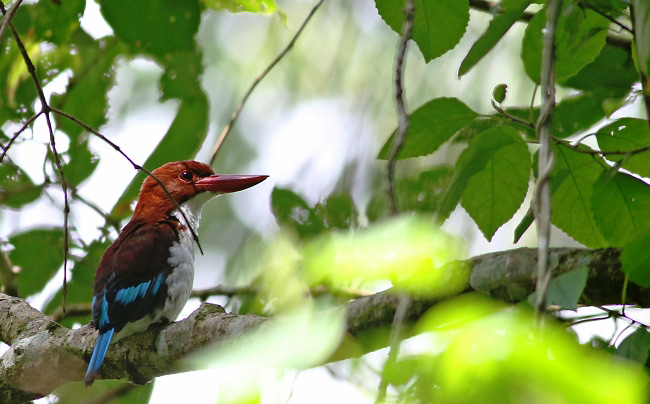
A fine image of a Chocolate-backed Kingfisher along the Royal Mile by Chris Townend.
- Off the main circuit
- Lake Bisina Shoebill, African Pygmy Goose and Lesser Jacana. Also a chance of Fox's Weaver.
- Lake Kyoga Fox's Weaver.
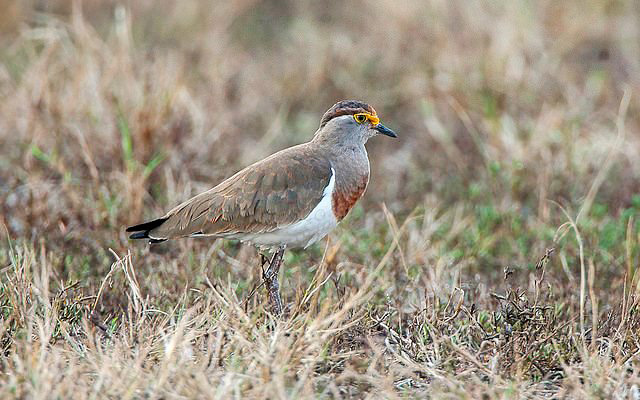
Brown-chested Lapwing at Lake Mburo National Park in Uganda by Francesco Veronesi.
Best Times for Birds and other wildlife in Uganda
Gorillas, Chimpanzees, Shoebills and African Green Broadbills may be seen all year round but are best looked for during the two dry seasons which usually last from December to February/March and from June to August/September. If other birds are important too and especially the very rare and elusive Green-breasted Pitta then the peak time to visit is July-August when this species usually sings the most and is therefore relatively easier to locate, although there may be several bird tour groups looking for it at peak time. Once nesting is under way it is present until at least September but much quieter. Late July-August also happens to coincide with the presence of Brown-chested Lapwing, another very rare and localized bird.
Temperatures are more or less the same all year round throughout lowland Uganda, with an average of about 21°C to 31°C during the day and about 16°C at night. In the highlands temperatures may fall as low as 10°C and it is much wetter there.
Recommended Bird Books etc. for Uganda
Field Guide to the Birds of East Africa by T Stevenson and J Fanshawe. Helm, due 2020 (Second Edition).
Birds of Africa south of the Sahara by I Sinclair and P Ryan. C Struik, 2011 (Second Edition).
Where to Watch Birds in Uganda by J Roussow and M Sacchi. Uganda Tourist Board, 1998.
The Kingdon Field Guide to African Mammals by J Kingdon. Bloomsbury, 2015 (Second Revised Edition).
The Kingdon Pocket Guide to African Mammals by J Kingdon. Bloomsbury, 2016 (Second Edition).
Bradt Travel Guides: East African Wildlife by P Briggs. Bradt, 2015 (Second Edition).
Watching Wildlife: East Africa by M D Firestone et al. Lonely Planet, 2009 (Second Edition).
Apps etc.
The Kingdon Guide to African Mammals.
Audubon African Wildlife.
eGuide to Birds of East Africa.
Where to watch birds in Africa by N Wheatley. Helm, 1995.
Don’t know which country/countries to visit in Africa? Then it may be worth considering taking a look at this book, written by this website’s author. It is many years old of course but it still provides a starting point, an overview and a guiding light to the best birds and the best places to look for them on the continent, and could save hours of searching for similar information on the internet. However, it is important to check more up-to-date sources for sites which have been opened up, sites and species which have been discovered, lodges that have been built etc. since the book was published.
Birding and Wildlife Trip Reports for Uganda
Many trip reports, some for Uganda, are posted on the websites listed here. On some of these websites some reports are independent and some are posted by tour companies who organize tours to Uganda. These tour companies and others also post their own reports on their websites, which are listed under 'Some Organized Tours to Uganda' below.
- The best website for trip reports is CloudBirders
- but these are also worth a look
- Birdtours
- Fatbirder
- Jon Hornbuckle
- Mammal Watching
Local bird and wildlife guides in Uganda
The costs of organized tours partly reflect the quality of the tour leaders. Some leaders are certainly better than others and many companies claim their leaders are the best but even the best rely at least to some extent on the exceptional skills of the local guides they employ. If you are travelling independently, employing such local guides will greatly increase your chances of seeing the wildlife you wish to see.
- Shoebill Safaris
- Shoebill SAFARIS is one of the leading eco-tour operators for bird watching, gorilla tracking and safaris. With over 1600 different bird species, Uganda is definitely a must for any bird watcher. From swamps and tropical forest to the rift Valley you are sure to record as many species as your eyes can see.

Accommodation for birders in Uganda
Some Organized Tours for birds and other wildlife to Uganda
There are many tour companies who organize tours to see mammals, birds, other wildlife and other natural wonders. The cost of these tours vary considerably according to such variables as the airlines used, the number of days the tours last, the number of sites visited, the number of people in the group (an important consideration if you wish to see such wildlife as rainforest mammals and birds), the number of tour leaders, the standard of accommodation and transport, and the percentage profit the company hopes to make. Generally, where the number of days tours last and the number of sites visited are similar, the cheapest tours are those that use the cheapest airlines, accommodation and local transport, that have the largest groups with the least number of leaders, and that make the least amount of profit. The most expensive tours tend to be those which are exceptionally long, use the most expensive accommodation (ridiculously lavish in some cases, even for single nights) and which make the most profit. Some tour costs partly reflect the quality of the tour leaders. Some leaders are certainly better than others and many companies claim their leaders are the best but even the best rely at least to some extent on the exceptional skills of the local guides they employ.
While tour companies organize tours with set itineraries many also organize custom tours for individuals and private groups who instead of taking a tour with a set itinerary want to follow their own itinerary to suit their own personal tastes, whether it be mammals, birds, other wildlife, other natural wonders or even man-made attractions, or a mixture of them all. Many organized tours with set itineraries are also fast-paced and target as many species as possible, whether they are mammals, birds or other wildlife or everything, which usually leaves little time to enjoy the best sites and individual species, but on a custom tour those taking part can specify the pace and the sites and species they wish to concentrate on. Custom tours also suit people who like to travel with people they already know, rather than with a group of strangers, and people with partners with different interests. Individuals and small groups will almost certainly have to pay more than the price of an organized tour with a set itinerary but a large group of friends may be able to travel for less than the price quoted for a set tour.
Tour companies who run organized tours or can arrange custom tours to Uganda include the following. Check to see if Gorilla Tracking Permits (US$500 and rising) are included in the price.
- Birdquest
- Field Guides
- Rockjumper
- Victor Emanuel Nature Tours
- Wings
- Wise Birding Holidays
- We are a small wildlife watching holiday company based in Devon (UK) specialising in birdwatching and mammal watching holidays across the world. What sets us apart from other wildlife watching companies is quite simple:
- 1 – small group sizes: (average between 4 – 8 people)
- 2 – a commitment to conservation: (donation after each tour)