
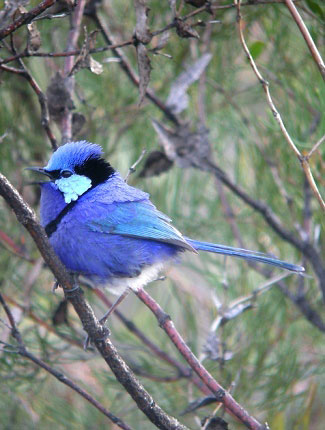
An aptly-named male Splendid Fairy-wren, photographed in the Stirling Ranges by Mark Harper.
- A high percentage of endemic mammal species, seven endemic bird families and over 360 endemic bird species (about half of those which occur regularly) make Australia unique in the true sense of the word
- About 20 birds endemic to Southwest Australia including Long-billed and Short-billed Black-cockatoos, Red-capped Parrot, Noisy Scrub-bird, Red-winged Fairy-wren, Western Bristlebird, Western Spinebill, Western Shrike-tit, Western Whipbird and Red-eared Firetail
- And more widespread Australian endemics including Emu, Malleefowl, Red-tailed Black-cockatoo, Splendid and White-winged
Fairy-wrens, and Western Bowerbird - While endemic mammals include Numbat, Honey Possum and Western Grey Kangaroo
- And more widespread species such as Short-beaked Echidna
- Although, arguably, it is the spectacular marine life which makes Western Australia special, what with Dugongs, Whale Sharks, Manta Rays, Southern Right and Humpback Whales, Bottlenose Dolphins, sealions, fur seals, Green and Loggerhead Turtles, Leafy and Weedy Sea Dragons, and even Stromatolites, living examples of the first life forms to have evolved on Earth
- All in some scenic surroundings and one of the best places in the world for wild flowers
- Dugongs, strange relatives of elephants which can grow up to three metres long, live in warm, shallow waters around the equator, from east Africa to the west Pacific, with the largest population – over 10,000 of them - in the Shark Bay/Ningaloo Reef/Exmouth Gulf area of Western Australia, the majority of them in Shark Bay, also famous for the tame Bottlenose Dolphins at Monkey Mia and Stromatolites, living examples of the first life forms to have evolved on Earth. The huge, shallow lagoon known as Shark Bay is about 820 km north of Perth; a ten hour drive or two-and-a-half-hour flight. The reason why Shark Bay is so good for Dugongs is the presence of extensive meadows of seagrass on which they graze. Their long snouts have big, bristly upper lips which they use to strip the leaves of grass or snuffle up rhizomes from the sea bed while able to stay underwater for up to six minutes. Although they may look slow they can swim at 20 km per hour over short distances, but this is not swift enough to avoid boats so the sailing catamarans which are allowed to carry visitors to see the herds of these ‘sea cows’ travel very slowly.
- Christmas Island, Australian territory accessible by air from Perth (but much closer to Java in Indonesia), is the only breeding site in the world of Abbott's Booby and Christmas Frigatebird, and also supports Red-tailed and White-tailed (Golden) Tropicbirds, Red-footed Booby, Great and a few Lesser Frigatebirds, and four endemic landbirds; an imperial-pigeon, a swiftlet, a boobook and a white-eye. More famous are the Red Crabs, an estimated 50 million of which live on this 135 sq km (52 sq mile) island and which usually migrate from the forest to the coast to spawn at the high spring tide during the last quarter of the moon in October (mostly), November or December, at the beginning of the wet season. The mass of crab eggs often attracts Manta Rays and Whale Sharks. The largest land crustacean, the Coconut or Robber Crab, is also present. One tour company which organizes tours to Christmas Island is Wildwings.
- Australia is an island-continent not a small country and to look for all of its best wildlife in one go would involve a trip lasting several months. Therefore it is probably best to plan several visits: to nearby Northwestern Australia where the endemic Black Grasswren occurs on the Mitchell Plateau in the Kimberley; Northern Australia where Hooded Parrot, Rainbow Pitta and White-throated Grasswren occur, along with the famous waterbirds and Saltwater Crocodiles of Kakadu; Outback Australia where it is possible to see Red Kangaroos and birds such as Malleefowl and Letter-winged Kite; Southeastern Australia where it is possible to see Koala, Platypus, Tasmanian Devil and birds such as Superb Lyrebird, Little Penguin and Plains-wanderer; and Eastern Australia where the wildlife includes Koala, Platypus and birds such as Southern Cassowary, Albert's Lyrebird, Paradise and Victoria's Riflebirds, and Regent and Satin Bowerbirds.
Best Birds and other wildlife in Western Australia
Birds
Southwest Australia Endemics 19 Long-billed Black-cockatoo, Short-billed Black-cockatoo, Western Corella, Red-capped Parrot, Western Rosella, Western Ground Parrot, Noisy Scrub-bird, Red-winged Fairy-wren, Western Bristlebird, Gilbert’s Honeyeater, Western Spinebill, Western Wattlebird, Western Fieldwren, Western Thornbill, Western Shrike-tit, Western Whistler, Western Whipbird, White-breasted Robin and Red-eared Firetail.
West Australia Endemics 4 Rufous Treecreeper, Blue-breasted Fairy-wren, Spotted (White-browed) Scrubwren and Western Yellow Robin.
Other specialities
Malleefowl, Red-tailed Tropicbird (mostly Oct-Nov), Banded Lapwing, Hooded Plover, Rock Parrot, Western Bowerbird, Western (Thick-billed) Grasswren,
Black-tailed (Mangrove Golden) Whistler, and Copperback (Chestnut) and Western (Chestnut-breasted) Quail-thrushes. Also a chance of Cape Barren Goose,
Scarlet-chested Parrot, Black and Pied Honeyeaters, and Crimson and Orange Chats.
Others
Emu, Painted Buttonquail, Black Swan, Australian Shelduck, ducks including Musk and Pink-eared, Hoary-headed Grebe, Australasian Gannet, Australian
Pelican, Australasian Darter, Brahminy Kite, Wedge-tailed Eagle, White-bellied Sea-eagle, Bush Thick-knee, Red-kneed Dotterel, Sooty Oystercatcher, Banded
Stilt, Red-necked Avocet, Pacific Gull, Bridled, Caspian and Fairy Terns, pigeons including Brush and Common Bronzewings, Galah, Major Mitchell's (Pink)
Cockatoo, Red-tailed Black-cockatoo, Australian (Port Lincoln) Ringneck, other parrots including Bourke's, Elegant and Regent, Purple-crowned Lorikeet,
Australian Owlet-nightjar, Laughing Kookaburra, Red-backed Kingfisher, Splendid and White-winged Fairy-wrens, Southern Emu-wren, Shy Heathwren, honeyeaters
including New Holland, Tawny-crowned and Yellow-plumed, Banded Whiteface, Grey-crowned and White-browed Babblers, Chiming Wedgebill, Black-faced and Dusky
Woodswallows, Magpie-lark, and Red-capped and Scarlet Robins.
Also a chance of Little Penguin, Black-browed, Indian Yellow-nosed and Shy Albatrosses, Northern and Southern Giant Petrels, Great-winged Petrel and (Australian) White-faced Storm-petrel.
Mammals
Over 80% of Australia's mammal species are endemic and in Western Australia
they include Numbat, Honey Possum, Quokka, Western Grey Kangaroo and Australian Sealion, while more widespread species
include Short-beaked Echidna, Dugong (mostly Sep-Apr), Southern Right (mostly Jul-Sep in Flinders Bay) and Humpback
Whales (mostly Jun-Aug in Flinders Bay then on southbound migration in Oct-Nov), Bottlenose Dolphin and New Zealand Fur Seal.
Also a chance of Blue Whale (Oct-Nov).
Reptiles, Amphibians and Fish
Whale Shark (mostly Apr-Jun), Manta Ray (mostly
May-Sep), Thorny Devil, Leafy and Weedy Sea Dragons, and Green and Loggerhead Turtles (both mostly Nov-Dec). Also a
chance of Tiger Shark, and Eagle, Giant Shovel-nosed and Sting Rays.
Plants
A great variety of wild flowers, including vast spreads of everlastings (Helichrysum spp.), which are
usually at their best in mid-September. Also the Karri Tree (Eucalyptus diversicolor) which grows to 90 m (295 ft), one of the tallest trees
in the world.
Other Natural Wonders of Western Australia
Wave Rock An overhanging ridge of rock about 110 m (361 ft) long and 15 m (49 ft) high sculpted into the shape of a wave by wind and water, about 350 km (220 miles) inland from Perth.
Best Sites for Birds and other wildlife in Western Australia
- East from Perth to Kalgoorlie and the South West Corner
- Kalgoorlie to Esperance A chance of Banded Stilt and Red-necked Avocet.
- Esperance including Woody Island Southern Right and Humpback Whales, New Zealand Fur Seal and Australian Sealion. Also a chance of Little Penguin, Black-browed, Indian Yellow-nosed and Shy Albatrosses, Great-winged Petrel, White-faced Storm-petrel, Cape Barren Goose and Pacific Gull.
- Fitzgerald River NP Short-billed Black-cockatoo, Red-capped Parrot, Western Fieldwren, Shy Heathwren, and Humpback and Southern Right Whales (both off Point Anne).
- Bremer Bay Hooded Plover, Fairy Tern, and Leafy and Weedy Sea Dragons.
- Waychinicup NP including Cheynes Beach Western Whipbird (Cheynes Beach), Western Bristlebird (Cheynes Beach), Noisy Scrub-bird (Cheynes Beach), Red-winged Fairy-wren, Southern Emu-wren, White-breasted Robin, Red-eared Firetail, and Honey and Western Pygmy Possums (both Cheynes Beach).
- Stirling Ranges Banded Lapwing, Australian Owlet-nightjar, Long-billed and Short-billed Black-cockatoos, Regent Parrot, Western Whipbird, Splendid Fairy-wren, Southern Emu-wren and Honey Possum. Also a chance of Western Shrike-tit.
- Cranbrook Hooded Plover, Red-kneed Dotterel and Red-necked Avocet.
- Walpole Wilderness Area Tree top walk at 40 m (131 ft) through Karri Trees.
- Perup Nature Reserve A chance of Western Quoll, Brush-tailed Bettong, Tammar Wallaby and Numbat.
- Thompson Road, Lake Muir Long-billed Black-cockatoo, Western Corella and Rufous Treecreeper.
- Warren River Mouth, Pemberton Hooded Plover (via Yeagarup Dunes, the tallest in Australia).
- Cape Leeuwin Rock Parrot, White-breasted Robin and New Zealand Fur Seal. Also a chance of Black-browed, Indian Yellow-nosed and Shy Albatrosses, Northern and Southern Giant Petrels, and Fairy Tern.
- Cape Naturaliste Red-tailed Tropicbird (the southernmost pair in the world nest on Sugarloaf Rock) and Humpback Whale (about 40,000 pass here in Oct-Nov when a hundred may pass per day, just a few hundred metres offshore). Also a chance of Blue Whale (with the Humpbacks, sometimes several per day, October to mid-December). Point Piquet is usually the best for whale-watching and there are also regular boat trips in search of them.
- Vasse-Wonnerup Wetlands A chance of Banded Stilt and Red-necked Avocet.
- Dryandra SF Painted Buttonquail, Wedge-tailed Eagle, Bush Thick-knee, Elegant and Red-capped Parrots, Rufous Treecreeper, Blue-breasted Fairy-wren, Western Spinebill, Red-capped and Scarlet Robins, Short-beaked Echidna and Woylie. Also a chance of Western Shrike-tit and Numbat.
- Rottnest Island Quokka.
- Shoalwater Islands Marine Park, Rockingham A chance to swim with Bottlenose Dolphins. Breeding colonies of Little Penguin, Bridled, Caspian and Fairy Terns, and Australian Sealion.
- North from Perth to Nallan Station
- Charles Darwin Reserve Malleefowl, Major Mitchell's Cockatoo, Red-tailed Black-cockatoo and Red-capped Robin.
- Goongarrie NP Malleefowl, White-winged Fairy-wren and Copperback Quail-thrush. Also a chance of Scarlet-chested Parrot and Crimson Chat.
- Mount Gibson Road, near Payne's Find Malleefowl and Copperback Quail-thrush.
- Maranalgo Road, near Payne's Find Major Mitchell's Cockatoo and Bourke’s Parrot.
- Cue-Dalgaranga Road Western Quail-thrush.
- Nallan Station Bourke’s Parrot and Western Bowerbird.
- West Coast, west of Nallan Station
- Kalbarri NP Thorny Devil.
- Monkey Mia/Shark Bay Western Grasswren, Chiming Wedgebill, Dugong, Bottlenose Dolphin, Green and Loggerhead Turtles, and Stromatolites (Hamelin Pool). Also a chance of Fairy Tern, Tiger Shark, and Eagle, Giant Shovel-nosed and Sting Rays.
- Carnarvon-New Beach Black-tailed Whistler. Also a chance of Black and Pied Honeyeaters, and Crimson Chat.
- Ningaloo Reef (Exmouth) Superb snorkeling, even from the beach, with the possibility of swimming with Whale Sharks (at Muiron Islands for example) and Manta Rays. Also possible to see White-bellied Sea-eagle, Red-backed Kingfisher, White-backed Swallow, Humpback Whale, and Green and Loggerhead Turtles.
Best Times for Birds and other wildlife in Western Australia
Dugongs are most likely to be seen during the southern summer between September and April when they usually feed in the Gladstone Special Purpose Zone in the eastern bay and at the southern end of Henri Freycinet Harbour. During the southern winter they usually move to the warmer waters off Dirk Hartog Island, and the Bernier and Dorre Islands. Whale Sharks are usually present at Ningaloo Reef (Exmouth) between April and June, so April is the best time to try and see these two. Manta Rays are also usually present but they usually occur in greater numbers between May and September.
The start of the southern spring, mid-September to mid-October, is the best time to look for birds because many resident species breed at this time and are therefore at their most active and they are joined by migrants from the north, but many birds can be seen just as easily in April. The best time for wild flower displays is usually mid-September and turtles usually start to nest in the Ningaloo Reef area in November.
Recommended Bird Books etc. for Western Australia
The Australian Bird Guide by P Menkhorst. PUP, 2017.
The Slater Field Guide to Australian Birds by P, P and R Slater. Reed/New Holland, 2009 (Revised Edition).
The Field Guide to the Birds of Australia by G Pizzey and F Knight. Harper Collins, 2012 (Ninth Edition).
Birds of Australia by K Simpson and N Day. PUP, 2010 (Eighth Edition).
Field Guide to Australian Birds by Michael Morcombe: complete compact edition. Steve Parish Publishing, 2016.
Field Guide to Australian Birds by Michael Morcombe. Steve Parish Publishing, 2003.
The Complete Guide to Australian Birds (Photographic) by George Adams. Viking Australia, 2019.
Finding Australian Birds by T Dolby and R Clarke. CSIRO, 2014.
The Complete Guide to Finding the Birds of Australia by R Thomas et al. CSIRO, 2011 (Second Edition).
Field Companion to the Mammals of Australia by S Van Dyck et al. New Holland, 2012.
A Field Guide to the Mammals of Australia by P Menkhorst and F Knight. OUP, 2010 (Third Edition).
Field Guide to Australian Mammals by C Jones and S Parish. Steve Parish Publishing, 2006.
The Complete Guide to Finding the Mammals of Australia by D Andrew. CSIRO, 2015.
A Complete Guide to Reptiles of Australia by S Wilson and G Swan. New Holland, 2013 (Fourth Edition).
The Complete Field Guide to Butterflies of Australia by M Braby. CSIRO, 2004.
Wildlife of Australia: Princeton Pocket Guides by I Campbell and S Woods. PUP, 2013.
Wildlife of Australia by L Egerton and J Lochman. Allen and Unwin, 2009.
Bradt Travel Guides: Australian Wildlife by S Martin. Bradt, 2010.
Wildflowers of Southern Western Australia by M G Corrick and B A Fuhrer. Five Mile Press, 2009 (Third Edition).
Guide to the Wildflowers of Western Australia by S Neville. Simon Neville Publications, 2006 (Third Edition).
Apps etc.
The Michael Morcombe and David Stewart eGuide to the Birds of Australia.
Pizzey and Knight Birds of Australia.
Where to watch birds in Australasia & Oceania by N Wheatley. Helm, 1998.
Don’t know which country/countries/regions to visit in Australasia? Then it may be worth considering taking a look at this book, written by this website’s author. It is many years old of course but it still provides a starting point, an overview and a guiding light to the best birds and the best places to look for them in the region, and could save hours of searching for similar information on the internet. However, it is important to check more up-to-date sources for sites which have been opened up, sites and species which have been discovered, lodges that have been built etc. since the book was published.
Birding and Wildlife Trip Reports for Western Australia
Many trip reports, some for Western Australia, are posted on the websites listed here. On some of these websites some reports are independent and some are posted by tour companies who organize tours to Western Australia. These tour companies and others also post their own reports on their websites, which are listed under 'Some Organized Tours to Western Australia' below.
- The best website for trip reports is CloudBirders
- but these are also worth a look
- Birdtours
- Fatbirder
- Jon Hornbuckle
- Mammal Watching
Local bird and wildlife guides in Australia
The costs of organized tours partly reflect the quality of the tour leaders. Some leaders are certainly better than others and many companies claim their leaders are the best but even the best rely at least to some extent on the exceptional skills of the local guides they employ. If you are travelling independently, employing such local guides will greatly increase your chances of seeing the wildlife you wish to see.
Accommodation for birders in Western Australia
Some Organized Tours for birds and other wildlife to Western Australia
There are many tour companies who organize tours to see mammals, birds, other wildlife and other natural wonders. The cost of these tours vary considerably according to such variables as the airlines used, the number of days the tours last, the number of sites visited, the number of people in the group (an important consideration if you wish to see such wildlife as rainforest mammals and birds), the number of tour leaders, the standard of accommodation and transport, and the percentage profit the company hopes to make. Generally, where the number of days tours last and the number of sites visited are similar, the cheapest tours are those that use the cheapest airlines, accommodation and local transport, that have the largest groups with the least number of leaders, and that make the least amount of profit. The most expensive tours tend to be those which are exceptionally long, use the most expensive accommodation (ridiculously lavish in some cases, even for single nights) and which make the most profit. Some tour costs partly reflect the quality of the tour leaders. Some leaders are certainly better than others and many companies claim their leaders are the best but even the best rely at least to some extent on the exceptional skills of the local guides they employ.
While tour companies organize tours with set itineraries many also organize custom tours for individuals and private groups who instead of taking a tour with a set itinerary want to follow their own itinerary to suit their own personal tastes, whether it be mammals, birds, other wildlife, other natural wonders or even man-made attractions, or a mixture of them all. Many organized tours with set itineraries are also fast-paced and target as many species as possible, whether they are mammals, birds or other wildlife or everything, which usually leaves little time to enjoy the best sites and individual species, but on a custom tour those taking part can specify the pace and the sites and species they wish to concentrate on. Custom tours also suit people who like to travel with people they already know, rather than with a group of strangers, and people with partners with different interests. Individuals and small groups will almost certainly have to pay more than the price of an organized tour with a set itinerary but a large group of friends may be able to travel for less than the price quoted for a set tour.
Tour companies who run organized tours or can arrange custom tours to Western Australia include the following.
