
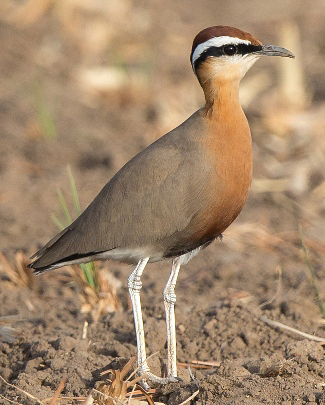
The very handsome Indian Courser by Simon Colenutt.
- Lion, Wild Ass and Blackbuck, a good chance of Leopard and Striped Hyaena, and even a chance of Wolf
- Thousands of Demoiselle Cranes and raptors with over a thousand, sometimes two thousand, harriers at the largest harrier roost in the world
- And some of Asia’s and the world’s other most spectacular birds including flamingos, pelicans, Indian Peafowl, Grey Junglefowl, Painted Stork, Steppe and Tawny Eagles, Indian and Asian Houbara Bustards, Crab Plover, and Cream-coloured and Indian Coursers
- As well as some of Asia’s and the world’s most spectacular localized birds including Hypocolius, White-bellied Minivet, Green Avadavat, Marshall’s Iora and White-naped Tit
- Some in rugged desert locations
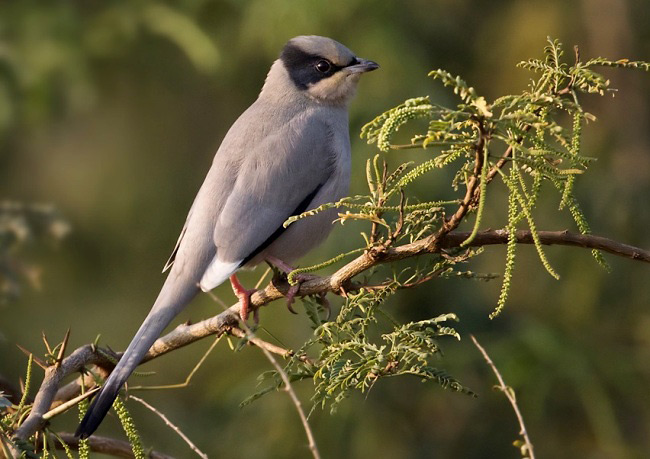
Hypocolius near the village of Fulay, a wintering site in Western India, by Lars Petersson.
- The Asiatic subspecies of Lion survives only in a tiny part of westernmost India. A few hundred live in Gir Sanctuary and National Park alongside thousands of livestock shepherded by the Maldhari who live in several villages inside the park. The cattle are a major source of meat for the lions which are slightly smaller than the African subspecies with a less luxuriant mane. They behave just like African Lions, spending most of their days snoozing in the shade before padding out to hunt when it cools down at dusk, the best time to head out into the rugged grasslands and woodlands in search of these impressive animals.
- Some tours include the wetlands around Harike in the Punjab in the far north of this region where there are many waterbirds and several localized landbirds such as White-tailed Stonechat and Black-breasted Weaver.
- This account deals with the northern winter period (November-March) when hundreds of thousands of birds from further north join the resident birds. One resident species, the rare Lesser Florican, is unlikely to be seen at this time of the year but can be seen displaying during July to September at Velavadar NP and around Surendranagar south of the Little Rann of Kutch.
- India is a huge country where there are several other great destinations. In Northern India the main attraction is Tiger, as well as Asian Elephant, Gharial and a chance of Sloth Bear and Ganges River Dolphin, plus the now occasional spectacle of thousands of waterbirds and numerous raptors at Bharatpur, and many other spectacular birds including Sarus Crane, Black-necked Stork, Brown and Tawny Fish-owls, and Indian Skimmer. In Northeastern India it is possible to see Indian Rhinoceros, Hoolock Gibbon and spectacular birds such as Himalayan Monal, Rufous-necked Hornbill, Green Cochoa, Long-tailed Broadbill, Sultan Tit, Grandala, Himalayan Cutia, Fire-tailed Myzornis and Beautiful Nuthatch. In far Northwestern India it is possible to see Snow Leopard, as well as high mountain birds such as White-browed Tit-warbler. Over 30 of India's 56 mainland endemic bird species and 30 species shared only with Sri Lanka occur in Southern India, including Malabar Trogon and White-bellied Treepie, and the south is also the best place to look for Indian Pitta and Heart-spotted Woodpecker.
Best Birds and other wildlife in Western India
Birds
The birds listed are usually present during the northern winter.
Specialities
Grey Junglefowl, Jungle and Rock Bush-quails, Red Spurfowl, Grey Francolin, Demoiselle Crane (usually thousands at Khichan alone), Indian and Asian
Houbara (MacQueen’s) Bustards, Crab Plover, Sirkeer Malkoha, Painted Sandgrouse, Yellow-eyed Pigeon (mostly Nov-Mar), Rock (Indian) Eagle-owl, Sykes’s
Nightjar, White-bellied Minivet, Marshall’s Iora, White-spotted (Spot-breasted) Fantail, Sykes’s (Tawny) Lark, Hypocolius, White-naped Tit, Sykes’s
Warbler, White-browed Bushchat and Green Avadavat.
Others
Indian Peafowl, Ruddy Shelduck, Comb (Knob-billed) Duck, Greater and Lesser Flamingos, Dalmatian and Great White Pelicans, Little and Indian Cormorants,
Oriental Darter, Western Reef-egret, Indian Pond-heron, Asian Openbill, Asian Woollyneck (Woolly-necked Stork), Painted Stork, Red-naped (Black) and
Black-headed Ibises, vultures, Montagu’s and Pallid Harriers, Long-legged Buzzard, Steppe and Tawny Eagles, Laggar Falcon, Grey-headed (Purple) Swamphen,
Common Crane (mostly Oct), Indian (Eurasian) Thick-knee, Red-wattled, White-tailed and Yellow-wattled Lapwings, Cream-coloured and Indian Coursers,
Pheasant-tailed Jacana, other shorebirds, Great Black-headed (Pallas’s) and Slender-billed Gulls, Chestnut-bellied Sandgrouse, Alexandrine and Plum-headed
Parakeets, Jungle and Spotted Owlets, Pied and White-breasted (Smyrna) Kingfishers, Asian Green Bee-eater, Indian Roller, Indian Grey Hornbill, Coppersmith
and Brown-headed Barbets, Black-rumped Flameback, White-naped Woodpecker, Common Iora, Small Minivet, Common Woodshrike, Bay-backed Shrike, White-browed
Fantail, Asian Paradise-flycatcher, larks including Bimaculated, White-eared Bulbul, Common Tailorbird, Striated Grassbird, Asian Desert and Eastern
Orphean Warblers, Tickell’s Blue-flycatcher, wheatears, Brahminy and Rosy Starlings, Bank and Common Mynas, Purple Sunbird, Grey-necked, Striolated and
White-capped Buntings, and Trumpeter Finch.
Also a chance of Black Stork, Baillon's Crake, Sarus Crane, Bonelli’s and Greater Spotted Eagles, Great Thick-knee, Sociable Lapwing (mostly Nov), Small Pratincole, Crested Treeswift and Greater Hoopoe-lark.
Mammals
(Asiatic) Lion, (Asian/Indian) Wild Ass, Blackbuck, Jungle Cat, Hanuman Langur (Northern Plains Grey Langur),
Indian Desert Gerbil (Jird), Indian Flying Fox, Nilgai, Sambar, Chinkara (Indian Gazelle), Spotted Deer, Common (Golden) Jackal, mongooses and Wild
Boar. Also a chance of Leopard, Striped Hyaena, Wild Cat and Indian Crested Porcupine, and an outside chance of Wolf and Chowsingha (Four-horned
Antelope).
Reptiles, Amphibians and Fish
Mugger Crocodile and Green Turtle (nests on beaches at Sodav Bankhara).
Invertebrates
The rich diversity of dragonflies includes some brilliant dartlets, dropwings, skimmers and waxtails.
Best Sites for Birds and other wildlife in Western India
- Velavadar (Blackbuck) NP Blackbuck, White-browed Bushchat and one of the world’s largest harrier roosts (a few hundred birds these days, once usually over 1000, sometimes over 2000 and even up to 3000!) mostly Montagu’s with large numbers of Pallid Harriers, with peak counts usually in Dec-Jan). Also an outside chance of Wolf and Striped Hyaena.
- Gir Sanctuary and NP Lion, Nilgai, Sambar and Mugger Crocodile. Also a chance of Leopard, Striped Hyaena, Chowsingha, Sarus Crane and White-bellied Minivet.
- Khijadiya Bird Sanctuary, near Jamnagar Flamingos, pelicans, Black-necked Stork, cranes, Small Pratincole and other shorebirds. Also a chance of Baillon's Crake.
- Marine NP, Narara, near Jamnagar Crab Plover and Great Black-headed Gull.
- Nalsarovar Lake Flamingos, pelicans, storks, cranes, Great Black-headed Gull and tens of thousands of Sand Martins.
- Little Rann of Kutch Wild Ass (Dhrangadhara WS), Nilgai, flamingos, pelicans, cranes, storks, Cream-coloured and Indian Coursers, other shorebirds, Slender-billed Gull and Sykes’s Nightjar. Also a chance of Jungle Cat, Sarus Crane, Asian Houbara Bustard, Greater Spotted Eagle, Sociable Lapwing (mostly Nov, around village of Dasada on the Banni Grasslands), Small Pratincole and Greater Hoopoe-lark, and an outside chance of Wolf.
- Bhuj Area including Gulf of Kutch Flamingos, Rock Eagle-owl, Crab Plover, Painted Sandgrouse, Hypocolius (up to 150 from Oct-Nov to Mar-Apr near the village of Fulay, south of Bhuj), White-bellied Minivet, Marshall’s Iora, White-naped Tit and Sykes’s Lark. Also a chance of Indian Bustard, Great Thick-knee and White-browed Bushchat, and an outside chance of Wolf.
- Udaipur Area Pheasant-tailed Jacana, White-tailed Lapwing and Comb Duck.
- Mount Abu Green Avadavat.
- Kumbhalgarh Area Hanuman Langur, Grey Junglefowl, Red Spurfowl, White-naped Woodpecker and White-capped Bunting. Also a chance of Jungle Cat, Green Avadavat and Painted Francolin.
- Siana Area Leopard, Jungle Cat, Hanuman Langur, Rock Eagle-owl, Painted Sandgrouse, Rock Bush-quail, Sirkeer Malkoha and White-bellied Minivet. Also a chance of Striped Hyaena, and an outside chance of Wolf.
- Desert NP Indian Bustard, Red-headed and White-rumped Vultures, Steppe and Tawny Eagles, Laggar Falcon, Cream-coloured Courser, Chestnut-bellied Sandgrouse, Bimaculated Lark, White-browed Bushchat, Asian Desert Warbler and Trumpeter Finch.
- Khichan Thousands of Demoiselle Cranes.
- Bikaner Cinereous, Egyptian and Griffon Vultures, Steppe Eagle and Yellow-eyed Pigeon.
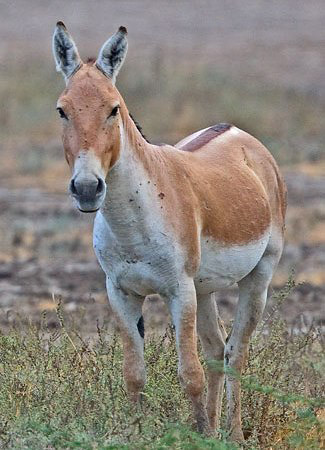
A fine image of a Wild Ass by Graham Ekins.
Best Times for Birds and other wildlife in Western India
Mid-November to February is the best time for mammals, birds and turtles, with Blackbucks usually rutting in February, although Wild Asses usually form their largest herds in March.
Recommended Bird Books etc. for Western India
Birds of the Indian Subcontinent by R Grimmett, and C and T Inskipp. Helm, 2012.
A Field Guide to the Birds of the Indian Subcontinent by K Kazmierczak. Helm, 2008.
Pocket Guide to the Birds of the Indian Subcontinent by R Grimmett, and C and T Inskipp. Helm, 1999.
Birds of South Asia: The Ripley Guide Volumes 1 and 2 by P C Rasmussen and J C Anderton. Lynx Edicions and Smithsonian Institution, 2012.
Indian Mammals: A Field Guide by V Menon. Hachette, 2014.
Field Guide to the Mammals of the Indian Subcontinent by K K Gurung and R Singh. Helm, 1998.
Apps etc.
eGuide to Birds of the Indian Subcontinent.
Where to watch birds in Asia by N Wheatley. Helm, 1996.
Don’t know which country/countries/regions to visit in Asia? Then it may be worth considering taking a look at this book, written by this website’s author. It is many years old of course but it still provides a starting point, an overview and a guiding light to the best birds and the best places to look for them in the region, and could save hours of searching for similar information on the internet. However, it is important to check more up-to-date sources for sites which have been opened up, sites and species which have been discovered, lodges that have been built etc. since the book was published.
Birding and Wildlife Trip Reports for Western India
Many trip reports, some for Western India, are posted on the websites listed here. On some of these websites some reports are independent and some are posted by tour companies who organize tours to Western India. These tour companies and others also post their own reports on their websites, which are listed under 'Some Organized Tours to Western India' below.
- The best website for trip reports is CloudBirders
- but these are also worth a look
- Birdtours
- Fatbirder
- Jon Hornbuckle
- Mammal Watching
Local bird and wildlife guides in Western India
The costs of organized tours partly reflect the quality of the tour leaders. Some leaders are certainly better than others and many companies claim their leaders are the best but even the best rely at least to some extent on the exceptional skills of the local guides they employ. If you are travelling independently, employing such local guides will greatly increase your chances of seeing the wildlife you wish to see.
Accommodation for birders in Western India
Some Organized Tours for birds and other wildlife to Western India
There are many tour companies who organize tours to see mammals, birds, other wildlife and other natural wonders. The cost of these tours vary considerably according to such variables as the airlines used, the number of days the tours last, the number of sites visited, the number of people in the group (an important consideration if you wish to see such wildlife as rainforest mammals and birds), the number of tour leaders, the standard of accommodation and transport, and the percentage profit the company hopes to make. Generally, where the number of days tours last and the number of sites visited are similar, the cheapest tours are those that use the cheapest airlines, accommodation and local transport, that have the largest groups with the least number of leaders, and that make the least amount of profit. The most expensive tours tend to be those which are exceptionally long, use the most expensive accommodation (ridiculously lavish in some cases, even for single nights) and which make the most profit. Some tour costs partly reflect the quality of the tour leaders. Some leaders are certainly better than others and many companies claim their leaders are the best but even the best rely at least to some extent on the exceptional skills of the local guides they employ.
While tour companies organize tours with set itineraries many also organize custom tours for individuals and private groups who instead of taking a tour with a set itinerary want to follow their own itinerary to suit their own personal tastes, whether it be mammals, birds, other wildlife, other natural wonders or even man-made attractions, or a mixture of them all. Many organized tours with set itineraries are also fast-paced and target as many species as possible, whether they are mammals, birds or other wildlife or everything, which usually leaves little time to enjoy the best sites and individual species, but on a custom tour those taking part can specify the pace and the sites and species they wish to concentrate on. Custom tours also suit people who like to travel with people they already know, rather than with a group of strangers, and people with partners with different interests. Individuals and small groups will almost certainly have to pay more than the price of an organized tour with a set itinerary but a large group of friends may be able to travel for less than the price quoted for a set tour.
Tour companies who are running organized tours to Western India in the next couple of years include the following. Many of these also offer custom tours.
