
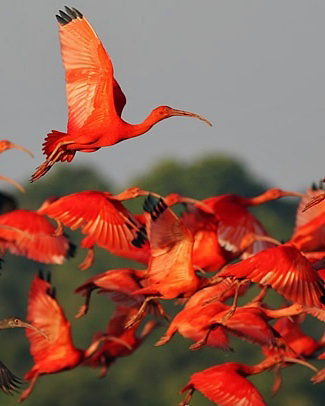
A shocking flock of Scarlet Ibises at Hato El Cedral in the Llanos of Venezuela by Lars Petersson.
- One of the world's top bird spectacles, in the wetlands of the Llanos where there are numerous waterbirds such as Scarlet Ibises, and the landbirds include Scarlet Macaws and Yellow-knobbed Curassows
- With, in the same place, Capybaras and a chance of seeing Giant Anteater, Southern Tamandua, Brazilian Tapir, Pink River Dolphin and Anaconda
- While elsewhere, along the coast and in the mountain forests, one of the best selections of the world's most spectacular birds
also includes American Flamingo, Red-and-green Macaw, Black-mandibled and Channel-billed Toucans, Sword-billed Hummingbird, three quetzals, Andean
Cock-of-the-rock and Wire-tailed Manakin - As well as over 30 endemics confined to western Venezuela including White-bearded Helmetcrest, Great and Scallop-breasted Antpittas, Ochre-browed Thistletail, White-fronted Whitestart, Slaty-backed Hemispingus, and Chestnut-breasted Tanager
- And other mammals such as Three-toed Sloth, Red Howler Monkey and Grey River Dolphin
- In October 2021 the British Foreign and Commonwealth Office (FCO) continued to advise against all travel to within 80 km (50 miles) of the Colombian border and 40 km (25 miles) of the Brazilian border, and against all but essential travel to the remaining areas of Venezuela due to ongoing crime and instability.
- If time allows it may be worth also visiting the lowland forests around the remote Camani Lodge in Amazonas, southern Venezuela, where Giant Otter and Pink River Dolphin occur, as well as many birds including Scarlet and Red-and-green Macaws, Grey-winged Trumpeter, Agami Heron, Amazonian Umbrellabird, Yellow-crested Manakin and White-browed Purpletuft. There is even a chance of the rarely seen Rufous-winged Ground-cuckoo.
- Another alternative if more time is available is Eastern Venezuela, the most reliable place in the world for Harpy Eagle, and where other spectacular birds include Scarlet Ibis, Red-and-green Macaw, Oilbird, hummingbirds such as Crimson and Ruby Topazes, White-plumed Antbird, and many cotingas including Guianan Cock-of-the-rock, Capuchinbird, Purple-breasted and Pompadour Cotingas, Bearded and White Bellbirds, and Handsome and Red-banded Fruiteaters.
- Coastal Range
- Colonia Tovar A chance of Three-toed Sloth, Slate-crowned Antpitta, Golden-breasted Fruiteater and Plushcap.
- Henri Pittier NP Over 500 species of bird recorded including Magnificent Frigatebird, White-tipped Quetzal, Long-tailed Sylph, Moustached and Russet-throated Puffbirds, Red-billed Scythebill, Black-throated Spinetail, Golden-breasted and Handsome Fruiteaters, Lance-tailed and Wire-tailed Manakins, and Rufous-chested Tanager. Also Red Howler Monkey and a chance of Three-toed Sloth.
- Northwest
- Cuare FR and Morrocoy NP Scarlet Ibis, American Flamingo and Reddish Egret.
- Cerro La Mision Red-and-green and Chestnut-fronted Macaws. Also a chance of Horned Screamer.
- Coro Vermilion Cardinal.
- Sanare Tocuyo Sparrow. Also a chance of Rosy Thrush-tanager.
- Yacambu NP Rusty-flanked Crake (El Blanquito Lagoon), Rufous-shafted Woodstar, Golden-winged Manakin and Red-ruffed Fruitcrow.
- Andes
- Estancia La Bravera Lazuline Sabrewing and Orange-throated Sunangel at hummingbird feeders.
- La Azulita Road Crested Quetzal, Long-tailed Sylph, Golden-breasted Fruiteater and Grey-throated Warbler.
- Cienagas de Catatumbo NP/Lake Maracaibo Grey River Dolphin, Red Howler Monkey, Horned and Northern Screamers, Slender-billed and Snail Kites, and Chestnut-fronted Macaw.
- Northern Tachira A chance of Sword-billed Hummingbird, Ocellated Tapaculo and Slaty-backed Hemispingus.
- Pico Humboldt/Sierra Nevada NP Golden-headed Quetzal and Golden-breasted Fruiteater. Also a chance of Slate-crowned Antpitta, Chestnut-breasted Chlorophonia and Plushcap.
- Pico Aguila White-bearded Helmetcrest and Ochre-browed Thistletail.
- Santo Domingo Valley Crested Quetzal, Andean Cock-of-the-rock, Torrent Duck and Pale-headed Jacamar. Also a chance of Ocellated Tapaculo.
- Llanos
- Throughout Scarlet Ibis, Sunbittern, Scarlet Macaw, Yellow-knobbed Curassow, Rufous-tailed Jacamar, Boat-billed Heron, Buff-necked Ibis, Aplomado Falcon, Grey-necked Wood-rail, Double-striped Thick-knee, Pied Plover, Large-billed Tern, Black Skimmer, Hoatzin, Common and Great Potoos, all five South American kingfishers, Fork-tailed Flycatcher, Capybara and Spectacled Caiman. Also a chance of Agami Heron, Sungrebe, Nacunda Nighthawk, Giant Anteater, Southern Tamandua, (Green) Anaconda, Pink River Dolphin, Ocelot, Brazilian Tapir, Red Howler Monkey and Vampire Bat.
- Hato El Cedral At times, hundreds of thousands of birds. Birds more likely to be seen here than at Hato Pinero are Orinoco Goose, Brazilian Teal, Maguari Stork, Jabiru, Azure Gallinule and Chestnut-fronted Macaw, as well as Orinoco Crocodile. Also a chance of Zigzag Heron.
- Hato Pinero Along the trail bordering Cano San Jeronimo - a chance of Agami Heron, five species of kingfisher, Red-billed Scythebill and Wire-tailed Manakin.
- San Fernando de Apure Area Black-capped Donacobius and Orinocan Saltator.
- The best website for trip reports is CloudBirders
- but these are also worth a look
- Birdtours
- Fatbirder
- Jon Hornbuckle
- Mammal Watching
Best Birds and other wildlife in West Venezuela
Birds
Endemics - 58 - not all of these occur in the west.
(Six hummingbirds, five antpittas and a fruiteater)
North/Northwest 36
Venezuelan Wood-quail, Merida Sunangel, White-bearded Helmetcrest, Golden (Golden-bellied) Starfrontlet, Green-tailed Emerald, Rusty-flanked Crake,
Plain-flanked Rail (small range), Groove-billed Toucanet, Venezuelan Parakeet, Red-eared Parakeet, Rose-headed Parakeet, Great Antpitta (probably also
occurs in Colombia), Grey-naped Antpitta, Scallop-breasted Antpitta, Merida Tapaculo, Caracas Tapaculo, Guttulate Foliage-gleaner, Ochre-browed
Thistletail, Black-throated Spinetail, Handsome Fruiteater, Rufous-lored Tyrannulet, Venezuelan Bristle-tyrant, Maracaibo Tody-flycatcher, Venezuelan
Tyrannulet, Blackish (Slaty-backed) Chat-tyrant, Rufous-browed (Brown-backed) Chat-tyrant, Merida Wren, Caracas Brush-finch, Merida (Moustached)
Brush-finch, Green-billed (Russet-backed) Oropendola, White-fronted Whitestart, Slaty-backed Hemispingus, Grey-capped Hemispingus, Merida Flowerpiercer,
Rufous-cheeked Tanager and Chestnut-breasted (Golden) Tanager.
West 1 Tachira Antpitta (small range).
Northeast/Paria Peninsula 13 Venezuelan Sylph (Cordillera de la Costa), Scissor-tailed Hummingbird (Paria), Black-spotted Piculet, White-throated Barbet (Serrania de Turimiquire and Cordillera de Caripe), Paria (White-throated) Barbet, Sucre Antpitta (also Paria Peninsula), White-throated Barbtail, Paria Barbtail, Urich’s Tyrannulet, Paria Brush-finch, Grey-headed Warbler (Cordillera de Caripe), Paria Whitestart and Venezuelan Flowerpiercer.
South 6 Tepui Tinamou (small range), Tepui (Band-winged) Nightjar, Orinoco Softtail (small range), White-faced Whitestart (Cerros Guanay, Sipapo and Yavi), Guaiquinima Whitestart (small range) and Duida Grass-finch (small range).
East - Lower Rio Caroni 1 Carrizal Seedeater (Isla Carrizal in the lower Caroni River, Bolivar. Three specimens found in 2001; the only known habitat, stands of spiny Guadua and Ripidocladus species of bamboo, has been cleared to allow construction of the Tocoma Dam, but researchers are hopeful of finding the birds living elsewhere).
East - Orinoco Delta 1
Near-endemics - not all in the west.
Venezuela and Colombia 81 (16 hummingbirds, three puffbirds and three antpittas) Rufous-vented Chachalaca, Yellow-knobbed Curassow, Helmeted Curassow, Black-fronted Wood-quail, Northern Screamer, Bare-eyed Pigeon, Pygmy Swift, Orange-throated Sunangel, Longuemare’s (Amethyst-throated) Sunangel, Perija Metaltail, Coppery-bellied Puffleg, Green (Collared) Inca, Perija (Golden-bellied) Starfrontlet, Blue-throated Starfrontlet, Red-billed Emerald, Coppery Emerald, Narrow-tailed Emerald, Short-tailed Emerald, Buffy Hummingbird, Steely-vented Hummingbird, Green-bellied Hummingbird, Shining-green Hummingbird, Violet-chested Hummingbird, Dwarf Cuckoo, White-tipped Quetzal, Pale-headed Jacamar, Russet-throated Puffbird, Two-banded (Russet-throated) Puffbird, Moustached Puffbird, Citron-throated (Channel-billed) Toucan, Yellow-billed (Groove-billed) Toucanet, Scaled Piculet, Chestnut Piculet, Rusty-faced Parrot, Perija (Painted) Parakeet, Scarlet-fronted Parakeet, Recurve-billed Bushbird, Streak-fronted (Black-crested) Antshrike, Bar-crested Antshrike, Black-backed Antshrike, Klages’s Antbird, Magdalena Antbird, Blue-lored Antbird, Perija (Rufous) Antpitta, Hooded Antpitta, Rusty-breasted Antpitta, Perija Tapaculo, Pale-bellied Tapaculo, Scalloped (Schwartz’s) Antthrush, Eastern Barred Woodcreeper, Caribbean (Pale-legged) Hornero, Plain (Rufous-fronted) Thornbird, Perija Thistletail, Streak-capped Spinetail, Crested Spinetail, White-whiskered Spinetail, Orinoco Spinetail, White-bibbed Manakin, Golden-breasted Fruiteater, Mountain (Spectacled) Tyrannulet, Slender-billed Tyrannulet, White-bearded Flycatcher, Scrub Greenlet, Black-collared Jay, Stripe-backed Wren, Black-billed Thrush, Tocuyo Sparrow, Perija Brush-finch, Yellow-mandibled (Pectoral) Sparrow, Golden-winged Sparrow, Ochre-breasted Brush-finch, Black-fronted (Yellow-breasted) Brush-finch, Grey-throated Warbler, Yellow-crowned (Golden-crowned) Warbler, Yellow-fronted Whitestart, Vermilion Cardinal, Orinocan Saltator, Fulvous-headed Tanager, Rufous-browed Conebill, Glaucous Tanager and Black-headed (Hooded) Tanager.
Venezuela, Colombia, and Trinidad & Tobago 6 Rufous-shafted Woodstar, Stripe-breasted Spinetail, Venezuelan Flycatcher, Trinidad Euphonia, Venezuelan Troupial and Masked Cardinal.
Venezuela, Colombia and Guyana 2 Northern Festive Parrot and Red Siskin.
Venezuela, Colombia and Guianas 1 Lilac-tailed Parrotlet.
Venezuela, Colombia and Brazil 7 Orinoco Piculet, Yapacana Antbird, Grey-bellied Antbird, Yellow-throated Antwren, Brown-headed Greenlet, Azure-naped Jay and Rio Negro Gnatcatcher.
Venezuela, and Trinidad & Tobago 1 Copper-rumped Hummingbird.
Venezuela and Tobago 1 White-tailed Sabrewing.
Venezuela and nearby islands 1 Yellow-shouldered Amazon (Venezuelan islands of Margarita and La Blanquilla, and the island of Bonaire in the Caribbean. It has been extirpated from the islands of Aruba and possibly also Curacao.)
Venezuela and Guyana 2 Fiery-shouldered Parakeet and Red-banded Fruiteater.
Venezuela, Guyana and Suriname 2 Blue-cheeked Amazon and Guianan (Rufous-brown) Solitaire.
Venezuela, Guyana and Brazil 35 Roraiman Nightjar, Tepui Swift, Tepui Goldenthroat, Peacock Coquette, Velvet-browed Brilliant, Rufous-breasted Sabrewing, Copper-tailed (Green-bellied) Hummingbird, Tepui Parrotlet, Roraiman Antwren, Streak-backed Antshrike, Roraiman Antbird, Tepui Antpitta, White-throated Foliage-gleaner, Roraiman Barbtail, Tepui Spinetail, Olive Manakin, Scarlet-horned Manakin, Orange-bellied Manakin, Rose-collared Piha, Green-cheeked (Green-backed) Becard, Black-fronted Tyrannulet, Chapman’s Bristle-tyrant, Sierra de Lema (McConnell’s) Flycatcher, Ruddy Tody-flycatcher, Tepui Elaenia, Flutist Wren, Tepui Wren, Pantepui (Black-billed) Thrush, Tepui Brush-finch, Golden-tufted Grackle, Roraiman (Two-banded) Warbler, Tepui Whitestart, Olive-backed Tanager, Greater Flowerpiercer and Black-hooded Tanager.
Venezuela, Guianas and Brazil 36 Guianan Puffbird, Tepui Toucanet, Guianan Toucanet, Green Aracari, Black-spotted Barbet, Caica Parrot, Painted Parakeet, Northern Red-shouldered Macaw, Brown-bellied Stipplethroat (Antwren), Spot-tailed Antwren, Todd’s Antwren, Black-throated Antshrike, Guianan Antwarbler (Warbling Antbird), Ferruginous-backed Antbird, Red-billed Woodcreeper, Chestnut-rumped Woodcreeper, Lineated (Guianan) Woodcreeper, McConnell’s Spinetail, Tiny Tyrant-manakin, Crimson-hooded Manakin, White-throated Manakin, Guianan Red Cotinga, White Bellbird, Dusky Purpletuft, Glossy-backed Becard, Olivaceous Schiffornis (Mourner), Smoky-fronted Tody-flycatcher, Painted Tody-flycatcher, Guianan Tyrannulet, Olive-crowned Greenlet, Tepui Vireo (not French Guiana), Cayenne Jay, Finsch’s Euphonia, Golden-sided Euphonia, Red-and-black Grosbeak and Blue-backed Tanager.
Venezuela and Brazil 6 Buff-breasted Sabrewing, Sapphire-spangled Emerald, Caura Antbird, Black-chested Tyrant, Great Elaenia (likely to occur in Guyana) and Scaled Flowerpiercer.
Other Specialities
Sunbittern. Also a chance of Agami and Zigzag Herons, Sungrebe and Nacunda Nighthawk.
Others
Horned Screamer, Orinoco Goose, Torrent Duck, Brazilian Teal, American Flamingo, Capped and Boat-billed Herons, Fasciated and Rufescent Tiger-herons,
Pinnated Bittern, Buff-necked and Scarlet Ibises, Roseate Spoonbill, Maguari Stork, Jabiru, Magnificent Frigatebird, King Vulture, Snail and Swallow-tailed
Kites, White Hawk, Aplomado Falcon, Grey-necked Wood-rail, Azure Gallinule, Limpkin, Double-striped Thick-knee, Pied Plover, Wattled Jacana, Large-billed
Tern, Black Skimmer, pigeons and doves, Chestnut-fronted, Red-and-green and Scarlet Macaws, parrots, Hoatzin, Squirrel Cuckoo, Burrowing Owl, Common and
Great Potoos, hummingbirds such as Long-tailed Sylph and Collared Inca, trogons, Crested and Golden-headed Quetzals, all five South
American kingfishers, Rufous-tailed Jacamar, puffbirds, Red-headed Barbet, Collared and Many-banded Aracaris, Black-mandibled and Channel-billed Toucans,
woodpeckers, spinetails, Pearled Treerunner, Streaked Tuftedcheek, woodcreepers including Red-billed Scythebill, antbirds, antpittas, many flycatchers
including Cliff, Vermilion and Fork-tailed, Andean Cock-of-the-rock, Golden-breasted Fruiteater, Red-ruffed Fruitcrow, Golden-winged, Lance-tailed and
Wire-tailed Manakins, White-capped Dipper, Black-capped Donacobius, Tropical Parula, wintering warblers such as Blackburnian, Cerulean and Prothonotary,
many tanagers, Chestnut-breasted Chlorophonia, honeycreepers, Plushcap, flowerpiercers, brush finches, Oriole Blackbird and Venezuelan Troupial.
Mammals
(Brown-throated) Three-toed Sloth, Capybara, Red Howler and Wedge-capped
Capuchin Monkeys, and Grey River Dolphin. Also a chance of Giant Anteater, Southern Tamandua, Pink River
Dolphin, Ocelot, Brazilian Tapir and Vampire Bat.
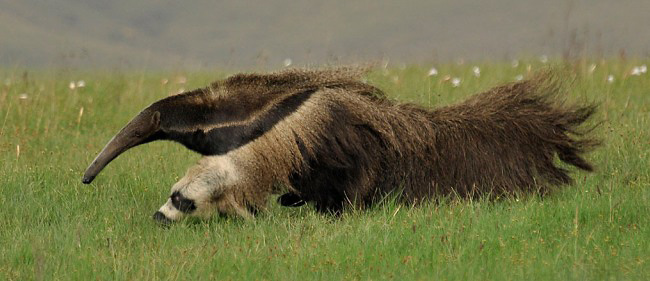
Giant Anteater by Jon Hornbuckle.
Reptiles, Amphibians and Fish
Spectacled Caiman. Also a chance of (Green)
Anaconda and Orinoco Crocodile.
Best Sites for Birds and other wildlife in West Venezuela
Best Times for Birds and other wildlife in West Venezuela
The best time to visit the Llanos is between December and March, especially February-March when it is usually drying out and the wildlife becomes more concentrated. The best time to look for White-bearded Helmetcrest is during the rainy season which usually lasts from April to November, although a few birds seem to remain on the high Andean paramo throughout the year.
Recommended Bird Books etc. for West Venezuela
Birds of Venezuela by D Ascanio, G Rodriguez and R Restall. Helm, due 2017.
Field Guide to the Birds of Venezuela by S Hilty. Helm, 2002.
Birds of South America: Non-Passerines by J R Roderiguez Mata et al. Harper Collins, 2006.
Birds of South America: Passerines by R S Ridgely and G Tudor. University of Texas Press/Helm, 2009 (Updated paperback edition of books listed next with 400 more illustrations).
The Birds of South America: Passerines by R S Ridgely and G Tudor. University of Texas Press, 1989 and 1994 (Two volumes).
Birds of Northern South America by R Restall, C Rodner and M Lentino. Helm, 2006 (Two volumes).
Birding in Venezuela by M L Goodwin. Lynx Edicions, 2003 (Fifth Edition).
Wild Mammals of Venezuela by R D Lord. Armitano Editores, 2000.
Mammals of South America by R D Lord. Johns Hopkins University Press, 2007.
Apps etc.
All Birds Venezuela by Bloomsbury/Sunbird Images.
Where to watch birds in South America by N Wheatley. Helm, 1994.
Don’t know which country/countries to visit in South America? Then it may be worth considering taking a look at this book, written by this website’s author. It is many years old of course but it still provides a starting point, an overview and a guiding light to the best birds and the best places to look for them on the continent, and could save hours of searching for similar information on the internet. However, it is important to check more up-to-date sources for sites which have been opened up, sites and species which have been discovered, lodges that have been built etc. since the book was published.
Birding and Wildlife Trip Reports for West Venezuela
Many trip reports, some for Western Venezuela, are posted on the websites listed here. On some of these websites some reports are independent and some are posted by tour companies who organize tours to Western Venezuela. These tour companies and others also post their own reports on their websites, which are listed under 'Some Organized Tours to Western Venezuela' below.
Local bird and wildlife guides in West Venezuela
The costs of organized tours partly reflect the quality of the tour leaders. Some leaders are certainly better than others and many companies claim their leaders are the best but even the best rely at least to some extent on the exceptional skills of the local guides they employ. If you are travelling independently, employing such local guides will greatly increase your chances of seeing the wildlife you wish to see.
Accommodation for birders in West Venezuela
Some Organized Tours for birds and other wildlife to West Venezuela
There are many tour companies who organize tours to see mammals, birds, other wildlife and other natural wonders. The cost of these tours vary considerably according to such variables as the airlines used, the number of days the tours last, the number of sites visited, the number of people in the group (an important consideration if you wish to see such wildlife as rainforest mammals and birds), the number of tour leaders, the standard of accommodation and transport, and the percentage profit the company hopes to make. Generally, where the number of days tours last and the number of sites visited are similar, the cheapest tours are those that use the cheapest airlines, accommodation and local transport, that have the largest groups with the least number of leaders, and that make the least amount of profit. The most expensive tours tend to be those which are exceptionally long, use the most expensive accommodation (ridiculously lavish in some cases, even for single nights) and which make the most profit. Some tour costs partly reflect the quality of the tour leaders. Some leaders are certainly better than others and many companies claim their leaders are the best but even the best rely at least to some extent on the exceptional skills of the local guides they employ.
While tour companies organize tours with set itineraries many also organize custom tours for individuals and private groups who instead of taking a tour with a set itinerary want to follow their own itinerary to suit their own personal tastes, whether it be mammals, birds, other wildlife, other natural wonders or even man-made attractions, or a mixture of them all. Many organized tours with set itineraries are also fast-paced and target as many species as possible, whether they are mammals, birds or other wildlife or everything, which usually leaves little time to enjoy the best sites and individual species, but on a custom tour those taking part can specify the pace and the sites and species they wish to concentrate on. Custom tours also suit people who like to travel with people they already know, rather than with a group of strangers, and people with partners with different interests. Individuals and small groups will almost certainly have to pay more than the price of an organized tour with a set itinerary but a large group of friends may be able to travel for less than the price quoted for a set tour.
Tour companies who run organized tours or can arrange custom tours to Western Venezuela include the following.
