
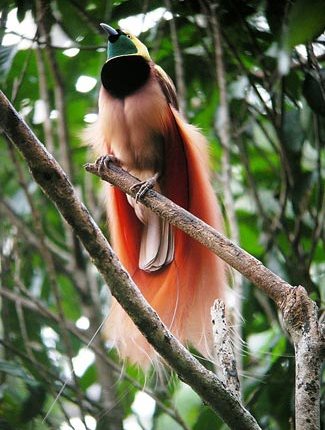
A fabulous Raggiana Bird-of-paradise in its display tree at Varirata National Park by Mark Harper.
- Birds-of-paradise - the most amazing birds in the world
- With bone china blue wings and a shimmering shield (Blue), long, silky white tail streamers (Ribbon-tailed Astrapia), shivering thick red and yellow plumes (Raggiana, Greater and Lesser), candyfloss-yellow plumes and tail-wires (Twelve-wired), and extraordinary long head-pennants (King-of-Saxony)
- As well as Black and Brown Sicklebills, Stephanie's Astrapia, parotias, Short-tailed Paradigalla, manucodes and Red Satinbird
- Bowerbirds, including Flame Bowerbird, one of the brightest birds on Earth, with bowers and 'gardens' meticulously designed and tended by males, to impress females
- Many of the island of New Guinea's other spectacular birds including crowned-pigeons, parrots, lorikeets, kingfishers and paradise-kingfishers, jewel-babblers, berryeaters and owlet-nightjars
- And three endemic monotypic bird families (those with just one species); Blue-capped Ifrit, Wattled Ploughbill and Mottled Berryhunter
- All along with some of the richest coral reefs in the world
- The island of New Guinea, north of Australia, is arguably an island-continent, where evolution has gone mad with birds, notably the extraordinary architects, landscape gardeners and collectors known as bowerbirds, and especially the aptly-named birds-of-paradise, the males of which are the most amazing birds on Earth. They come in all shapes and sizes, from the tiny 'blood and snow' King Bird-of-paradise to the huge heron-sized dark and rather sinister Black Sicklebill, with everything imaginable in between. The birds may be fabulous but for the most part they are extremely elusive and birding in Papua New Guinea is as tough as it gets, so this is a destination where local guides are vital, not only to help with arranging boat trips and other transport, but to see the birds and to see them well. Most birds-of-paradise and bowerbirds for example are only likely to be seen well at their traditional display trees and courts, known to only a few. Unfortunately for those who prefer to travel independently this is virtually impossible in Papua New Guinea because the few local guides who can also provide transport are at full stretch during the short lowland dry season catering for the flood of organized tours.
- There are many slight differences between Papua New Guinea and West Papua as far as birds are concerned but the main ones are that Blue Bird-of-paradise and Ribbon-tailed Astrapia are endemic to Papua New Guinea, whereas Wilson's Bird-of-paradise is endemic to West Papua, a parotia and Magnificent Bird-of-paradise are only likely to be seen dancing and displaying in West Papua, male Brown Sicklebill is only likely to be seen well in Papua New Guinea, and Macgregor's Honeyeater (a former bird-of-paradise) is usually on the beaten track in West Papua but a long way off it in Papua New Guinea.
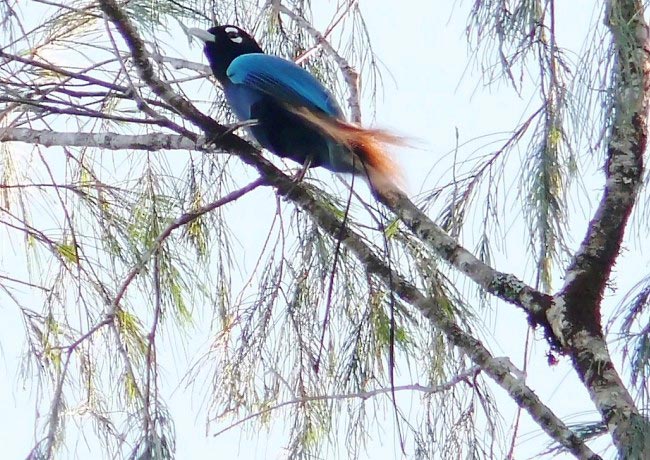
A beautiful male Blue Bird-of-paradise in a 'garden' in the Tari Valley, by Paul Macklam.
Best Birds and other wildlife in Papua New Guinea
Birds
Mainland Endemics 33 (136 endemics including islands, from those just to the east of the mainland, and those from Manus in the Admiralty Islands through New Britain and New Ireland of the Bismarck Archipelago, to Bougainville) (Two bowerbirds and 11 birds-of-paradise) Central 15 Grey-naped Pheasant-pigeon, Creamy-breasted (Orange-breasted) Fig-parrot, Campbell’s Fairy-wren (west), Rufous-backed Honeyeater, Long-bearded Honeyeater, Dimorphic Jewel-babbler, Brown-backed Whistler, White-bellied Whistler (also Louisiade Archipelago), Lawes’s Parotia, Growling Riflebird, Stephanie’s Astrapia, Ribbon-tailed Astrapia (Central Highlands), Blue Bird-of-paradise, Raggiana Bird-of-paradise and Spotted (Thick-billed) Berrypecker.
Southeast mainland 11 Scheepmaker’s Crowned-pigeon, Brown-headed Paradise-kingfisher, Black-capped (Black-eared) Catbird, Streaked Bowerbird, Elegant Honeyeater, Variable (Little) Shrike-thrush (also nearby islands), Eastern Parotia, Lesser Lophornia (Superb Bird-of-paradise), Yellow Satinbird, Grey-headed Mannikin/Munia and Alpine Mannikin/Munia.
Adelbert Mountains, northeast mainland 1 Fire-maned Bowerbird.
Adelbert Mountains and Huon Peninsula 1 Wahnes’s Parotia.
Huon Peninsula 5 Huon (Black-eared) Catbird, Spangled Honeyeater, Huon Honeyeater, Huon Astrapia and Emperor Bird-of-paradise.
Offshore East New Guinea D’Entrecasteaux Islands 4 Black-naped Pheasant-pigeon (Fergusson), Long-billed Myzomela (Goodenough), Goldie’s Bird-of-paradise and Oya Tabu (Capped) White-eye.
D’Entrecasteaux Islands and Trobriand Islands 1 Curl-crested Manucode.
D’Entrecasteaux Islands and Louisiade Archipelago 1 Louisiade Imperial-pigeon.
Louisiade Archipelago 11 Colonist Kingfisher (also nearby islands), Louisiade Pitta (Rossel), White-chinned Myzomela, Tagula Honeyeater (Tagula), Louisiade Whistler, Tagula (Little) Shrike-thrush (Tagula), Rossel (Common) Cicadabird (Rossel), Tagula Butcherbird (Tagula), Tagula White-eye (Tagula), Louisiade White-eye (also other islands) and Louisiade Flowerpecker.
Bismarck Archipelago (Admiralty Islands, New Britain, New Ireland, New Hanover etc.) 68 Karkar Island, off northeast mainland 1 Sclater’s Myzomela (also other small islands).
Admiralty Islands (Manus etc.) 8 Manus Masked-owl, Manus Boobook, Manus Dwarf-kingfisher, Superb Pitta, White-naped Friarbird, Manus Cuckooshrike, Admiralty Cicadabird and Manus Monarch.
Admiralty Islands and rest of Bismarck Archipelago (New Britain, New Ireland, New Hanover etc.) 5 Pied Cuckoo-dove, Yellowish Imperial-pigeon, Yellow-breasted Pygmy-parrot (only St Matthias in Bismarck Archipelago), Bismarck Black Myzomela and Manus Fantail (extinct on Manus).
Widespread New Britain, New Ireland, New Hanover etc. 16 Finsch’s Imperial-pigeon, Bismarck Imperial-pigeon, Knob-billed Fruit-dove, Pied Coucal, Violaceous Coucal, New Britain Sparrowhawk, Bismarck Kingfisher, Red-chinned Lorikeet, Bismarck Hanging-parrot, Bismarck Whistler, White-backed Woodswallow, Bismarck Fantail, Black-tailed Monarch, Bismarck Crow, Bismarck (Black-headed) White-eye and Red-banded Flowerpecker.
New Britain 20 New Britain Bronzewing, New Britain Rail, Golden Masked-owl, New Britain Boobook, Black Honey-buzzard, New Britain Goshawk, Slaty-backed Goshawk (also Umboi), New Britain Dwarf-kingfisher, New Britain Kingfisher, Black-headed Paradise-kingfisher, Blue-eyed Cockatoo, New Britain Pitta, New Britain Friarbird, Bismarck Honeyeater, Ashy Myzomela (also Umboi), Black-bellied Myzomela, New Britain Flyrobin, New Britain (Bismarck) Thicketbird, Rusty Thicketbird and New Britain Thrush.
New Ireland 8 New Ireland Dwarf-kingfisher, White-naped Lory, New Ireland Pitta, New Ireland Friarbird, Reddish Myzomela (also nearby islands), New Ireland Myzomela, Ribbon-tailed Drongo and New Ireland Mannikin.
New Ireland and New Hanover 1 Bismarck Boobook.
New Hanover 1 New Hanover Mannikin/Munia.
Tabar 1 Tabar Pitta.
Djaul 2 Djaul (Mussau) Flycatcher and Djaul (Black-tailed) Monarch.
St Matthias Group 1 White-breasted Monarch.
Mussau 4 (St Matthias Group) Mussau Triller, Mussau Fantail, Mussau (Dull) Flycatcher and Velvet (Mussau) Flycatcher.
Bougainville 12 (Papua New Guinea) Bougainville Rail, Bougainville Dwarf-kingfisher, Bougainville Moustached Kingfisher, Bougainville Honeyeater, Bougainville Hooded Whistler, Bougainville (Brown) Fantail, Bougainville Monarch, Bougainville Crow, Bougainville Thicketbird, Bougainville Bush-warbler, Bougainville White-eye and Bougainville Thrush.
New Guinea Mainland, West Papuan and Geelvink (Bay) Islands, and Aru Islands Endemics 293 (Nine fruit-doves, seven owlet-nightjars, 13 kingfishers, nine bowerbirds, 48 honeyeaters, 35 birds-of-paradise and 21 robins) Northern Cassowary, Wattled Brush-turkey, Black-billed (Yellow-legged) Brush-turkey, Collared (Red-legged) Brush-turkey, New Guinea Scrubfowl, Salvadori’s Teal, New Guinea Bronzewing, Cinnamon Ground-dove, Western Bronze Ground-dove, Thick-billed Ground-pigeon, Green-naped Pheasant-pigeon, Sclater’s Crowned-pigeon, Victoria Crowned-pigeon, Purple-tailed Imperial-pigeon, Shining (Rufescent) Imperial-pigeon, Pinon’s Imperial-pigeon, Collared Imperial-pigeon, Zoe’s Imperial-pigeon, Dwarf Fruit-dove, Orange-fronted Fruit-dove, Eastern Ornate Fruit-dove, Pink-spotted Fruit-dove, Orange-bellied Fruit-dove, Beautiful Fruit-dove, Coroneted Fruit-dove, Archbold’s Nightjar, Papuan Nightjar, Feline Owlet-nightjar, Spangled (Starry) Owlet-nightjar (small range), Allied (Vogelkop) Owlet-nightjar, Barred Owlet-nightjar, Wallace’s Owlet-nightjar, Archbold’s Owlet-nightjar, Mountain Owlet-nightjar, Papuan Spinetail, Papuan (Three-toed) Swiftlet, Bare-legged Swiftlet, Mountain Swiftlet, Ivory-billed (Greater Black) Coucal, Black-billed (Lesser Black) Coucal, Dwarf Koel, Long-billed Cuckoo, Rufous-throated Bronze-cuckoo, White-eared Bronze-cuckoo, White-crowned Cuckoo (Koel), Chestnut Forest-rail, Forbes’s Forest-rail, Mayr’s Forest-rail, New Guinea Flightless Rail, Forest Bittern, New Guinea Woodcock, Jungle (Papuan) Boobook, Papuan Hawk-owl, Long-tailed Honey-buzzard, Papuan (New Guinea) Eagle, Papuan Harrier (mostly Papua New Guinea), Grey-headed Goshawk, Black-mantled Goshawk, Chestnut-shouldered Goshawk, Doria’s Goshawk, New Guinea (Papuan) Dwarf-kingfisher, Mountain Kingfisher, Blue-black Kingfisher, Little Paradise-kingfisher, Red-breasted Paradise-kingfisher, Hook-billed Kingfisher, Spangled Kookaburra, Rufous-bellied Kookaburra, Shovel-billed Kingfisher, Pesquet’s Parrot, Brehm’s Tiger-parrot, Painted Tiger-parrot (mostly Papua New Guinea), Modest Tiger-parrot, Madarasz’s Tiger-parrot, Plum-faced Lorikeet, Striated Lorikeet, Pygmy Lorikeet, Red-fronted Lorikeet, Fairy Lorikeet, Josephine’s Lorikeet, Stella’s (Papuan) Lorikeet, Yellow-billed Lorikeet, Orange-billed Lorikeet, Black-capped Lory, Brown Lory, Yellow-streaked Lory, Dusky Lory, Goldie’s Lorikeet, Yellow-naped (Large) Fig-parrot, Red-faced (Large) Fig-parrot (mostly Papua New Guinea), Edwards’s Fig-parrot (mostly Papua New Guinea), Black-fronted (Orange-breasted) Fig-parrot, Dusky-cheeked (Orange-breasted) Fig-parrot, Orange-fronted (Papuan) Hanging-parrot, Papuan King-parrot, Blue-collared Parrot, Eastern Hooded Pitta, Ochre-breasted (White-eared) Catbird, Tan-capped (White-eared) Catbird, Northern Catbird, Archbold’s Bowerbird, MacGregor’s Bowerbird, Flame Bowerbird, Masked Bowerbird, Yellow-breasted Bowerbird, Papuan Treecreeper, Wallace’s Fairy-wren, Orange-crowned Fairy-wren, Broad-billed Fairy-wren, Emperor Fairy-wren, White-shouldered Fairy-wren, Silver-eared Honeyeater, Spotted Honeyeater, Meyer’s Friarbird, New Guinea (Helmeted) Friarbird, Ruby-throated Myzomela, Papuan Black Myzomela, Mountain (Elfin) Myzomela, Red-collared Myzomela, Plain Honeyeater, Marbled Honeyeater, Streak-headed Honeyeater, Leaden Honeyeater, Yellowish-streaked Honeyeater, Mayr’s Honeyeater, Grey-streaked Honeyeater, Long-billed Honeyeater, Tawny Straightbill, Olive Straightbill, MacGregor’s Honeyeater, Smoky Honeyeater, Puff-backed Honeyeater, Scrub Honeyeater, Hill-forest Honeyeater (Meliphaga), Mimic Honeyeater, Forest Honeyeater, Mottle-breasted Honeyeater (Spot-breasted Meliphaga), Graceful Honeyeater, Yellow-gaped Honeyeater, Obscure Honeyeater, Black-throated Honeyeater, Sooty Honeyeater (Meliphaga), Short-bearded Honeyeater (Meliphaga) (mostly West Papua), Cinnamon-browed Honeyeater (Meliphaga), Belford’s Honeyeater (Meliphaga), Yellow-browed Honeyeater (Meliphaga) (mostly Papua New Guinea), Ornate Honeyeater (Meliphaga), Goldenface, Yellow-bellied Gerygone, Brown-breasted Gerygone, Rusty Mouse-warbler, Bicoloured Mouse-warbler, Mountain Mouse-warbler, Pale-billed Scrubwren, Papuan Scrubwren, Buff-faced Scrubwren, Grey-green Scrubwren, Perplexing Scrubwren, Large Scrubwren, Grey Thornbill, New Guinea (Papuan) Thornbill, Papuan Logrunner, Papuan Babbler, Ploughbill, Papuan Sittella, Black Sittella, Northern Variable Pitohui, Southern Variable Pitohui, Hooded Pitohui, Brown Oriole, Tit Berrypecker, Eastern Crested Berrypecker, Rufous-naped Bellbird, Piping Bellbird, Spotted Jewel-babbler, Chestnut-backed Jewel-babbler, Blue Jewel-babbler, Painted Quail-thrush, Black Pitohui, Regent Whistler, Sclater’s Whistler, Lorentz’s Whistler, Rusty Whistler, Black-headed Whistler, Golden-backed Whistler, Rusty Pitohui, White-bellied Pitohui, Sooty Shrike-thrush, Sepik-Ramu (Little) Shrike-thrush, Papuan Whipbird, Hooded Cuckooshrike, Boyer’s Cuckooshrike, Golden Cuckooshrike, Black-bellied Cuckooshrike, Grey-headed Cicadabird, Black-shouldered (Papuan) Cicadabird, New Guinea (Black) Cicadabird, Black-browed Triller, Mottled Berryhunter, Lowland Peltops, Mountain Peltops, Hooded Butcherbird, Great Woodswallow, Black-breasted Boatbill, Drongo Fantail, Black Fantail, Sooty Thicket-fantail, Black Thicket-fantail, White-bellied Thicket-fantail, Dimorphic Fantail, Rufous-backed Fantail, Friendly Fantail, Chestnut-bellied Fantail, Blue-capped Ifrit(a), Ochre-collared Monarch, Frilled Monarch, Torrent-lark, Black (Fan-tailed) Monarch, Rufous Monarch, Spot-winged Monarch, Hooded Monarch, Golden Monarch, Grey Crow, Lesser Melampitta, Greater Melampitta, Glossy-mantled Manucode, Jobi Manucode, Crinkle-collared Manucode, King-of-Saxony Bird-of-paradise, Carola’s Parotia, Twelve-wired Bird-of-paradise, Black-billed Sicklebill, Pale-billed Sicklebill, Broad-plumed (Greater) Lophornia, Black Sicklebill, Brown Sicklebill, Short-tailed Paradigalla, Splendid Astrapia, King Bird-of-paradise, Magnificent Bird-of-paradise, Lesser Bird-of-paradise, Greater Bird-of-paradise, Obscure Berrypecker, Black Berrypecker, Mid-mountain Berrypecker, Fan-tailed Berrypecker, Streaked Berrypecker, Thick-billed (Spotted) Berrypecker, Spectacled Longbill, Pygmy Longbill, Yellow-bellied Longbill, Slaty-headed (Slaty-chinned) Longbill, Loria’s Satinbird, Red (Crested) Satinbird, Yellow-breasted Satinbird, Greater Ground-robin, Lesser Ground-robin, Green-backed Robin, White-eyed Robin, Garnet Robin, Subalpine Robin, Olive Flyrobin, Canary Flyrobin, Torrent Flyrobin, Papuan Scrub-robin, Black-throated Robin, Black-chinned Robin, Black-sided Robin, Black-capped Robin, Banded Yellow (Olive-yellow) Robin, White-winged Robin, Blue-grey Robin, White-rumped Robin, Papuan Grassbird, Fly River Grassbird, Black-fronted White-eye, Green-fronted White-eye, Capped White-eye, New Guinea White-eye, Yellow-faced Myna, Golden Myna, Yellow-eyed Starling, Red-capped Flowerpecker, Rand’s (Olive-backed) Sunbird, Streak-headed Mannikin, White-spotted (Streak-headed) Mannikin, Great-billed (Grand) Munia, Grey-crowned Munia, Black Munia, Snow Mountain Munia, Mountain Firetail, Papuan Parrotfinch and Alpine Pipit.
New Guinea and New Britain (Bismarck Archipelago) 3 Dwarf Cassowary, Red Myzomela and Hooded Mannikin (Munia).
New Guinea and Bismarck Archipelago 3 Black-billed Cuckoo-dove, Purple-bellied Lory (Papua New Guinea only) and Buff-faced Pygmy-parrot.
Near-endemics
New Guinea and Moluccas 3 Gurney’s Eagle, Pygmy Eagle and Common Paradise-kingfisher.
New Guinea, Kai Islands and Gebe 1 Yellow-capped Pygmy-parrot.
New Guinea to Solomon Islands 5 White-breasted (White-bibbed) Ground-dove, Island Imperial-pigeon (islands off New Guinea), Papuan Eclectus, Melanesian Cicadabird (Papua New Guinea only) and Singing Starling.
New Guinea, Solomon Islands and Australia 1 Russet-tailed Thrush (Papua New Guinea only, and Choiseul Island in the Solomon Islands).
Admiralty Islands, rest of Bismarck Archipelago, Bougainville and Solomon Islands 3 Melanesian Scrubfowl (also Karkar and Bagabag Islands), Eastern Bronze Ground-dove and Yellow-banded (Yellow-bibbed) Fruit-dove.
Bismarck Archipelago (New Britain etc.) and Caroline Islands 1 Hunstein’s (Mottled) Mannikin/Munia.
Bismarck Archipelago (New Britain etc.) and Buka Island (north of Bougainville) 1 Buff-bellied Mannikin/Munia.
Bismarck Archipelago (New Britain etc.), Bougainville and Solomon Islands 10 Yellow-legged Pigeon, Red-knobbed Imperial-pigeon, Mayr’s Swiftlet, Heinroth’s Shearwater, Pied Goshawk, Melanesian Kingfisher, Cardinal Lory, Song (Singing) Parrot, Green Pygmy-parrot, Long-tailed Myna and Atoll Starling.
New Guinea and Australia 92 Magpie Goose, Marbled Frogmouth, Papuan Frogmouth, White-throated Nightjar (Papua New Guinea only), Australian Owlet-nightjar (Papua New Guinea only), Black-eared Cuckoo (rare in Indonesia), Pallid Cuckoo (rare in Indonesia), Brolga (Crane), Australian Bustard, Straw-necked Ibis, White-necked (Pacific) Heron, Bush Thick-knee, Pied Oystercatcher (also recorded on Kai Islands), Masked Lapwing (irregular in Indonesia), Red-kneed Dotterel, Australian Gull-billed Tern, Greater Sooty-owl, Australian Masked-owl, Rufous Owl, Wedge-tailed Eagle, Collared Sparrowhawk, Whistling Kite, Yellow-billed Kingfisher, Forest Kingfisher (rare in Indonesia), Torresian (Collared) Kingfisher, Buff-breasted Paradise-kingfisher, Blue-winged Kookaburra, Nankeen (Australian) Kestrel (also Christmas Island, and rare in Indonesia), Brown Falcon, Palm Cockatoo (Cape York only in Australia), Little Corella, Sulphur-crested Cockatoo, Double-eyed Fig-parrot, Red-winged Parrot, Papuan Pitta, Noisy Pitta, Black-eared Catbird (Cape York only in Australia), Fawn-breasted Bowerbird (Cape York only in Australia), Brown Honeyeater, Blue-faced Honeyeater, White-throated Honeyeater, Tawny-breasted Honeyeater (Cape York only in Australia), Little Friarbird, Noisy Friarbird, Dusky Myzomela, Red-headed Myzomela, Green-backed Honeyeater (Cape York only in Australia), Brown-backed Honeyeater, Rufous-banded Honeyeater, Varied Honeyeater, Yellow-tinted Honeyeater, Fairy Gerygone, Green-backed Gerygone, White-throated Gerygone (Papua New Guinea only), Large-billed Gerygone, Mangrove Gerygone (Papua New Guinea only), Tropical Scrubwren (Cape York only in Australia), Grey-crowned Babbler, Australasian Figbird, Olive-backed Oriole, Green Oriole (also Romang Island, east of Timor), Brown (Grey) Whistler, Black-tailed Whistler, Little Shrike-thrush, Rufous (Little) Shrike-thrush, Grey Shrike-thrush, White-winged Triller (Papua New Guinea only), Varied Triller, Black Butcherbird, Australian Magpie, Black-backed Butcherbird (Cape York only in Australia), Black-faced Woodswallow (range also reaches Timor, Leti and Sermata), Yellow-breasted Boatbill, Northern Fantail, Mangrove Fantail (Papua New Guinea and Aru Islands only), Leaden Flycatcher, Satin Flycatcher, Paperbark Flycatcher, Magpie-lark (also east Timor), Black-winged Monarch (Cape York only in Australia), Black-faced Monarch, Trumpet Manucode (Cape York only in Australia), Magnificent Riflebird (Cape York only in Australia), Yellow-legged Flyrobin (Cape York only in Australia), Lemon-bellied Flyrobin, Jacky Winter (Papua New Guinea only), White-faced Robin (Cape York only in Australia), Mangrove Robin, Little Grassbird (West Papua only), Chestnut-breasted Munia, White-bellied Crimson Finch (Cape York only in Australia) and Australasian Pipit (Papua New Guinea only).
Bougainville and Solomon Islands 24 Crested Cuckoo-dove, Pale Mountain-pigeon, Solomons Frogmouth, Solomons Nightjar, West Solomons Boobook, Fearful Owl, Imitator Goshawk, Sanford’s Sea-eagle, Ultramarine Kingfisher, Solomons (Ducorps’s) Cockatoo, Meek’s Lorikeet, Duchess Lorikeet, Black-faced Pitta, Red-capped (Scarlet-naped) Myzomela, Oriole Whistler, North Melanesian Cuckooshrike, Solomons Cicadabird, White-winged (Cockerell’s) Fantail, Steel-blue Flycatcher, Solomons Pied (Black-and-white) Monarch, Yellow-throated White-eye, White-eyed Starling, Brown-winged Starling and Midget Flowerpecker.
Others Spotted Whistling-duck, Great-billed and Pied Herons, White-browed Crake, Comb-crested Jacana, Oriental Hobby and Island Thrush. Also, on and around offshore islands; Great and Lesser Frigatebirds, White-tailed Tropicbird, Red-footed Booby, Black and Brown Noddies, White Tern and Nicobar Pigeon.
Mammals
Speckled Dasyure and Agile Wallaby. Also a chance of Silky Cuscus, Striped Possum,
Coppery Ringtail and Long-fingered Triok.
Reptiles, Amphibians and Fish
Some of the richest coral reefs on Earth, with 900 fish
species around Walindi Dive Resort in Kimbe Bay, New Britain, for example. Green (10%) and Hawksbill (90%) Turtles nest
on Edmago and Ral, two uninhabited islands near New Ireland, between September and January.
Invertebrates
Hundreds of butterflies and moths including Hercules Moth, one of the
largest moths in the world, and Queen Alexandra's Birdwing, the largest butterfly in the world, which, unfortunately,
rarely casts shadows over the Popondetta Plain in northern Papua New Guinea, off the usual, well worn, circuits.
Best Sites for Birds and other wildlife in Papua New Guinea
- Port Moresby Area
- Port Moresby Area Pied Heron, Comb-crested Jacana, Torresian Imperial-pigeon, Papuan Frogmouth, Blue-winged Kookaburra and Black-backed Butcherbird. Also a chance of Spotted Whistling-duck and White-browed Crake.
- Brown River A chance of Black-billed Brush-turkey, Ivory-billed Coucal, Cinnamon Ground-dove, Buff-faced Pygmy-parrot, Common Paradise-kingfisher, Blue Jewel-babbler, Emperor Fairy-wren and King Bird-of-paradise.
- Varirata NP Raggiana Bird-of-paradise (display site), Growling Riflebird, Rufous-bellied Kookaburra, Painted Quail-thrush, Barred Owlet-nightjar, Marbled Frogmouth, Yellow-billed Kingfisher, Brown-headed Paradise-kingfisher, Papuan Pitta, Yellow-breasted Boatbill and Frilled Monarch. Also a chance of Crinkle-collared Manucode, Black-billed Brush-turkey, Grey-naped Pheasant-pigeon, Chestnut-backed Jewel-babbler, Goldenface, Ochre-breasted Catbird and Wallace's Fairy-wren.
- Kiunga-Tabubil Area
- KM 27 out of Kiunga Greater and Raggiana Birds-of-paradise (both at display site including some hybrids), Trumpet Manucode and Rufous-bellied Kookaburra. Also a chance of Blue Jewel-babbler.
- Boystown Road near Kiunga Flame Bowerbird and Palm Cockatoo. Also a chance of Blue Jewel-babbler.
- Fly and Elevala Rivers out of Kiunga King and Twelve-wired Birds-of-paradise (both at display sites), Glossy-mantled Manucode, Palm Cockatoo, Sclater's Crowned-pigeon, Papuan Hornbill, Rufous-bellied Kookaburra, Channel-billed Cuckoo, Common and Little Paradise-kingfishers, and Eastern Hooded and Papuan Pittas. Also a chance of Black-billed Brush-turkey, Great-billed Heron, Forest Bittern, New Guinea Flightless Rail (Kwatu Lodge), Pesquet's Parrot, Spangled (Kwatu) and Wallace's (Kwatu) Owlet-nightjars, Hook-billed Kingfisher, Blue Jewel-babbler, Flame Bowerbird (at bowers, at Kwatu for example), Black-eared Catbird and Emperor Fairy-wren.
- Dablin Creek, Tabubil Magnificent Bird-of-paradise, Carola's Parotia, Goldenface and Obscure Berrypecker. Also a chance of Torrent-lark.
- Ok Ma Road, Tabubil Magnificent Riflebird, Crinkle-collared Manucode, Palm Cockatoo and Shovel-billed Kingfisher. Also a chance of Greater Melampitta and Chestnut-backed Jewel-babbler.
- Ok Menga, Tabubil Salvadori's Teal and Torrent Flyrobin. Also a chance of Torrent-lark.
- Central Highlands
- Kumul Lodge and Area The lodge's legendary bird table attracts several otherwise shy and skulking birds difficult to see in the forest including Ribbon-tailed Astrapia and Brown Sicklebill (usually females but sometimes the rarely seen male), while in the grounds and nearby it is also possible to see Blue Bird-of-paradise (at Tonga, 30 minutes away by road), King-of-Saxony Bird-of-paradise, Lesser Bird-of-paradise (display site at Kama, Minamba Valley, about an hour away by road), Broad-plumed Lophornia, Ribbon-tailed Astrapia, Brown Sicklebill, Red Satinbird (there is usually a male in or near the grounds), Loria's Satinbird, Lesser Melampitta, Archbold's and Yellow-breasted (Minamba Valley) Bowerbirds, Wattled Ploughbill, Blue-capped Ifrit, Torrent-lark (Lai River near Lesser Bird-of-paradise site), Brehm's Tiger-parrot, Mountain Owlet-nightjar, Eastern Crested and Fan-tailed Berrypeckers, Black-breasted Boatbill, Regent Whistler, Torrent Flyrobin (Lai River) and Island Thrush. Also a chance of Chestnut Forest-rail and New Guinea Woodcock.
- Yaskom Hotel Resort Hooded Cuckooshrike, Papuan Treecreeper, Orange-crowned Fairy-wren, Lesser Melampitta, Blue-capped Ifrit, Wattled Ploughbill, Stephanie’s Astrapia, Brown Sicklebill, King-of-Saxony Bird-of-Paradise and Loria’s Satinbird.
- Rondon Ridge King-of-Saxony Bird-of-paradise, Broad-plumed Lophornia, Stephanie's Astrapia, Black and Brown Sicklebills, MacGregor's and Yellow-breasted Bowerbirds, Lesser Melampitta, Wattled Ploughbill and Blue-capped Ifrit. Also a chance of Orange-crowned Fairy-wren, Loria's Satinbird, Blue Bird-of-paradise, Papuan Parrotfinch and Silky Cuscus.
- Tari Valley including Ambua Lodge Blue and King-of-Saxony Birds-of-paradise, Broad-plumed Lophornia, Ribbon-tailed and Stephanie's Astrapias, Black and Brown Sicklebills, Lawes's Parotia, Short-tailed Paradigalla, Loria's Satinbird, Lesser Melampitta, Wattled Ploughbill, Papuan King-parrot, Eastern Grass-owl, Greater Sooty-owl, Papuan Logrunner, Fan-tailed, Eastern Crested and Tit Berrypeckers, Black-breasted Boatbill, Great Woodswallow, Regent Whistler, Mottled Berryhunter and Blue-capped Ifrit. Also a chance of Black-billed Sicklebill, Torrent-lark, Papuan Eagle, Chestnut and Forbes's Forest-rails, Feline Owlet-nightjar, Papuan Whipbird, Spotted Jewel-babbler, Garnet Robin, Spotted Berrypecker and Hercules Moth, as well as Striped Possum, Coppery Ringtail and Long-fingered Triok.
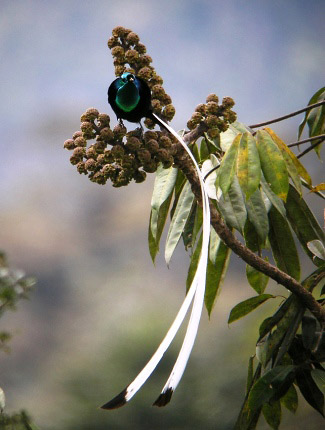
A fantastic male Ribbon-tailed Astrapia in the Tari Valley above Ambua Lodge by Mark Harper. There are still, relatively, quite a lot of Ribbon-tailed Astrapias in the Tari Valley but adult males with full tails like this are few and far between.
- Off the Standard Circuit
- Kokada Trail (a 96-km-long hiking trail/track, popular during the drier season from April to October), Owen Stanley Range Raggiana Bird-of-paradise (several stands of trees used for displaying), Magnificent Bird-of-paradise, Lesser Lophornia (along first 15 km from Kokoda (350m) to the Isurava Memorial (1350m)), Eastern (Kokoda-Isurava) and Lawes's Parotias, Black-billed Sicklebill, Stephanie's Astrapia, Growling Riflebird and Dimorphic Jewel-babbler (Kokoda-Isurava), as well as Oriental Hobby, Forbes's Forest-rail, Mountain Kingfisher, Black-capped Catbird, Mottled Berryhunter, Olive Straightbill, Bicoloured Mouse-warbler and White-eyed Robin. Elsewhere, in the Kagi area in the central part of the trail requiring perhaps nine days hard walking or an air drop via trekking supply planes to Kagi airstrip, it is possible to see Streaked Bowerbird and Alpine Mannikin.
- Karawari Lodge and Area King and Twelve-wired Birds-of-paradise (both at display sites), Jobi Manucode, Palm Cockatoo, Victoria Crowned-pigeon, Papuan Hornbill, White-bellied Sea-eagle, and Great-billed and Pied Herons. Also a chance of New Guinea Scrubfowl and Papuan Eagle.
- Keki Lodge, Adelbert Range Fire-maned Bowerbird, Tan-capped Catbird, Collared Brush-turkey, Victoria Crowned-pigeon, Cinnamon Ground-dove, Pesquet's Parrot, Dwarf Koel, Dimorphic Jewel-babbler, and Lesser (display trees) and Magnificent (display court) Birds-of-paradise.
- Crater Mountain NP Yellow-breasted Satinbird.
- Madang, Milne Bay, Tufi and Port Moresby Area Top scuba-diving and snorkeling sites.
- Huon Peninsula Forbes’s Forest-rail, Feline Owlet-nightjar, MacGregor's (Huon) Bowerbird, Spangled Honeyeater, Mottled Berryhunter, Spotted Jewel-babbler, Emperor Bird-of-Paradise, Huon Astrapia and Wahnes’s Parotia (viewable displaying at court from hide).
- Bensbach Spangled Kookaburra, Fly River Grassbird, and Black and Grey-crowned Mannikins, as well as Brolga Crane, Black-necked Stork, Wedge-tailed Eagle, Australian Bustard and Spangled Kookaburra.
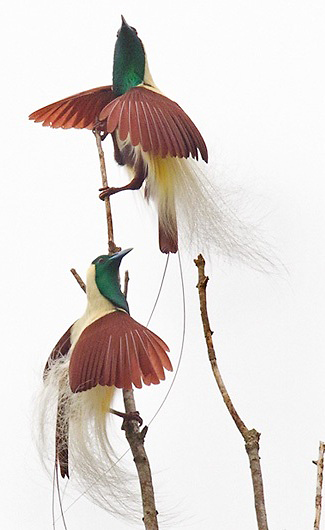
Displaying male Emperor Birds-of-paradise at Gatop on the Huon Peninsula by Lars Petersson.
- Bismarck Archipelago
- New Britain Over half of the archipelago's 50+ endemics including Blue-eyed Cockatoo, Golden Masked-owl, New Britain Kingfisher and Black-headed Paradise-kingfisher, as well as Lesser and Great Frigatebirds, Black-naped Tern, Nicobar Pigeon (Malu Malu and Restorf Islands) and superb scuba-diving and snorkeling (900 fish species). Also a chance of Heinroth's Shearwater. Should the highlands of New Britain become accessible and that looked possible in 2019 there is a chance of seeing additional birds such as New Britain Goshawk, New Britain Thicketbird (not seen since its discovery in 1949), Bismarck Honeyeater and New Britain Thrush, as well as Red-chinned Lorikeet, Bismarck Imperial-pigeon, Rusty Thicketbird and Bismark Fantail. Other specialties hard to see in the lowlands include New Britain Sparrowhawk, Slaty-backed Goshawk and Yellow-legged Pigeon, and there is even an outside chance of New Britain Rail and New Britain Pitta.
- New Ireland Nearly half of the archipelago's 50+ endemics including 9 island endemics and 14 shared with New Britain including Ribbon-tailed Drongo, as well as nesting turtles (mostly September to January).
- Tench Island Lesser and Great Frigatebirds, White-tailed Tropicbird, White Tern, Red-footed Booby, Black and Brown Noddies, Nicobar Pigeon and Atoll Starling. Also a chance of other seabirds to and from the island and elsewhere in the archipelago including Bulwer's and Tahiti Petrels, Heinroth's, Streaked and Wedge-tailed Shearwaters, and Black-naped Tern, as well as Melon-headed Whale and Spinner Dolphin.
- Manus Island 8 endemics including Superb Pitta.
- D'Entrecasteaux Islands
- Fergusson and Normanby Islands Goldie's Bird-of-paradise and Curl-crested Manucode.
- Louisiade Archipelago
- Misima and Sudest Islands Colonist Kingfisher, Tagula Butcherbird, Tagula Honeyeater, Louisiade and Tagula White-eyes, White-chinned Myzomela, Louisiade Whistler, Tagula Shrike-thrush and Louisiade Flowerpecker, as well as local forms of Glossy-mantled Manucode (possibly a separate species), Double-eyed Fig-parrot, White-bellied Whistler, Spectacled Monarch and Common Cicadabird.
- Rossel Island Common (Rossel) Paradise-kingfisher, Louisiade Pitta and Rossel Cicadabird.
- Bougainville
- This island, which lies between the Bismarck Archipelago and the Solomon Islands east of New Guinea, is politically part of Papua New Guinea but ecologically more like the Solomon Islands. It supports Bougainville Rail, Bougainville Moustached Kingfisher, Bougainville Bush-warbler, Bougainville Thicketbird, Bougainville Crow, Bougainville Hooded Whistler, Bougainville Honeyeater and Bougainville Monarch, as well as Sanford’s Sea-eagle, Duchess Lorikeet, Fearful Owl and White-eyed Starling.
Best Times for Birds and other wildlife in Papua New Guinea
Papua New Guinea has a warm, wet equatorial climate and rain falls year round in the highlands, but there is a dry season in the lowlands which usually lasts from May to September and this is the best time to go, with July arguably being the best month. The best scuba-diving and snorkeling conditions overlap with both ends of this season; from April to June and from September to November. The average temperature in the lowlands from May to September is a hot and sticky 28°C or so but it is cooler and more pleasant in the highlands, usually around 20°C. Long-sleeved shirts, a hat and repellants for chiggers and mosquitoes are recommended.
Recommended Bird Books etc. for Papua New Guinea
Birds of New Guinea by P Gregory. Lynx Edicions, 2017.
Birds of New Guinea by T K Pratt and B M Beehler. PUP, 2014 (Second Edition).
Birds of New Guinea by B M Beehler et al. PUP, 1986 (First Edition but arguably better than the Second).
Birds of New Guinea and the Bismarck Archipelago: Photographic Guide by B Coates. Dove Publications, 2001.
Birds of Paradise and Bowerbirds (Helm Identification Guide) by P Gregory and R Allen. Helm, 2020.
Birding Indonesia edited by P Jepson and R Ounsted. Periplus Editions, 1997.
Mammals of New Guinea by T Flannery. Cornell University Press, 1995 (Revised Edition).
Where to watch birds in Australasia & Oceania by N Wheatley. Helm, 1998.
Don’t know which country/countries/regions to visit in Australasia? Then it may be worth considering taking a look at this book, written by this website’s author. It is many years old of course but it still provides a starting point, an overview and a guiding light to the best birds and the best places to look for them in the region, and could save hours of searching for similar information on the internet. However, it is important to check more up-to-date sources for sites which have been opened up, sites and species which have been discovered, lodges that have been built etc. since the book was published.
Birding and Wildlife Trip Reports for Papua New Guinea
Many trip reports, some for Papua New Guinea, are posted on the websites listed here. On some of these websites some reports are independent and some are posted by tour companies who organize tours to Papua New Guinea. These tour companies and others also post their own reports on their websites, which are listed under 'Some Organized Tours to Papua New Guinea' below.
- The best website for trip reports is CloudBirders
- but these are also worth a look
- Birdtours
- Fatbirder
- Jon Hornbuckle
- Mammal Watching
Local bird and wildlife guides in Papua New Guinea
The costs of organized tours partly reflect the quality of the tour leaders. Some leaders are certainly better than others and many companies claim their leaders are the best but even the best rely at least to some extent on the exceptional skills of the local guides they employ. If you are travelling independently, employing such local guides will greatly increase your chances of seeing the wildlife you wish to see.
- Trans Niugini Tours
- Trans Niugini Tours (TNT) is Papua New Guinea’s leading inbound tour operator, owning six wilderness lodges in Papua New Guinea. At each of TNTs' lodges are comprehensive cultural or birding programs. With over 30 years of operating in PNG, you can be assured of a consistently high service while with TNTs.
Accommodation for birders in Papua New Guinea
- Ambua Lodge, Karawari Lodge, Lake Murray Lodge, Malolo Plantation Lodge, MV Sepik Spirit, Bensbach Wildlife Lodge and Rondon Ridge
- Trans Niugini Tours (TNT) is Papua New Guinea’s leading inbound tour operator, owning six wilderness lodges in Papua New Guinea. At each of TNTs' lodges are comprehensive cultural or birding programs. With over 30 years of operating in PNG, you can be assured of a consistently high service while with TNTs.
- Kumul Lodge
Some Organized Tours for birds and other wildlife to Papua New Guinea
There are many tour companies who organize tours to see mammals, birds, other wildlife and other natural wonders. The cost of these tours vary considerably according to such variables as the airlines used, the number of days the tours last, the number of sites visited, the number of people in the group (an important consideration if you wish to see such wildlife as rainforest mammals and birds), the number of tour leaders, the standard of accommodation and transport, and the percentage profit the company hopes to make. Generally, where the number of days tours last and the number of sites visited are similar, the cheapest tours are those that use the cheapest airlines, accommodation and local transport, that have the largest groups with the least number of leaders, and that make the least amount of profit. The most expensive tours tend to be those which are exceptionally long, use the most expensive accommodation (ridiculously lavish in some cases, even for single nights) and which make the most profit. Some tour costs partly reflect the quality of the tour leaders. Some leaders are certainly better than others and many companies claim their leaders are the best but even the best rely at least to some extent on the exceptional skills of the local guides they employ.
While tour companies organize tours with set itineraries many also organize custom tours for individuals and private groups who instead of taking a tour with a set itinerary want to follow their own itinerary to suit their own personal tastes, whether it be mammals, birds, other wildlife, other natural wonders or even man-made attractions, or a mixture of them all. Many organized tours with set itineraries are also fast-paced and target as many species as possible, whether they are mammals, birds or other wildlife or everything, which usually leaves little time to enjoy the best sites and individual species, but on a custom tour those taking part can specify the pace and the sites and species they wish to concentrate on. Custom tours also suit people who like to travel with people they already know, rather than with a group of strangers, and people with partners with different interests. Individuals and small groups will almost certainly have to pay more than the price of an organized tour with a set itinerary but a large group of friends may be able to travel for less than the price quoted for a set tour.
Tour companies who run organized tours or can arrange custom tours to Papua New Guinea include the following.
