- 1
The most incredible diversity of mammals and birds on Earth
in Kenya and Northern Tanzania,
including the greatest range and highest numbers of large mammals, not least over a million migrating Blue Wildebeest crossing rivers, as well the largest flocks of flamingos in the world and numerous other easy-to-see birds, all in some of the most wonderful landscapes on the planet. - 2 and 3
Mountain Gorillas and Chimpanzees,
both of which may be seen in either Uganda or Rwanda,
where an hour is allowed with each, one with calm and relaxed Gorillas and one with often noisy and active, some might say menacing, Chimpanzees, either of which may prove to be the ultimate singular wildlife experience. - 4
Tigers in
Northern India,
the most beautiful of the big cats, as well as many great birds and possibly the now occasional spectacle of waterbirds and raptors at Bharatpur. - 5
Humpback Whales off the
Dominican Republic and the islands of Tonga.
It is possible to see these huge whales in many places around the world, maybe even breaching clear of the water, but in these two places it is possible to swim with them! - 6
Grizzly Bears
fishing for salmon in Alaska and Western Canada,
where there are also Black Bears and, in Canada, the greatest gathering of Killer Whales in the world. - 7
Seeing Killer Whales is one thing, seeing them hunt sealion pups on the beaches of
Southern Argentina is another.
Here too are Southern Right Whales and Southern Elephant Seals, as well as a rookery of up to a million Magellanic Penguins. - 8
Polar Bears
on Spitsbergen,
from boats and zodiacs, along with Walruses and seabirds in one of the world's most amazing settings. - 9
Orang-utans
on Borneo, in some of the richest rainforest on Earth, along with Proboscis Monkeys, Bornean Gibbons and many fabulous birds. - 10
Monarch Butterflies, millions of them at their winter roosts
in Central Mexico,
as well as many other superb butterflies and birds.
THE TOP TEN WILDLIFE EXPERIENCES?
WHAT DO YOU THINK?
Email us
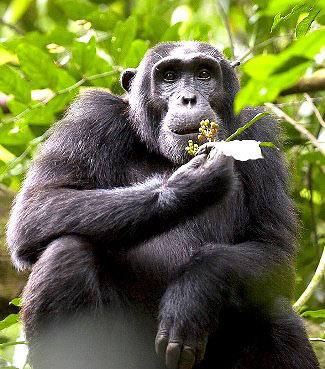
A wild Chimpanzee at Kibale Forest, Uganda, by Francesco Veronesi. With Gorillas, monkeys and many birds as well Uganda is possibly the ultimate wildlife destination, although there are many contenders!
THE BEST WILDLIFE
IN THE WORLD
and where to see it all
There are an estimated 7.77 million animal species on Earth (only 12% of which have been described so far) so lists such as this one are of course highly subjective but the 100 plants and animals listed below are the ones we believe are the best in the world. They have been chosen very carefully and for a multitude of reasons, but mainly based on personal experience of some of them and on dreams of seeing the rest, dreams resulting from what we have heard, read or seen.
To find out more about the wildlife listed here and read about other amazing plants and animals see the great book Animal Records by Mark Carwardine, an updated reprint of which was published by the Natural History Museum, London, in 2010.
Email us which plants and animals you think should be on the list.
The list is in alphabetical order. In most species accounts there is some information about the plant or animal and the best destinations in the world to look for it, with those included in the Destinations A-Z linked.
Birds are dealt with separately under The Best Birds in the World.
Introduction
Life exists everywhere on Earth. Microscopic organisms live underneath ice floes, in volcanoes, in pools of sulphuric acid, even on the surfaces of high-altitude clouds. Over 200 species of bacteria live in and on each one of us, about ten million of them per square centimetre of skin and even more inside. It is believed that a colony of shrimps survived in a black lagoon in a seasonless world of perpetual darkness over a thousand feet underground at Monkwearmouth colliery in England, from when the shaft was sunk in 1826 to when the shaft was sealed and they were rescued in 1994, by eating the bacteria which were eating the sulphur in the coal.
Even larger animals live in what we consider extreme places. Polar Bear footprints have been seen within 2 degrees of the North Pole, presumably in pursuit of Ringed Seals which have been recorded there. Two bird species, the Antarctic Petrel and the Snow Petrel, nest within 10 degrees of the South Pole, both further south than where Emperor Penguins raise their young. The Emperor endures temperatures which fall to minus 76 Fahrenheit (minus 60 Celsius) and hurricane-force winds on a regular basis while incubating their eggs during the Antarctic winter. Almost as hardy is the Snowy Owl, individuals of which sometimes spend the Arctic winter on Ellesmere Island, Canada, within 10 degrees of the North Pole. The Siberian Salamander can survive winter temperatures as low as minus 69 Fahrenheit (minus 56 Celsius).
In the cold mountain tops Snow Leopards are occasionally seen as high as 5500 m (18,040 ft), a Wolf has been recorded at 5791 m (19,000 ft), a Puma spotted at 5800 m (19,024 ft) in the Andes, Yaks probably forage as high as 6100 m (20,000 ft) and the highest-living mammal, the Large-eared Pika of Asia, lives as high as 6130 m (20,106 ft). In the Himalayas Jumping Spiders, which probably eat wind-blown waifs, live under stones frozen to the ground nearly 6700 m (21,980 ft) up the slopes of Everest, a Common Toad has been found at 8000 m (26,246 ft) and Alpine Choughs have been seen soaring just 600 metres below the summit of Everest at 8235 m (27,010 ft). Other birds, notably the Bar-headed Goose and Common Crane, fly over the Himalayas each spring and autumn, at heights of up to 10,000 m (33,000 ft), but even they do not reach the heights of the highest-flying bird, a Ruppell’s Griffon Vulture which collided with an aircraft 11,277 m (37,000 ft) above the Ivory Coast.
Below African skies some of the lakes in the Great Rift Valley are caustic enough to burn human flesh and yet support a broth of brine shrimps and blue-green algae which, in turn, feed flamingos with legs protected by scales. Even deserts are not devoid of life. African Skimmers which nest on the shores of Lake Rudolph in north Kenya are able to withstand ground air temperatures of over 100 degrees Fahrenheit (up to 40 Celsius). When temperatures reach 115 Fahrenheit (46 Celsius) at midday in the Sahara, Silver Ants are out and about searching for other insects which have died in the heat, and they do not suffer any ill effects until the temperature rises to 128 Fahrenheit (53 Celsius).
In the oceans life is just as tough. Way down, eyeless shrimps, giant clams, crabs, squat lobsters, giant tube worms, octopuses and fish, a whole community of animals, live in the dark and survive on bacteria which feed on sulphur in the super-hot water gushing from deep-sea vents at 662 Fahrenheit (350 Celsius). Unlike other animal communities on Earth this one is not dependent on the Sun for energy but on the energy generated by the planet’s molten core. Could such vents and communities have been where life on Earth began?
Life exists even deeper. One unidentified red shrimp has been recorded at a depth of 10,913 m (35,802 ft) in the Marianas Trench, while the deepest-living fishes, the Abyssobrotula genus of brotulids, survive down to at least 8370 m (27,450 ft), where one was captured in the Puerto Rico Trench. Even large animals enter the abyss. A Leatherback Turtle has been tracked to a depth of 1200 m (4000ft) and these animals are thought to reach 1500 m (5000 ft) where clouds of jellyfish, their main prey, occur. A Northern Elephant Seal has been recorded diving to a depth of 1603 m (5290 ft) and a Sperm Whale has been tracked down to 2000 m (6560 ft) to the seabed off Dominica. It was underwater for over an hour but Sperm Whales can spend much longer without air. One which was killed south of Durban surfaced after an hour and 52 minutes and in its stomach were two dogfish, which live on the seabed, which for a radius of 48-64 km (30-40 miles) lay at depths exceeding 3193 m (10,473 ft), the depth to which Sperm Whales probably pursue Giant Squid.
So which are the best places for wildlife in the world? By comparing data on amphibians, reptiles, fish, birds, mammals and vascular plants Mongabay compiled a list of the most biodiverse countries. The biggest countries came out on top but on a per square mile basis the small country biodiversity champions were, in ascending order, Brunei, The Gambia, Belize, Jamaica, El Salvador, Costa Rica, Rwanda, Equatorial Guinea and Panama.
The List
Aardvark Orycteropus afer
This mammal’s unique anatomy means it has been placed in its own taxonomic order. It occurs
in open country in much of Africa south of Sahara but is nocturnal and because night-drives are not allowed in most parks and reserves it is
difficult to see except at places where such drives are allowed. Hence the best places to see Aardvark are in
Namibia and Western South Africa, not least Marrick
Safaris private reserve near Kimberley.
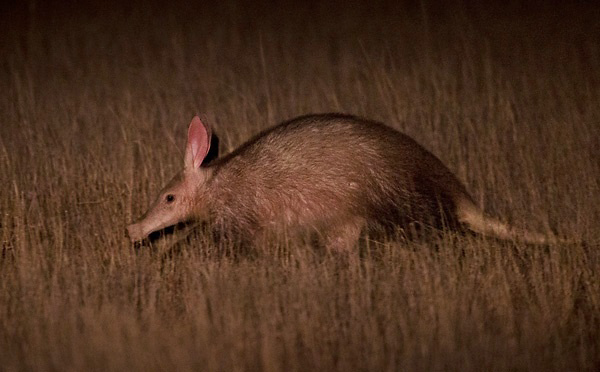
An Aardvark out at night near Kimberley in South Africa by Lars Petersson.
African Wild Dog Lycaon pictus
Although once found across Africa today the main strongholds of this elusive predator are
the Okavango Delta area in Botswana, Mana Pools National Park in Zimbabwe and the Selous Game Reserve in
Southern Tanzania where there are believed to be about 800, about a fifth of a possible total world
population of about 4000. Even in these places they can be hard to track down because these pack animals have territories up to 1500 sq km in extent and
can cover 50 km a day, and they only stay in one location while denning.
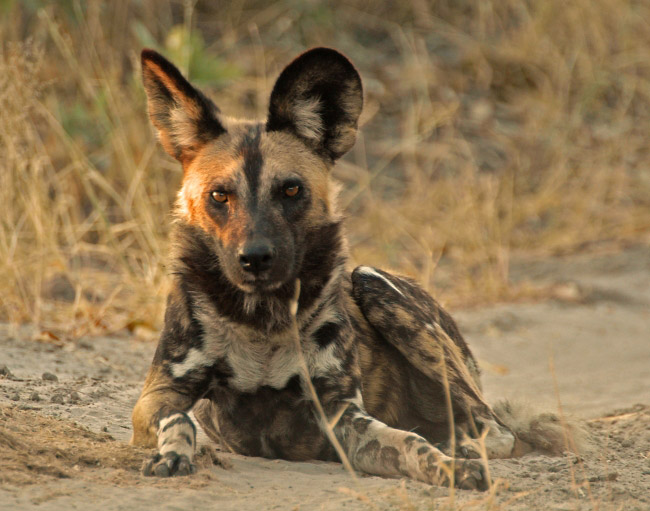
African Wild Dog in Botswana by Marie-France Grenouillet.
(Giant) Anteater Myrmecophaga tridactyla
This amazing animal may reach up to 2 m (6.5 ft) long including the big, bushy
tail which may be up to 90 cm (3 ft) long. It occurs in Central and South America south to Northern Argentina. The best places in the world to see
Giant Anteater include Emas and Serra da Canastra National Parks, and the Pantanal in Southern Brazil,
although it is also possible to see one in the Llanos of Western Venezuela and in
Guyana.
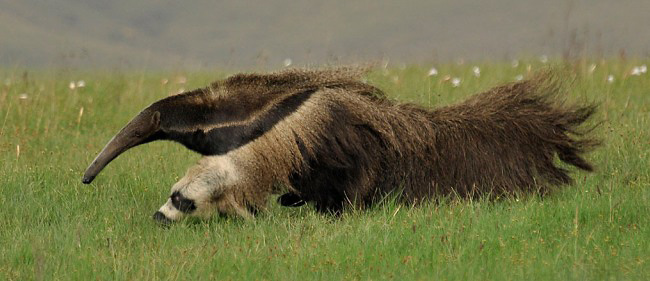
Giant Anteater in Serra da Canastra National Park by Jon Hornbuckle.
There are two species of rare and elusive arboreal anteaters called Tamanduas. They occur in Central and South America south to Brazil. The best places in the world to look for Northern Tamandua (Tamandua mexicana) include Carara Reserve, Palo Verde National Park and Corcovado National Park in Costa Rica. The best places in the world to look for Southern Tamandua (Tamandua tetradactyla) include the Llanos in Western Venezuela, the Amazon, Machalilla National Park on the west coast of Ecuador, the Pantanal in Southern Brazil, Kaa-Iya del Gran Chaco National Park in Bolivia and Copo National Park in northern Argentina.
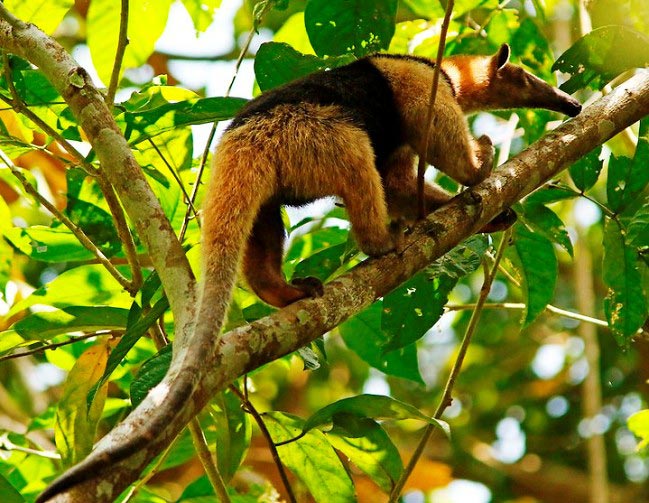
A Northern Tamandua along the Pipeline Road in Panama by David Beadle.
Armadillos Dasypodidae
There are about 20 species of armadillo which occur from southern North America to southern South
America. The largest is Giant Armadillo (Priodontes maximus), up to at least 1 m (3 ft) long not including the tail of up to 50 cm (20 in),
but it is rarely seen in the wild and the only real chance of seeing one is where they are being radio-tracked at
Fazenda Baia das Pedras in Southern Brazil. It also occurs in Emas National Park in Southern
Brazil but is rarely seen there. The smallest armadillo, Pink Fairy Armadillo (Chlamyphorus truncatus), which grows to a maximum of 15 cm
(6 in), occurs in central Argentina.
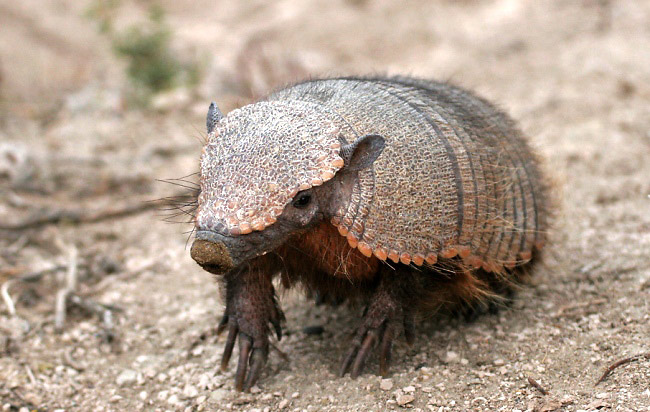
A Pichi, or Dwarf Armadillo, in Argentina, by Lee Dingain.
Aye-aye Daubentonia madagascariensis
This curious creature with elongated fingers for winkling out wood-boring insect
larvae is very rare on Madagascar and very hard to see. The best place to look for the nocturnal
Aye-aye is in the Daraina area in the far north, well away from the beaten track, and there is also a chance at Ankarana Special Reserve, Ile mon Desir,
Masoala (Peninsula) National Park, Nosy Mangabe (introduced) and Parc Tsimbazaza, but even where they have been introduced the chances of seeing one
are very slim, even during a prolonged stay.
Baboons Cercopithecidae
These mainly terrestrial monkeys occur throughout the open country of Africa south of Sahara. Most
of the eight species are easy to see although the Mandrill (Mandrillus sphinx), arguably most attractive, is one of the most elusive. The
best place to see Mandrill is Lope National Park in Gabon, but it is a nomadic species which is very difficult
to find without joining the people radio-tracking them.
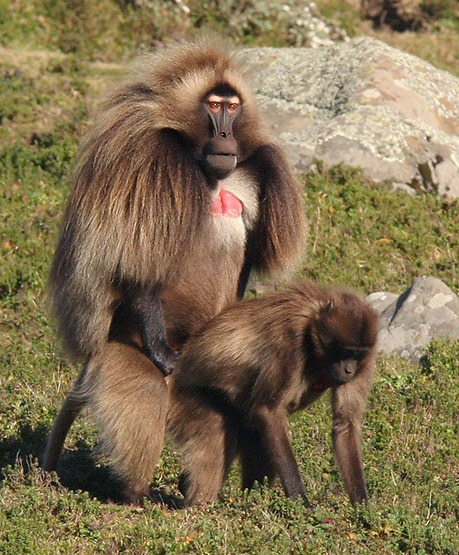
Gelada Baboons at Gemassa Gedel in Ethiopia by Lars Petersson.
Bat Roosts
One of the largest roosts of flying foxes (Black Flying Foxes (Pteropus alecto)) is that at Tooan Tooan Creek
near Hervey Bay in Eastern Australia and one of the largest roosts of fruit bats involves up to five
million Straw-coloured Fruit Bats (Eidolon helvum) which have been estimated roosting in Kasanka National Park in
Zambia. There are several sites in the world, usually caves, where such huge numbers of bats may be seen
departing their roosts at dusk, including Gomantong Caves in Sabah and Deer Cave (with the world’s largest cave passage) in Gunung Mulu NP in Sarawak,
both in Borneo, where the bats are mainly Wrinkle-lipped Bats (Tadarida plicata), but the largest bat
roosts in the world are believed to be those on the Edward’s Plateau in Texas, notably the northern summer
nursery of 10 million Mexican Free-tailed Bats (Tadarida brasiliensis), as well as potentially 10 million baby bats, in Bracken Cave
near San Antonio. Access to this sensitive site is restricted to members of Bat Conservation International
so the best place in the world to see millions of bats leaving their roost at dusk is the private Frio Cave also near San Antonio, where there are up to
ten million Mexican Free-tailed Bats. About 1.5 million also roost under Congress Bridge in Austin, Texas, and many too in Carlsbad Caverns National Park
in New Mexico. The bats are usually present from March to September, with the highest numbers in July-August.
Bears see Brown Bear and Polar Bear.
Beetles Coleoptera
There are more species of beetle than any other animal (about 350,000) and they account for about a
quarter of all life-forms. The largest (bulkiest) beetle in the world is Megasoma actaeon, a Rhinoceros Beetle which occurs throughout
South America. The longest beetles in the world are two species of Hercules Beetle; Dynastes hercules which may reach 19 cm (7.5 in)
and Dynastes neptunus which may reach 18 cm (7 in), both of which occur in Central America, northern South America and on some Caribbean
islands. More than half the length of both is taken up by the horns and the longest beetle in the world without long horns is the Titan Beetle
(Titanus giganteus) of the Amazon which reaches 16.7 cm (6.25 in). Other big beetles include the
five species of goliath beetle (Goliathus) of tropical Africa which can be seen at places such as Odzala-Kokoua National Park in the
Republic of Congo and Ituri Forest in the Democratic Republic of Congo.
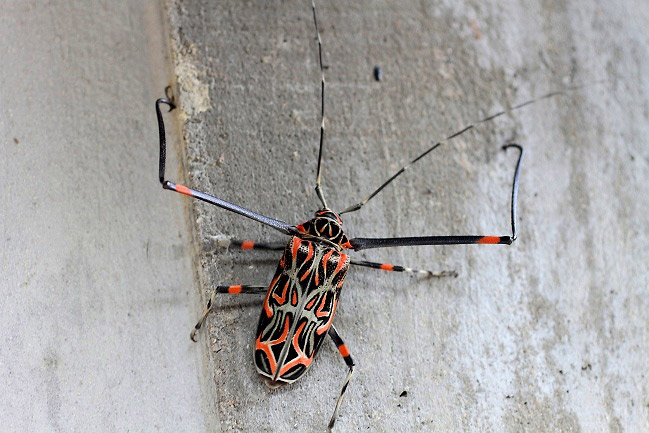
A Harlequin Beetle in Southeast Brazil by Lee Dingain.
Billfish Istiophoridae and Xiphiidae
These large fish occur across the world, including in the Mediterranean and Black
Seas. The Sailfishes (Istiophorus spp.) are considered to be the fastest fish over short distances, having been recorded taking out 91 m
(300 ft) of line at 109 km/h (68 mph). The next fastest fish is arguably the Swordfish (Xiphias gladius) which is thought to be able to
reach 96 km/h (60 mph) then the marlins (Makaira spp.) which have been timed at 80 km/h (50 mph). Billfish are difficult to see away from
the end of a fishing line and the best place in the world to see Sailfish swimming free is off the coast of
Eastern South Africa where they attend the annual Sardine Run which usually takes place
between May and July, especially in late June-early July. Billfish do occasionally leap out of the sea too and one of the best places in the world
to see Sailfish do this is the Maldives.
Bisons Bison spp.
These large animals can reach 2 m (6.5 ft) tall and 3 m (10 ft) long. The American Bison (Bison
bison) was all but wiped out long ago but has since been reintroduced to many parts of North America. However, the best places to see genetically
pure American Bison include Elk Island National Park in Alberta, Canada, Yellowstone National Park in
Wyoming, Wind Cave National Park in South Dakota and the Henry Mountains in Utah, in the USA. The European
Bison or Wisent (Bison bonasus) was totally wiped out in the wild but has since been reintroduced to the wild in Bialowieza Forest and Bieszczady
National Park in Poland; the bigger, wilder part of Bialowieza which straddles the border with
Belarus and is known there as Belowezhskaya Pushcha; and in the western Caucasus.
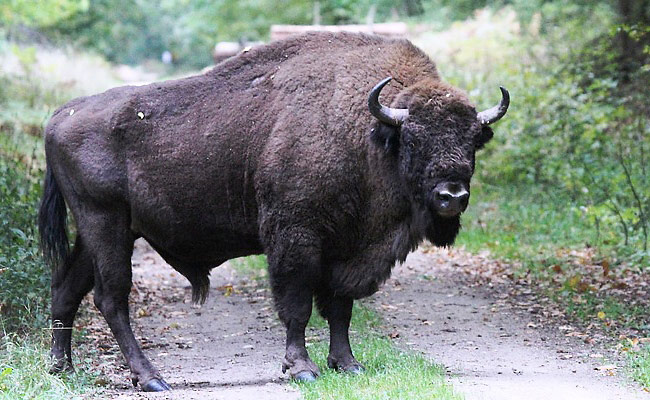
A rare image of a bull European Bison taken in Bialowieza Forest, Poland by Lee Dingain.
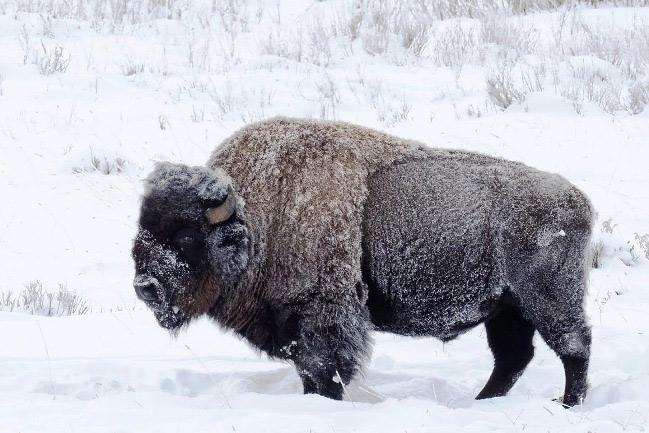
American Bison in Yellowstone National Park by Simon Colenutt.
Black-and-white Colobus Monkeys Colobus guereza etc.
These very attractive, agile, long-fingered monkeys occur in a variety
of forms across central Africa, from the Congo east through Uganda,
Ethiopia and
Kenya to
Northern Tanzania and
Southern Tanzania, and can be seen in many places. The East African highland form of guereza
has much longer and thicker fur than the Central African lowland form pictured right, and the tail is all white.
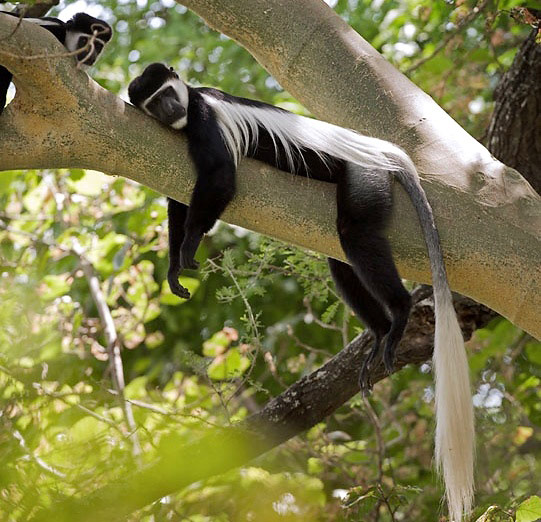
A Black-and-white Colobus Monkey in Omo National Park, Ethiopia by Lars Petersson.
Blue Whale Balaenoptera musculus
This is not only the largest animal in the world but also the largest thing that has
ever lived. The average length is 26.2 m (86 ft) but the longest ever measured was 29.6 m (97 ft) long, a female killed in Twofold Bay, New South Wales,
Australia, in 1910. Such huge mature animals have hearts as big as small cars. They occur around virtually the whole planet and can be seen in many
places, but the best places in the world to see Blue Whale include Monterey Bay in Northern
California, Baja California and Sri Lanka.
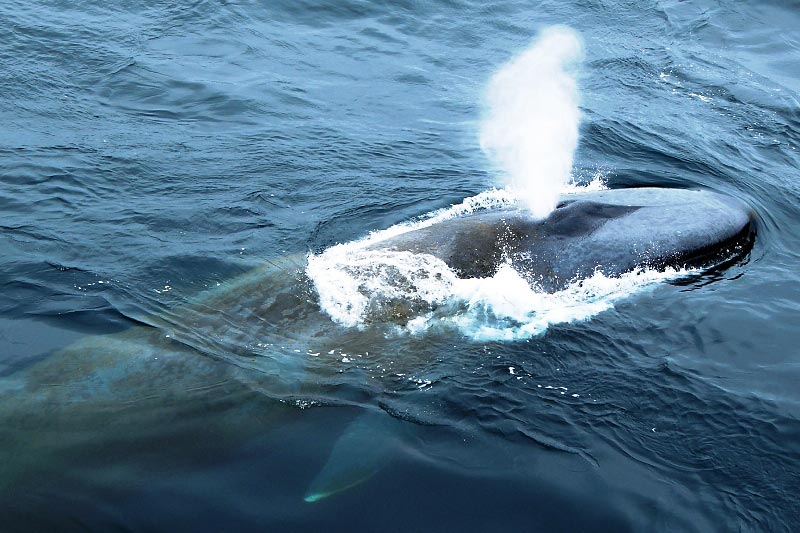
A rare close-up of a Blue Whale taken in the Drake Passage between South America and the Antarctic Peninsula by Dave Barnes.
Bonobo Pan paniscus
This ape takes the place of Chimpanzee south of the River Congo in the Democratic Republic of Congo,
a remote part of the world where the best places to see Bonobo are the Lomako-Yokolala Faunal Reserve, Luo Scientific Reserve and Salonga National Park.
Bonobos and Chimpanzees are not good swimmers and the formation of the River Congo between 1.5 and 2 million years ago may have led to them becoming
separate species, the only two members of the Pan genus, our closest living relatives.
Brown Bear Ursus arctos
This bear has a large range, encompassing parts of Europe, across north Asia to Kamchatka, and
northern North America where the subspecies is known as the Grizzly Bear (Ursus arctos horribilis). The best places to see Grizzly Bears include
several places in Alaska including Southeastern Alaska,
and Western Canada, where watching them pluck salmon from rivers is one of the top wildlife experiences,
and there is also a chance in Alberta and Yellowstone National Park in
Wyoming. In Europe and Asia the best places to see Brown Bear include
Finland, the Carpathian Mountains in Romania,
the Pindos Mountains in Greece and
Kamchatka, although it is also seen quite regularly in
Abruzzo National Park, Italy and there is even a chance in the Cantabrian Mountains of
Northwestern Spain; in Somiedo National Park for example.
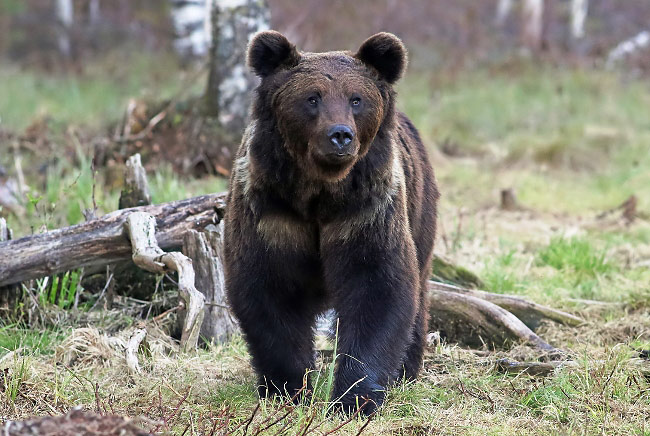
Brown Bear in Finland by Chris Townend.
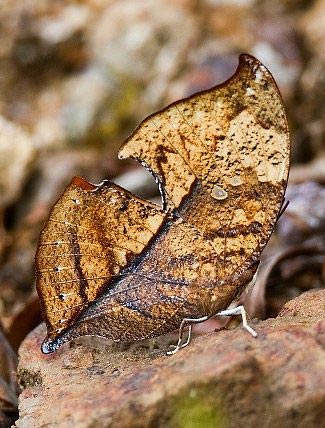
The incredible Leaf Wing Butterfly, in Panama, by Francesco Veronesi.
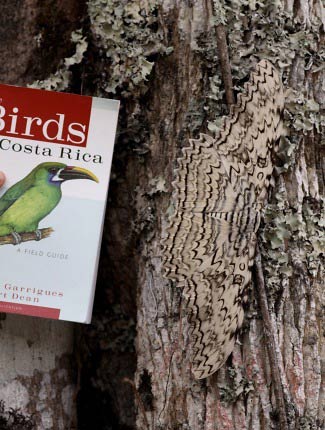
The well-camouflaged, largest moth in the world, the Giant Agrippa or White Witch, photographed in Panama (not Costa Rica!) by Ian Davies.
Butterflies and Moths Lepidoptera
There are about 180,000 species of butterfly and moth in the world and many of them
could claim to be beautiful. The largest butterfly in the world is the very rare Queen Alexandra’s Birdwing (Ornithoptera alexandrae)
which casts large shadows over the Popondetta Plain in Papua New Guinea, well off the established circuit taken to see birds-of-paradise.
It has an average front wingspan of 21 cm (8 in) but it can exceed 28 cm (11 in). The smallest butterflies in the world are the Dwarf Blue
(Brephidium barberae) which has a wingspan of 1.4 cm (0.5 in) and occurs in South Africa, and the Pygmy Blues (Brephidium exilis
and Brephidium isophthalma) which occur from the southern USA to South America. The largest moth in the world according to wingspan is the
Giant Agrippa (Thysania agrippina), also known as the Owlet or White Witch, of Central and South America, which has been recorded with a wingspan
of 30.8 cm (12.25 in). The Hercules Moth (Coscinocera hercules), which occurs in New Guinea as well as tropical north and east Australia, can have
a wingspan of up to 28 cm (11 in). The largest moth in the world by surface area is the Atlas Moth (Attacus atlas) which occurs from India
through Southeast Asia to Indonesia. It has a wingspan of up to 25 cm (10 in). The smallest moth in the world is Trifurcula ridiculosa which occurs
in the Canary Islands and has a wingspan of 2 mm (one sixteenth of an inch) and a similar body length. The greatest diversity of butterflies probably
occurs in Amazonia where it is estimated that about 2000 species occur in the small Rio Cristalino (Jungle Lodge) Forest Reserve in Brazil for example.
Also see Monarch Butterfly Winter Roosts.
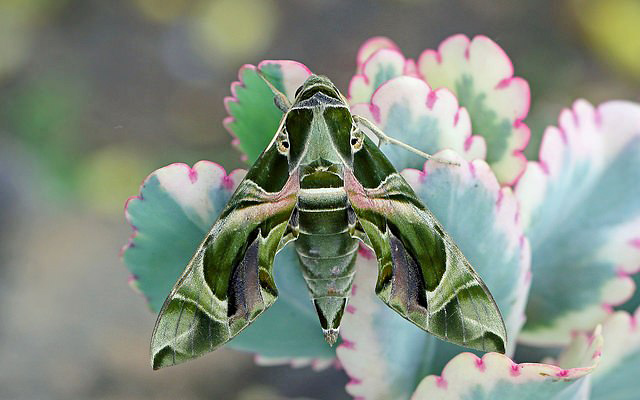
A truly gorgeous Oleander Hawkmoth at Sakania in the Democratic Republic of Congo by Nigel Voaden.
(Bactrian) Camel Camelus bactrianus
This animal is nearly extinct in the wild. Only a thousand are thought to
survive and the best places to see wild camels in the world are the remotest (but accessible) parts of the Gobi Desert in
Mongolia, and China, particularly in the Lop Nur Wild Camel Nature Reserve in Xinjiang Province.
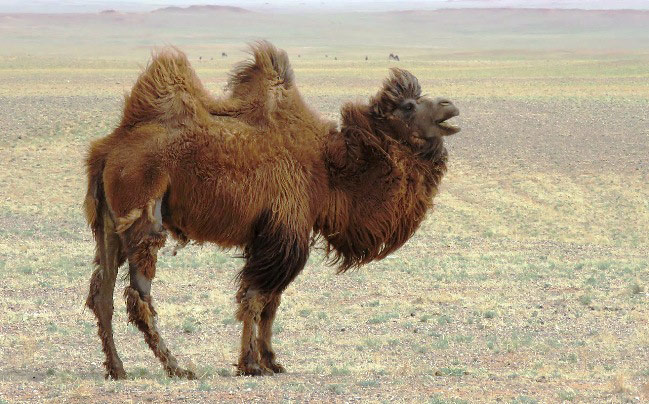
A fine example of the extraordinary Bactrian Camel, in Mongolia, by Simon Colenutt (not a wild one!).
Capybara Hydrochoerus hydrochaeris
The largest rodent in the world occurs from Panama south to northern Argentina. The
best places to see Capybara include the Llanos in Western Venezuela and
Colombia, and the Pantanal in Southern Brazil.
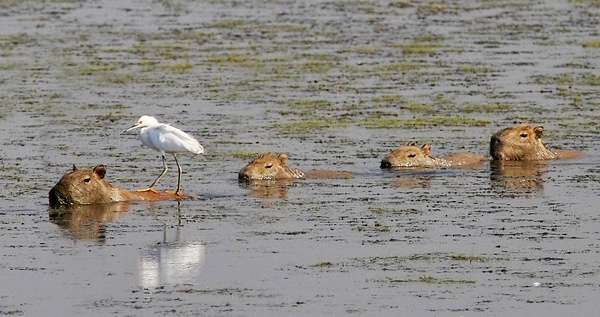
Capybaras at Hato El Cedral in the Llanos of Venezuela by Lars Petersson.
Cephalopods (Cuttlefish, Octopuses and Squids) Cephalopoda
These eight-armed molluscs and often beautifully coloured animals are
believed to be the most intelligent invertebrates. Octopuses can learn from other octopuses and are even capable of opening screw-top jars and stoppered
bottles to get at food placed inside! All cephalopods have the ability to change colours, to deter predators, distract prey and for use in courtship.
They can also escape predators by suddenly shooting backwards and/or ejecting a cloud of inky fluid to produce something like a 'smokescreen'. Flying squid can even
shoot out of the water to avoid predators. The largest octopus is the Pacific Giant Octopus (Enteroctopus dofleini) which occurs from Japan across
the top of the Pacific to Alaska and south down the west coast of North America to California. Its average arm-span is believed to be about 2.5 m
(8 ft 2 in) although the largest known had a span of 9.6 m (31 ft 6 in). Watch out for the pretty Blue-ringed Octopuses (Hapalochlaena spp.); they are
the most dangerous to humans with some individuals believed to carry enough venom to paralyse ten adults and kill a single person within minutes. The
Atlantic Giant Squid (Architeuthis dux) is the longest invertebrate on Earth excluding worm-like animals. The two longest were washed ashore in
Newfoundland, Canada between 1870 and 1889, and in Lyall Bay, Cook Strait, New Zealand, in 1887; the latter's body was 1.7 m (5 ft 7 in) long and
including the two longest tentacles the whole animal was 16.8 m (55 ft 2 in) long. They are deep-sea creatures that have never been studied in the
wild.
Chameleons Chamaeleonidae
These strange and beautiful creatures have a wide distribution, including Iberia, Africa
and south Asia but the best place in the world to see chameleons is Madagascar where over 80 species,
over half of the world total, occur, including the Pygmy Stump-tailed Chameleon which is just 2 cm (0.8 in) long.
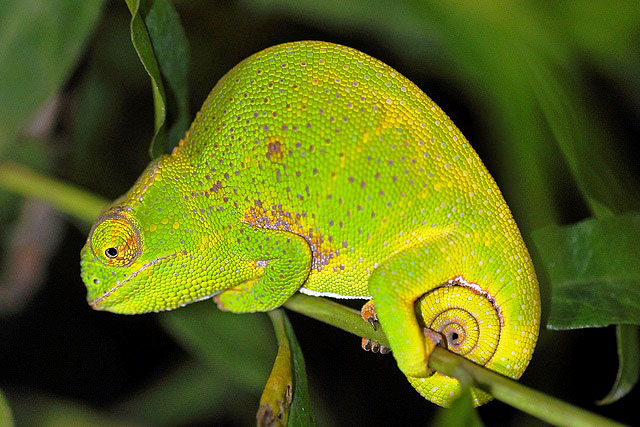
Canopy Chameleon in Madagascar by Nigel Voaden.
Cheetah Acinonyx jubatus
The fastest land mammal in the world over short distances (the fastest land mammal in the world
over long distances is the Pronghorn (Antilocapra americana)). This beautiful cat can accelerate to 72 km/h (45 mph) in two seconds and
run at up to about 96 km/h (60 mph) for 500 m (1640 ft). It occurs in Africa from Mauritania and Algeria across to East Africa and down
to Eastern South Africa, with some in Iran and maybe elsewhere in the Middle East-Pakistan region. The best places in the world to see Cheetah include
Samburu and the Masai Mara in Kenya, the Serengeti in Northern
Tanzania, Ruaha in Southern Tanzania, Etosha National Park in
Namibia, Kruger National Park in Eastern South Africa and
Kgalagadi Transfrontier Park in Western South Africa.
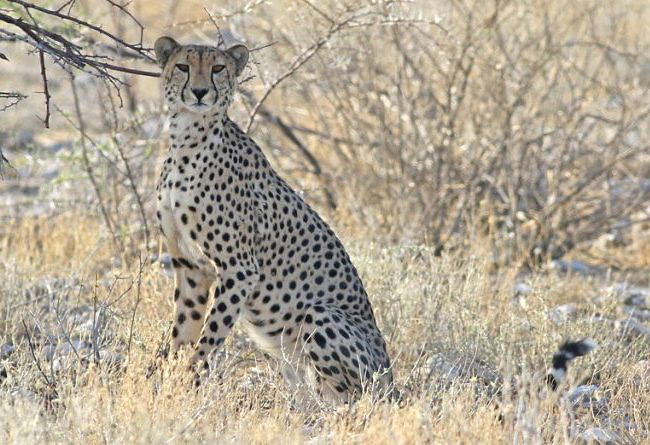
Cheetah in Etosha National Park, Namibia, by Chris Townend.
Chimpanzee Pan troglodytes
Spending an hour in the company of our closest living relatives as they make their way
noisily through the forest is one of the top wildlife experiences. They occur from Guinea through western and central Africa north of the River Congo
(Bonobos live to the south of the river) east to Tanzania but they are shy and wary where they have not been habituated to humans and hence difficult
to see in many areas. However, there are a few places where they have been habituated and it is possible to join organised tours to track them down and
spend up to an hour in their company and these places, the best places in the world to see Chimpanzees, are in
Uganda and Rwanda, and at Gombe Stream and Mahale Mountains National
Parks in western Tanzania.
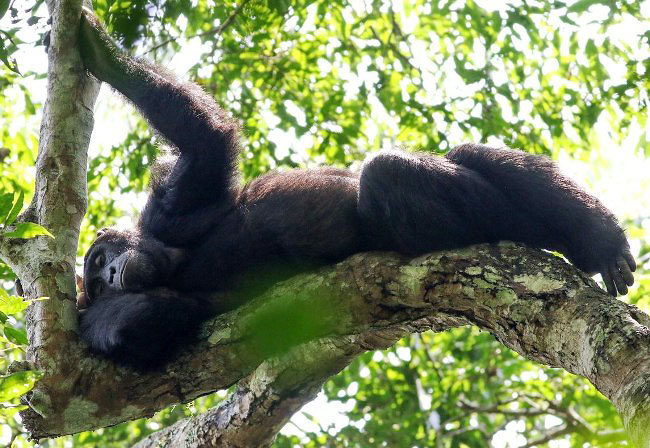
A Chimpanzee having a nap in Kibale Forest, Uganda, by Chris Townend.
Coatis Procyonidae
The four species of cute coatis occur from Arizona through Central America to northern Argentina and may be
seen in many places.
Coral Reefs
Coral Reefs are probably the oldest ecosystems in the world. Shallow water reefs which are confined to the tropics and
subtropics support an astonishing variety of life, especially fish, over a thousand species of which may co-exist in some small areas of reef, and
swimming through this psychedelic world is one of the top wildlife experiences. The best Coral Reefs in the world include those around
Hawaii; the Caribbean, notably the 300 km (185 mile) long barrier reef (the longest unbroken reef in the world,
second in size to the Great Barrier Reef only), which supports 500 fish species, off Southern Mexico,
Belize and Honduras; the Red Sea;
Kenya; Aldabra; the Seychelles; the
Maldives;
the Philippines; Southern Thailand;
the Malay Peninsula; Borneo; the seas between Sulawesi and
West Papua in Indonesia where over 3000 fish species have been recorded, the greatest diversity of fish in
the world, particularly Bunaken Marine Park, the Lembeh Strait, Wakatobi Marine Park and the Raja Ampat Archipelago off West Papua (where there are over
1300 fish species alone, part of the greatest concentration of marine life for an area of its size in the world);
Komodo; Papua New Guinea; the Solomon Islands, particularly
the island of Rennell; Fiji; Palau; the Ningaloo Reef in
Western Australia; and the Great Barrier Reef off
Eastern Australia, the largest structure ever built by living things, at over 2000 km (1242 miles)
long.
Apart from fish coral reefs are inhabited by a multitude of other fantastic animals, including Echinoderms (see below) and Shrimps (Decapoda). The 67,000 species of Crustacean include barnacles, crabs, crayfish, krill, woodlice and shrimps and some of the shrimps which live on coral reefs are truly spectacular brightly-coloured and intricately-patterned creatures, including the pan-tropical Banded Coral or Boxing Shrimp (Stenopus hispidus), the Sexy or Squat Shrimp (Thor amboinensis) of parts of the Atlantic and Indo-West Pacific, clown shrimps such as the Spotted Cleaner Shrimp (Periclimenes yucatanicus) of the Caribbean, the Red-backed Shrimp (Lysmata grabhami) of the tropical and subtropical Atlantic, the Red-veined Shrimp (Lysmata rathbunae) of the western Atlantic, and dancing shrimps (Rhynchocinetes sp.).
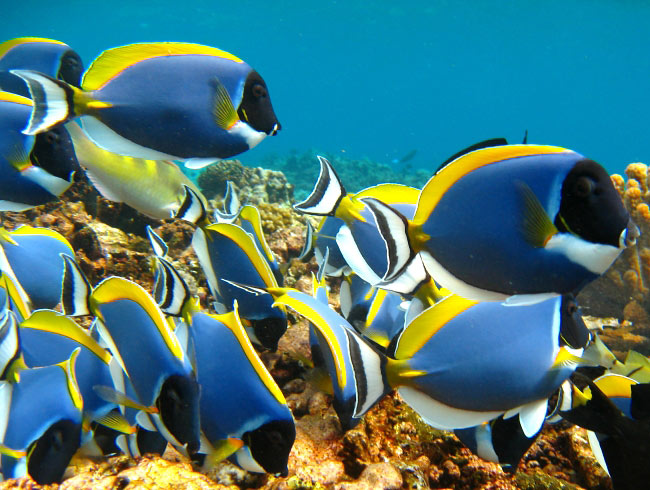
Powder-blue Surgeonfish in the Seychelles by Marie-France Grenouillet.
Crocodiles Crocodilia
These ancient reptiles are largely confined to the tropics. They include two species of gharial
(Gavialidae), two species of alligator (Alligatorinae), six species of caiman (Caimaninae) and over ten species of crocodile (Crocodylidae). The
largest crocodile in the world is the Saltwater Crocodile (Crocodylus porosus) which occurs from the west coast of India to Fiji, in salt
and fresh water. One individual reached a length of 7 m (23 ft) and another, almost certain, record concerns one which measured 8.6 m (28 ft 4 in),
but the average size of a mature male is up to 4.5 m (15 ft), similar to that of the Gharial (Gavialis gangeticus) and the Nile Crocodile
(Crocodylus niloticus), both of which can grow to over 6 m (20 ft). The best places in the world to see Saltwater Crocodiles include
Northern Australia where Kakadu National Park near Darwin is one of the most reliable sites.
Nile Crocodiles occur in many places on mainland Africa from the Sahara south to Botswana, and on Madagascar. The best places in the world to see
Gharials, which occur on the Indian subcontinent east to Myanmar, include Nepal,
Northern India and Northeastern India.
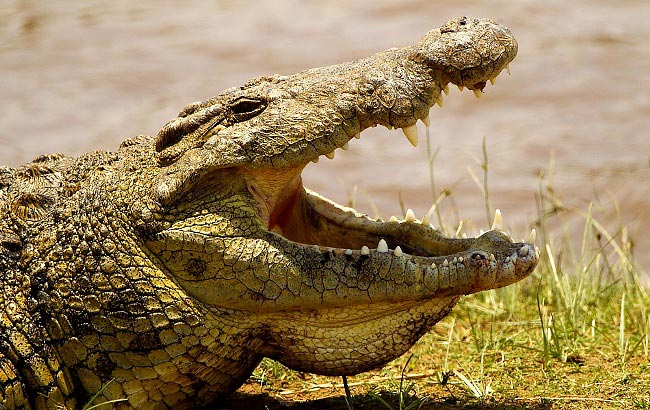
A Nile Crocodile waits for the Blue Wildebeest and Zebras to attempt to cross the Mara River on their annual migration in Kenya, by Francesco Veronesi.
Damselflies and Dragonflies Odonata
There are numerous beautiful damselflies and dragonflies in the world. The largest
damselflies or dragonflies in the world are the Giant Helicopter Damselflies (Megaloprepus coerulatus) which occur in Central America and northern
South America and have wingspans of up to 19 cm (7.5 in) and body lengths of up to 12 cm (5 in). The smallest damselfly or dragonfly in the world,
Agriocnemis naia, occurs in Myanmar. It has been recorded with a wingspan of just 1.8 cm (0.7 in) and a similar body length. Some dragonflies
undertake great migrations. Vast numbers migrate from India to eastern Africa via the
Maldives in October-December, with the next generation returning in March-June, and countless numbers of
Green Darners (Anax junius) migrate south along the east coast of America in September to the Gulf of Mexico, the fresh adults returning the
following spring.
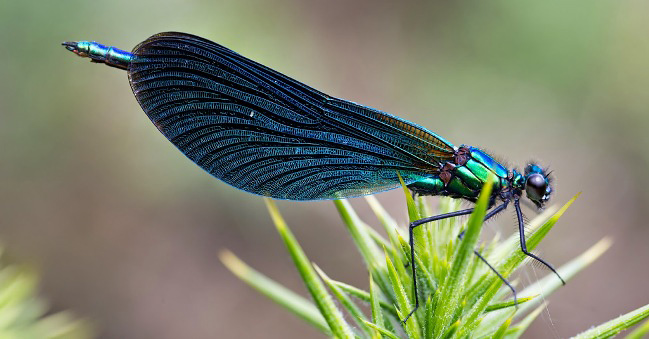
An aptly-named Beautiful Demoiselle in the New Forest, England by Simon Colenutt.
Dolphins and Porpoises Cetacea
These vibrant marine mammals may be encountered almost anywhere in the world, at sea and along
the major rivers of Asia and South America but the very best places in the world to see dolphins and porpoises include
Monterey Bay in Northern California,
the Bahamas,
Baja California,
on the Atlantic Odyssey boat trip through the South Atlantic Ocean, into the North Atlantic Ocean,
at places such as Madeira and the Azores,
the Bay of Biscay, off Eastern South Africa,
in the Maldives, Western Australia, Kaikoura in
New Zealand,
on the Western Pacific Odyssey between New Zealand and Japan, and around
Hawaii.
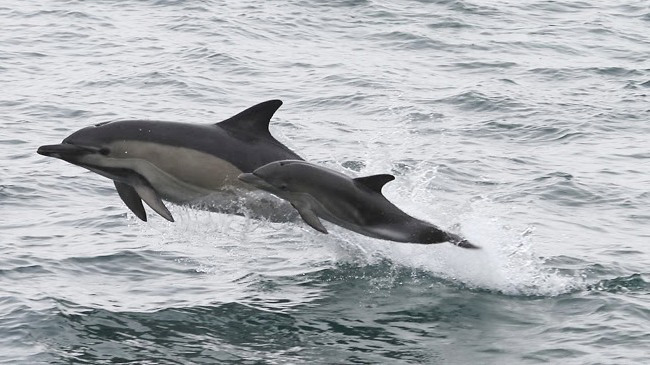
Common Dolphins by Chris Townend.
Dugong and Manatees Dugong dugon and Trichechus spp.
The Dugong occurs from the Red Sea across the Indian Ocean through
Indonesia to New Guinea and Australia. The best places in the world to see Dugong include Mozambique,
Dimakya Island in the Philippines and Shark Bay in
Western Australia, and there is an outside chance of seeing one in Mafia Island Marine Park off
Northern Tanzania. Manatees occur from Florida in North America through Central America to Guyana
and Amazonia in South America, and in West Africa. The best places in the world to see and even swim with West Indian Manatee
(Trichechus manatus) include Florida and Belize although
there is an outside chance of seeing one in Tortuguero National Park, Costa Rica. The best place in the
world to see West African Manatee (Trichechus senegalensis) is Senegal where they can be observed
from a tower coming to a freshwater spring to drink at low tide.
(Short-beaked) Echidna Tachyglossus aculeatus
This strange hedgehog-like mammal lays eggs and incubates its young in
a pouch. The best places to see Short-beaked Echidna, which occurs in southeastern New Guinea and Australia, include
Litchfield NP in Northern Australia,
Cania Gorge NP in Eastern Australia,
Bruny Island, Cradle Mountain NP and Narawntapu NP in Tasmania, Southeastern Australia, and
Dryandra SF in Western Australia.
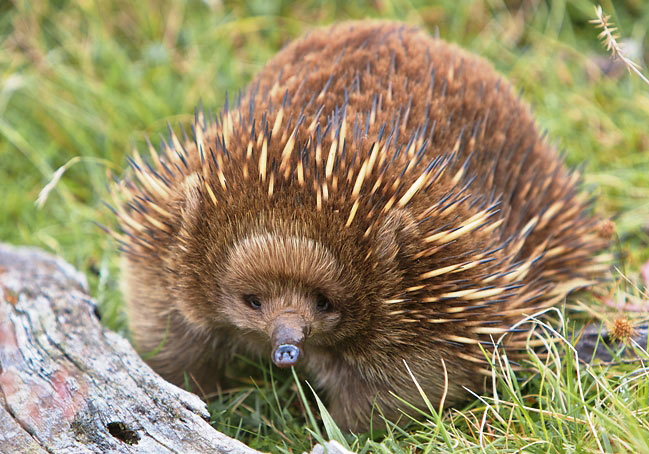
An Echidna in Cradle Mountain National Park, Tasmania, by Michael Halliday.
Echinoderms Echinodermata
The 'spiny skins' (Echinoderms) include the often beautiful Brittle Stars (Ophiuroidea),
Feather Stars (Crinoidea), Sea Cucumbers (Holothuroidea), Sea Urchins (Echinoidea) and Starfishes or Seastars (Asteroidea),
some of which, notably brightly-coloured reef starfishes, have to be seen to be believed, not least the Indo-Pacific Blue Seastar (Linkia laevigata),
the Necklace or Tiled Starfish (Fromia monilis) also of the Indo-Pacific which is red with what looks like white bubbles all over it, the
Red-knobbed Starfish (Protoreaster linckii), another Indo-Pacific species, and the infamous Crown-of-thorns Starfish (Acanthaster planci)
which reached plague proportions in parts of the Indo-Pacific in the late 1960s and early 1970s and temporarily destroyed large parts of the Great Barrier
Reef.
Elephants Elephantidae
The African (Bush) Elephant (Loxodonta africana) is the largest land animal in the world,
standing, on average, up to 3.7 m (12 ft) at the shoulder, although an individual of the tallest race, the ‘Desert Elephant’ of Damaraland, Namibia,
has been measured at 4.42 m (14 ft 6 in). Watching African (Bush) Elephants in the wild is fortunately still possible in many places throughout most
of Africa south of Sahara, although African (Forest) Elephants are more elusive. The Asian Elephant (Elephas maximus) which occurs from India
to South East Asia is rarer and patchily distributed but can still be seen in the wild in
Northeastern India, Northern India and
Sri Lanka.
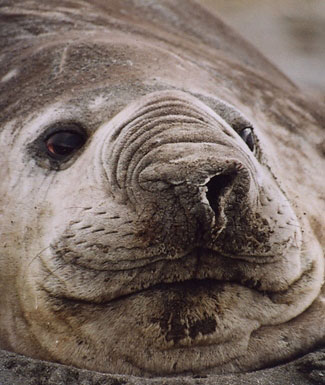
The face of a 4.5 m (15 ft) bull Southern Elephant Seal on South Georgia by Alice Perry.
Elephant Seals Mirounga
These massive animals, the largest seals and largest carnivores in the world, occur from Alaska
to Baja California, and in the Southern Ocean on islands around Antarctica north to mainland Southern Argentina. The largest pinniped of all is the
male Southern Elephant Seal (Mirounga leonine) which may reach a length of 5.8 m (19 ft), attain a girth of 3.7 m (12 ft) and weigh up to 3500 kg
(7720 lb). The best places in the world to see elephant seals include Ano Nuevo State Natural Reserve in
Northern California (Northern (Mirounga angustirostris)),
Baja California (Northern), Punta Tombo and the Valdes Peninsula in
Southern Argentina (Southern),
the Falkland Islands (Southern),
South Georgia (Southern) and the
Subantartic Islands of Australia and New Zealand (Southern). They are great divers; a male Northern was
recorded reaching a depth of 1529 m (5016 ft) off California in 1989.
(Golden-rumped) Elephant Shrew Rhynchocyon chrysopygus
There are over 15 species of elephant shrew (sengi), all of
which occur in Africa. The largest is the extraordinarily long-nosed Golden-rumped which can reach 31.5 cm (12.5 in) long not including the tail which
may be up to 26.5 cm (10.5 in) long. The best place to see Golden-rumped Elephant Shrew, which occurs only by the southeast
Kenya coast, is Arabuko-Sokoke Forest Reserve.
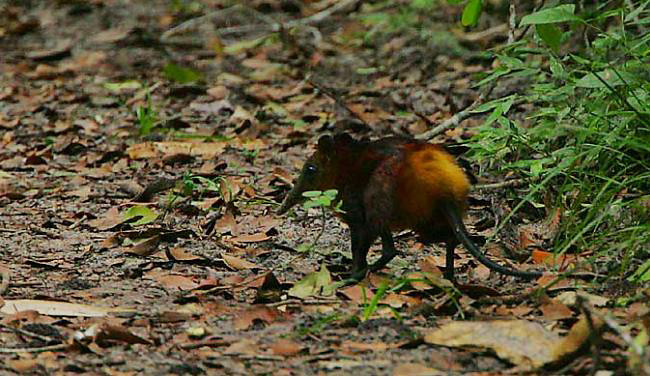
A rare image of a Golden-rumped Elephant Shrew taken in Arabuko-Sokoke Forest Reserve by Steve Garvie.
Fireflies Lampyridae
There are over 2000 species of fireflies, winged beetles which can produce flashes of chemical light known as
bioluminescence. In numbers they make a wonderful sight when it gets dark in many places in the temperate and tropical zones around the world including
Mexico, Japan, Taiwan, India, Thailand and the Philippines. Some species which occur in large numbers together even synchronise flashing and this amazing
spectacle can be seen at places such as Kuala Selangor on the Malay Peninsula and the
Elkmont Campground/Trailhead near the Sugarlands Visitor Centre at the edge of Great Smoky Mountains National Park in Tennessee, USA, where activity
usually peaks in the first half of June. Visitors should be careful not to affect firefly behaviour with artificial light (torches, flash photography and
so on) and especially take great care where they walk because the female insects are wingless and cannot fly and live on the ground where visitors walking
around may trample on them and their eggs, thereby killing the next generation.
Flying Fish Exocoetidae
Gliding Fish is a more appropriate name but they are still very impressive. Some species are able to remain
airborne for about 10 seconds, rise to 3 m (10 ft) above the water and glide over 200 m (650 ft), and in favourable seas and winds, remain airborne
for 30-40 seconds, rise to 10 m (33 ft) above the water and glide over 400 m (1300 ft). They occur in the tropics and subtropics, and the best places
in the world to see flying fish cover a wide area of the globe, especially the seas sailed on long pelagic voyages like the
Atlantic Odyssey and the Western Pacific Odyssey,
as well as at sea around Baja California, the Maldives
and Sri Lanka. Watch out for flying squid too. They have been recorded up to 6 m (20 ft) above the water,
covering distances of 55 m (180 ft)! Some even 'fly' in flocks.
Flying Foxes and Fruit Bats Pteropodidae
Flying foxes and fruit bats are the biggest bats. Some are as big as 45 cm (1.5 ft)
with wingspans of at least 1.7 m (5.5 ft). They occur in the tropics and subtropics of Africa, Asia and Australasia, and they can be seen in many
places, sometimes in large numbers, as described under Bat Roosts.
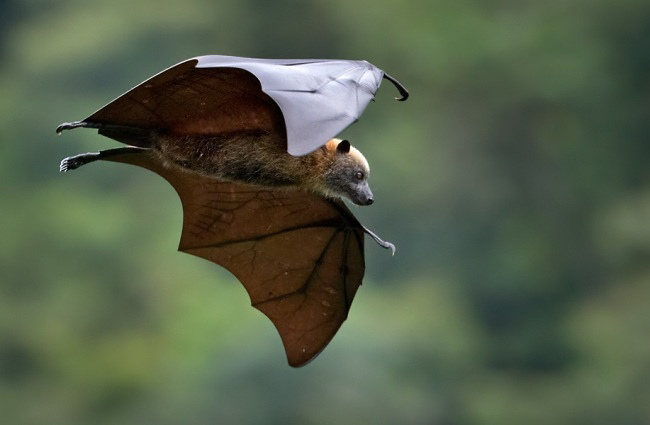
A great image of a Samoan Flying Fox by Lars Petersson.
Fosa or Fossa Cryptoprocta ferox
This handsome, slinky arboreal predator with a body 70-80 cm (2 ft 3 in to 2 ft 7 in)
long and a slightly shorter but still long tail occurs only on Madagascar where the best place to see a
Fosa is Kirindy Forest Reserve, although there is also a chance at Ampijoroa, Andasibe-Mantadia National Park and Ankarana Reserve. It is most likely
to be seen during October when females in oestrous climb their favourite trees, year after year, in order to attract males.
Frogs and Toads Anura
There are over 5000 species of frogs and toads, mainly in the tropics, including flying frogs, almost
transparent glass frogs and some very colourful poison dart frogs, although the most famous is arguably the Red-eyed Leaf or Tree Frog (Agalychnis
callidryas), an elusive creature which is mainly nocturnal and best looked for at the start of the wet season in the lowland forests of Central
America, from far south Mexico to far north Colombia, where the best places in the world to see Red-eyed Tree Frog include Cockscomb Basin Wildlife
Sanctuary in Belize, and several places in Costa Rica. The
largest frog is the Goliath Frog (Conraua goliath) of Cameroon and Equatorial Guinea which averages about 30 cm (a foot) although one captured
in Cameroon in 1889 was reputed to measure 87.6 cm (2 ft 10.5 in). The Cane Toad (Bufo marinus) averages about 50 cm (1 ft 7.7 in).
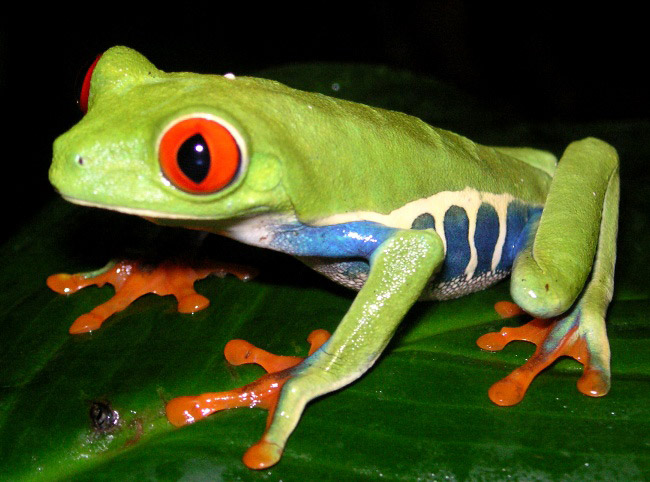
Red-eyed Tree Frog in Costa Rica by Marie-France Grenouillet.
Gemsbok Oryx gazella
This striking, beautiful antelope with long, straight horns sometimes over a metre long, a black and
white face, and black-trimmed torso, occurs in southwestern Africa where the best places to see
Gemsbok include much of Namibia and the northern half of
Western South Africa. The best places to see the equally handsome Beisa/Fringe-eared
Oryx (Oryx beisa), its northeast African counterpart, include Ethiopia, and northern (Samburu)
and Eastern (Tsavo) Kenya.
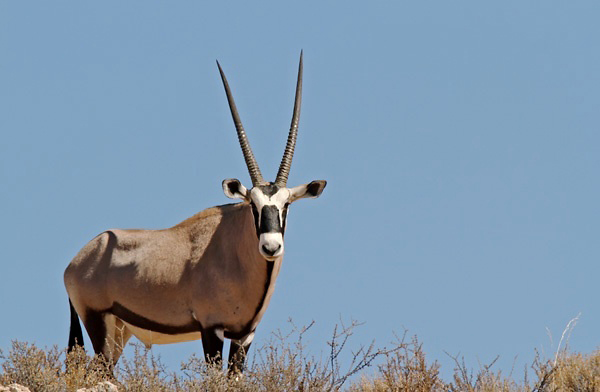
A Gemsbok in Kgalagadi Transfrontier Park which crosses the border between Botswana and South Africa by Lars Petersson.
Gerenuk Litocranius walleri
This beautiful, long-necked antelope occurs in northeastern Africa, from Somalia south to
Tanzania, and the best places to see Gerenuk include Samburu, Meru National Park and Tsavo East National Park in
Kenya.
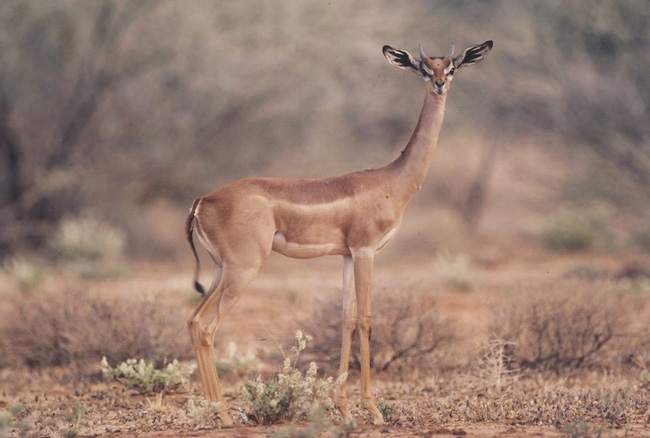
A Gerenuk in Samburu, Kenya, by Nick Cobb.
Giant Otter Pteronura brasiliensis
These really are giants, reaching lengths of up to 1.4 m (4 ft 7 in) not including
the tail which may reach 1 m (40 in). The best places to see Giant Otter, which occurs from Venezuela to Northern Argentina, are Manu National Park in
Southern Peru, and the Pantanal in Southern Brazil.
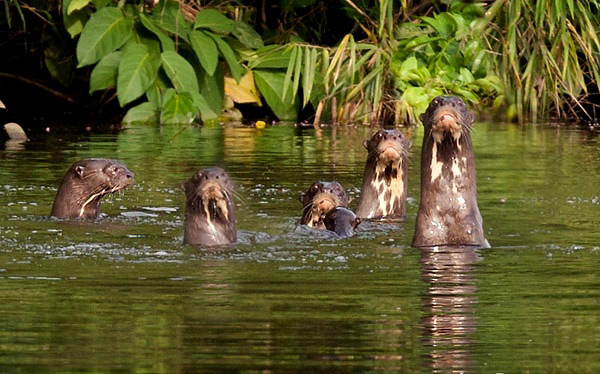
A family of Giant Otters on Cocha Blanco in southern Peru by Lars Petersson.
Giant Panda Ailuropoda melanoleuca
This extraordinary animal occurs only in
Central China where it is rare and elusive and unlikely to be seen in the wild, especially since the
core areas of Foping and Laoxiancheng National Nature Reserves in the Qinling Mountains, where they were seen quite regularly, were closed to tourists in
the early 2010s.
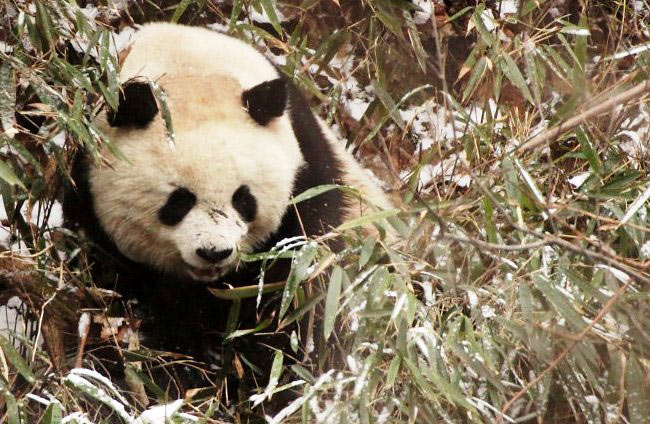
A rare image of a wild Giant Panda, taken in the Foping Reserve by Coke & Som Smith.
Gibbons Hylobatidae
There are over ten species of these supremely agile and graceful arboreal mammals. They occur from
Northeastern India to Southern China and South East Asia to Sumatra, Borneo and Java. The best places in the world to see gibbons include
Yunnan (Black-crested (Nomascus concolor) and Hoolock (Hylobates hoolock) Gibbons),
Northeastern India (Hoolock Gibbon (Hylobates hoolock)), Khao Yai and Kaeng Krachan National
Parks in Southern Thailand (White-handed or Lar Gibbon (Hylobates lar)), Fraser’s Hill in the
Malay Peninsula (Siamang (Symphalangus syndactylus)), Danum Valley, Gomantong and Sukau in
Borneo (Mueller’s Bornean Gibbon (Hylobates muelleri)), Bukit Barisan Selatan National Park in
Sumatra (White-handed or Agile Gibbon (Hylobates agilis) and Siamang which is widespread on Sumatra),
and Gunung Halimun National Park in Java (Javan or Silvery Gibbon (Hylobates moloch)).
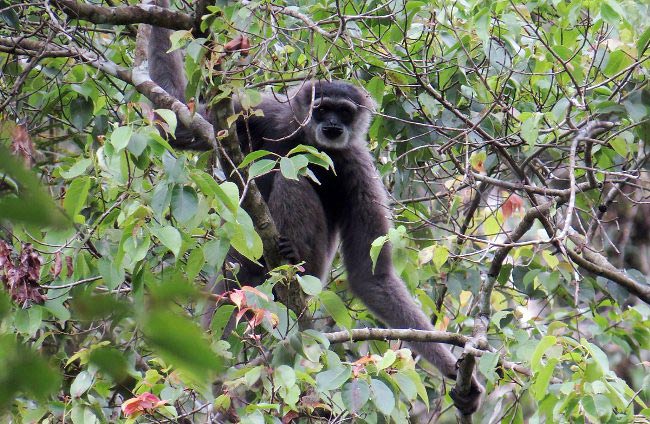
Javan Gibbon by Mark Harper.
Giraffe Giraffa camelopardalis
The tallest, arguably most amazing, animal on planet Earth, with an average height of
5 m (16.5 ft). On the move, their slow-motion lope does not look fast but their long legs cover the ground quickly, as fast as 60 km/h (37 mph), and
watching a group seemingly glide across the African plain, or browsing an acacia grove, is one of the top wildlife experiences. They still occur, in
several 'varieties', in large areas of Africa south of the Sahara, especially in East and southern Africa, and can be seen in many places.
Gorilla(s) Gorilla gorilla
Spending an hour in the company of the largest primates and arguably most magnificent animals
on planet Earth - ‘silverback’ males can reach a standing height of up to 1.95 m (6 ft 5 in) – is one of if not thee top wildlife experience. The best
places in the world to join organised tours to track and watch 'Mountain' Gorillas for up to an hour are Volcanoes National Park in
Rwanda, Bwindi National Park in Uganda and Virunga National Park in
the Democratic Republic of Congo. The best places in the world to see 'Lowland' Gorillas are Nouabale Ndoki National Park and Odazala-Kokoua National
Park in the Republic of Congo. Nouabala Ndoki is contiguous with Dzanga Sangha National Park in the Central African
Republic where gorillas are easy to see. 'Lowland' Gorillas are also present in Gabon and easiest to see in
Ivindo National Park but it is not always accessible.
The 'Lowland' Gorilla is the most widespread, occurring from southeastern Nigeria across the River Congo to the lowlands of eastern Democratic Republic of Congo. The 'Mountain' Gorilla occurs on just a few volcanoes in the eastern Democratic Republic of Congo, Rwanda and Uganda. 'Mountain' Gorillas are so rare that there is just one for every nine million humans and, despite a recent increase in numbers, there seems little hope that they will survive in the wild as long as the human population of the region increases and the tribal conflicts there continue.
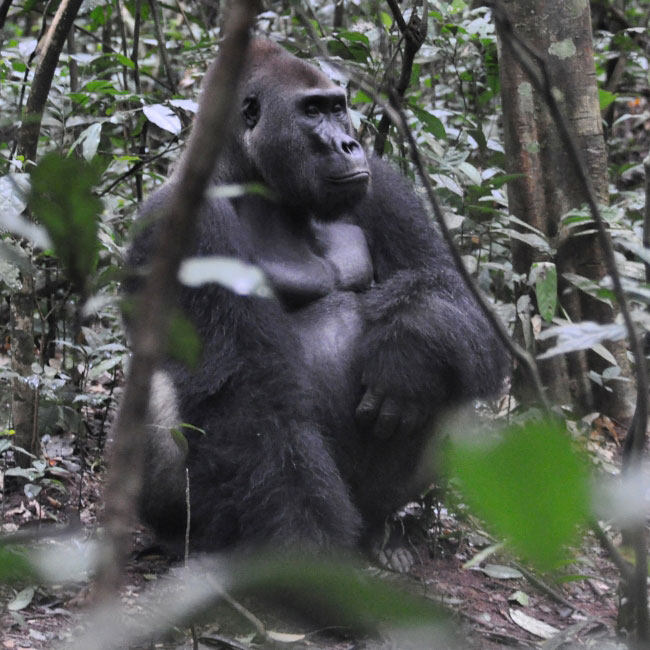
A magnificent silverback 'Western Lowland Gorilla' in the Central African Republic by Sjef Ollers.
Great White Shark Carcharodon carcharias
The ultimate shark occurs across the globe but the best place in the world
to see a Great White Shark (from the safety of a boat!) is off Western South Africa between
mid-April and mid-September when they come to meat dragged behind the boats, and where it is even possible to watch them from inside underwater
cages, with or without breathing apparatus. Such cages, which sit just below the surface, are also available around the island of Guadalupe off
Mexico where Great White Sharks are seen regularly from August to October. One company who organises trips here is
San Diego Shark Diving Expeditions. Although Great White Sharks probably grow the most
consistently to the largest sizes of any sharks in the world the species is technically only the equal second largest shark, reaching 6 m (20 ft)
like the Great Hammerhead Shark (Sphyrna mokarron), but not the 6.4 m (21 ft) reached by the Greenland Shark (Somniosus microcephalus).
Grizzly Bear see Brown Bear.
Hedgehogs Erinaceinae
There are seventeen species of hedgehog in Europe, Asia and Africa. They are characterized by their spines, which are hollow hairs made stiff with keratin,
designed to protect them from predators such as badgers, foxes and owls, and when faced with danger they can also roll up into an almost impenetrable ball
to protect the face, belly and feet, which are not quilled. They are also mainly active at dusk and at night, sleeping during the day in dens dug in the
ground, and they can hibernate, so many species are quite difficult to see. Some of the Tenrecs Tenrecidae resemble hedgehogs
although the small Lowland Streaked Tenrec Hemicentetes semispinosus is something of a one-off! They are endemic to
Madagascar where the best places to see tenrecs include Andasibe-Mantadia National Park and Ranomafana
National Park.
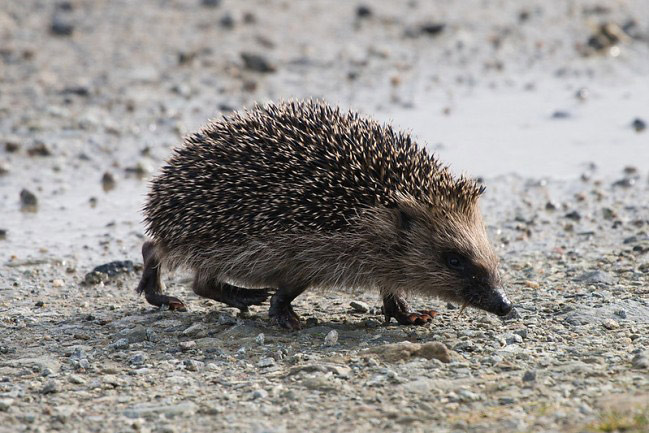
A European Hedgehog on the island of Fetlar, Shetland, by Paul Macklam. As in many places the European Hedgehog has been introduced to Fetlar but they are not considered to be a major threat to the eggs of the many nesting birds because although they have been there since about the 1950s they are still very scarce.
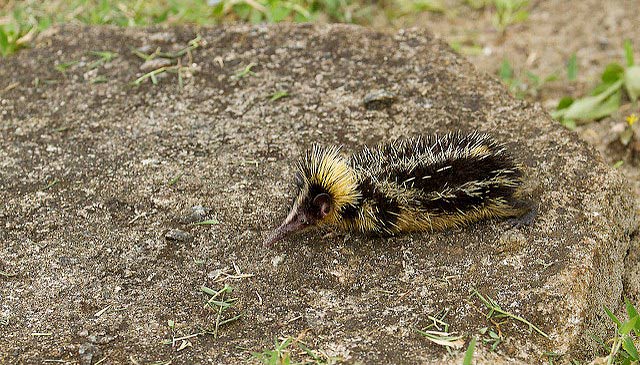
A rare image of a Lowland Streaked Tenrec in Masoala, Madagascar, by Francesco Veronesi.
Hippopotamus Hippopotamus amphibius
This extraordinary animal is still widespread in Africa south of the Sahara,
from the Senegal River down to Eastern South Africa, and numerous in some places. The other species of Hippopotamus, known as Pygmy Hippopotamus
(Hexaprotodon liberiensis), is very rare and almost impossible to see in the wild. It occurs in
Sierra Leone which offers the best chance of a glimpse, Liberia, Ivory Coast and Nigeria.
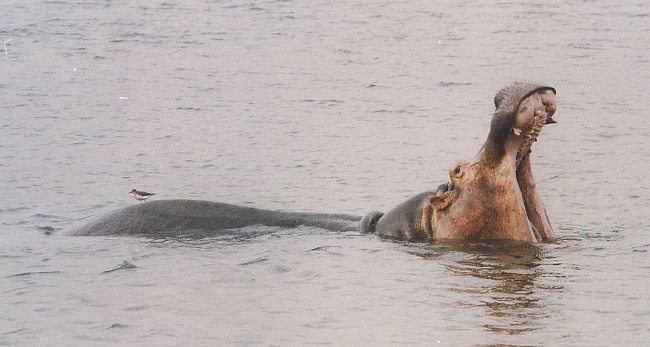
A Hippopotamus in the River Nile below Murchison Falls, Uganda, with a Common Sandpiper on its back. Photographed by Alice Perry.
Humpback Whale Megaptera novaeangliae
This is the most active large whale, at least as far as breaching is concerned,
so spectacular in fact that watching them in action is one of the top wildlife experiences. They occur virtually around the whole world and can be
seen in many places, but the best places in the world to see Humpback Whales include
Southeastern Alaska (where they may even be seen ‘bubble-feeding’),
Eastern Canada,
Massachusetts, Monterey Bay in
Northern California,
Puerto Vallarta in Central Mexico,
Antarctica and
Hawaii.
It is even possible to swim with Humpback Whales, on the Silver Bank off the
Dominican Republic, off the Abrolhos Islands off Brazil, and off Vava’u in Tonga.
Hunting Dog see African Wild Dog.
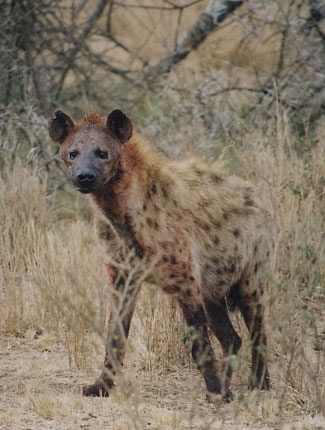
A Spotted Hyaena in the Serengeti by Alice Perry. Its head and neck are covered in Zebra blood.
(Spotted) Hyaena Crocuta crocuta
This large carnivore and fearsome predator is as much a part of the scene on the African
Plains as the more celebrated Lions, Cheetahs, Elephants, Giraffes and grazing animals like Zebras and Wildebeest, and the scene would be much poorer
without it. There are many places to see this animal which is widespread south of the Sahara except in the Congo but the best places to see Spotted
Hyaena include the Masai Mara in Kenya, the Ngorongoro Crater and Serengeti in
Northern Tanzania, South Luangwa National Park in Zambia,
Botswana, and Kruger National Park in Eastern South
Africa. The
other three species of hyaena are the Aardwolf (Proteles cristata) of East and Southern Africa, the Brown Hyaena (Hyaena brunnea) of
Southern Africa, and the Striped Hyaena (Hyaena hyaena) of East and Northern Africa, and the Middle East to India, all of which are much harder
to see. The best places to look for Aardwolf are in Namibia and especially the private reserves where night drives are
allowed in the Kimberley area of Western South Africa. The best place in the world to see Brown
Hyaena is Kgalagadi Transfrontier Park which straddles the border between Botswana and
Western South Africa although it is also possible in other parts of Botswana and Western South
Africa, as well as Eastern South Africa and Namibia.
The best place to see Striped Hyaena is Sasan Gir National Park in Western India and it is also possible
in East Africa, especially in Kenya.
Indri Indri indri
This bright-eyed, boldly marked black and white, woolly-coated lemur occurs on
Madagascar where the best place to see Indri is Andasibe-Mantadia National Park. Listening to the
incredibly loud, wailing groups of these beauties singing to each other first thing in the morning in the forest is one of the greatest wildlife
experiences.
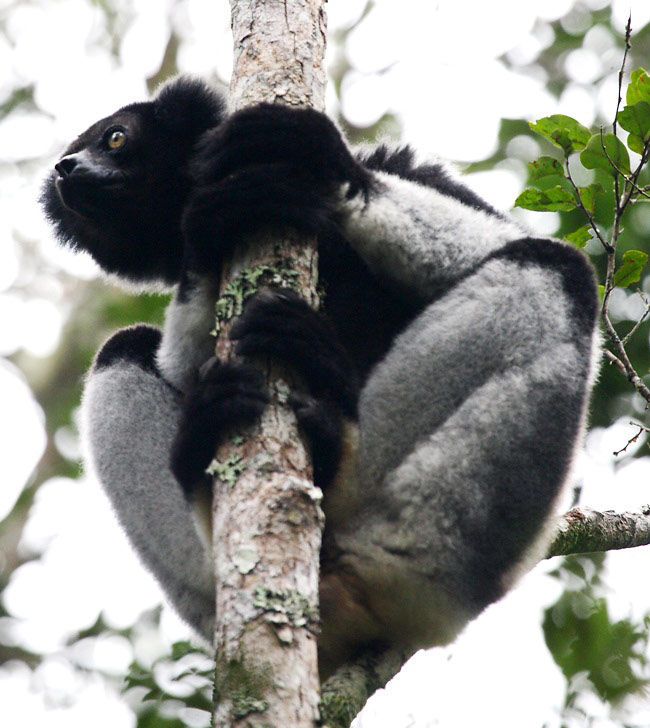
An Indri in Madagascar by Simon Colenutt.
Jaguar Panthera onca
This big cat has a large range, from northwest Mexico to northern Argentina but it is only seen
regularly in the Pantanal in Southern Brazil where seeing one is almost guaranteed between June
and October but especially in July-August. The next best places are Bolivia and
Guyana where they are occasionally seen on forest trails and tracks.
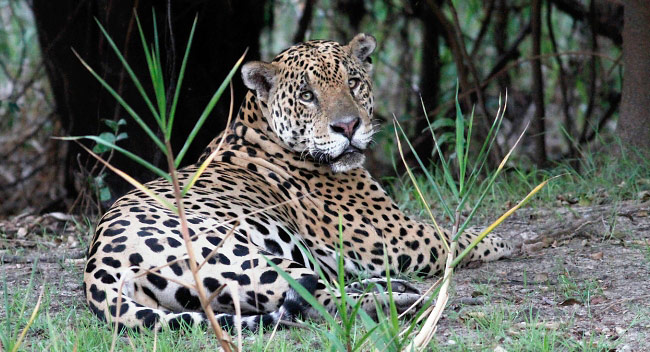
A beautiful Jaguar in the Pantanal, Southern Brazil, by Chris Townend.
Japanese Macaque (‘Snow Monkey’) Macaca fuscata
This monkey, which is endemic to
Japan, is famous for the habit of bathing in hot spring pools during the cold northern winters on the island of Honshu.
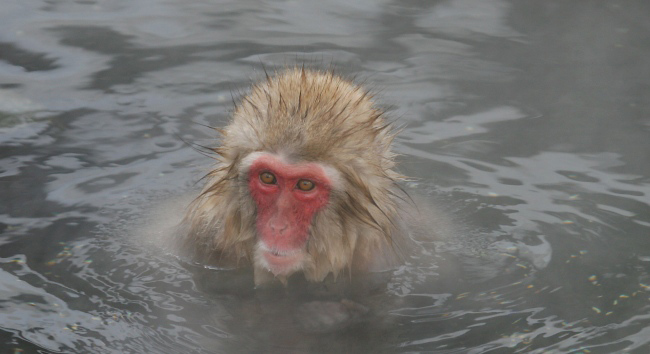
A bathing 'Snow Monkey' in Japan by Brian Field.
Great Jerboa Allactaga major
This extraordinary nocturnal hopping rodent occurs in forest-steppe to deserts from Ukraine
and European Russia through Kazakhstan and northern Uzbekistan to western Siberia and western Xinjiang in China, and the best places in the world to see
Great Jerboa include Cherny Zemly in Russia. There are over 30 other species of jerboa, some of which live in Northern Africa and as far east as
northern China and Manchuria, and the best country to see some jerboas in is Mongolia.
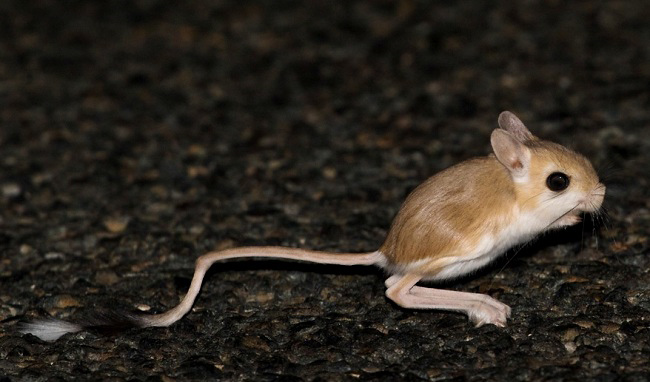
A Lesser Egyptian Jerboa alongside the Aousserd Road in the Western Sahara by Lars Petersson.
Kangaroos Macropus
There are about four species of kangaroo and they inhabit much of Australia. The most
frequently seen is the Eastern Grey Kangaroo which can stand as high as 2 m (6 ft 6 in) but Red Kangaroos are much more impressive animals since they
are much bulkier than Eastern Greys and slightly taller, reaching 1.8 m (5 ft 11 in) in height when standing in their normal position and up to 2.1 m
(6 ft 11 in) on their toes. At a top speed of 56 km/h (35 mph) they can leap about 3.1 m (10 ft) high and jump as far as 12.8 m (42 ft). The best
places to see Red Kangaroo are from northwestern Australia through the central Australian deserts to outback Queensland, South Australia (along the
Birdsville and Strzelecki Tracks) and New South Wales (especially in National Parks in the Broken Hill region).
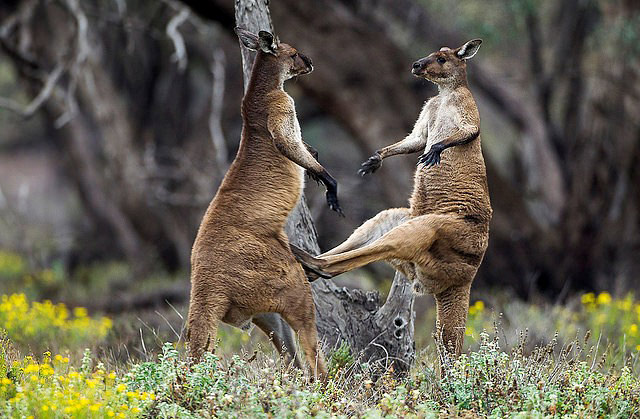
Two male Western Grey Kangaroos fighting in Wyperfeld National Park, Australia, by Francesco Veronesi.
Killer Whale Orcinus orca
The fastest marine mammal in the world, which was recorded travelling at up to about 55.5
km/h (34.5 mph) in the northeast Pacific in 1958, is also the largest member of the dolphin family, usually reaching about 8 m (26 ft) although the
longest recorded was 9.8 m (32 ft). It occurs all around the world but the best places to see Killer Whale include Kenai Fjords National Park in
Alaska; the Johnstone Strait (where it is possible to kayak in close proximity to the some of the greatest
concentration of these animals in the world) and San Juan Islands off Vancouver Island in Western Canada
and Washington state, USA; Punta Norte on the Valdes Peninsula in Southern Argentina (where they may
be seen ‘intentionally stranding’ in pursuit of sealion pups, from platforms at the top of the beach);
Antarctica; and Kamchatka.
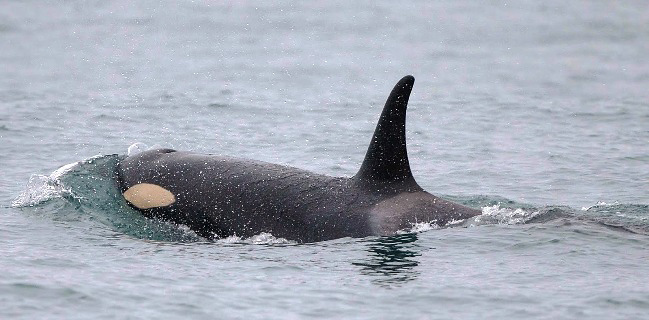
A Killer Whale in the Kenai Fjords, Alaska, by Simon Colenutt.
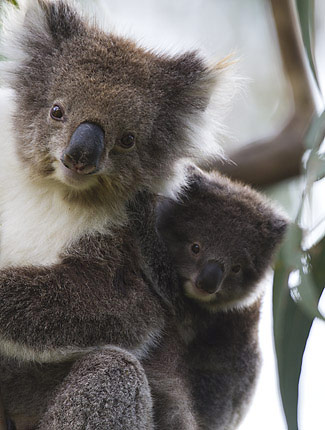
A mother koala and her joey near the Kennett River campsite in the Otway Ranges near Melbourne in Southeastern Australia by Ray Wilson.
Koala Phascolarctos cinereus
This tree-dwelling marsupial occurs in
Eastern Australia where the best places to see a Koala include Warrumbungle National Park in New
South Wales and Redlands in Queensland, and Southeastern Australia where the best places
include the Otway Ranges near Melbourne in Victoria.
Komodo Dragon Varanus komodoensis
The largest lizard in the world is the Komodo Dragon which reaches a scary average of
2.25 m (7 ft 5 in) long, although the longest recorded was 3.1 m (10 ft 2 in)! It occurs on the Indonesian island of Komodo, where it is easy to see, as well as its smaller satellites and parts of Flores. Some other monitor lizards of Africa, Asia
and Oceania in the same Varanus genus as the dragon may not be so bulky but are as long, including the second largest the Asian Water
Monitor (Varanus salvator), the largest specimen on record of which was found in Sri Lanka and measured 3.21 m (10.5 ft); the third largest the
Papuan or Salvadori's Monitor (Varanus salvadorii) of New Guinea; and the fourth largest the Perentie or Perente (Varanus giganteus) of
remote arid regions of Australia. The smallest lizard in the world is the Dwarf Gecko (Sphaerodactylus ariasae) which measures about 3 cm (1.2 in)
and occurs in the Caribbean where the best place to see it is Jaragua National Park in the Dominican Republic.
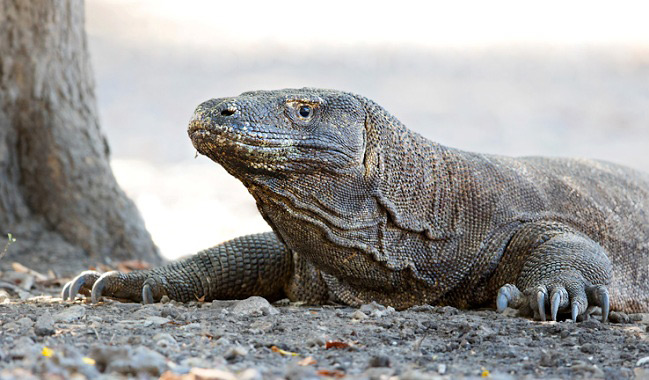
A Komodo Dragon by Dubi Shapiro.
Lemurs see Aye-aye, Indri, Ring-tailed Lemur and Sifakas.
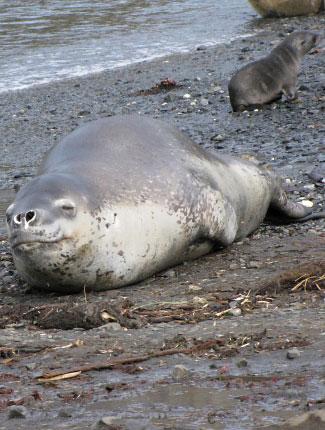
A resting Leopard Seal by John Foster, not a particularly menacing sight but when hunting they look a lot more dangerous.
Leopard Panthera pardus
The beautiful and powerful Leopard occurs throughout Africa south of the Sahara, across the
Middle East to Asia and from there to Java. The best places in the world to see Leopard are many but include the the Serengeti in
Northern Tanzania, South Luangwa National Park in
Zambia, Kruger National Park in Eastern South Africa
and Yala National Park in Sri Lanka.
Leopard Seal Hydrurga leptonyx
This fearsome seal may reach a length of 3.6 m (11 ft 10 in) and it can be a danger to
humans, a fact based on a number of documented cases in which individual animals have been seen suddenly lunging through cracks in the ice to snap at
people’s feet and even chasing people across the ice for up to 100 m (330 ft). Several divers have also been attacked. The best places to see Leopard
Seal are where it occurs; around Antarctica and its outlying islands.
Lion Panthera leo
Watching a pride of Lions hunting on the African plains is one of the top wildlife experiences. Lions
live in open country south of the Sahara in Africa, as well as in a small area of Western India, and the best places in the world to see Lions include
the Masai Mara in Kenya, the Ngorongoro Crater and Serengeti in
Northern Tanzania, Etosha National Park in Namibia and
Kruger National Park in Eastern South Africa. In
Western India the best place to see Lions is the Sasan Gir National Park where about 400 survive.
Manatees see Dugong and Manatees.
Mandrill see Baboons.
Manta Rays Manta birostris and Manta alfredi
There are two species of manta; Oceanic (birostris) and
Reef (alfredi), and they occur in tropical waters around the world. Most of the huge but harmless Oceanic Manta Rays usually have a ‘wingspan’
of two to four metres when fully grown but the largest known specimen was an awesome 7.6 metres (25 ft) across! Reef Manta Rays have a maximum
wingspan of about 3.5 m (11-12 ft). Mantas can be seen, often close-up, while scuba-diving or, in a few places, snorkelling, at many places but,
arguably, the best places in the world to see Manta Rays include
Isla Holbox in Southern Mexico, the Revillagigedos Islands (Socorro) 400 km west of Mexico,
Cocos Island and the Gulf of Papagayo in Costa Rica,
Panama, Tofo in
Mozambique,
the Azores,
the Maldives,
the Philippines,
Sangalaki island off eastern Kalimantan in Indonesia,
Ningaloo Reef (Exmouth) in Western Australia,
Lady Elliot Island on the Great Barrier Reef off Queensland, Eastern Australia,
the island of Yap in Micronesia,
the islands of Bora Bora, Rangiroa and Tikehau in French Polynesia, and
Hawaii.
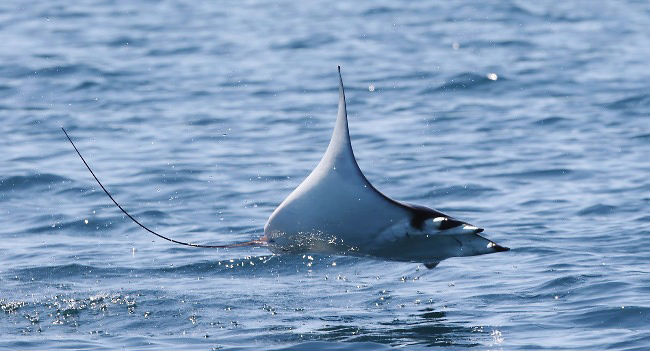
It is not a Manta Ray but it is Devil Ray, a very close relative, captured 'in flight' in Baja California, Mexico, by Chris Gibbins.
Marlins see Billfish.
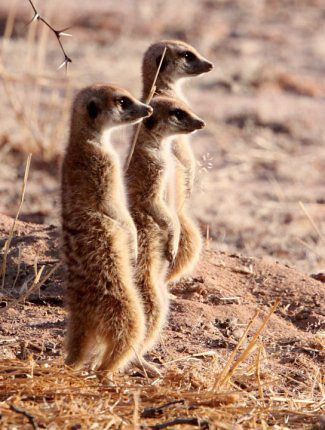
Meerkats in Kgalagadi by Coke & Som Smith.
Meerkat Suricata suricata
Also known as Suricate, this famous mongoose occurs in southwest Africa where the best
places to see Meerkat are the Wakkerstroom area in Eastern South Africa, and the Kimberley
area, Kgalagadi Transfrontier Park and Oudtshoorn in Western South Africa.
Monarch Butterfly Winter Roosts
One species of butterfly, the Monarch (Danaus plexippus), is a bit special, because
it is beautiful, it migrates long distances between Canada and Mexico, and it spends the northern winter in small groups of trees in the mountains
of Mexico in roosts containing millions of individuals (smaller roosts, usually containing a maximum of about 100,000 individuals, also exist in
California - at Natural Bridges SB, Santa Cruz, Northern California for example). The sight
of the butterflies, several deep, covering whole trees, is extraordinary, but nothing compared to the scene when they take to the air, hence
visiting a Monarch Butterfly Winter Roost in Central Mexico is one of the top wildlife experiences.
The butterflies, which may represent the third or fourth generation of butterflies which left the roost in the first place, fly to the roosts from
as far away as Canada - a tagged individual which was released in Ontario, Canada on 6th September 1986 was recaptured a straight-line distance of
3432 km (2133 miles) to the south near Angangueo, Mexico on 15th January 1987. How they manage to find their way to such specific sites no one knows.
Another much smaller but nevertheless impressive gathering involves hundreds of thousands of Jersey Tiger Moths (Euplagia quadripunctaria)
which spend the hot northern summer days on the Greek island of Rhodes in the cool shade of the Pelekanos Canyon.
Monkeys see Black-and-white Colobus Monkey, Golden Snub-nosed Monkey, Japanese Macaque ('Snow Monkey') and Proboscis Monkey.
Moose Alces alces
Male Moose are big animals, reaching over 2 m (6.5 ft) at the shoulder with a 1.8 m (6 ft) span
across their antlers. The Moose occurs from Alaska south along the Rockies to Utah and Colorado, and east through Canada to New England and upstate
New York, and from Poland, the Baltic States and Scandinavia east through Russia. The best places in the world to see Moose include Denali, Glacier and
Katmai National Parks, and Nome, in Alaska, several places in
Alberta, Algonquin Provincial Park in Ontario, Canada, and Yellowstone and Grand Tetons National Parks in
Wyoming. In Europe the Moose is known as the Elk. The animal called an Elk in North America is what is known
as the Red Deer (Cervus elaphus) in Europe, although it is now considered to be a different species called Wapiti (Cervus canadensis) by
some taxonomists.
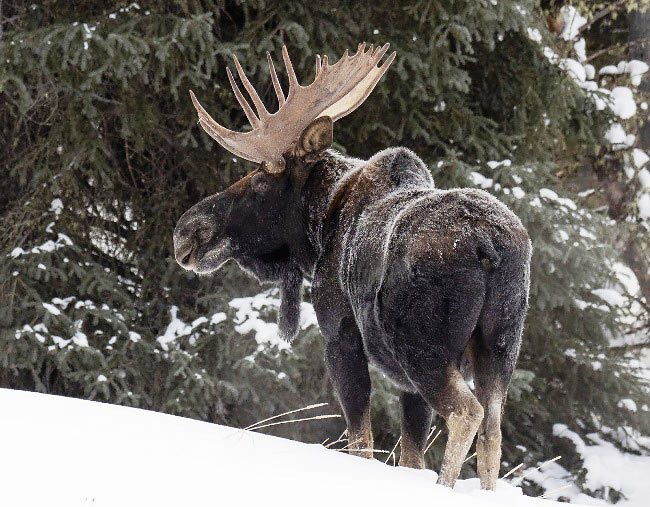
A Moose in Yellowstone National Park by Simon Colenutt.
Musk Ox Ovibos moschatus
This is one of the hardiest animals on the planet. It occurs in north-central Canada and northern
Greenland, and has been introduced or reintroduced to several other Arctic regions including Alaska (around
Nome for example) and Russia (on the Taymyr Peninsula and Wrangel Island). The best places in the world to see wild stock Musk Ox include Banks Island
and Ellesmere Island National Park in north-central Canada, accessible on cruises in
Arctic Canada.
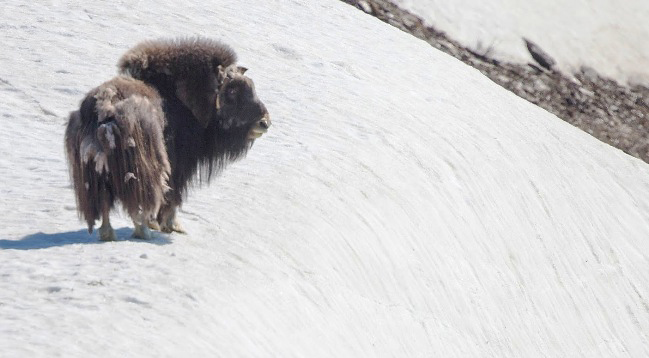
An impressive Musk Ox near Nome in Alaska by Simon Colenutt.
Narwhal Monodon monoceros
This medium-sized whale usually grows to 4-5 m (13-16 ft) long and the males have tusks,
formed by elongated teeth, which may grow to 2-3 m (7-10 ft) long. It occurs in the Arctic, mainly between Canada and Greenland but also in smaller
numbers from east Greenland via Spitsbergen to the north of much of Russia. The best places in the world to see Narwhal include the waters off
Baffin Island and other islands in Arctic Canada.
Okapi Okapia johnstoni
This extraordinary animal occurs only in dense rainforest in the Democratic Republic of Congo where
the best place to see Okapi is Ituri Forest Reserve.
Orang-utan Pongo pygmaeus
The largest arboreal mammal, split into two species by some taxonomists, one on Borneo and
one on Sumatra (Pongo abelii). The best places in the world to see Orang-utan include Danum Valley in Sabah, north Borneo, Tanjung Puting National Park in Kalimantan, south Borneo, and Gunung Leuser National Park in
Sumatra.
Orca see Killer Whale.
Oryx see Gemsbok.
Pandas see Giant Panda and Red Panda.
Pangolins Manis
There are eight species of pangolin. These rare, elusive, heavily poached, scaly, ant-eating mammals occur in
Africa south of the Sahara, and from India to South East Asia and Indonesia. The largest is the Giant Pangolin (Smutsia
gigantea) which reaches a length of 1.7 m (5 ft 8 in) including the tail. It occurs from West Africa across the Congo to west Kenya and Tanzania.
The best places in the world to look for pangolins include the Gola FRs in Sierra Leone (White-bellied or
Tree (Manis tricuspis)); Kakum NP in Ghana (Black-bellied or Long-tailed (Manis tetradactyla));Lope
National Park in Gabon (Giant); around Sangha Lodge in the Central African
Republic where both Black-bellied or Long-tailed and White-bellied or Tree (Manis tricuspis) are possible; Ituri FR
in Democratic Republic of Congo (Tree (Phataginus tricuspis)); the Masai Mara in Kenya (Ground (Smutsia
temminckii)); the Serengeti in Northern Tanzania (Ground); Kruger National Park in
Eastern South Africa (Ground); Bandhavgarh National Park in
Northern India (Indian (Manis crassicaudata)); Sigiriya in
Sri Lanka (Indian); and Danum Valley in Borneo (Sunda (Manis
javanica)), although the chances of seeing one are extremely slim in all of these places.
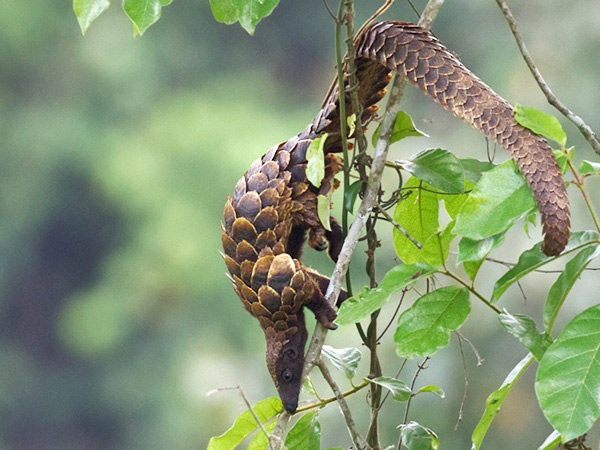
A rare image of a Black-bellied or Long-tailed Pangolin, in Kakum National Park, Ghana, by Lars Petersson.
Plants Plantae
There are at least 350,000 plant species, from single-celled algae to the Giant Sequoia
(Sequoiadendron giganteum), the largest (but not the tallest) tree species in the world. It can grow up to 85 m (280 ft), 30 m (100 ft)
less than the tallest tree species in the world, the Coast Redwood (Sequoia sempervirens) which can reach 116 m (379 ft). The best place
in the world to see the largest and tallest tree species, as well as the oldest tree species in North America (the Bristlecone Pine (Pinus
longaeva), some of which are believed to be over 4700 years old), is Northern California,
where the largest known tree is believed to be the one known as 'General Sherman' in Sequoia National Park, and the tallest is thought to be the one
known as 'Hyperion' in Redwood National Park.
The best place in the world to see the largest flowering plant species in the world, Rafflesia arnoldii, is Borneo, although it also occurs in Sumatra. This parasitic plant flowers unpredictably and for a few days only but when it does it may reach a diameter of 1 m (39 in). The greatest diversity of flowers in the world, known as the Fynbos, is present in Western South Africa where there over 2600 flowering plants in 500 sq km (200 square miles). There are also over 2000 in the Drakensberg region of Eastern South Africa and another area of the world with an exceptionally rich flora is Western Australia. In terms of total plant diversity there currently seems to be some confusion over whether the rainforest of the Amazon, or the Malay Peninsula and Borneo, is the richest in the world. What is known is that there are about 16,000 tree species in the Amazon Basin and Guianan Shield region.
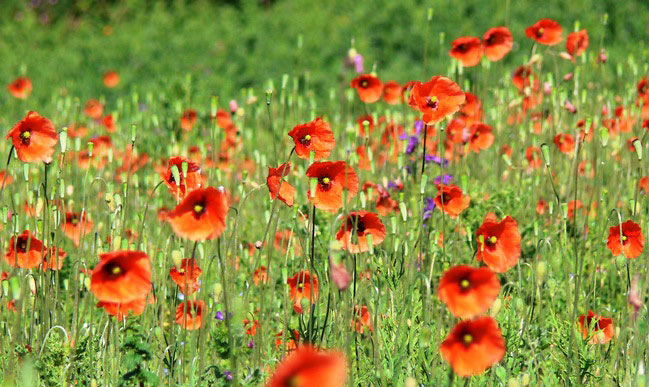
Common Poppies, Cornwall, England by Nigel Wheatley. This plant has been associated with life and death since farming first took place and it has followed its spread so far and wide across the world that no one is actually sure where its native home is.
Platypus Ornithorhynchus anatinus
This extraordinary mammal lays eggs and incubates its young in a nesting chamber.
The best places to see a (Duck-billed) Platypus include the Atherton Tablelands in Queensland, Eastern
Australia, Lake Elizabeth in the Otway Ranges near Melbourne and a few sites in Tasmania including Mountain Valley and the Peter Murrell Reserve, in
Southeastern Australia.
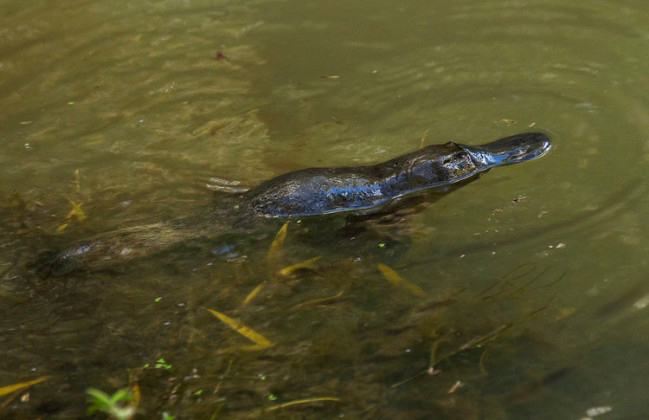
A rare image of a Platypus, in the Atherton Tablelands of Australia, by Francesco Veronesi.
Polar Bear Ursus maritimus
The largest land carnivore in the world can reach a length of 2.5 m (over 8 ft). The best
places in the world to see Polar Bear include Arctic Canada; Churchill in
Manitoba, Canada, where starving bears can be watched at close range from the safety of huge ‘tundra
buggies’, and Spitsbergen where they can be watched at close range from the safety of ships and
zodiacs. Polar Bears are great travellers; some may cover 30,000 sq km in a year.
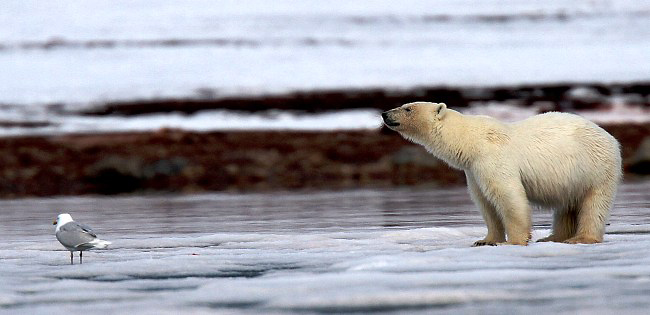
Polar Bear on Spitsbergen by Brian Field.
Porcupines Hystricidae and Erethizontidae
These spiny, mainly nocturnal, rodents occur throughout the world, in Italy, Israel,
Africa, Asia including South East Asia, and the Americas. Two of the most impressive are the extremely similar Crested or African (Hystrix cristata)
and Cape or South African (Hystrix africaeaustralis) Porcupines, with the former occurring mainly north and the latter mainly south of the equator.
They are elusive creatures and may be encountered virtually anywhere in Africa apart from the Sahara and central Congo but the best places in the world
to see Crested and South African Porcupines include Ngulia Lodge in Tsavo West National Park in Kenya, several
sites in Namibia, Kruger National Park in
Eastern South Africa, and the Kimberley area in
Western South Africa. In Asia there is a chance of seeing Indian Porcupine (Hystrix
indica) in Southern India, especially in Tholpetty Wildlife Sanctuary, and a small chance of seeing
Malayan Porcupine (Hystrix brachyura) in Khao Yai National Park, Southern Thailand.
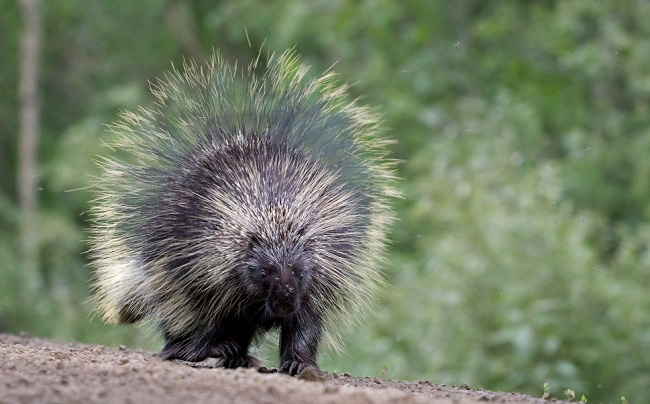
A North American Porcupine in Alaska by Lars Petersson.
Proboscis Monkey Nasalis larvatus
This odd-looking monkey with a big, floppy nose and a big belly is endemic to
Borneo where the best places to see Proboscis Monkey are along the Kinabatangan River in Sabah and Bako
National Park in Sarawak.
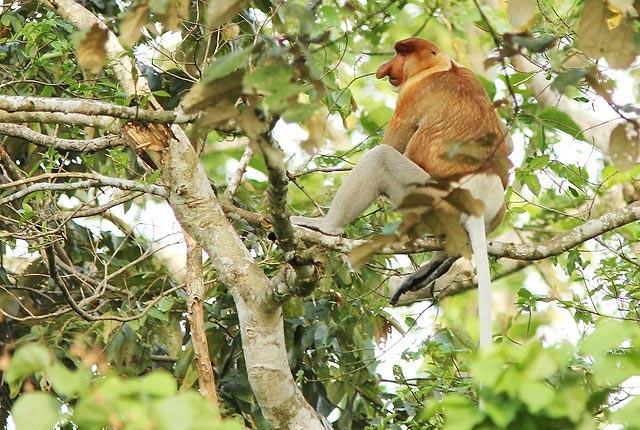
A male Proboscis Monkey along the Kinabatangan River in Borneo by David Beadle.
Puma Puma concolor
This big cat has a large range, from western North America to southern South America but it is only
seen with relative regularity in Torres del Paine NationalPark in Chile where the chance of seeing one is
fairly good, especially in March when the females usually have cubs to feed. Another good place to look is Kaa-Iya del Gran Chaco National Park in
Bolivia.
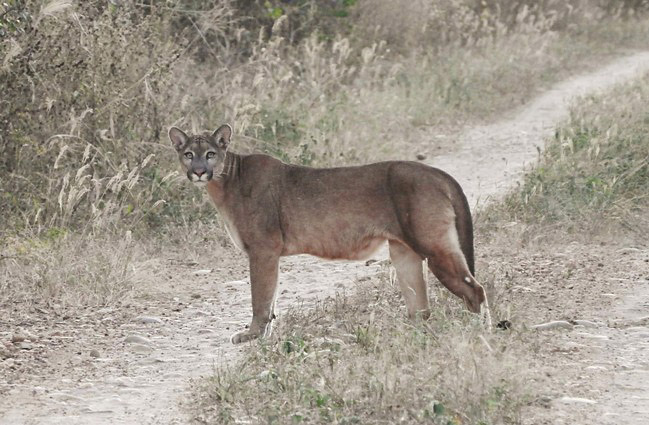
Puma in Kaa-Iya National Park, Bolivia, by Nick's Adventures Bolivia.
Red Panda Ailurus fulgens
This ‘panda’ is not related to the other panda. It may belong to a family of its own but is
closest to the mustelids such as skunks, stoats and otters. It is endemic to the Himalayan region of Nepal, India, Bhutan, Myanmar and China
where it is elusive and rarely seen. The best place in the world to see a Red Panda is in the temperate forests around
Hange Tham in far eastern Nepal where they are being tracked by scientists. This lies close to
Singalila National Park which straddles the border between Nepal and West Bengal, India, where Red Pandas are also tracked and there is therefore a
good chance of seeing one. Elsewhere, chances are much slimmer in Labe He Forest Park, Sichuan, China;
Yunnan, China; and Eaglenest Wildlife Sanctuary in
Northeastern India.
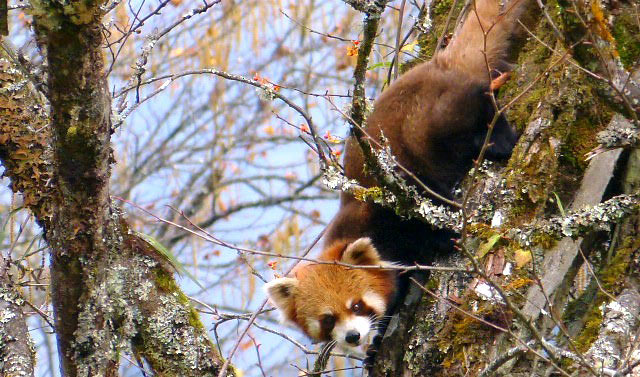
Red Panda at Laba He in Sichuan, China by Richard Webb.
Rhinoceroses Rhinocerotidae
The five Rhinoceros species occur in Africa (Black (Diceros bicornis)
and White (Ceratotherium simum)), in Nepal and Northeastern India (Indian (Rhinoceros unicornis)), in Java (Javan (Rhinoceros
sondaicus)), and in Borneo and Sumatra (Sumatran (Dicerorhinus sumatrensis)). The best places in the world to see truly wild rhinoceroses
(many have been translocated, introduced, reintroduced and so on, especially in South Africa) include Nairobi National Park in
Kenya (Black), the Ngorongoro Crater in Northern Tanzania
(Black), Etosha National Park in Namibia (Black), Chitwan National Park in
Nepal (Indian) and Kaziranga National Park in
Northeastern India (Indian).
Ring-tailed Lemur Lemur catta
This attractive and confiding lemur occurs on
Madagascar where the best place to see Ring-tailed Lemur is Berenty.
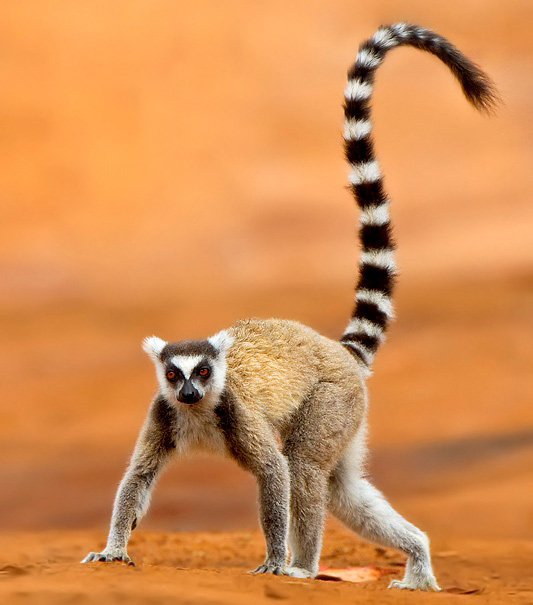
A Ring-tailed Lemur at Berenty, Madagascar, by Dubi Shapiro.
Sailfish see Billfish.
Seahorses and Sea Dragons Syngnathidae
There are many strange fish but these are arguably the strangest of all. Seahorses
occur throughout the world but the two species of sea dragon, Leafy (Phycodurus eques) and Weedy (Phyllopteryx taeniolatus), occur
only along the south coast of Australia roughly between Sydney and Perth. These two fantastic fish have long bony filaments with flaps of skin
which resemble the seaweeds and other plants they frequent and the best places in the world to see Sea Dragons include Portsea Pier at the end of the
Mornington Peninsula south of Melbourne (Weedy) and the dive site known as Studio One, Deep Glen Bay, Tasmania (Weedy) in
Southeastern Australia;
Kangaroo Island, South Australia (Leafy); and Bremer Bay,
Western Australia (Leafy and Weedy). The smallest seahorse recorded so far is known as
the Pygmy Seahorse (Hippocampus denise) which was first discovered in the Flores Sea and has an average length of 16 mm (0.63 of an inch).
Seals Otariidae and Phocidae
These animals occur where there is water throughout much of the world and in some places certain
species occur in extraordinary numbers. For example, there are over one and a quarter million Northern Fur Seals (Callorhinus ursinus) present
in the Pribilof Islands of Alaska, over half of which breed on the two main islands, St George and
St Paul - one of the greatest concentrations of large mammals in the world. The best places in the world to see fur seals and sealions also include
Northern California, Baja California,
Galapagos, Southern Argentina, South Georgia, Western South Africa, the
Commander Islands and the
Subantarctic Islands. At places such as Baja California and Galapagos it may even be possible to swim
with the California Sealions (Zalophus californianus) there. Also see Elephant Seals and Leopard Seal.
Serval Felis serval
This small, elegant, long-legged cat occurs throughout most of Africa except the Sahara, the Congo
and the southwest. The best places to see Serval include the Gaysay grasslands in Bale Mountains National Park in
Ethiopia, the Masai Mara in Kenya, the Ngorongoro Crater in
Northern Tanzania and Kruger National Park in
Eastern South Africa.
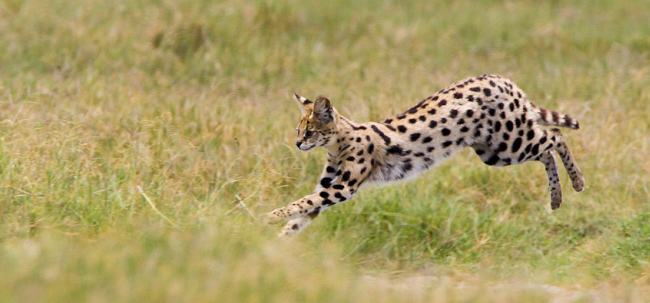
Serval in the Ngorongoro Crater, Northern Tanzania, by Francesco Veronesi.
Sifakas Propithecus spp.
These beautiful lemurs occur throughout
Madagascar where the most easily accessible places to see sifakas include Ampijoroa (Coquerel’s Sifaka (Propithecus coquereli)),
Andasibe-Mantadia National Park (Diademed Sifaka (Propithecus diadema)), Ranomafana National Park (Milne-Edward’s Sifaka (Propithecus
edwardsi)), Marojejy National Park (Silky Sifaka (Propithecus candidus)) and Berenty, Kirindy Forest Reserve and Zombitse National Park
(Verreaux’s Sifaka (Propithecus verreauxi)).
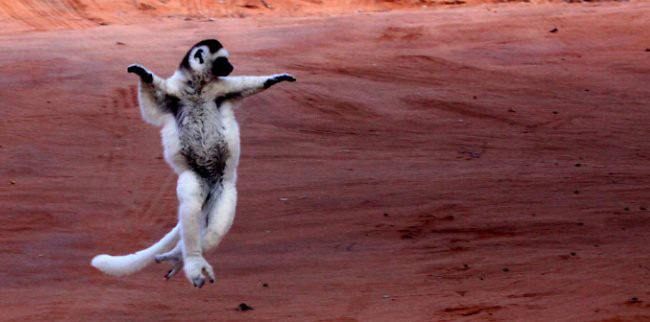
Verreaux's Sifaka in full flow, 'hopping' sideways, across the ground, by Coke & Som Smith.
Skunks Mephitidae
There are about twelve species of skunk, most of which can produce a spray with a sulphurous smell so
foul it may cause nausea and retching, but they usually do so only under extreme provocation. Two are stink-badgers (Mydaus spp.), occurring on
Java and Palawan (in the Philippines). The rest are the more familiar bold black and white skunks of the Americas, including the Striped
Skunk (Mephitis mephitis) and the spotted skunks (Spilogale spp.) of North America, and the hog-nosed skunks (Conepatus spp.)
which occur from the southwest USA to Patagonia. Stink-badgers are rarely seen but skunks may be seen in many places throughout their ranges.
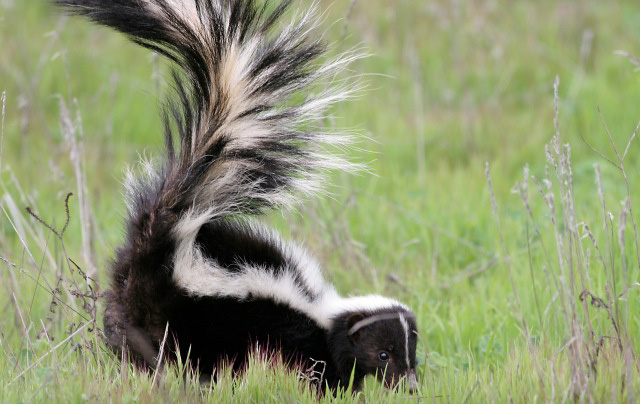
Striped Skunk in California by Ian Davies.
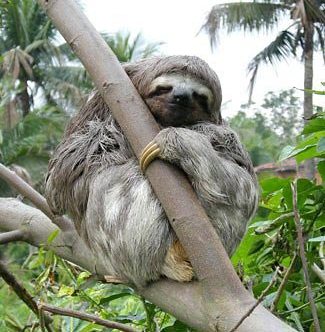
Brown-throated Three-toed Sloth in Southern Brazil by Chris Townend.
Sloths Pilosa
There are fewer stranger creatures than the sloths, so specialised to life in the trees that they are unable
to walk on the ground and have to drag themselves across it if they can find no other way to get from tree to tree or between forest fragments. They
occur from Honduras to northern Argentina. There are six species, one of which, the Pygmy Three-toed Sloth (Bradypus pygmaeus), occurs only
in the mangroves on the long-isolated Isla Escudo de Veraguas off the north coast of Panama, and another, the Maned Sloth (Bradypus torquatus),
occurs only in eastern Brazil. The best places in the world to see sloths, apart from Pygmy Three-toed and Maned, include
Costa Rica and Panama (both Brown-throated Three-toed
(Bradypus variegatus) and Hoffmann’s Two-toed (Choloepus hoffmanni), with both present in some places), Colonia Tovar and Henri
Pittier National Park in Western Venezuela (Brown-throated Three-toed), the
Amazon (Pale-throated Three-toed (Bradypus tridactylus)) and
Southern Brazil (Brown-throated Three-toed).
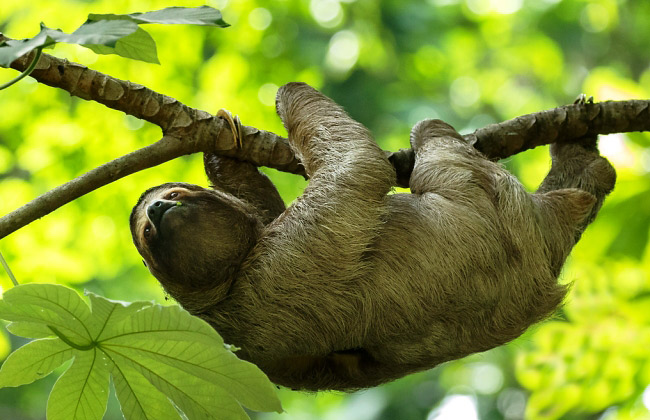
A more typical position of a Three-toed Sloth at Cerro Ancon in Panama by Francesco Veronesi.
Snakes Serpentes
There are about 2900 species of snake and they occur on every continent except Antarctica. The longest
snake in the world is the Reticulated Python (Python reticulates) which regularly exceeds 6.25 m (20.5 ft) and has reached 10 m (32 ft
9.5 in). The best places in the world to see Reticulated Python, which occurs from Bangladesh to Indonesia and the Philippines, include Khao Yai
National Park in Southern Thailand, and Sukau in Borneo,
although the chances are slim. The largest snake in the world is the Common or Green Anaconda (Eunectes murinus) of South America east of the
Andes south to Brazil. It rarely exceeds 6.25 m (20.5 ft) but one individual was 8.4 m (27 ft 9 in) long and had a girth of 1.1 m (44 in). The best
places in the world to see an anaconda include the Llanos in Western Venezuela and the Pantanal in
Southern Brazil, although the latter site is home to the smaller Yellow Anaconda (Eunectes
notaeus). The most venomous land snake in the world is the Fierce Snake or Inland Taipan (Oxyuranus microlepidotus) of Australia
but the most venomous snake of all is the Beaked Sea Snake (Enhydrina schistosa) which occurs from the Arabian Sea to northern Australia.
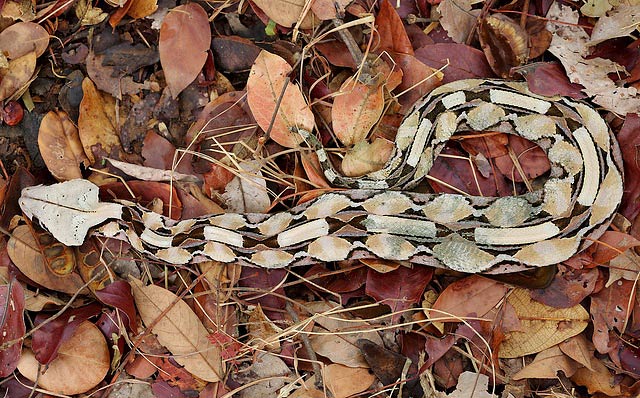
The amazingly marked Gaboon Viper at Sakania in the Democratic Republic of the Congo by Nigel Voaden. This is the viper with the longest fangs – up to 5 cm - and the highest venom yield of any snake bite, and it is responsible for many deaths in Africa due to people accidentally stepping on them because they rely on their camouflage to hunt and rarely move when approached.
Snow Leopard Uncia (Panthera) uncia
This impressive big cat inhabits the wildest land left on the planet; the high
mountains of central Asia, and is one of the most difficult large animals to see. However, at the best place in the world to see Snow Leopards,
Hemis National Park in Ladakh, Northwestern India, one or more are seen by visitors on organized
tours with surprising regularity.
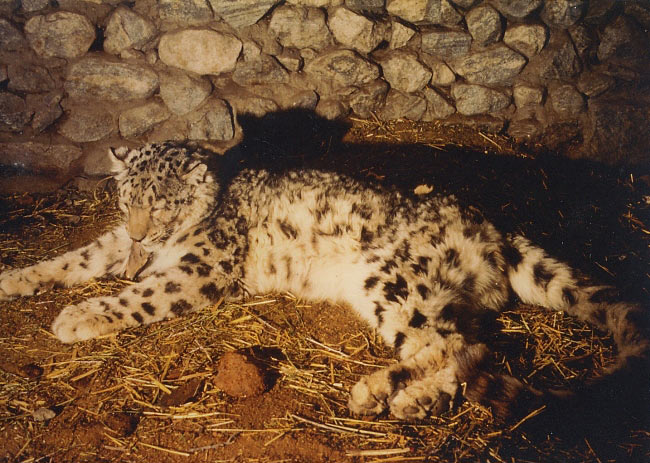
A Snow Leopard which ate two goats being kept in the stone hut the cat is sleeping in. This photograph was taken by Forest Officer Kazmi near Skardu in Baltistan, northern Pakistan, during the winter of 1985-1986 while Rob Roberts and Nigel Wheatley were taking a break from searching for Snow Leopards there.
'Snow Monkey' see Japanese Macaque.
Spiders Araneae
There are about 40,000 species of spider and they occur throughout the world except Antarctica. The
largest spider in the world is Heteropoda maxima, a huntsman spider which occurs in Laos and has a leg span of 30 cm (12 in). The
bulkiest spider in the world is the Goliath Bird-eating Spider (Theraphosa blondi) of Venezuela, Guyana and Brazil, which can have a
body as large as 9 cm (3.5 in) long and a leg span of 25 cm (10 in). The largest and strongest spider webs in the world, which have been
measured up to 1.5 m (5 ft) in circumference, are built by golden orb-web spiders of the genus Nephila which occur throughout the warm
regions of the world. The most venomous spider in the world is believed to be the Brazilian Wandering Spider (Phoneutria fera) of the
Amazon.
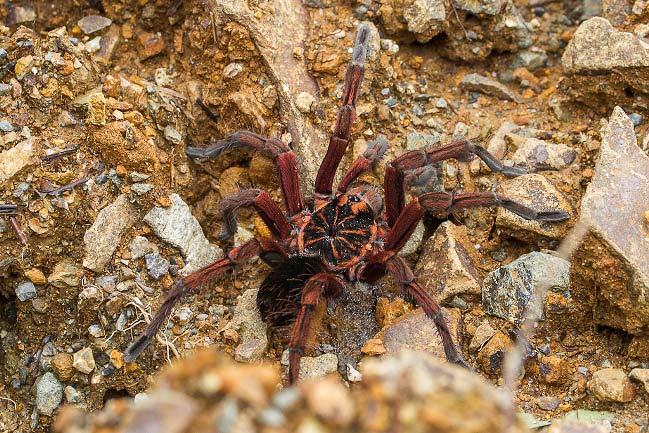
A tarantula in Los Galapagos Reserve, Colombia, by Francesco Veronesi.
Spring Hare Pedetes capensis
This extraordinary nocturnal ‘miniature kangaroo’ is actually a rabbit-sized rodent with
massive hind legs which enable it to jump over 2 m (6 ft 7 in). It lives on the plains of eastern and southern Africa, from Kenya to South Africa,
where the best places to see Spring Hare are those parks and reserves where night driving and spot-lighting are allowed.
Swordfish see Billfish.
Tapirs Tapirus
The four species of tapir occur from southeast Mexico to Northern Argentina and from southern Myanmar and
Thailand through the Malay Peninsula to Sumatra. They are strangely absent from Africa. The best places in the world to see tapirs include Corcovado
National Park in Costa Rica (Baird’s (Tapirus bairdii)), Manu National Park in
Southern Peru (Brazilian (Tapirus terrestris)), Emas National Park and the Pantanal in
Southern Brazil (Brazilian), and Taman Negara in the
Malay Peninsula (Malayan (Tapirus indicus)).
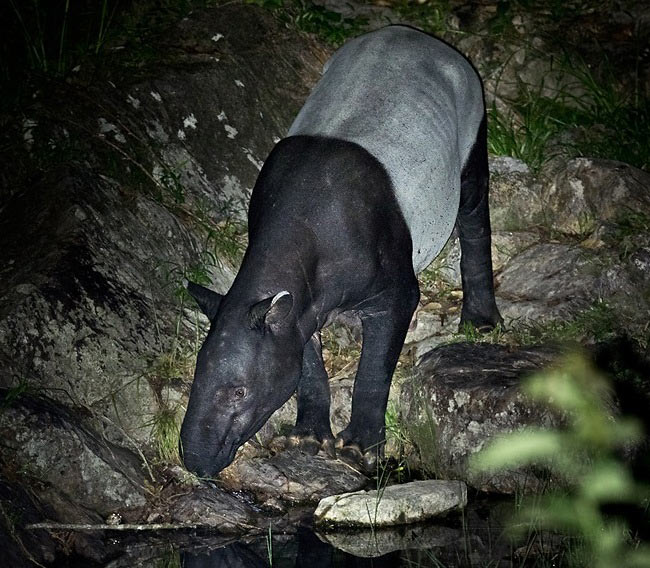
A Malayan Tapir captured on camera at night in Taman Negara, Malaya, by Lars Petersson.
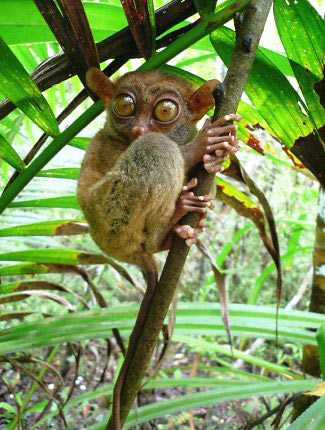
Philippine Tarsier by Jon Hornbuckle.
Tarsiers Tarsius
These tiny primates have got eyes as big as their brains. The smallest primate in the world is believed to be
Madame-Berthe's Mouse Lemur (Microcebus berthae) of Madagascar, which is less than 10 cm (3.5 in) long, but tarsiers are not much bigger. The
best places in the world to see tarsiers, of which there are nine species occuring in Borneo, Indonesia and the Philippines, include Danum Valley in
Borneo (Western Tarsier (Tarsius bancanus)), Tangkoko National Park in
Sulawesi (Spectral Tarsier (Tarsius tarsier)) and Bohol Island in the
Philippines (Philippine Tarsier (Tarsius syrichta)).
Thorny Devil Moloch horridus
This lizard is just 15 cm (6 in) long but it is one of the most impressive thanks to its
‘skin of thorns’. It lives in the deserts of Australia where the best places in the world to see a Thorny Devil include Uluru (Ayers Rock) National
Park in Northern Territory and Kalbarri National Park in Western Australia.
Tiger Panthera tigris
Watching the largest, most impressive and arguably best-looking big cat is one of the top wildlife
experiences. It occurs in east Siberia and from northwest India to South East Asia and Sumatra but is rare everywhere except parts of India where the
best places in the world to see Tiger are Bandhavgarh, Kanha, Panna and Pench Tiger Reserves, as well as Ranthambore, Satpura and Tadoba-Andhari Tiger
Rerserves in Northern and Central India. It is also possible to see Tigers in
Northeastern India, especially in Kaziranga National Park. The Bengal Tiger, the subspecies present
in India, is a very big cat but it is not as big as the 'Siberian (Amur)' Tiger, the largest subspecies, which may reach 3.3 m (11 ft) long. It is almost
impossible to see in the wild, in the taiga forest of far eastern Russia, but known to be present in Durminskoye Reserve, 200 km south of Khabarovsk and
best looked for there during the snowy winter, especially Feb-Mar.
(Sea) Turtles Chelonioidea
There are seven species of sea turtle and these great wanderers occur in all the world’s oceans
except those at the poles. The largest turtle in the world is the Leatherback Turtle (Dermochelys coriacea) which regularly reaches 2.1 m
(7 ft) although the largest ever recorded was 2.91 m (9 ft 5.5 in). Turtles can be seen underwater, especially at 'cleaning stations' where they are
'cleaned' by fish, or nesting and/or hatching on beaches, in many places in the warmer parts of the world, from Central America (especially
Costa Rica) and Trinidad, to Africa, South East Asia,
Borneo, the Great Barrier Reef and
Hawaii. Different species nest at different times so trips to see them need to be timed carefully.
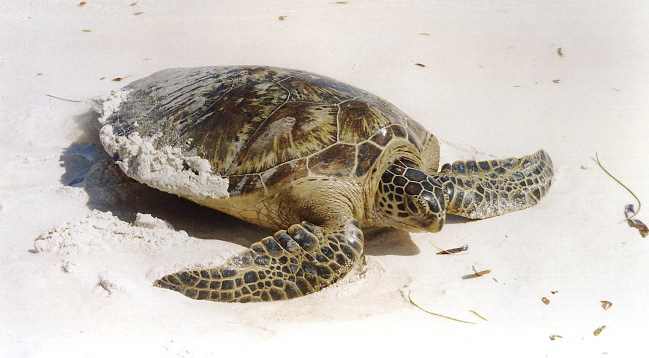
A Green Turtle, rescued from a fishing net in Mida Creek, Kenya, by Alice Perry.
Walrus Odobenus rosmarus
This massive animal occurs only in the high Arctic where the best places in the world to see
Walrus include Baffin Island and Ellesmere Island in
Arctic Canada, Round Island in Alaska,
Spitsbergen, and Wrangel Island off the northeast coast of Russia.
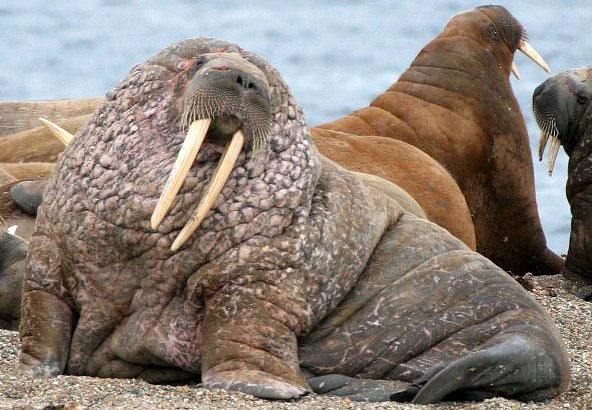
Walrus on Spitsbergen by Coke & Som Smith.
Warthog Phacochoerus africanus
The African plains experience would be incomplete without the Warthog. It is widespread
in open and lightly wooded country in Africa south of the Sahara.
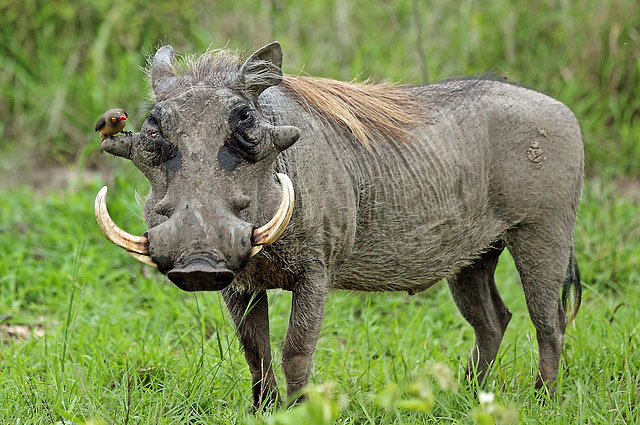
An impressive Warthog in Kruger National Park by Nigel Voaden, attended by a Red-billed Oxpecker.
Whale Shark Rhincodon typus
The largest species of fish in the world can reach a length of over 12 m (40 ft) – the
largest ever recorded, off Baba Island near Karachi, Pakistan in 1949, was 12.7 m (41.5 ft) long and had a maximum girth of 7 m (23 ft). It occurs all
round the world in tropical and warm temperate waters mainly, but it is a great wanderer and there are rarely many in one place longer than a few months
at a time so it is crucial to visit the best sites at the best time of year. The best places in the world to see or even swim with Whale Sharks include
Islas Holbox and Mujeres in Southern Mexico, Gladden Spit in
Belize, the Bay Islands in
Honduras, Djibouti, Tofo in Mozambique, the
Maldives, off Southern Thailand, near Donsol on the island
of Luzon in the Philippines, and Ningaloo Reef (Exmouth) in
Western Australia.
The largest fresh (and brackish) water fish in the world is the Mekong Giant Catfish (Pangasianodon gigas), the longest recorded individual
of which was 2.7 m (9 ft) long and weighed 293 kg (646 lb). It occurs in the Mekong River and its tributaries in China, Thailand, Laos and Cambodia.
A European (Wels) Catfish (Silurus glanis) caught in Russia in the 19th century measured 4.6 m (15 ft) and weighed 336 kg (720 lb) but this
species rarely exceeds 1.8 m (6 ft) and 90 kg (200 lb) these days.
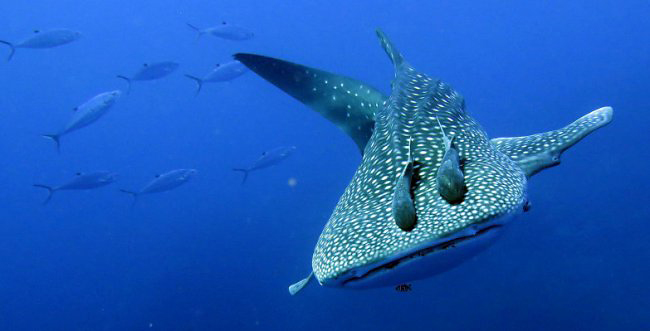
A magnificent Whale Shark in the Similan Islands National Park, Thailand by Coke & Som Smith.
Wild Asses Equus
The three species of this attractive horse occur from northeast Africa (African (Equus africanus))
through the Middle East to Western India and north to Kazakhstan, Mongolia and Northern China (Asiatic or Onager (Equus hemionus)), and in Southwest
China, Ladakh and Tibet (Tibetan or Kiang (Equus kiang)). The best places in the world to see wild asses include the Arjinshan Nature Reserve in
Xinjiang, China, Tibet and the Little Rann of Kutch in
Western India.
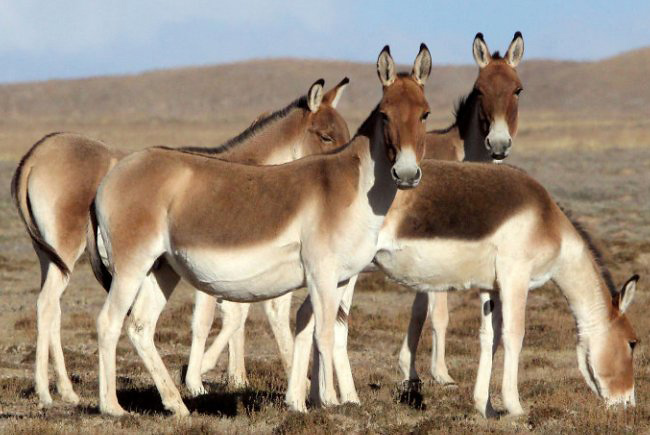
Kiangs in Tibet by Coke & Som Smith.
(Blue) Wildebeest Migration
Depending on the rains there are usually one to two million large mammals, mostly Blue Wildebeest or
Brindled Gnu (Connochaetes taurinus), as well as Thomson’s Gazelles (Gazella rufifrons) and Burchell’s Zebras (Equus quagga), in
the southeast Serengeti, in Northern Tanzania, between January and April, the largest gathering of
ungulates (hoofed mammals) in the world. They usually calve in February-March, attracting numerous predators. Then they move through
the central Serengeti in May-June when herds of Blue Wildebeest up to 40 km (25 miles) long have been seen from the air. They are heading west, toward
Lake Victoria, and north, to the Masai Mara in Kenya, and the best places to watch the Blue Wildebeest Migration
include the Grumeti River in the Serengeti which they usually cross in June (sometimes July), and the Mara and Talek Rivers in the Masai Mara which they
also usually cross in June and July (though sometimes as late as August when they may move back and forth across the Mara several times). They usually
remain in the Masai Mara until October-November then begin their long march back to the Serengeti.
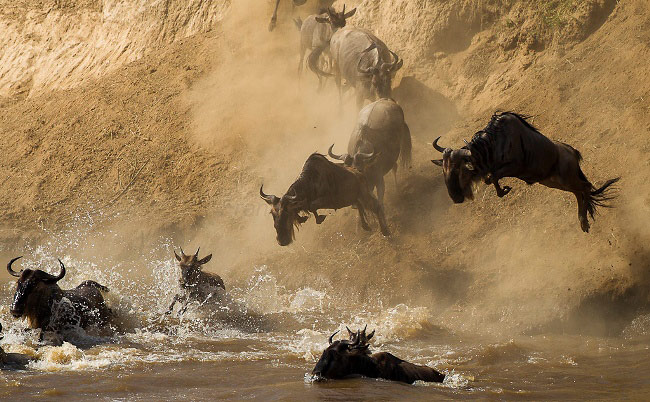
Blue Wildebeest attempting to cross the Mara River, Kenya, by Francesco Veronesi.
The Blue Wildebeest occurs on plains and in open woodlands from the Masai Mara south through east Africa to Namibia, where it has been reintroduced, and South Africa where it overlaps with its southern counterpart the Black Wildebeest or White-tailed Gnu (Connochaetes gnou) which once inhabited high temperate grasslands during the winter season and the arid Karoo shrublands during the summer rains but due to excessive hunting during European settlement this migration came to an end and today the Black Wildebeest is arguably extinct in the wild, surviving only as an introduced animal in reserves, including those in Namibia which is not part of its historical range.
Wolf Canis lupus
The Wolf has a large range but there are few easily accessible places where it is seen regularly. It
occurs in Spain, Italy, Eastern Europe, Turkey, the Middle East, across Russia south to the Himalayas and India, and across northern North America.
The best places in the world to see Wolf include Denali and Glacier National Parks in Alaska, Yellowstone
National Park in Wyoming (reintroduced), the Sierra de la Culebra and other areas in
Northwestern Spain, and Tibet, with a slimmer chance in
places such as Sweden, Bieszczady National Park in Poland, and
Abruzzo and Majella National Parks in Italy.
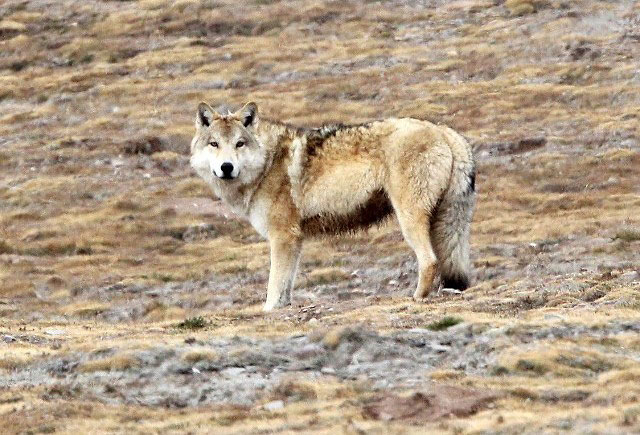
'Tibetan' Wolf by Coke & Som Smith.
Zebras Equus
These extraordinary horses occur from East Africa to South Africa. There are at least three species:
Burchell’s, also known as Common or Plains (Equus quagga), which occurs from East Africa to northeast South Africa; Grevy’s (Equus grevyi),
which occurs in northeast Africa including northern Kenya and
Ethiopia; and (Cape) Mountain (Equus zebra), which occurs in southwest Africa including Namibia
and Western South Africa.
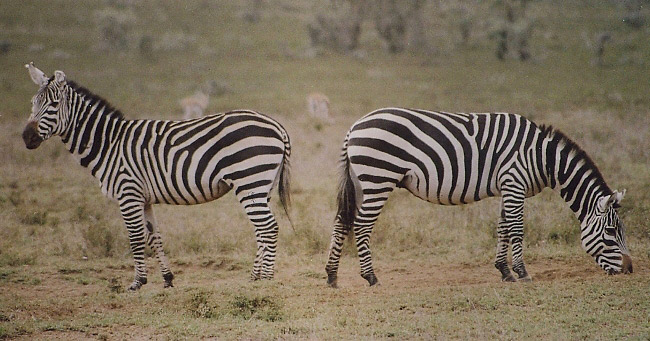
Burchell's Zebras in Hell's Gate National Park, Kenya by Alice Perry.
As far as the species which are not widespread or relatively easy to see throughout their range are concerned the top destinations where the highest number of Our Top 100 Wildlife occurs on a regular basis are Madagascar (6), Arctic Canada and China (4), Southern Brazil, Borneo and Southeastern Australia (all 3), and Baffin Island, Kenya, Uganda, Rwanda, DR Congo, Spitsbergen, Philippines, Eastern Australia and Western Australia (all 2), with single species for many more.
- The 800-page book, A Mind-blowing Birding Trip to a Planet called Earth, is Nigel Wheatley's attempt to capture what birding, and life, is all about. It was published in September 2021 and is available from Amazon for under £20/$25.