

Southern Cassowary in Australia by Mark Harper.
- A high percentage of endemic mammal species, seven endemic bird families and over 360 endemic bird species (about half of those which occur regularly) make Australia unique in the true sense of the word
- Endemic birds which in Eastern Australia include Albert's and Superb Lyrebirds, Paradise and Victoria's Riflebirds, Regent and Satin Bowerbirds, and Superb Fairy-wren
- While some of the world's more widespread spectacular birds also present include Southern Cassowary, many seabirds such as Wandering Albatross, and Lesser and Great Frigatebirds, Black-necked Stork, Wedge-tailed Eagle, White-bellied Sea-eagle, Brolga and Sarus Cranes, and Blue-winged Kookaburra
- And endemic mammals include Koala and Platypus, as well as more widespread species such as Short-beaked Echidna and Sugar Glider
- All in some superb forests
- And offshore lies the Great Barrier Reef, the largest expanse of coral reef in the world, with Whale Sharks, Manta Rays and numerous colourful coral reef fish
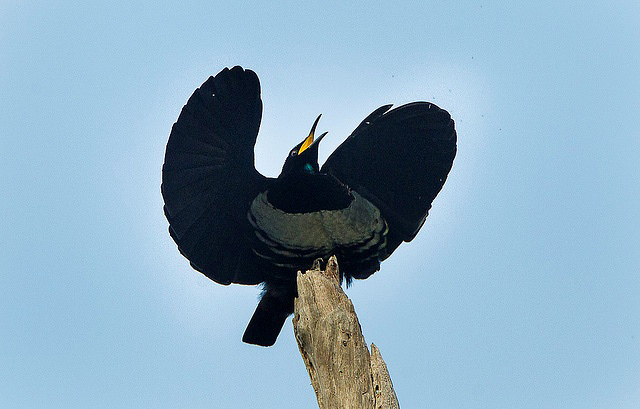
A great image of a displaying male Victoria's Riflebird at Lake Eacham by Francesco Veronesi.
- The Great Barrier Reef is not only the biggest reef on Earth it is the largest structure ever built by living things; tiny, stony, colonial corals which have been 'constructing' it for about 18 million years. At over 3000 km long and covering over 300,000 sq km it is not actually a single reef but consists of over 3000 individual reefs and coral cays, which together support an astonishing variety of life. This is why the Great Barrier Reef is often considered to be one of the seven natural wonders of the world. The main attraction for the millions of people who visit the reef each year are the coral reef fish, which are easy to see in the warm, clear waters. Many towns and cities along the Queensland coast offer boat trips out to the reef, lasting from hours to weeks but mainly day-trips, and it is also possible to stay on the reef itself since there are resorts on many islands, accessible by air from the mainland. There are more than 1500 different species of fish, including hundreds of brightly coloured beauties with different combinations of colours, spots and stripes, and together they form a slow-motion explosion of brilliant colours and intricate patterns. There are angelfish and butterflyfish, clownfish, damselfish, pufferfish, scorpionfish, surgeonfish, triggerfish and wrasses, as well as seahorses and even more bizarre creatures such as the Potato Cod, a gentle giant grouper which can grow to nearly two metres, and the Wobbegong, a sluggish shark with whiskers. The Great Barrier Reef is then one of the world’s best places to don snorkel, mask and flippers, and fly, like an eagle, in a psychedelic world, over and down in amongst the coral where the 'trees' are green and blue and red and every other colour, and marvel at the unbelievable numbers and variety of fish and invertebrates, in a diversity of form and an explosion of brilliant colours and crazy patterns almost impossible to comprehend.
- If time allows on an Eastern Australia tour it may be worth including Cape York, reached north of Cairns via the Peninsula Development Road which may be closed for a few months during the wet season which usually lasts from mid-November to mid-April. There are nine birds endemic to this peninsula; Buff-breasted Buttonquail, Lesser Sooty-owl, Golden-shouldered Parrot, White-streaked Honeyeater, Macleay’s Honeyeater, Frill-necked Monarch, Pied Monarch, Northern Scrub-robin and Grey-headed Robin. In the Iron Range a narrow 175 km band of lowland rainforest south of Portland Roads supports the localised Frill-necked Monarch and Northern Scrub-robin, as well as the more widespread White-streaked Honeyeater, plus Palm Cockatoo, Papuan Eclectus, Double-eyed Fig Parrot, Red-cheeked Parrot, Marbled Frogmouth, Yellow-billed Kingfisher, Noisy Pitta, Fawn-breasted Bowerbird, Black-eared Catbird, Lovely Fairy-wren, Tropical Scrubwren, Green-backed Honeyeater, Yellow-breasted Boatbill, Magnificent Riflebird, Trumpet Manucode, White-browed and White-faced Robins, and Yellow-legged Flyrobin. Farther north, Golden-shouldered Parrot can be seen out of Lotusbird Lodge, at Artemis Station near Musgrave Roadhouse, along with Black-backed Butcherbird. In nearby Rinyirru (Lakefield) National Park it is possible to see Red-backed and Red-chested Buttonquails, as well as Eastern Grass-owl, Torresian Kingfisher, and Black-throated and Star Finches.
- About 500 km west of Rockhampton on the Queensland coast between Cairns and Brisbane it is possible to see the rare Northern Hairy-nosed Wombat in Epping Forest NP, along with Rufous Bettong, Eastern Grey Kangaroo, Black (Swamp) Wallaby and Spotted Bowerbird.
- Several hundred kilometres inland from the Cairns-Townsville stretch of Queensland coast is a place called Mount Isa where it is possible to see Carpentarian Grasswren, one of the toughest birds to see well in Australia (along McNamara Road) and Kalkadoon (Dusky) Grasswren (along the Pamela Street Walking Track), as well as Long-tailed Finch and Painted Finch (Firetail) at Lake Moondarra. To the east, Pictorella Mannikin, as well as Crimson Chat, occur at Chinaman Creek Dam near Cloncurry. Southeast of there lies the town of Winton, a good base to bird (i) the sewage works, for Freckled Duck, Baillon’s Crake, Spotted Bowerbird, White-winged Fairy-wren, Orange Chat and Plum-headed Finch; (ii) Lark Quarry Conservation Park, the best known site for Rusty (Striated) Grasswren and famous for fossilised dinosaur footprints. Also possible are Grey Falcon, Red-backed Kingfisher, Rufous-crowned Emu-wren and Hall’s Babbler; and (iii) Bladensburg National Park, where Hall’s Babbler and Chestnut-breasted Quail-thrush occur, as well as Spinifex Pigeon, Splendid Fairy-wren and Plum-headed Finch, and there is a chance of Grey Falcon and Black Honeyeater. Also in this region of southwest Queensland lives the mysterious Night Parrot which was present in unknown numbers between August 2013 and January 2016 at the strictly protected and off-limits Pullen Pullen Reserve adjacent to Diamantina NP, and for the first time ever a juvenile was photographed there during the day in February 2018 (In early 2017 a Night Parrot was photographed 2000 km to the west in Western Australia, the first 100% certain record of the bird in that state for nearly a century). On the 6000 square kilometre Coorabulka Station farmland/Diamantina floodplain around Boulia it is possible to see Gibberbird, as well as Inland Dotterel and there is a chance of Letter-winged Kite.
- Much farther south of Winton, due west of Brisbane, Chestnut-breasted Quail-thrush can also be seen around Cunnamulla, along with Major Mitchell's (Pink) Cockatoo, Bourke's Parrot, Hall's Babbler, and Crimson and Orange Chats.
- Australia is an island-continent not a small country and to look for all of its best wildlife in one go would involve a trip lasting several months. Therefore it is probably best to plan several visits, including ones to: nearby Southeastern Australia including Tasmania where it is possible to see Platypus, Tasmanian Devil and birds such as Superb Lyrebird, Little Penguin and Plains-wanderer; Outback Australia where it is possible to see Red Kangaroos and birds such as Malleefowl and Letter-winged Kite; Western Australia where the wildlife includes Manta Ray, Whale Shark, Dugong, Numbat and birds such as Red-capped Parrot; Northwestern Australia where Black Grasswren occurs on the Mitchell Plateau in the Kimberley; and Northern Australia where Hooded Parrot, Rainbow Pitta and White-throated Grasswren occur, along with the famous waterbirds and Saltwater Crocodiles of Kakadu.
Best Birds and other wildlife in Eastern Australia
Birds
East Australia Endemics 34 Australian Brush-turkey, White-headed Pigeon, Brown Cuckoo-dove, Wonga Pigeon, Topknot Pigeon, Black-breasted Buttonquail, Powerful Owl, Glossy Black-cockatoo (also Kangaroo Island off south coast), Eastern Ground Parrot, Scaly-breasted Lorikeet, Coxen’s (Double-eyed) Fig-parrot, Australian King-parrot, Albert’s Lyrebird, Superb Lyrebird, Rufous Scrub-bird, Green Catbird, Regent Bowerbird, Satin Bowerbird, Red-browed Treecreeper, Variegated Fairy-wren, Eastern Bristlebird, Scarlet Myzomela, Lewin’s Honeyeater, Mangrove Honeyeater, Bell Miner, Brown Gerygone, Yellow-throated Scrubwren, Large-billed Scrubwren, Australian Logrunner, Eastern Whipbird, White-eared Monarch, Paradise Riflebird, Pale-yellow Robin and Plum-headed Finch.
Northeast Australia Endemics 22 Squatter Pigeon, Australian Swiftlet, Red (Southern) Boobook, Spotted Catbird, Tooth-billed Bowerbird, Golden Bowerbird (most likely during breeding season Nov-Jan), Lovely Fairy-wren, Rusty (Striated) Grasswren, Hornbill Friarbird, Yellow-spotted Honeyeater, Imitatress (Graceful) Honeyeater, Yellow Honeyeater, Bridled Honeyeater, Eungella Honeyeater, Fernwren, Atherton Scrubwren, Mountain Thornbill, Chowchilla, Bower’s Shrike-thrush, Victoria’s Riflebird, White-browed Robin and Black-throated Finch.
Southeast Australia including Tasmania Endemics 20 - not all of these occur in Eastern Australia Cape Barren Goose, Gang-gang Cockatoo, Long-billed Corella, Blue-winged Parrot, Superb Parrot, Striated Grasswren, Rufous Bristlebird, Crescent Honeyeater, Regent Honeyeater, Pilotbird, Chestnut-rumped Heathwren, Striated Fieldwren, Rockwarbler, Olive Whistler, Red-lored Whistler, Little Raven, Forest Raven, Pink Robin, Flame Robin and Beautiful Firetail.
Near-endemics
Australia and New Guinea 92 - not all of these occur in Eastern Australia Magpie Goose, Marbled Frogmouth, Papuan Frogmouth, White-throated Nightjar (Papua New Guinea only), Australian Owlet-nightjar (Papua New Guinea only), Black-eared Cuckoo (rare in Indonesia), Pallid Cuckoo (rare in Indonesia), Brolga (Crane), Australian Bustard, Straw-necked Ibis, White-necked (Pacific) Heron, Bush Thick-knee, Pied Oystercatcher (also recorded on Kai Islands), Masked Lapwing (irregular in Indonesia), Red-kneed Dotterel, Australian Gull-billed Tern, Greater Sooty-owl, Australian Masked-owl, Rufous Owl, Wedge-tailed Eagle, Collared Sparrowhawk, Whistling Kite, Yellow-billed Kingfisher, Forest Kingfisher (rare in Indonesia), Torresian (Collared) Kingfisher, Buff-breasted Paradise-kingfisher (mostly Nov-Mar), Blue-winged Kookaburra, Nankeen (Australian) Kestrel (also Christmas Island, and rare in Indonesia), Brown Falcon, Palm Cockatoo (Cape York only in Australia), Little Corella, Sulphur-crested Cockatoo, Double-eyed Fig-parrot, Red-winged Parrot, Papuan Pitta, Noisy Pitta, Black-eared Catbird (Cape York only in Australia), Fawn-breasted Bowerbird (Cape York only in Australia), Brown Honeyeater, Blue-faced Honeyeater, White-throated Honeyeater, Tawny-breasted Honeyeater (Cape York only in Australia), Little Friarbird, Noisy Friarbird, Dusky Myzomela, Red-headed Myzomela, Green-backed Honeyeater (Cape York only in Australia), Brown-backed Honeyeater, Rufous-banded Honeyeater, Varied Honeyeater, Yellow-tinted Honeyeater, Fairy Gerygone, Green-backed Gerygone, White-throated Gerygone (Papua New Guinea only), Large-billed Gerygone, Mangrove Gerygone (Papua New Guinea only), Tropical Scrubwren (Cape York only in Australia), Grey-crowned Babbler, Australasian Figbird, Olive-backed Oriole, Green Oriole (also Romang Island, east of Timor), Brown (Grey) Whistler, Black-tailed Whistler, Little Shrike-thrush, Rufous (Little) Shrike-thrush, Grey Shrike-thrush, White-winged Triller (Papua New Guinea only), Varied Triller, Black Butcherbird, Australian Magpie, Black-backed Butcherbird (Cape York only in Australia), Black-faced Woodswallow (range also reaches Timor, Leti and Sermata), Yellow-breasted Boatbill, Northern Fantail, Mangrove Fantail (Papua New Guinea and Aru Islands only), Leaden Flycatcher, Satin Flycatcher, Paperbark Flycatcher, Magpie-lark (also east Timor), Black-winged Monarch (Cape York only in Australia), Black-faced Monarch, Trumpet Manucode (Cape York only in Australia), Magnificent Riflebird (Cape York only in Australia), Yellow-legged Flyrobin (Cape York only in Australia), Lemon-bellied Flyrobin, Jacky Winter (Papua New Guinea only), White-faced Robin (Cape York only in Australia), Mangrove Robin, Little Grassbird (West Papua only), Chestnut-breasted Munia, White-bellied Crimson Finch (Cape York only in Australia) and Australasian Pipit (Papua New Guinea only).
Australia, New Guinea and Solomon Islands 1 Russet-tailed Thrush (Papua New Guinea only, and Choiseul Island in the Solomon Islands).
Other Specialities
Sarus Crane and Eastern Shrike-tit. Also a chance of Red-necked Crake and Regent Honeyeater.
Others
Orange-footed Scrubfowl, Black Swan, ducks, Antipodean, Wandering (Gibson's), White-capped, Black-browed, Campbell and Indian Yellow-nosed Albatrosses,
Great-winged and Providence Petrels, Flesh-footed, Short-tailed and Wedge-tailed Shearwaters, Fairy Prion (mostly Oct-Mar), Brown Booby, Australian
Pelican, Australasian Darter, Lesser and Great Frigatebirds, Red-tailed Tropicbird, Black Bittern, Royal and Yellow-billed Spoonbills, Black-necked Stork,
Brahminy Kite, Wedge-tailed Eagle, White-bellied Sea-eagle, Buff-banded Rail, Red-capped Plover, Black-fronted Dotterel, Red-necked Avocet, Comb-crested
Jacana, wintering shorebirds (mostly Oct-Mar) including Latham's Snipe, Great Knot, Grey-tailed Tattler, Far Eastern Curlew, Red-necked Stint, and
Sharp-tailed and Terek Sandpipers, Black-naped, Bridled and Sooty Terns (all three mostly Oct-May), Black and Brown Noddies, pigeons, Eastern Superb and
Wompoo Fruit-doves, Torresian Imperial-pigeon, Red-tailed and Yellow-tailed Black-cockatoos, lories, lorikeets including Rainbow, rosellas including
Crimson, parrots including Red-winged and Turquoise, Double-eyed Fig-parrot, Channel-billed Cuckoo (mostly Oct-Mar), Tawny Frogmouth, White-throated
Needletail (mostly Nov-Mar), Laughing Kookaburra, Azure, Forest and Little Kingfishers, Rainbow Bee-eater, many honeyeaters including Eastern Spinebill,
woodswallows, whistlers, monarchs, Magpie-lark, Bassian and Russet-tailed Thrushes, robins and Diamond Firetail.
Also a chance of many seabirds, Great-billed Heron, Aleutian Tern, Lewin's Rail, Brush Bronzewing, Cockatiel, Budgerigar, Eastern Ground Parrot, Powerful Owl, Southern Emu-wren and Beautiful Firetail.
Mammals
Over 80% of Australia's 360 mammal species are endemic and in Eastern Australia they include Koala, Platypus,
Eastern Grey Kangaroo, wallabies, gliders, possums and bandicoots, while more widespread species include Short-beaked Echidna, Musky Rat Kangaroo,
and Black, Grey-headed and Spectacled Flying Foxes. Also a chance of the endemic Common Wombat, Lumholtz's Tree Kangaroo and Spotted-tailed Quoll,
as well as more widespread species such as Dugong, Australian Humpback and Indo-Pacific Bottlenose Dolphins (all three in Moreton Bay, Brisbane),
Bryde's (mostly Aug-Dec), Humpback (mostly Jul-Sep), Dwarf Minke (mostly Aug-Dec) and Sperm Whales, and (Oceanic) Bottlenose, Common, Risso's and
(Pantropical) Spotted Dolphins.
Reptiles, Amphibians and Fish
Whale Shark, Manta Ray (both mostly Aug-Dec), and Green,
Leatherback and Loggerhead Turtles (all three mostly Oct-Nov although Nov-Feb on Lady Elliot Island). Also a chance of
Tiger Shark (mostly Aug-Dec).
Invertebrates
The many butterflies and moths include Cape York Birdwing Butterfly, one of
the largest butterflies in the world, and Hercules Moth, one of the largest moths in the world.
Other Natural Wonders of Eastern Australia
Great Barrier Reef The largest structure ever built by living things (stony corals) which is over 3000 km long and covers over 300,000 sq km. It is not actually a single reef, but consists of thousands of smaller reefs, built up over the course of about 18 million years.
Best Sites for Birds and other wildlife in Eastern Australia
- Sydney Area
- Sydney, Eden and Wollongong/Kiama Pelagic Boat Trips Wandering (Gibson's), White-capped, Black-browed, Campbell and Indian Yellow-nosed Albatrosses, Great-winged and Providence Petrels, Flesh-footed, Short-tailed and Wedge-tailed Shearwaters, Fairy Prion, and many other possible seabirds such as (Australian) White-faced Storm-petrel, as well as cetaceans such as Sperm Whale. For more details see
- Southern Oceans Seabird Study Association.
- Sydney Botanical Gardens Grey-headed Flying Fox, Brushtail and Ringtail Possums, and a chance of Powerful Owl (ask at information kiosk).
- Centennial Park A chance of Powerful Owl.
- Royal NP Superb Lyrebird (Lady Carrington Drive), Sulphur-crested Cockatoo, Yellow-tailed Black-cockatoo, Australian King-parrot, Laughing Kookaburra and Satin Bowerbird. Also a chance of Powerful Owl, Southern Emu-wren (Mount Bass Trail), Eastern Whipbird and Rockwarbler (Lady Carrington Drive).
- Barren Grounds NR A chance of Gang-gang Cockatoo, Eastern Ground Parrot, Southern Emu-wren, Eastern Bristlebird, Pilotbird and Beautiful Firetail.
- Minna Murra Rainforest Park Superb Lyrebird.
- Capertree Valley/Glen Davis Wedge-tailed Eagle, Turquoise Parrot, Regent Honeyeater (Glen Alice and Glen Davis Roads), White-winged Chough and Diamond Firetail, as well as Common Wombat, Eastern Grey Kangaroo, and Red-necked and Swamp Wallabies. Also a chance of White-browed Woodswallow, Eastern Shrike-tit and Plum-headed Finch.
- Lithgow Sewage Works A chance of Freckled and Pink-eared Ducks.
- Lake Wallace, near Lithgow A chance of Freckled, Musk and Pink-eared Ducks.
- North to Newcastle and that region
- Dharug NP Common Wombat.
- Belmont Lagoon A chance of Lewin's Rail and Brush Bronzewing.
- Pelagic Boat Trips Antipodean and Wandering Albatross, Providence Petrel and many other possible seabirds including White-faced Storm-petrel, and cetaceans.
- Barrington Tops/Gloucester Tops Superb Lyrebird, Rufous Scrub-bird (last part of the Gloucester Tops Road and the Kerripit Trail), Bassian Thrush, Olive Whistler, and Flame, Rose and Scarlet Robins. Also a chance of Greater Sooty-owl.
- Old Bar Beach Inlet A chance of Aleutian Tern (Nov-Mar, Farquhar Inlet (Old Bar)).
- Warrumbungle NP Koala.
- Brisbane Area
- Moreton Bay A chance of Dugong, as well as Australian Humpback and Indo-Pacific Bottlenose Dolphins.
- Point Lookout, North Stradbroke Island Seawatching in southeasterlies when possibilities include albatrosses (mostly Jun-Jul), shearwaters (mostly Oct-Nov), petrels such as Kermadec (mostly Oct-Nov), Providence (mostly May-Jun) and Tahiti, and Red-footed Booby.
- Southport Pelagic Boat Trips An incredible 81 species of seabird have been recorded on these monthly trips up to mid-2012, including New Zealand Storm-petrel, Kermadec and Tahiti Petrels, and Sooty and White Terns. For more details see Southern Oceans Seabird Study Association.
- Daisy Hill Conservation Park, Brisbane Koala.
- Lamington NP Australian Brush-turkey, Wonga Pigeon, Glossy Black-cockatoo, Australian King-parrot, Crimson Rosella, Australian Owlet-nightjar, Marbled and Tawny Frogmouths, Noisy Pitta, Albert's Lyrebird, Regent and Satin Bowerbirds, Paradise Riflebird, Superb Fairy-wren, Green Catbird, Red-browed Treecreeper, Scarlet Myzomela, Lewin's Honeyeater, Australian Logrunner, Eastern Whipbird, Rose Robin and Russet-tailed Thrush, as well as Red-necked Pademelon (grazing lawns) and Mountain Brushtail Possum (at feeders). Also a chance of Koala (Binna Burra), Greater and Sugar Gliders, Spotted-tailed Quoll, and Rufous Scrub-bird (on a 24 km (15 mile) round hike from the main centre or closer to Binna Burra Lodge).
- Lake Samsonvale Asian Blue and Brown Quails, and Painted, Red-backed and Red-chested Buttonquails.
- Tooan Tooan Creek, Hervey Bay Black Flying Fox roost (peak numbers usually at end of March).
- Yarraman area A chance of Black-breasted Buttonquail.
- Eungella NP Platypus (from Broken River Viewing Platform) and Eungella Honeyeater.
- Cania Gorge NP A chance of Short-beaked Echidna, and Greater and Yellow-bellied Gliders.
- Cairns Area
- Yule Point, north of Cairns Beach Thick-knee.
- Cairns Brahminy Kite, wintering shorebirds including Great Knot, Grey-tailed Tattler, Far Eastern Curlew, Red-necked Stint, and Sharp-tailed and Terek Sandpipers, Papuan Frogmouth (Botanic Gardens), Torresian Kingfisher, Varied Honeyeater and Mangrove Robin (all three north of the Esplanade), as well as Spectacled Flying Fox. Also a chance of Black-necked Stork, White-browed Crake (Cattana Wetlands), Bush Thick-knee (Centenary Lakes) and Rufous Owl.
- Mareeba Wetlands and entrance road (Pickford Road) Australian Bustard, Blue-winged Kookaburra, Red-backed Fairy-wren, Black-throated and Double-barred Finches, and Chestnut-breasted Mannikin.
- Granite Gorge Squatter Pigeon, Great Bowerbird and Mareeba Rock Wallaby.
- Atherton Tablelands including Mount Lewis (the main site along with Mount Hypipamee for all higher elevation forest birds), Mount Molloy, Mount Carbine, and Lakes Barrine, Eacham and Mitchell Black-necked Stork, Brolga and Sarus Cranes (roost at Broomfield Swamp near Malanda), Australian Bustard, Bush Thick-knee, Comb-crested Jacana, Squatter Pigeon (Mt Carbine), Double-eyed Fig-parrot, Australian Owlet-nightjar, Papuan Frogmouth, Forest Kingfisher, Blue-winged Kookaburra, Buff-breasted Paradise-kingfisher (Kingfisher Park, Julatten, Nov-Mar), Noisy Pitta, Victoria's Riflebird (Cassowary House, Kuranda, Lake Eacham and Mt Lewis), Great and Tooth-billed (Lake Eacham and Mt Lewis) Bowerbirds, Spotted Catbird, Red-backed Fairy-wren, Bridled and Macleay's Honeyeaters, Chowchilla (Mt Lewis), Eastern Whipbird, Yellow-breasted Boatbill, Pied Monarch, Grey-headed Robin (Mt Lewis), Bower's Shrike-thrush (Mt Lewis), Atherton Scrubwren (Mt Lewis), Fernwren and Mountain Thornbill (Mt Lewis), as well as Platypus (Bushey Creek, Kingfisher Park; Petersen Creek Bridge on edge of Yungaburra; Tarzalli Lakes; and Winfield Park near Malanda), Sugar Glider (in honey-baited trees at Chamber's Wildlife Lodge), Musky Rat Kangaroo (Cassowary House, and Lakes Barrine and Eacham), Striped Possum (Chamber's Wildlife Lodge), Long-nosed (Chamber's Wildlife Lodge and Kingfisher Park) and Northern Brown Bandicoots, Striped Possum, Spectacled Flying Fox (Kingfisher Park and Millaa Millaa Falls car-park) and Cape York Birdwing Butterfly. Also a chance of Southern Cassowary (Cassowary House), Red-necked Crake (Cassowary House and Kingfisher Park), Lesser Sooty-owl (Mt Lewis), Australian Masked-owl, and Golden Bowerbird (very difficult to see outside breeding season which is Nov-Jan. During Nov-Jan best sites are Mt Lewis; Birthday Creek Falls Road in Paluma NP; The Crater, Mount Hypipamee NP; and Possum Valley near Kingfisher Park), as well as Lumholtz's Tree Kangaroo (Malanda Falls, Mount Hypipamee and Nerada Tea Estate/Plantation, south of Malanda).
- Daintree River Cruise Great-billed Heron, Black Bittern, Papuan Frogmouth, Azure and Little Kingfishers, and Shining Flycatcher. Also a chance of Wompoo Fruit-dove, Double-eyed Fig-parrot and Pied Monarch. Also Saltwater Crocodile and Common Tree Snake.
- Daintree NP A chance of Southern Cassowary.
- Etty Bay and Mission Beach A chance of Southern Cassowary (drive around very carefully looking for the birds in and alongside the roads).
- Georgetown area, inland Wedge-tailed Eagle, Australian Bustard, Red-winged Parrot and Great Bowerbird. Also a chance of Budgerigar, Cockatiel and Banded Honeyeater.
- Great Barrier Reef
- Michaelmas Cay Great and Lesser Frigatebirds, Brown Booby, Sooty Tern and Brown Noddy. Also a chance of Black-naped and Bridled Terns, and Black Noddy.
- Green Island Black Noddy.
- Lady Elliot Island Red-tailed Tropicbird, Black-naped, Bridled and Sooty Terns, and Black and Brown Noddies (terns and noddies mostly Oct-May), as well as Manta Ray, and Green and Loggerhead Turtles.
- Remote Northern Reefs Whale Shark, Manta Ray, and Green, Leatherback and Loggerhead Turtles (all Raine Island). Also a chance of Tiger Shark (Raine Island), and Humpback, Bryde's and Dwarf Minke Whales.
Best Times for Birds and other wildlife in Eastern Australia
October-November, the start of the southern spring, is the best time to look for birds and mammals, when many resident birds are breeding and therefore at their most active, although this is not true for the two lyrebirds which are most likely to be heard singing and seen displaying in the southern autumn and winter. Migrant birds from the north, including Buff-breasted Paradise-kingfisher, also arrive in October-November which falls into the June-October period when the greatest variety of seabirds are present. Spring also overlaps with the August-December period which is the best time for scuba-diving and snorkeling on the Great Barrier Reef.
Recommended Bird Books etc. for Eastern Australia
The Australian Bird Guide by P Menkhorst. PUP, 2017.
The Slater Field Guide to Australian Birds by P, P and R Slater. Reed/New Holland, 2009 (Revised Edition).
The Field Guide to the Birds of Australia by G Pizzey and F Knight. Harper Collins, 2012 (Ninth Edition).
Birds of Australia by K Simpson and N Day. PUP, 2010 (Eighth Edition).
Field Guide to Australian Birds by Michael Morcombe: complete compact edition. Steve Parish Publishing, 2016.
Field Guide to Australian Birds by Michael Morcombe. Steve Parish Publishing, 2003.
The Complete Guide to Australian Birds (Photographic) by George Adams. Viking Australia, 2019.
Finding Australian Birds by T Dolby and R Clarke. CSIRO, 2014.
The Complete Guide to Finding the Birds of Australia by R Thomas et al. CSIRO, 2011 (Second Edition).
Field Companion to the Mammals of Australia by S Van Dyck et al. New Holland, 2012.
A Field Guide to the Mammals of Australia by P Menkhorst and F Knight. OUP, 2010 (Third Edition).
Field Guide to Australian Mammals by C Jones and S Parish. Steve Parish Publishing, 2006.
The Complete Guide to Finding the Mammals of Australia by D Andrew. CSIRO, 2015.
A Complete Guide to Reptiles of Australia by S Wilson and G Swan. New Holland, 2013 (Fourth Edition).
The Complete Field Guide to Butterflies of Australia by M Braby. CSIRO, 2004.
Wildlife of Australia: Princeton Pocket Guides by I Campbell and S Woods. PUP, 2013.
Wildlife of Australia by L Egerton and J Lochman. Allen and Unwin, 2009.
Bradt Travel Guides: Australian Wildlife by S Martin. Bradt, 2010.
Apps etc.
The Michael Morcombe and David Stewart eGuide to the Birds of Australia.
Pizzey and Knight Birds of Australia.
Where to watch birds in Australasia & Oceania by N Wheatley. Helm, 1998.
Don’t know which country/countries/regions to visit in Australasia? Then it may be worth considering taking a look at this book, written by this website’s author. It is many years old of course but it still provides a starting point, an overview and a guiding light to the best birds and the best places to look for them in the region, and could save hours of searching for similar information on the internet. However, it is important to check more up-to-date sources for sites which have been opened up, sites and species which have been discovered, lodges that have been built etc. since the book was published.
Birding and Wildlife Trip Reports for Eastern Australia
Many trip reports, some for Eastern Australia, are posted on the websites listed here. On some of these websites some reports are independent and some are posted by tour companies who organize tours to Eastern Australia. These tour companies and others also post their own reports on their websites, which are listed under 'Some Organized Tours to Eastern Australia' below.
- The best website for trip reports is CloudBirders
- but these are also worth a look
- Birdtours
- Fatbirder
- Jon Hornbuckle
- Mammal Watching
Local bird and wildlife guides in Australia
The costs of organized tours partly reflect the quality of the tour leaders. Some leaders are certainly better than others and many companies claim their leaders are the best but even the best rely at least to some extent on the exceptional skills of the local guides they employ. If you are travelling independently, employing such local guides will greatly increase your chances of seeing the wildlife you wish to see.
Accommodation for birders in Eastern Australia
Some Organized Tours for birds and other wildlife to Eastern Australia
There are many tour companies who organize tours to see mammals, birds, other wildlife and other natural wonders. The cost of these tours vary considerably according to such variables as the airlines used, the number of days the tours last, the number of sites visited, the number of people in the group (an important consideration if you wish to see such wildlife as rainforest mammals and birds), the number of tour leaders, the standard of accommodation and transport, and the percentage profit the company hopes to make. Generally, where the number of days tours last and the number of sites visited are similar, the cheapest tours are those that use the cheapest airlines, accommodation and local transport, that have the largest groups with the least number of leaders, and that make the least amount of profit. The most expensive tours tend to be those which are exceptionally long, use the most expensive accommodation (ridiculously lavish in some cases, even for single nights) and which make the most profit. Some tour costs partly reflect the quality of the tour leaders. Some leaders are certainly better than others and many companies claim their leaders are the best but even the best rely at least to some extent on the exceptional skills of the local guides they employ.
While tour companies organize tours with set itineraries many also organize custom tours for individuals and private groups who instead of taking a tour with a set itinerary want to follow their own itinerary to suit their own personal tastes, whether it be mammals, birds, other wildlife, other natural wonders or even man-made attractions, or a mixture of them all. Many organized tours with set itineraries are also fast-paced and target as many species as possible, whether they are mammals, birds or other wildlife or everything, which usually leaves little time to enjoy the best sites and individual species, but on a custom tour those taking part can specify the pace and the sites and species they wish to concentrate on. Custom tours also suit people who like to travel with people they already know, rather than with a group of strangers, and people with partners with different interests. Individuals and small groups will almost certainly have to pay more than the price of an organized tour with a set itinerary but a large group of friends may be able to travel for less than the price quoted for a set tour.
Tour companies who run organized tours or can arrange custom tours to Eastern Australia include the following.
