
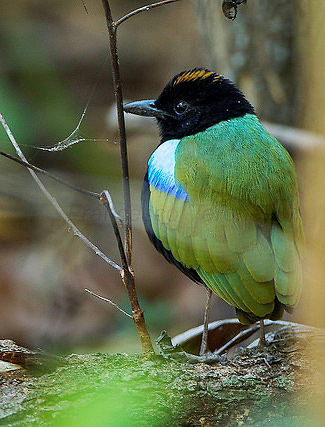
A lovely Rainbow Pitta at Howard Springs near Darwin by Francesco Veronesi.
- A high percentage of endemic mammal species, seven endemic bird families and over 360 endemic bird species (about half of those which occur regularly) make Australia unique in the true sense of the word
- Endemic birds which in Northern Australia include Chestnut-quilled Rock-pigeon, Partridge Pigeon, Grey-rumped Fruit-dove, Chestnut-backed Buttonquail, Hooded Parrot, Rainbow Pitta, Purple-crowned Fairy-wren, White-throated Grasswren, White-breasted Whistler, Northern Shrike-tit and Gouldian Finch.
- While some more widespread spectacular birds which are also present include Pied Heron, Black-necked Stork, Wedge-tailed Eagle, Brolga Crane, Blue-winged Kookaburra and Rainbow Bee-eater
- As well as numerous other waterbirds and Saltwater Crocodiles
- And endemic mammals such as Black Wallaroo and Rock Ringtail Possum
- All in some fine scenery, notably sandstone gorges and the Arnhem Land Escarpment
- Alice Springs and Uluru lie at the southern end of the very long Northern Territory. Birds in the Alice Springs area include Bourke’s Parrot (at Kunnoth Bore), Rufous-crowned Emu-wren, Dusky (both along St Theresa Road) and Sandhill (Uluru sunset viewing car park area, best not visited at sunset, at least for birds) Grasswrens, Grey Honeyeater (Desert Springs Park), Banded Whiteface and Cinnamon Quail-thrush (both at Cannonball Memorial on road from Alice to Erldunda).
- Australia is an island-continent not a small country and to look for all of its best wildlife in one go would involve a trip lasting several months. Therefore it is probably best to plan several visits, including ones to: nearby Northwestern Australia where the endemic Black Grasswren occurs on the Mitchell Plateau in the Kimberley; Western Australia where the wildlife includes Manta Ray, Whale Shark, Dugong, Numbat and birds such as Red-capped Parrot; Outback Australia where it is possible to see Red Kangaroos and birds such as Malleefowl and Letter-winged Kite; Eastern Australia where the wildlife includes Koala, Platypus and birds such as Southern Cassowary, Albert's Lyrebird, Paradise and Victoria's Riflebirds, and Regent and Satin Bowerbirds; and Southeastern Australia including Tasmania where it is possible to see Koala, Platypus, Tasmanian Devil and birds such as Superb Lyrebird, Little Penguin, Plains-wanderer and Satin Bowerbird.
Best Birds and other wildlife in Northern Territory, Australia
Birds
North Australia Endemics 11 Chestnut-quilled Rock-pigeon, Grey-rumped (Black-banded) Fruit-dove, Chestnut-backed Buttonquail, Hooded Parrot, Red-collared Lorikeet, White-throated Grasswren, Carpentarian Grasswren, Kalkadoon Grasswren (Selwyn Range), White-lined Honeyeater, Northern Shrike-tit and Grey Whistler.
North and Northwest Australia Endemics 13 Partridge Pigeon, Northern Rosella, Varied Lorikeet, Rainbow Pitta, Purple-crowned Fairy-wren, White-quilled (Blue-faced) Honeyeater, White-breasted Whistler, Sandstone Shrike-thrush, Silver-backed Butcherbird, Buff-sided Robin, Yellow-rumped Mannikin, Long-tailed Finch and Gouldian Finch.
Other specialities
Pied Heron (near-endemic), Black-necked Stork, Chestnut Rail (occurs only on the Aru Islands beyond Northern Australia), Brolga Crane, Blue-winged
Kookaburra, Black-tailed Treecreeper (endemic), Yellow-tinted Honeyeater (near-endemic), Black-tailed (Mangrove Golden) Whistler (near-endemic), Arafura
Fantail (near-endemic), Broad-billed Flycatcher (near-endemic), and Masked Finch (endemic). Also a chance of Black-breasted Buzzard (endemic), Rufous Owl
(near-endemic), Red Goshawk (endemic), Star Finch (endemic) and Pictorella Mannikin (endemic).
Also a chance of White-quilled Rock-pigeon.
Others
Black Swan, Magpie Goose, Radjah Shelduck, Plumed and Wandering Whistling-ducks, Green Pygmy-goose, Orange-footed Scrubfowl, Hoary-headed Grebe,
cormorants, Australasian Darter, White-faced and White-necked (Pacific) Herons, Rufous Night-heron, Australian and Straw-necked Ibises, Royal Spoonbill,
Spotted and Swamp Harriers, Brahminy and Whistling Kites, Wedge-tailed Eagle, White-bellied Sea-eagle, Brown and Grey Goshawks, Little Eagle, Brown Falcon,
Australian and White-browed Crakes, Australasian (Purple) Swamphen, Bush Thick-knee, Red-capped Plover, Black-fronted and Red-kneed Dotterels, Comb-crested
Jacana, passage and wintering (mostly Oct-Mar) shorebirds such as Far Eastern and Little Curlews, Marsh, Sharp-tailed and Terek Sandpipers, Grey-tailed
Tattler, Great Knot and Red-necked Stint, Australian Pratincole, Silver Gull, terns, Rose-crowned Fruit-dove, Common Bronzewing, Diamond Dove, Torresian
Imperial-pigeon, Sulphur-crested Cockatoo, Galah, Red-tailed Black-cockatoo, Red-collared (Rainbow) and Varied Lorikeets, Red-winged Parrot, Australian
Ringneck, Horsfield’s Bronze-cuckoo, Pheasant Coucal, Barking Owl, Large-tailed and Spotted Nightjars, Azure, Forest, Little, Red-backed, Sacred and
Torresian (Collared) Kingfishers, Great Bowerbird, Purple-backed (Variegated) and Red-backed Fairy-wrens, Yellow Chat, Red-headed Myzomela, Banded,
Bar-breasted, Grey-fronted, Rufous-banded, Rufous-throated and White-gaped Honeyeaters, friarbirds, Yellow-throated Miner, Red-browed and Striated
Pardalotes, gerygones, Weebill, Grey-crowned Babbler, woodswallows, butcherbirds, Varied Sittella, Green Oriole, Australasian Figbird, Mangrove Fantail,
Leaden, Paperbark and Shining Flycatchers, Magpie-lark, Apostlebird, Mangrove Robin, Double-barred and Black-bellied Crimson Finches, and
Chestnut-breasted Mannikin.
Also a chance of Australian Pelican, Great-billed Heron, Australian Bustard, Beach Thick-knee and Oriental Plover.
Mammals
Agile and Short-eared Rock Wallabies, Antilopine and Black Wallaroos, Euro, Northern Brushtail and Rock Ringtail
Possums, Northern Dibbler, Ghost Bat, and Black and Little Red Flying Foxes. Also a chance of Short-beaked Echidna, Sugar Glider, Dingo, Northern
Brown Bandicoot and Sahul (Indo-Pacific) Humpback Dolphin.
Reptiles, Amphibians and Fish
Saltwater and Freshwater Crocodiles, and Frill-necked Lizard. Also a chance of Water Python,
Green Tree Snake and Water Monitor.
Best Sites for Birds and other wildlife in Northern Territory, Australia
- Darwin Area
- Nightcliff Park A chance of Barking Owl.
- Nightcliff Shore shorebirds including a chance of Beach Thick-knee and Oriental Plover.
- East Point Reserve Orange-footed Scrubfowl, Rose-crowned Fruit-dove, Large-tailed Nightjar, Torresian Kingfisher, Rainbow Pitta, Mangrove Fantail, Grey Whistler and Little (Arafura) Shrike-thrush. Also a chance of Beach and Bush Thick-knees.
- Palmerston Sewage Works Mangrove specialists and waterbirds. Also a chance of Freshwater Crocodile.
- Buffalo Creek Chestnut Rail (most likely on a falling tide), Red-headed Myzomela and Black Butcherbird. Also a chance of Great-billed Heron and Sahul Humpback Dolphin.
- Lee Point Shorebirds including Great Knot and Bush Thick-knee (caravan park).
- Howard Springs Nature Park Orange-footed Scrubfowl, Rainbow Pitta and Black Flying Fox. Also a chance of Rose-crowned Fruit-dove and Northern Brushtail Possum
- Knuckey's Lagoons Waterbirds.
- Litchfield NP Short-eared Rock Wallaby. Also a chance of Short-beaked Echidna, Sugar Glider, Dingo, Antilopine Wallaroo, Northern Brown Bandicoot, Northern Brushtail Possum and Red-tailed Black-cockatoo.
- Fogg Dam Numerous waterbirds and Rainbow Pitta. Also a chance of Water Python and Water Monitor.
- Mary River NP Possibly the highest density of Saltwater Crocodiles in the world.
- Kakadu NP
- Nourlangie Rock (Anbanbang) Black Wallaroo, Grey-rumped Fruit-dove, Black-tailed Treecreeper, Sandstone Shrike-thrush and White-lined Honeyeater.
- Bardedjilidji Northern Dibbler, Rock Ringtail Possum and Short-eared Rock Wallaby.
- Yellow Waters Saltwater Crocodile and numerous waterbirds. Also a chance of Green Tree Snake.
- Gunlom Falls Chestnut-quilled Rock-pigeon, Partridge Pigeon, White-lined Honeyeater, Frill-necked Lizard and Black Wallaroo. Also a chance of White-throated Grasswren at a formerly reliable site.
- Pine Creek Park Hooded Parrot roost.
- Umbrawarra Gorge Partridge Pigeon, Silver-backed Butcherbird and Rock Ringtail Possum.
- Drinking pool, Edith Falls Road (Between Katherine & Pine Creek) Gouldian, Masked and Long-tailed Finches. Also a chance of Hooded Parrot.
- Edith Falls Grey-rumped Fruit-dove.
- Katherine Area A chance of Red Goshawk (Mataranka).
- Katherine Sewage Works Yellow Chat, as well as Pied Heron and Oriental Plover.
- Chainman & Chinaman Creek (just west of Katherine) Chestnut-backed Buttonquail.
- Km 8 Arnhem Highway (south of Katherine) Northern Shrike-tit.
- Victoria River Roadhouse Purple-crowned Fairy-wren. Also a chance of White-quilled Rock-pigeon (on escarpment walk).
- Timber Creek One of the best sites in the Northern Terroritory for Star Finch, and Pictorella and Yellow-rumped Mannikins (Policemen Point and the Airstrip). Also a chance of Oriental Plover and Gouldian Finch.
Best Times for Birds and other wildlife in Northern Territory, Australia
September-October is the best time, especially October, by which time migrant birds from the north such as Little Curlew and Oriental Plover have usually arrived, just before the big rains of the wet season which usually lasts from November to April. The impressive concentrations of waterbirds in Kakadu usually occur in July though, in the middle of the dry season.
Recommended Bird Books etc. for Northern Territory, Australia
The Australian Bird Guide by P Menkhorst. PUP, 2017.
The Slater Field Guide to Australian Birds by P, P and R Slater. Reed/New Holland, 2009 (Revised Edition).
The Field Guide to the Birds of Australia by G Pizzey and F Knight. Harper Collins, 2012 (Ninth Edition).
Birds of Australia by K Simpson and N Day. PUP, 2010 (Eighth Edition).
Field Guide to Australian Birds by Michael Morcombe: complete compact edition. Steve Parish Publishing, 2016.
Field Guide to Australian Birds by Michael Morcombe. Steve Parish Publishing, 2003.
The Complete Guide to Australian Birds (Photographic) by George Adams. Viking Australia, 2019.
Finding Australian Birds by T Dolby and R Clarke. CSIRO, 2014.
The Complete Guide to Finding the Birds of Australia by R Thomas et al. CSIRO, 2011 (Second Edition).
Field Companion to the Mammals of Australia by S Van Dyck et al. New Holland, 2012.
A Field Guide to the Mammals of Australia by P Menkhorst and F Knight. OUP, 2010 (Third Edition).
Field Guide to Australian Mammals by C Jones and S Parish. Steve Parish Publishing, 2006.
The Complete Guide to Finding the Mammals of Australia by D Andrew. CSIRO, 2015.
A Complete Guide to Reptiles of Australia by S Wilson and G Swan. New Holland, 2013 (Fourth Edition).
The Complete Field Guide to Butterflies of Australia by M Braby. CSIRO, 2004.
Wildlife of Australia: Princeton Pocket Guides by I Campbell and S Woods. PUP, 2013.
Wildlife of Australia by L Egerton and J Lochman. Allen and Unwin, 2009.
Bradt Travel Guides: Australian Wildlife by S Martin. Bradt, 2010.
Apps etc.
The Michael Morcombe and David Stewart eGuide to the Birds of Australia.
Pizzey and Knight Birds of Australia.
Where to watch birds in Australasia & Oceania by N Wheatley. Helm, 1998.
Don’t know which country/countries/regions to visit in Australasia? Then it may be worth considering taking a look at this book, written by this website’s author. It is many years old of course but it still provides a starting point, an overview and a guiding light to the best birds and the best places to look for them in the region, and could save hours of searching for similar information on the internet. However, it is important to check more up-to-date sources for sites which have been opened up, sites and species which have been discovered, lodges that have been built etc. since the book was published.
Birding and Wildlife Trip Reports for Northern Territory, Australia
Many trip reports, some for Northern Australia, are posted on the websites listed here. On some of these websites some reports are independent and some are posted by tour companies who organize tours to Northern Australia. These tour companies and others also post their own reports on their websites, which are listed under 'Some Organized Tours to Northern Australia' below.
- The best website for trip reports is CloudBirders
- but these are also worth a look
- Birdtours
- Fatbirder
- Jon Hornbuckle
- Mammal Watching
Local bird and wildlife guides in Australia
The costs of organized tours partly reflect the quality of the tour leaders. Some leaders are certainly better than others and many companies claim their leaders are the best but even the best rely at least to some extent on the exceptional skills of the local guides they employ. If you are travelling independently, employing such local guides will greatly increase your chances of seeing the wildlife you wish to see.
Accommodation for birders in Northern Territory, Australia
Some Organized Tours for birds and other wildlife to Northern Territory, Australia
There are many tour companies who organize tours to see mammals, birds, other wildlife and other natural wonders. The cost of these tours vary considerably according to such variables as the airlines used, the number of days the tours last, the number of sites visited, the number of people in the group (an important consideration if you wish to see such wildlife as rainforest mammals and birds), the number of tour leaders, the standard of accommodation and transport, and the percentage profit the company hopes to make. Generally, where the number of days tours last and the number of sites visited are similar, the cheapest tours are those that use the cheapest airlines, accommodation and local transport, that have the largest groups with the least number of leaders, and that make the least amount of profit. The most expensive tours tend to be those which are exceptionally long, use the most expensive accommodation (ridiculously lavish in some cases, even for single nights) and which make the most profit. Some tour costs partly reflect the quality of the tour leaders. Some leaders are certainly better than others and many companies claim their leaders are the best but even the best rely at least to some extent on the exceptional skills of the local guides they employ.
While tour companies organize tours with set itineraries many also organize custom tours for individuals and private groups who instead of taking a tour with a set itinerary want to follow their own itinerary to suit their own personal tastes, whether it be mammals, birds, other wildlife, other natural wonders or even man-made attractions, or a mixture of them all. Many organized tours with set itineraries are also fast-paced and target as many species as possible, whether they are mammals, birds or other wildlife or everything, which usually leaves little time to enjoy the best sites and individual species, but on a custom tour those taking part can specify the pace and the sites and species they wish to concentrate on. Custom tours also suit people who like to travel with people they already know, rather than with a group of strangers, and people with partners with different interests. Individuals and small groups will almost certainly have to pay more than the price of an organized tour with a set itinerary but a large group of friends may be able to travel for less than the price quoted for a set tour.
Tour companies who are running organized tours to Northern Australia in the next couple of years include the following. Many of these also offer custom tours.
