
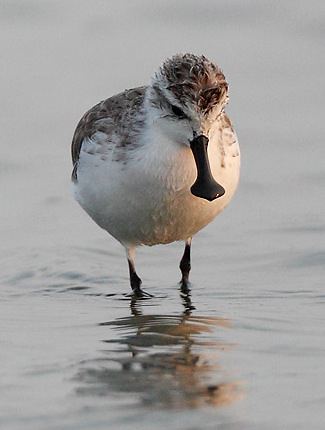
A superb image of a Spoon-billed Sandpiper taken by Michael McKee at Ban Pak Thale, Thailand.
- A chance of some of Asia’s and the world’s most spectacular localized birds including Siamese Fireback, Coral-billed Ground-cuckoo, Nicobar Pigeon, Malay Banded Pitta and Rail-babbler
- And shorebirds, not least Spoon-billed Sandpiper, Spotted Greenshank, White-faced Plover and, possibly, Asian Dowitcher
- Amongst a long list of fabulous South-East Asian birds including trogons, kingfishers, bee-eaters, barbets, broadbills, pittas, hornbills, leafbirds, babblers and sunbirds
- And enough other birds to see over 400
species in two weeks - As well as some beautiful primates including
White-handed Gibbon - In some fine forests with coral reefs offshore
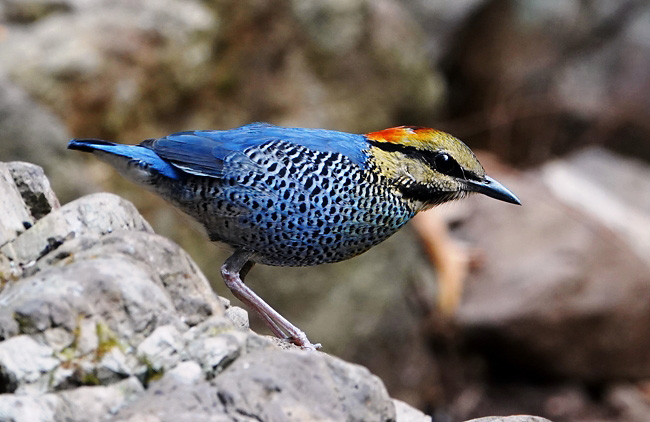
A Blue Pitta, from one of the hides at Kaeng Krachan NP, Thailand, by Mark Harper.
- Khao Nor Chuchi (Khao Pra Bang Khram WS) in Southern Thailand used to be the only place in the world where it was possible to see the rare Gurney's Pitta but there are very few of these birds left in Thailand now and seeing one is almost impossible. The species survives across the border in southern Myanmar (Burma) where it is now possible to visit in search of this famous bird. However, the last strongholds, lowland forest patches within the Lenya, Nga Wun and Parchan Reserved Forests, lie in yet another part of South-East Asia being rapidly deforested, mainly for oil palm cultivation. In 2016 researchers revisited 142 out of 147 locations where the pitta was recorded during 2003 to 2012 and found the bird in only 41 (29%) of the locations; in all other locations the forest was gone. Since 1999 suitable habitat had declined by 80%. Without habitat protection Gurney’s Pitta seems doomed.
- Northern Thailand is very different from the rest of the country. Mountain ranges support a more Himalayan avifauna and montane specialities at sites such as Doi Chiang Dao, Doi Ang Khang, Doi Inthanon and Doi Lang include Mrs Hume’s Pheasant and Giant Nuthatch, as well as Rufous-naped Pitta, Crested Finchbill, Scarlet-faced Liocichla and Spot-breasted Parrotbill. There is even a chance of Black-tailed Crake, Hodgson's Frogmouth (most likely in April) and Green Cochoa while other spectacular species present include Collared Falconet, Blossom-headed Parakeet, Black-headed Woodpecker, Long-tailed and Silver-breasted Broadbills, Rufous Treepie, Common Green Magpie, Slaty-bellied Tesia, Silver-eared Mesia, Pygmy Cupwing, Spot-winged Grosbeak, and Gould's and Green-tailed Sunbirds (endemic angkaensis subspecies on Doi Inthanon). Some birds, especially shy, skulking, ground-dwelling, forest birds are much easier to see than they once were thanks to the popularity of bird photography in East Asia; the photographers have set up 'feeding stations' where mealworms are provided. In the lowlands nearby it is possible to see the rare Green Peafowl at Huai Hong Khrai. December to March is the best time to visit, when resident species are joined by wintering birds from northeast Asia.
- This account deals mainly with the northern winter period (November-March). During October there is a spectacular passage of raptors down the east side of Southern Thailand involving at least 25 species and a quarter of a million birds, many of which may be seen at close range from several hills in the Chumphon area, especially Khao Dinsor, about 25 km northeast. Raptors include Black Baza (103,000 during the 2011 season and 68,848 on one day, 24th October, in 2016!), Pied Harrier, Chinese Goshawk and Grey-faced Buzzard, while other species include Brown-backed, Silver-backed and White-throated Needletails, and Blue-tailed, Blue-throated and Chestnut-headed Bee-eaters. During spring, mainly between mid-March and early April, over 50,000 raptors have been recorded heading north, mainly from Khao Promsri.
Best Birds and other wildlife in Southern Thailand
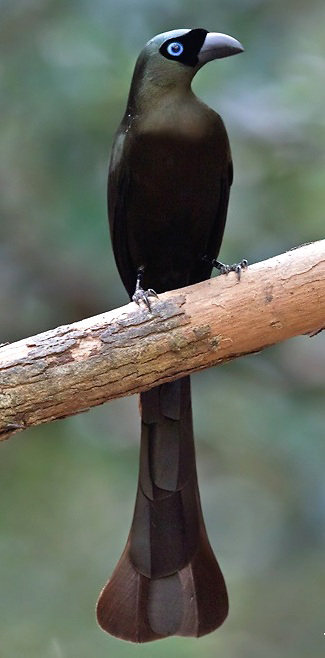
A small, slim, sleek Racquet-tailed Treepie at Kaeng Krachan by Lars Petersson.
Birds
Most of the birds listed are usually present during the northern winter.
Endemics 3 Siamese (Chestnut-headed) Partridge (southeast), Turquoise-throated (Blue-throated) Barbet (southern peninsula) and Rufous Limestone-babbler (Limestone Wren-babbler) (south-central).
Near-endemics
Thailand and Myanmar 5 Tickell’s Brown (Rusty-cheeked) Hornbill, Gurney’s Pitta (probably only Myanmar), White-headed Bulbul, Burmese Yuhina and Western Spectacled Barwing.
Thailand, Myanmar and Malay Peninsula 6 White-fronted Scops-owl, Plain-pouched Hornbill, Bamboo Woodpecker, Rufous-bellied (Red-rumped) Swallow, Olive Bulbul and Chestnut-winged Babbler.
Thailand, Myanmar, Malay Peninsula and Sumatra 3 Malay Brown Barbet, Malay Black Magpie and Buff-vented Bulbul.
Thailand and Malay Peninsula 2 Malay Peacock-pheasant and Malay Laughingthrush.
Thailand, Malay Peninsula and Sumatra 4 Fire-tufted Barbet, Malay Banded Pitta, Cinereous Bulbul and Marbled Wren-babbler.
Thailand and Cambodia 3 White-tailed (Davison’s) Leaf-warbler, Cambodian (White-tailed) Blue Robin and Cambodian (Fire-breasted) Flowerpecker.
Thailand, Cambodia, Laos and Vietnam 2 Coral-billed Ground-cuckoo and Mekong Wagtail.
Other specialities Siamese Fireback, Spoon-billed Sandpiper, Spotted (Nordmann's) Greenshank, Nicobar Pigeon, Brown-winged Kingfisher, Helmeted Hornbill, Streak-breasted Woodpecker, Blue, Blue-winged, Western Hooded and Mangrove Pittas, Large Wren-babbler and White-necked Babbler.
Also a chance of Great Argus, Grey Peacock-pheasant, Storm's Stork, Asian Dowitcher, White-fronted Scops-owl, Malay Honeyguide, Eared Pitta and Rail-babbler, and an outside chance of Black-faced Spoonbill, Masked Finfoot, and Austen's Brown, Tickell’s Brown and Plain-pouched Hornbills.
Others Red Junglefowl, Bar-backed and Green-legged (Scaly-breasted) Partridges, Siamese Fireback, Christmas and Lesser Frigatebirds, Chinese Egret, Chinese and Javan Pond-herons, Cinnamon and Yellow Bitterns, Asian Openbill, Brahminy Kite, White-bellied Sea-eagle, Grey-headed and Lesser Fish-eagles, Black and Rufous-bellied Eagles, Black-thighed Falconet, Ruddy-breasted Crake, Grey-headed Lapwing, Malay and White-faced Plovers, Bronze-winged and Pheasant-tailed Jacanas, Broad-billed, Marsh and Terek Sandpipers, Long-toed and Red-necked Stints, Black-naped, Bridled, Caspian and Greater Crested Terns, green-pigeons, Pied Imperial-pigeon, Red-breasted Parakeet, Vernal Hanging-parrot, Violet Cuckoo, malkohas, Asian Barred and Collared Owlets, Great Eared-nightjar, Grey-rumped and Whiskered Treeswifts, Brown-backed and Silver-backed Needletails, Diard's, Orange-breasted and Scarlet-rumped Trogons, Banded, Black-capped, Malay Blue-banded, Collared, Ruddy, Rufous-collared and White-breasted (Smyrna) Kingfishers, Blue-tailed, Chestnut-headed and Red-bearded Bee-eaters, Indochinese Roller, barbets, Bushy-crested, Great, Oriental Pied, White-crowned and Wreathed Hornbills, piculets, woodpeckers, Banded, Black-and-red, Black-and-yellow, Dusky, Green, Long-tailed and Silver-breasted Broadbills, Maroon-breasted and Rufous-winged Philentomas, Ashy Woodswallow, Brown-rumped and Rosy Minivets, Golden-bellied Gerygone (Flyeater), Mangrove Whistler, White-browed Shrike-babbler, orioles, Greater Racquet-tailed and Lesser Racquet-tailed Drongos, Black-naped Monarch, Asian Paradise-flycatcher, Crested Jay, Common Green, Racquet-tailed and Ratchet-tailed Magpies, bulbuls including Scaly-breasted, tailorbirds, leaf-warblers, Siberian Blue Robin, flycatchers including Hainan Blue, White-rumped Shama, Chestnut-naped Forktail, Sultan Tit, leafbirds, Asian Fairy-bluebird, many laughingthrushes including White-crested, many babblers, scimitar-babblers, wren-babblers, White-shouldered Starling, flowerpeckers, sunbirds and Little, Grey-breasted and Thick-billed Spiderhunters.
Also a chance of Kalij and Silver Pheasants, Painted Stork, Blyth’s and Wallace’s Hawk-eagles, Slaty-legged Crake, Far Eastern Curlew, Great Black-headed (Pallas's) Gull, Oriental Bay-owl, Barred Eagle-owl, Brown and Spotted Wood-owls, Buffy Fish-owl, Blyth's and Gould’s Frogmouths, Black-backed and Rufous-backed Dwarf-kingfishers, Rhinoceros Hornbill, Orange-headed Thrush and Temminck's Sunbird.
Mammals
White-handed Gibbon, Dusky Langur, Long-tailed (Crab-eating) and Pig-tailed Macaques, Sunda Flying Lemur (Colugo),
Irrawaddy Dolphin, Indian Giant Flying Squirrel, Black Giant Squirrel, (Common) Southern and Northern Tree Shrews, Sambar, Island and Lyle's
Flying Foxes, and Wrinkle-lipped Bat. Also a chance of Asian Elephant, Asiatic Black and Sun Bears, Gaur, Pileated Gibbon, Banded Langur, Slow Loris,
Malayan Porcupine, Leopard Cat, Lesser Mouse Deer, Yellow-throated Marten, Smooth-coated Otter, Red Giant Flying Squirrel and Finless Porpoise, and an
outside chance of Clouded Leopard.
Reptiles, Amphibians and Fish
Big water Monitors, flying lizards, Tockay Gecko, a chance of Reticulated Python, and,
offshore, numerous coral reef fish and a chance of flying fish, Whale Shark, Manta Ray, Blacktip Reef and Leopard Sharks, Sailfish, Black Marlin, and
Green and Hawksbill
Turtles.
Invertebrates
A rich diversity of butterflies including Common and Golden Birdwings, swordtails and Paris Peacock.
Best Sites for Birds and other wildlife in Southern Thailand
- Central
- Ban Pak Thale, Coast of Gulf of Thailand Spoon-billed Sandpiper, Spotted Greenshank and Black-capped Kingfisher. Also a chance of Painted Stork, Black-faced Spoonbill, Greater Painted-snipe, Asian Dowitcher and Far Eastern Curlew.
- Laem Pak Bia, Coast of Gulf of Thailand White-faced and Malay Plovers, gulls, terns, Black-capped Kingfisher and White-shouldered Starling. Also a chance of Chinese Egret and Great Black-headed Gull.
- Kaeng Krachan NP over 400 bird species recorded including Kalij Pheasant, Bar-backed and Green-legged Partridges (both from hides/screens overlooking pools where it is also possible to see other normally skulking birds such as Siberian Blue Robin, as well as Lesser Mouse Deer), Black-thighed Falconet, Collared Owlet, Orange-breasted and Red-headed Trogons, Red-bearded Bee-eater, Green-eared Barbet, Great and Wreathed Hornbills, woodpeckers including Great Slaty and Heart-spotted, Blue Pitta, Banded, Black-and-red, Black-and-yellow, Dusky, Long-tailed and Silver-breasted Broadbills, Common Green, Racquet-tailed and Ratchet-tailed Magpies, Crested Jay, Sultan Tit, babblers, Large Scimitar-babbler and Forest Wagtail, as well as White-handed Gibbon and Dusky Langur. Also an outside chance of Grey Peacock-pheasant, Slaty-legged Crake, Yellow-vented Green-pigeon and Tickell's Hornbill, as well as Clouded Leopard, Asian Elephant, Asiatic Black Bear, Banded Langur, Slow Loris, Malayan Porcupine, Reticulated Python.
- Khao Yai NP Coral-billed Ground-cuckoo, Red-breasted Parakeet, Brown-backed and Silver-backed Needletails, Orange-breasted and Red-headed Trogons, Green-eared Barbet, Blue Pitta, Banded, Dusky and Long-tailed Broadbills, Common Green Magpie, Hainan Blue-flycatcher, and Black-throated and White-crested Laughingthrushes, as well as White-handed Gibbon, a Wrinkle-lipped Bat roost and very popular organised night-drives for Slow Loris and Malayan Porcupine. Also a chance of Silver Pheasant, Siamese Fireback, Heart-spotted Woodpecker, and Eared and Western Hooded Pittas, as well as Asian Elephant, Gaur (Klong Pla Kaung at eastern edge of NP), Pileated Gibbon (and hybrid Pileated/White-handed Gibbons), Red Giant Flying Squirrel and Reticulated Python.
- Wat Pra Puttabath Noi Temple Rufous Limestone-babbler.
- South
- Pang Nga Mangrove Reserve near Krabi Brown-winged and Ruddy Kingfishers, and Mangrove Pitta. Also a chance of Chinese Egret and Spotted Greenshank.
- Khao Banthat near Krabi A chance of Blue-winged and Hooded Pittas.
- Similan Islands Nicobar Pigeon (Miang/Number 4 Island), White-bellied Sea-eagle, Black-naped and Bridled Terns, Green and Pied Imperial-pigeons, and Island Flying Fox. Also a chance of Whale Shark (Richelieu Rock) and Manta Ray.
- Phi Phi Islands Christmas and Lesser Frigatebirds (both roost on Koh Bida Nok), Black-naped and Bridled Terns, and Pied Imperial-pigeon. Also a chance of Blacktip Reef and Leopard Sharks, and Green and Hawksbill Turtles.
- Khao Nor Chuchi (Khao Pra Bang Khram WS) Not what it once was, the place to see Gurney's Pitta and lots of other great birds; now fragmented forest amongst palm oil plantations.
- Thale Noi Waterfowl Reserve waterbirds such as Chinese and Javan Pond-herons, and Bronze-winged and Pheasant-tailed Jacanas.
- Krung Ching, Khao Laung NP Numerous bird photographers queueing up with mobile hides mainly to photograph Rail-babbler. Other birds include Whiskered Treeswift, Orange-breasted and Scarlet-rumped Trogons, Banded and Rufous-collared Kingfishers, Red-bearded Bee-eater, Bushy-crested Hornbill, Malay Banded Pitta, Banded, Black-and-yellow and Green Broadbills, Maroon-breasted and Rufous-winged Philentomas, Crested Jay, Chestnut-naped Forktail, bulbuls including Scaly-breasted, and babblers. Also a chance of Wallace's Hawk-eagle, Brown Wood-owl and Diard's Trogon, as well as Slow Loris.
- Khao Sok Reservoir An outside chance of Storm's Stork, Asian Elephant, Gaur and Sun Bear.
- Khlong Saeng WS Grey-headed and Lesser Fish-eagles, Banded, Blue-banded and Rufous-collared Kingfishers, Red-bearded Bee-eater, Bushy-crested, Great, Helmeted, Oriental Pied, White-crowned and Wreathed Hornbills, Malay Banded and Western Hooded Pittas, and Black-and-red Broadbill. Also an outside chance of Oriental Bay-owl, Buffy Fish-owl, Asian Elephant, Gaur and White-handed Gibbon.
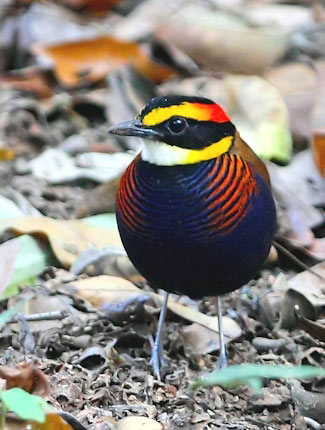
The superb Malay Banded Pitta, photographed at Khao Nor Chuchi by Roger Wyatt ('in the old days').
- Far South
- Sri Phang Nga NP Whiskered Treeswift, Orange-breasted Trogon, Blue-banded and Rufous-collared Kingfishers, Malay Banded, Blue-winged and Western Hooded Pittas, Green Broadbill, Chestnut-naped Forktail and babblers including Black-capped. Also a chance of Blyth's Frogmouth and numerous bird photographers.
- Ao Phang Nga NP Ruddy Kingfisher, Streak-breasted Woodpecker, Mangrove Pitta, White-chested Babbler and Brown-throated Sunbird.
- Hala-Bala Wildlife Research Station Whiskered Treeswift, Diard's and Scarlet-rumped Trogons, Malay Blue-banded and Rufous-collared Kingfishers, Red-bearded Bee-eater, Bushy-crested, Rhinoceros and White-crowned Hornbills, woodpeckers, Chestnut-naped Forktail, Sultan Tit, bulbuls including Finsch's and Scaly-breasted, babblers including White-necked, Large Wren-babbler and Chestnut-backed Scimitar-babbler. Also a chance of Great Argus, Malay Honeyguide, Silver-breasted Broadbill and Temminck's Sunbird.
- Yaring Mangrove Forest Mangrove Blue-flycatcher, Mangrove Whistler, Olive-winged Bulbul and Ashy Tailorbird.
- Ban Tha Kham Boat trips for Irrawaddy Dolphin. Also a chance of Finless Porpoise.
Best Times for Birds and other wildlife in Southern Thailand
December to February is usually the driest and coolest time of the year and the best time for birds which are winter visitors from northern Asia. During March to May some of these visitors are still present and some resident forest birds begin to call and sing at the start of their breeding seasons, including pittas and broadbills, but the majority of the resident forest birds, including many of the hardest to see, are at their most active during their breeding seasons which usually fall between June and August which is, unfortunately, during the rainy season.
Recommended Bird Books etc. for Southern Thailand
Birds of South-East Asia by C Robson. Helm, 2018. (Second Edition)
Birds of South-East Asia Concise Edition by C Robson. Helm, 2015.
Guide to the Birds of Thailand by B Lekagul, P Round et al. Saha Karn Bhaet Co Ltd, Thailand, 1991.
A Field Guide to the Mammals of South-East Asia by C M Francis. New Holland Publishers, 2008.
A Field Guide to the Reptiles of South-East Asia by I Das. Bloomsbury, 2015.
Where to watch birds in Asia by N Wheatley. Helm, 1996.
Don’t know which country/countries/regions to visit in Asia? Then it may be worth considering taking a look at this book, written by this website’s author. It is many years old of course but it still provides a starting point, an overview and a guiding light to the best birds and the best places to look for them in the region, and could save hours of searching for similar information on the internet. However, it is important to check more up-to-date sources for sites which have been opened up, sites and species which have been discovered, lodges that have been built etc. since the book was published.
Birding and Wildlife Trip Reports for Southern Thailand
Many trip reports, some for Southern Thailand, are posted on the websites listed here. On some of these websites some reports are independent and some are posted by tour companies who organize tours to Southern Thailand. These tour companies and others also post their own reports on their websites, which are listed under 'Some Organized Tours to Southern Thailand' below.
- The best website for trip reports is CloudBirders
- but these are also worth a look
- Birdtours
- Fatbirder
- Jon Hornbuckle
- Mammal Watching
Local bird and wildlife guides in Thailand
The costs of organized tours partly reflect the quality of the tour leaders. Some leaders are certainly better than others and many companies claim their leaders are the best but even the best rely at least to some extent on the exceptional skills of the local guides they employ. If you are travelling independently, employing such local guides will greatly increase your chances of seeing the wildlife you wish to see.
Accommodation for birders in Southern Thailand
Some Organized Tours for birds and other wildlife to Southern Thailand
There are many tour companies who organize tours to see mammals, birds, other wildlife and other natural wonders. The cost of these tours vary considerably according to such variables as the airlines used, the number of days the tours last, the number of sites visited, the number of people in the group (an important consideration if you wish to see such wildlife as rainforest mammals and birds), the number of tour leaders, the standard of accommodation and transport, and the percentage profit the company hopes to make. Generally, where the number of days tours last and the number of sites visited are similar, the cheapest tours are those that use the cheapest airlines, accommodation and local transport, that have the largest groups with the least number of leaders, and that make the least amount of profit. The most expensive tours tend to be those which are exceptionally long, use the most expensive accommodation (ridiculously lavish in some cases, even for single nights) and which make the most profit. Some tour costs partly reflect the quality of the tour leaders. Some leaders are certainly better than others and many companies claim their leaders are the best but even the best rely at least to some extent on the exceptional skills of the local guides they employ.
While tour companies organize tours with set itineraries many also organize custom tours for individuals and private groups who instead of taking a tour with a set itinerary want to follow their own itinerary to suit their own personal tastes, whether it be mammals, birds, other wildlife, other natural wonders or even man-made attractions, or a mixture of them all. Many organized tours with set itineraries are also fast-paced and target as many species as possible, whether they are mammals, birds or other wildlife or everything, which usually leaves little time to enjoy the best sites and individual species, but on a custom tour those taking part can specify the pace and the sites and species they wish to concentrate on. Custom tours also suit people who like to travel with people they already know, rather than with a group of strangers, and people with partners with different interests. Individuals and small groups will almost certainly have to pay more than the price of an organized tour with a set itinerary but a large group of friends may be able to travel for less than the price quoted for a set tour.
Tour companies who are running organized tours to Southern Thailand in the next couple of years include the following. Many of these also offer custom tours.
