
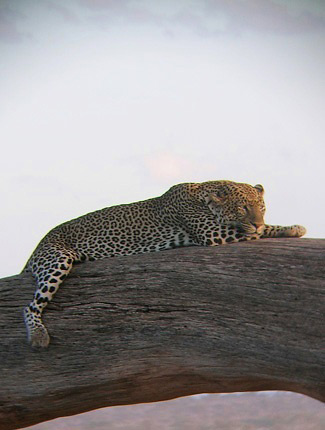
Leopard by Chris Townend.
- Lion, Leopard, Spotted Hyaena and, possibly, African Wild Dog
- As well as African Elephant, Giraffe, Hippopotamus and African Buffalo
- In South Luangwa National Park, one of the few places in Africa where walking safaris and nighttime spotlighting are allowed
- And a roost of millions of Straw-coloured Fruit Bats in Kasanka National Park
- Some of Africa's and the world's most spectacular birds including African Fish-eagle, Black Heron, Saddle-billed Stork, hornbills, Pennant-winged Nightjar and, possibly, Shoebill
- And some of Africa’s and the world’s most spectacular localized birds such as Black-cheeked Lovebird, African Pitta, Zambian Barbet and many Miombo woodland specialities
- And Victoria Falls, one of the top natural wonders of the world
- All in some truly wild places, notably South Luangwa National Park
- Zambia is probably best known in wildlife circles as a great place to see a wide range of Africa’s larger animals, especially in South Luangwa National Park which is most famous for being one of the best places in the world to go on walking safaris and/or see Leopards (the park is believed to support the highest naturally-occurring population of Leopards on the planet). Yet even the vast majority of people who have been to South Luangwa probably don’t know that a little more than a hundred kilometres away it is possible to see one of the world’s greatest wildlife spectacles. Every year, from the end of October to mid-December, up to eight million Straw-coloured Fruit Bats arrive from the Congo region of West Africa to feed on the seasonal fruits in Kasanka National Park. It is the world's largest mammal migration, bigger even than the much more famous wildebeest migration of East Africa. The large yellowish bats which have a wingspan of up to 75 cm roost in a small area of Mushitu swamp forest, a single hectare of which may support as many as five million! They swarm all over the trees and so many have settled to roost under single branches at times that the branches have broken under the sheer weight of so many animals. Visitors can take guided walks through the forest during the day to view the bats as they chatter, fly and crawl about their roosts but the real spectacle occurs during the African sunset. Then they take to the air, filling the darkening sky in all directions for up to twenty minutes, as they disperse over many square kilometres of Miombo woodland in search of a wide variety of fruits. Visitors can watch this explosion of life from the Fibwe Hide which is situated 18 metres up a massive mahogany tree, a short walk from the lakeside Wasa Lodge. Carefully positioned to allow visitors to observe the rare Sitatunga antelope in the swamp below it also provides the perfect vantage point to watch the bats.
- Many localized bird species occur in the Mwinilunga area of far northwest Zambia including Angola Lark, Grimwood's Longclaw, Black-and-rufous Swallow, Bocage's Weaver and Locust Finch on the Chitunta Plain, and Bar-winged Weaver in Luakera Forest, and, farther afield, Fulleborn's Longclaw, Black-collared Bulbul and Bannerman's Sunbird occur in Nchila Wildlife Reserve.
- Many tour companies combine Zambia, especially South Luangwa National Park, with neighbouring Malawi where the many localized birds include Pel’s Fishing-owl, African Skimmer, Boehm’s Bee-eater, Racket-tailed Roller, Blue Swallow and White-winged Apalis.
Best Birds and other wildlife in Zambia
Birds
Endemics 3 White-chested (Yellow-rumped) Tinkerbird (small range in northwest), Zambian (Chaplin’s) Barbet and Black-cheeked Lovebird.
Near-endemics
Zambia and Tanzania 1 Tanzanian Masked Weaver.
Zambia, Tanzania and Malawi 10 Dark Batis, Fulleborn’s Boubou, Chapin’s Apalis, Black-lored Cisticola, Sharpe’s (Yellow-streaked) Greenbul, Rusty-flanked (Olive-flanked) Robin-chat, Sharpe’s Akalat, Whyte’s (Ludwig’s/Montane) Double-collared Sunbird, Montane (Buff-shouldered) Widowbird and Yellow-browed Seedeater.
Zambia, Tanzania and Angola 1 Oustalet’s Sunbird.
Zambia, Tanzania, Malawi and Mozambique 6 Black-browed Mountain Greenbul, White-chested Alethe, Forest Double-collared Sunbird, Bertram’s Weaver, Olive-headed Weaver and Vincent’s (Cape) Bunting.
Zambia, Malawi and Mozambique 1 Malawi (Cape) Batis.
Zambia, Malawi and Democratic Republic of Congo (DRC) 1 Whyte’s (Shelley’s) Francolin.
Zambia and DRC 2 Zambian (Papyrus) Yellow Warbler and Katanga Masked Weaver.
Zambia, DRC and Angola 7 Margaret’s (Boulton’s) Batis, Dambo (Cloud-scraping) Cisticola, Black-and-rufous Swallow, Bannerman’s Sunbird, Bocage’s Weaver, Bar-winged Weaver and Grimwood’s Longclaw.
Other specialities Nyasa (Lilian's) Lovebird, Boehm's Bee-eater, Racket-tailed Roller, African Pitta (mostly Dec-Jan), Black-necked Eremomela, Livingstone’s Flycatcher, Bocage's Akalat, Hartlaub's Babbler, Anchieta's Sunbird and Chestnut-backed Sparrow-weaver. Also a chance of Shoebill (especially in May), Chestnut-headed and Red-chested Flufftails, Bronze-winged Courser and Locust Finch.
Others African Pygmy Goose, Helmeted Guineafowl, Great White Pelican, African Darter, Black and Rufous-bellied Herons, Dwarf Bittern (mostly Nov-Mar), Hamerkop, African Spoonbill, Saddle-billed Stork, vultures including Lappet-faced, African Fish-eagle, Bateleur, African Crowned, Long-crested and Martial Eagles, Allen’s Gallinule, Grey Crowned Crane, White-headed Lapwing, Blacksmith Plover, African Jacana, Rock Pratincole, Heuglin’s Courser, African Skimmer (mostly Nov-Mar), Ross’s and Schalow’s Turacos, Grey Go-away-bird, cuckoos including African Emerald, Coppery-tailed Coucal, owls including Verreaux's Eagle-owl, Pennant-winged Nightjar (mostly Sep-Mar), mousebirds, Narina Trogon, kingfishers including Brown-hooded, Half-collared and Giant, bee-eaters including Southern Carmine (usually at colonies Oct-Nov), Lilac-breasted Roller, African Hoopoe, Green Woodhoopoe, hornbills, Southern Ground-hornbill, barbets, honeyguides including Brown-backed Honeybird, woodpeckers, African Broadbill, Chin-spot Batis, Retz’s and White-crested Helmetshrikes, Grey-headed and Sulphur-breasted Bushshrikes, Magpie and Souza’s Shrikes, orioles, African Paradise-flycatcher, Eastern Nicator, African Spotted Creeper, greenbuls, Southern and Yellow-bellied Hyliotas, Collared Flycatcher (mostly Nov-Mar), Arnot’s Chat, Collared Palm-thrush, Groundscraper Thrush, Miombo Rock-thrush, starlings including Meves’s Glossy, Red-billed and Yellow-billed Oxpeckers, sunbirds, Rosy-breasted and Yellow-throated Longclaws, weavers, Cuckoo-finch, bishops, widowbirds, waxbills, Peters’s Twinspot and Golden-breasted Bunting. Also a chance of Goliath Heron, African Finfoot, Lesser Jacana, Pel’s Fishing-owl and Swallow-tailed Bee-eater.
Mammals
Lion, Leopard, Spotted Hyaena, African Elephant, Giraffe, Hippopotamus, African Buffalo, Straw-coloured Fruit
Bat (mostly Nov-Dec), Burchell's Zebra, Blue Wildebeest, Chacma and Yellow Baboons, Eland, Greater Kudu, Waterbuck, Topi, (Lichtenstein’s) Hartebeest,
Impala, Sitatunga, (Black) Lechwe, Puku, Greater Galago (Bushbaby), Large Spotted (Blotched) Genet and Four-toed Elephant Shrew. Also a chance of
African Wild Dog (mostly Apr-May), Cheetah, (Red) Lechwe, Roan, Sable, South African Porcupine and Honey Badger.
Reptiles, Amphibians and Fish
Nile Crocodile.
Other Natural Wonders in Zambia
Victoria Falls
In the local language these falls are known as mosi-oa-tunya which in English means ‘smoke that thunders’.
These spectacular falls which can be seen close up are 108 m (360 ft) high and 1.7 km (1.1 mile) wide, making them the highest of the ‘big three’
(with Niagara and Iguassu Falls). The amount of water varies considerably from season to season with the most usually occurring between February and May,
peaking in April, though sometimes as late as July.
Best Sites for Birds and other wildlife in Zambia
- Victoria Falls Area Black-cheeked Lovebird (Machile River), Black Heron, African Crowned Eagle, White-headed Lapwing, Rock Pratincole, Schalow’s Turaco, African Black Swift, Giant Kingfisher, Southern Carmine Bee-eater and Red-winged Starling. Also a chance of Red-chested Flufftail, Pel’s Fishing-owl, African Pygmy Goose, African Finfoot and Swallow-tailed Bee-eater.
- Nkanga River Conservation Area Zambian Barbet (Choma, near Masuku Lodge), Pennant-winged Nightjar, Heuglin’s Courser, Schalow’s Turaco and Racket-tailed Roller. Also a chance of Lesser Jacana.
- Kafue NP Tree-climbing Lions, Red Lechwe, Roan and Sable. Also a chance of African Wild Dog, Cheetah, Leopard, Lichtenstein's Hartebeest and Greater Kudu.
- Siavonga Area African Pitta, Bohm’s Spinetail, Livingstone’s Flycatcher, Collared Palm-thrush and Peters’s Twinspot.
- Lower Zambezi NP Almost as good for Leopards as South Luangwa NP.
- South Luangwa NP Many mammals including a large population of Leopards (most likely Jun-Oct), Lions (which can be tracked on foot) and a chance of African Wild Dog, as well as Nile Crocodile, Saddle-billed Stork, Southern Carmine Bee-eater colonies, Black Heron, Martial Eagle, Dwarf Bittern, White-headed Lapwing, African Skimmer and Nyasa Lovebird. Also a chance of Bronze-winged and Heuglin's Coursers, and Pel’s Fishing-owl.
- Kasanka NP Straw-coloured Fruit Bats (mostly Nov), African Elephant, Hippopotamus, Sitatunga, Pennant-winged Nightjar, Boehm’s Bee-eater and Racket-tailed Roller. Also a chance of Sable, Lichtenstein's Hartebeest, Pel’s Fishing-owl, African Pygmy Goose, Pale-billed Hornbill and Locust Finch.
- Bangweulu Wetlands Black Lechwe, Sitatunga and Blue-breasted Bee-eater. Also a chance of Shoebill.
- Mutinondo Area Anchieta's Sunbird and Bar-winged Weaver. Also a chance of Chestnut-headed Flufftail.
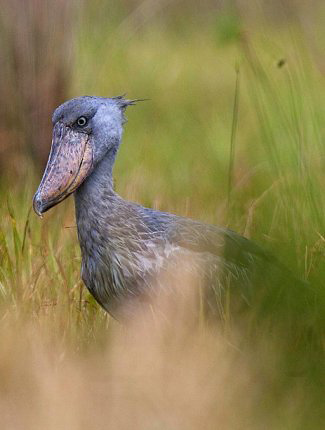
A stately Shoebill by Francesco Veronesi.
Best Times for Birds and other wildlife in Zambia
The dry season usually lasts from June to October. At the end of this period many birds and mammals congregate around the remaining areas of water, making them easier to find. Southern Carmine Bee-eaters usually begin nesting in September and can be seen at their colonies in October and November. Millions of Straw-coloured Fruit Bats usually arrive in Kasanka NP at the beginning of the wet season with numbers peaking in November. The wet usually lasts from November to April, usually peaking January to March, and this is the best time to track down African Pitta, especially December-January. The end of the wet season, in April-May, when water levels are usually at their highest and the country is at its greenest, is the best time to look for African Wild Dogs in Kafue and South Luangwa National Parks, and Shoebill and Black Lechwe in Bangweulu Wetlands.
Recommended Bird Books etc. for Zambia
SASOL Birds of Southern Africa by I Sinclair et al. C Struik, 2020 (Fifth Edition).
Birds of Africa south of the Sahara by I Sinclair and P Ryan. C Struik, 2011 (Second Edition).
Newman's Birds by Colour by K Newman. C Struik, 2011 (Third Edition).
Newman's Birds of Southern Africa by K and V Newman. C Struik, 2010 (Tenth Edition).
Roberts Bird Guide edited by H Chittenden. Africa Geographic, 2007.
Southern African Birdfinder by C Cohen and C Spottiswoode. New Holland Publishers, 2005.
The Birds of Zambia by R J Dowsett et al. Tauraco Press, 2008.
Stuarts' Field Guide to Mammals of Southern Africa by C and M Stuart. Random House Struik, 2015 (Revised Edition).
The Kingdon Field Guide to African Mammals by J Kingdon. Bloomsbury, 2015 (Second Revised Edition).
The Kingdon Pocket Guide to African Mammals by J Kingdon. Bloomsbury, 2016 (Second Edition).
Apps etc.
eGuide to Mammals of Southern Africa
Kingdon eGuide to African Mammals.
Audubon African Wildlife.
SASOL eBirds of Southern Africa.
Newman's Birds of Southern Africa.
Roberts Multimedia Birds of Southern Africa.
Where to watch birds in Africa by N Wheatley. Helm, 1995.
Don’t know which country/countries to visit in Africa? Then it may be worth considering taking a look at this book, written by this website’s author. It is many years old of course but it still provides a starting point, an overview and a guiding light to the best birds and the best places to look for them on the continent, and could save hours of searching for similar information on the internet. However, it is important to check more up-to-date sources for sites which have been opened up, sites and species which have been discovered, lodges that have been built etc. since the book was published.
Birding and Wildlife Trip Reports for Zambia
Many trip reports, some for Zambia, are posted on the websites listed here. On some of these websites some reports are independent and some are posted by tour companies who organize tours to Zambia. These tour companies and others also post their own reports on their websites, which are listed under 'Some Organized Tours to Zambia' below.
- The best website for trip reports is CloudBirders
- but these are also worth a look
- Birdtours
- Fatbirder
- Jon Hornbuckle
- Mammal Watching
Local bird and wildlife guides and Tours in Zambia
The costs of organized tours partly reflect the quality of the tour leaders. Some leaders are certainly better than others and many companies claim their leaders are the best but even the best rely at least to some extent on the exceptional skills of the local guides they employ. If you are travelling independently, employing such local guides will greatly increase your chances of seeing the wildlife you wish to see.
- Kasanka Trust Ltd
- A non-profit charitable institution responsible for park management, community development and tourism, the trust operates two lodges and two campsites in Kasanka NP as well as Shoebill Island Camp in the adjacent Bangweulu Wetlands. It also arranges tours to Kasanka, Bangweulu, Shiwa Ngandu, North and South Luangwa, and beyond.
Accommodation for birders in Zambia
- Kasanka Trust Ltd
- A non-profit charitable institution responsible for park management, community development and tourism, the trust operates two lodges and two campsites in Kasanka NP as well as Shoebill Island Camp in the adjacent Bangweulu Wetlands. It also arranges tours to Kasanka, Bangweulu, Shiwa Ngandu, North and South Luangwa, and beyond.
Some Organized Tours for birds and other wildlife to Zambia
There are many tour companies who organize tours to see mammals, birds, other wildlife and other natural wonders. The cost of these tours vary considerably according to such variables as the airlines used, the number of days the tours last, the number of sites visited, the number of people in the group (an important consideration if you wish to see such wildlife as rainforest mammals and birds), the number of tour leaders, the standard of accommodation and transport, and the percentage profit the company hopes to make. Generally, where the number of days tours last and the number of sites visited are similar, the cheapest tours are those that use the cheapest airlines, accommodation and local transport, that have the largest groups with the least number of leaders, and that make the least amount of profit. The most expensive tours tend to be those which are exceptionally long, use the most expensive accommodation (ridiculously lavish in some cases, even for single nights) and which make the most profit. Some tour costs partly reflect the quality of the tour leaders. Some leaders are certainly better than others and many companies claim their leaders are the best but even the best rely at least to some extent on the exceptional skills of the local guides they employ.
While tour companies organize tours with set itineraries many also organize custom tours for individuals and private groups who instead of taking a tour with a set itinerary want to follow their own itinerary to suit their own personal tastes, whether it be mammals, birds, other wildlife, other natural wonders or even man-made attractions, or a mixture of them all. Many organized tours with set itineraries are also fast-paced and target as many species as possible, whether they are mammals, birds or other wildlife or everything, which usually leaves little time to enjoy the best sites and individual species, but on a custom tour those taking part can specify the pace and the sites and species they wish to concentrate on. Custom tours also suit people who like to travel with people they already know, rather than with a group of strangers, and they are popular with people with partners with different interests. Individuals, partners and small groups will almost certainly have to pay more for a custom tour than an organized tour with a set itinerary but a large group of friends may be able to travel for less than the price quoted for a set tour.
Tour companies who run organized tours to Zambia include the following. Many of these also offer custom tours.
