
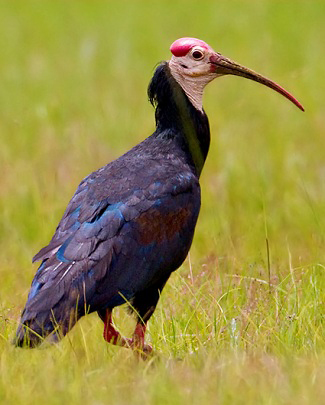
The odd-looking Southern Bald Ibis near Witsieshoek Mountain Lodge by Dubi Shapiro.
- About 26 of the 38 birds endemic to South Africa, Lesotho and Eswatini including Southern Bald Ibis, Blue Bustard, Knysna Turaco, Drakensberg Rockjumper and Buff-streaked Chat
- Some of the 140-150 species endemic to Southern Africa such as Bokmakierie, Fairy Flycatcher, Rudd's Apalis and Gurney's Sugarbird
- Other spectacular localized birds including Wattled Crane, Taita Falcon and Blue Swallow
- And more widespread spectacular birds such ass Common Ostrich, Black Heron,
Saddle-billed Stork, African Fish-eagle,
Lammergeier and Kori Bustard - As well as many classic African mammals including Lion, Leopard, Cheetah, African Elephant, Giraffe, White and Black Rhinoceroses, Spotted Hyaena and Meerkat
- With a chance of African Wild Dog and some nocturnal mammals on night drives which are allowed in most private reserves
- With, along the coast and offshore, nesting turtles, Whale Shark, Manta Ray and the Sardine Run
- All in some superb settings, from the ocean to the Drakensberg Mountains
- It is not possible to cover every major site in Eastern South Africa well during a couple of weeks so it may be worth considering at least two visits to this part of the world. On the other hand visitors with plenty of time may even wish to consider extending their trip to Western South Africa where it is possible to see Southern Right Whale, African (Jackass) Penguin, Black Harrier, Cape Rockjumper, Cape Sugarbird, Orange-breasted Sunbird, a wide variety of seabirds including albatrosses and one of the finest wild flower displays in the world. Some tour companies even combine the best of Eastern and Western South Africa in single tours.
- Part of Eastern South Africa also lies next to Mozambique where it is possible to swim with Manta Rays and Whale Sharks, as well as numerous other fish on some of the most pristine coral reefs in the world, and see such spectacular birds as Great Frigatebird, Pennant-winged Nightjar, Crab Plover, African Pitta, Green-headed Oriole and White-winged Apalis.
- Many of Eastern (and Western) South Africa's National Parks, and Private 'Game Parks and Reserves' are surrounded by high fences and, to a varying extent, 'stocked' with reintroduced 'wild animals', bred in captivity, for people to see or people to shoot. The numbers of each 'wild animal' may also be very carefully 'controlled'. Some people think this is the right way to go about things and argue that the money from tourism funds the conservation of the 'wild animals', some think there has to be a better way.
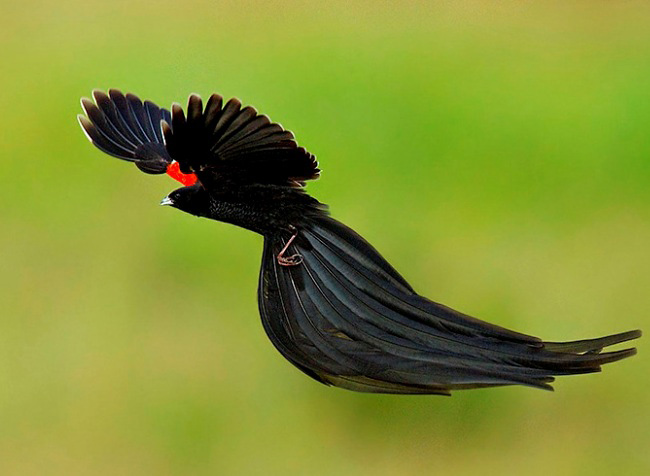
Long-tailed Widowbird at Wakkerstroom by Dubi Shapiro.
Best Birds and other wildlife in Eastern South Africa
Birds
South Africa Endemics 6 out of 18 Forest Buzzard, Knysna Woodpecker, Cape Parrot, Rudd’s Lark, Botha’s Lark and Knysna Warbler.
South Africa, Lesotho and Eswatini (formerly Swaziland) Endemics 20 Grey-winged Francolin, Blue Bustard (not Eswatini), Knysna Turaco (not Lesotho), Southern Bald Ibis, Ground Woodpecker, Southern Crested-flycatcher (not Lesotho), Drakensberg Rockjumper (not Eswatini), Eastern Long-billed Lark, Drakensberg Prinia (not Lesotho), Bush Blackcap (not Lesotho), African Pied Starling, Chorister Robin-chat, Sentinel Rock-thrush, Cape Rock-thrush, Buff-streaked Chat, Greater Double-collared Sunbird, Yellow-tufted Pipit, Yellow-breasted Pipit (not Eswatini), Forest Canary and Drakensberg Siskin (not Eswatini).
Near-endemics
South Africa and Botswana 1 Short-clawed Lark.
South Africa, Botswana and Mozambique 2 Cape White-eye and Fiscal Flycatcher.
South Africa, Botswana, Mozambique and Zimbabwe 1 Cape (Orange-throated) Longclaw.
South Africa and Mozambique 5 Southern Tchagra, Brown Scrub-robin, Sentinel Rock-thrush, Neergaard’s Sunbird and Pink-throated Twinspot.
South Africa, Mozambique and Malawi 1 Rudd’s Apalis.
South Africa, Mozambique, Malawi and Zimbabwe 1 Lemon-breasted Canary (Seedeater).
South Africa, Mozambique and Zimbabwe 5 Cape Grassbird, Barratt’s Warbler, Gurney’s Sugarbird, Swee Waxbill and Cape Canary.
South Africa and Zimbabwe 1 Melodious (Latakoo) Lark.
Other specialities (including some of the 150 or so species endemic to Southern Africa)
Northern Black Bustard (White-quilled Korhaan), Cape Vulture, Taita Falcon, Blue and Wattled Cranes, Eastern Bronze-naped Pigeon, Woodward's Batis, Blue
Swallow (mostly Oct-Mar), Bokmakierie, Fairy Flycatcher, Spotted Ground-thrush, Malachite Sunbird, Mountain Pipit, Long-tailed Widowbird and Cape Weaver.
Also a chance of Buff-spotted Flufftail, Bronze-winged Courser, Black-winged Lapwing and Pel's Fishing-owl.
Others
Common Ostrich, Orange River Francolin, Crested Guineafowl, Black and Goliath Herons, Hamerkop, Saddle-billed Stork, Great White and Pink-backed Pelicans,
African Darter, vultures, Lammergeier, Bateleur, African Fish-eagle, African Crowned, Martial, Tawny and Verreaux's Eagles, Black Crake, bustards including
Kori, Grey Crowned Crane, Spotted Thick-knee, White-headed Lapwing, African and Lesser Jacanas, Purple-crested Turaco, Whistling Yellowbill, owls including
African Grass-owl, Narina Trogon, kingfishers including Giant, White-fronted Bee-eater, Lilac-breasted Roller, hornbills, Southern Ground-hornbill, Green
Barbet, African Broadbill, batises, Retz's and White-crested Helmetshrikes, Gorgeous, Grey-headed and Sulphur-breasted Bushshrikes, Crimson-breasted
Gonolek, Magpie Shrike, larks, Yellow-throated Woodland-warbler, robin-chats, White-starred Robin, scrub-robins, Orange Ground-thrush, starlings,
Red-billed Oxpecker, Scaly-fronted Weaver and waxbills. Also a chance of Lesser and Greater Flamingos, Secretary Bird and Greater Painted-snipe.
Mammals
Lion, Leopard, Cheetah, African Elephant, Giraffe, Hippopotamus,
White and Black Rhinoceroses, Spotted Hyaena, Burchell's Zebra, Blue and Black Wildebeests, African Buffalo,
Chacma Baboon, Blue and Vervet Monkeys, Meerkat, Bat-eared Fox, Spring Hare, Eland, Greater Kudu, Nyala,
Waterbuck, Topi (Tsessebe), Blesbok, Impala, Klipspringer, Humpback Whale (mostly Jun-Oct), and Bottlenose
and Common Dolphins. Also a chance of African Wild Dog, Caracal, Serval, Brown Hyaena, Aardvark, Aardwolf,
South African Crested Porcupine, Sable, and Killer and Southern Rights Whales, and an outside chance of
Temminck's Ground Pangolin.
Reptiles, Amphibians and Fish
Nile Crocodile, Sardine Run (vast, elusive, shoals
of fish/baitballs which usually occur offshore from May to July, especially late June to mid-July, and attract
a wide range of predators including whales and dolphins), Whale (mostly Dec-Mar), Tiger and Ragged-tooth
(mostly Jun-Nov) Sharks, Manta Ray, Sailfish, and Leatherback and Loggerhead Turtles (both mostly Nov-Feb,
laying eggs in Feb).
Plants
The Drakensberg Mountains are a World Centre for Plant Diversity, where
there are over 2200 species, of which about 400 are endemic. They include orchids, proteas and 'red hot
pokers'.
Best Sites for Birds and other wildlife in Eastern South Africa
- Suikerbosrand NR, near Johannesburg Orange River Francolin and African Grass-owl.
- Madikwe GR, near border with Botswana Lion, Cheetah, White Rhinoceros, Eland and Greater Kudu. Also a chance of African Wild Dog, Brown Hyaena and Aardwolf.
- Mapungubwe NP White and Black Rhinoceroses. Also a chance of African Wild Dog and Pel's Fishing-owl.
- Venetia Limpopo Reserve A chance of African Wild Dog.
- Kruger NP Lion, Leopard, Cheetah, African Elephant, Giraffe, Hippopotamus, White Rhinoceros, Spotted Hyaena, Blue Wildebeest, Spring Hare, Nile Crocodile, 500 bird species including Common Ostrich, Saddle-billed Stork, Kori Bustard, Temminck's Courser, Senegal and White-headed Lapwings, Purple-crested Turaco, Southern Ground-hornbill and Retz's Helmetshrike. Also a chance of African Wild Dog, Caracal, Serval, Black Rhinoceros, Sable, South African Crested Porcupine, Secretary Bird, Bronze-winged Courser, Pel's Fishing-owl and Giant Kingfisher, and an outside chance of Temminck's Ground Pangolin.
- Sabi Sands GR Lion, Leopard, Cheetah, African Elephant, White Rhinoceros and Spring Hare. Also a chance of Caracal, Serval, Brown Hyaena, Aardvark and South African Crested Porcupine.
- J G Strijdom Tunnel Taita Falcon.
- Woodbush Forest A chance of Cape Parrot and Orange Ground-thrush.
- Polokwane GR Common Ostrich, Cape Vulture, Northern Black Bustard, Short-clawed Lark, Short-toed Rock-thrush, Crimson-breasted Gonolek, Magpie Shrike, Burnt-neck Eremomela, Ashy Tit, Great Sparrow, and Red-headed Finch and Scaly-fronted Weaver. Also a chance of Burchell's Sandgrouse.
- Dullstroom A chance of Blue, Grey Crowned and Wattled Cranes, Buff-streaked Chat and Yellow-breasted Pipit.
- Wakkerstroom Meerkat, Southern Bald Ibis, Grey-winged and Red-winged Francolins, Blue Bustard, Blue and Grey Crowned Cranes, Botha's and Rudd's Larks, Fairy Flycatcher, Buff-streaked Chat, Cape Longclaw, Yellow-breasted Pipit and Long-tailed Widowbird. Also a chance of Secretary Bird, Denham's Bustard and Black-winged Lapwing.
- Chrissiesmeer A chance of Lesser and Greater Flamingos, Blue Crane, Black Heron, Chestnut-banded Plover and Greater Painted-snipe.
- Malolotje NR (Swaziland) Blue Swallow, Buff-streaked Chat and Malachite Sunbird. Also a chance of Gurney's Sugarbird.
- Tembe Elephant Reserve African Elephant, Giraffe, White Rhinoceros, Narina Trogon, Rudd's Apalis and Pink-throated Twinspot. Also a chance of Black Rhinoceros.
- Mkhuze (Mkuzi) GR Giraffe, Hippopotamus, White Rhinoceros, Nile Crocodile, African Broadbill, White-crested Helmetshrike, Gorgeous Bushshrike, Rudd's Apalis, Neergaard's Sunbird and Pink-throated Twinspot. Also a chance of Leopard, Black Rhinoceros, Greater Flamingo and Black Heron.
- Hluhluwe-Umfolozi GR Giraffe, White Rhinoceros, Southern Ground-hornbill and Gorgeous Bushshrike. Also a chance of African Wild Dog, Lion, Leopard, Cheetah, African Elephant, Black Rhinoceros and Spotted Hyaena.
- Ongoye Forest Green Barbet and Yellow-throated Woodland-warbler.
- Xumeni Forest Cape Parrot, Knysna Turaco and Orange Ground-thrush.
- Rocktail Bay Whale Shark, Humpback Whale, Woodward's Batis and Gorgeous Bushshrike. Also a chance of Buff-spotted Flufftail, and Leatherback and Loggerhead Turtles.
- Sodwana Bay Whale Shark, Humpback Whale, and Leatherback and Loggerhead Turtles.
- St Lucia Area Hippopotamus, White Rhinoceros (Cape Vidal GR), Nile Crocodile, Denham's Bustard (Cape Vidal GR), Lesser Jacana, Greater Painted-snipe, Whistling Yellowbill, Woodward's Batis (Cape Vidal GR campsite), Brown Scrub-robin (Cape Vidal GR campsite) and Rudd's Apalis. Also a chance of Greater Flamingo and Southern Banded Snake-eagle.
- Phinda GR African Elephant, Nile Crocodile, and Leatherback and Loggerhead Turtles. Also a chance of Lion, Leopard and Black Rhinoceros.
- Dlinze (Dhlinza) FR, Eshowe African Crowned Eagle, Eastern Bronze-naped Pigeon, Narina Trogon, Chorister Robin-chat and Spotted Ground-thrush.
- Amatikulu Reserve A chance of Whistling Yellowbill and Grey Waxbill.
- Mount Moreland Reedbed (La Mercy Airport) Barn Swallow roosting site, where up to five million may be present.
- Marutswa Cape Parrot, Yellow-throated Woodland-warbler, Bush Blackcap, White-starred Robin and Orange Ground-thrush. Also a chance of Buff-spotted Flufftail.
- Karkloof Conservation Centre Wattled Crane.
- Drakensberg (Himeville to Sani Pass into Lesotho) Black Wildebeest, Blesbok, Wattled Crane, Lammergeier, Cape Vulture, Southern Bald Ibis, Verreaux's Eagle, Giant Kingfisher, Ground Woodpecker, Fairy Flycatcher, Buff-streaked Chat, Drakensberg Rockjumper, Gurney's Sugarbird, Malachite Sunbird, Yellow-breasted Pipit, Drakensberg Siskin and a world centre for plant diversity. Also a chance of Secretary Bird, Buff-spotted Flufftail and Black-winged Lapwing.
- Giants Castle NR To book time at the 'vulture restaurant' where it is possible to see Lammergeier and Cape Vulture, as well as Jackal Buzzard and Lanner Falcon, contact KZN (Kwazulu Natal) Wildlife.
- Weza Blue Swallow.
- Oribi Gorge African Crowned Eagle, Knysna Turaco, Narina Trogon, Yellow-throated Woodland-warbler and White-starred Robin.
- Offshore
- Aliwal Shoal Scuba-diving for Tiger and Ragged-tooth Sharks, and Manta Ray. Also a chance of Humpback Whale and Bottlenose Dolphin.
- Protea Banks Scuba-diving for Ragged-tooth Shark.
- Sardine Run This vast shoal of fish attracts predatory billfish such as Sailfish, as well as whales, dolphins, fur seals, sharks and seabirds.
Best Times for Birds and other wildlife in Eastern Southern Africa
The best time to visit is August to November, especially October during the southern spring when many resident birds begin to breed and are therefore more active, and by which time it is usually so dry (and hot and humid unfortunately) that many mammals concentrate around remaining waters, making them easier to see. The dry season usually lasts from June to October and the peak wet season from November to March, although January-February is at the height of the South African summer and therefore the best time to observe the extraordinary variety of flowering plants in the Drakensberg, especially during the second half of January. The peak time for the Sardine Run is usually late June-early July.
Recommended Bird Books etc. for Eastern South Africa
Travellers' Wildlife Guides: Southern Africa by B Branch et al. Interlink Books, 2013.
Bradt Travel Guide: Southern African Wildlife by M Unwin. Bradt, 2011 (Second Edition).
Watching Wildlife: Southern Africa by M D Firestone et al. Lonely Planet, 2009 (Second Edition).
Stuarts' Field Guide to Mammals of Southern Africa by C and M Stuart. Random House Struik, 2015 (Revised Edition).
The Kingdon Field Guide to African Mammals by J Kingdon. Bloomsbury, 2015 (Second Revised Edition).
The Kingdon Pocket Guide to African Mammals by J Kingdon. Bloomsbury, 2016 (Second Edition).
SASOL Birds of Southern Africa by I Sinclair et al. C Struik, 2020 (Fifth Edition).
Birds of Africa south of the Sahara by I Sinclair and P Ryan. C Struik, 2011 (Second Edition).
Newman's Birds by Colour by K Newman. C Struik, 2011 (Third Edition).
Newman's Birds of Southern Africa by K and V Newman. C Struik, 2010 (Tenth Edition).
Roberts Bird Guide edited by H Chittenden. Africa Geographic, 2007.
Southern African Birdfinder by C Cohen and C Spottiswoode. New Holland Publishers, 2005.
The Chamberlain Guide to Birding Gauteng (the Johannesburg and Pretoria region) by E Marais and F Peacock. Mirafra Publishing, 2008.
Field Guide to Butterflies of South Africa by S Woodhall. C Struik, 2005.
Photo Guide to the Wildflowers of South Africa by J Manning. Briza Publications, 2012 (Revised Edition).
Apps etc.
eGuide to Mammals of Southern Africa
The Kingdon Guide to African Mammals.
Audubon African Wildlife.
SASOL eBirds of Southern Africa.
Newman's Birds of Southern Africa.
Roberts Multimedia Birds of Southern Africa.
Where to watch birds in Africa by N Wheatley. Helm, 1995.
Don’t know which country/countries to visit in Africa? Then it may be worth considering taking a look at this book, written by this website’s author. It is many years old of course but it still provides a starting point, an overview and a guiding light to the best birds and the best places to look for them on the continent, and could save hours of searching for similar information on the internet. However, it is important to check more up-to-date sources for sites which have been opened up, sites and species which have been discovered, lodges that have been built etc. since the book was published.
Birding and Wildlife Trip Reports for Eastern South Africa
Many trip reports, some for Eastern South Africa, are posted on the websites listed here. On some of these websites some reports are independent and some are posted by tour companies who organize tours to Eastern South Africa. These tour companies and others also post their own reports on their websites, which are listed under 'Some Organized Tours to Eastern South Africa' below.
- The best website for trip reports is CloudBirders
- but these are also worth a look
- Birdtours
- Fatbirder
- Jon Hornbuckle
- Mammal Watching
Local bird and wildlife guides in Eastern South Africa
The costs of organized tours partly reflect the quality of the tour leaders. Some leaders are certainly better than others and many companies claim their leaders are the best but even the best rely at least to some extent on the exceptional skills of the local guides they employ. If you are travelling independently, employing such local guides will greatly increase your chances of seeing the wildlife you wish to see.
Accommodation for birders in Eastern South Africa
Some Organized Tours for birds and other wildlife to Eastern South Africa
There are many tour companies who organize tours to see mammals, birds, other wildlife and other natural wonders. The cost of these tours vary considerably according to such variables as the airlines used, the number of days the tours last, the number of sites visited, the number of people in the group (an important consideration if you wish to see such wildlife as rainforest mammals and birds), the number of tour leaders, the standard of accommodation and transport, and the percentage profit the company hopes to make. Generally, where the number of days tours last and the number of sites visited are similar, the cheapest tours are those that use the cheapest airlines, accommodation and local transport, that have the largest groups with the least number of leaders, and that make the least amount of profit. The most expensive tours tend to be those which are exceptionally long, use the most expensive accommodation (ridiculously lavish in some cases, even for single nights) and which make the most profit. Some tour costs partly reflect the quality of the tour leaders. Some leaders are certainly better than others and many companies claim their leaders are the best but even the best rely at least to some extent on the exceptional skills of the local guides they employ.
While tour companies organize tours with set itineraries many also organize custom tours for individuals and private groups who instead of taking a tour with a set itinerary want to follow their own itinerary to suit their own personal tastes, whether it be mammals, birds, other wildlife, other natural wonders or even man-made attractions, or a mixture of them all. Many organized tours with set itineraries are also fast-paced and target as many species as possible, whether they are mammals, birds or other wildlife or everything, which usually leaves little time to enjoy the best sites and individual species, but on a custom tour those taking part can specify the pace and the sites and species they wish to concentrate on. Custom tours also suit people who like to travel with people they already know, rather than with a group of strangers, and people with partners with different interests. Individuals and small groups will almost certainly have to pay more than the price of an organized tour with a set itinerary but a large group of friends may be able to travel for less than the price quoted for a set tour.
Tour companies who run organized tours or can arrange custom tours to Eastern South Africa include the following.
