
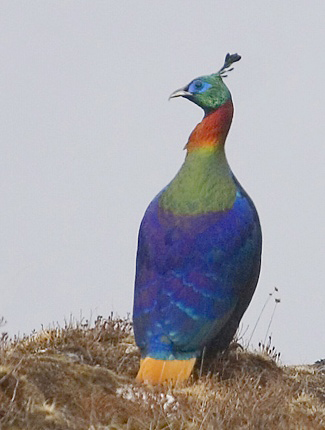
A rare image of a rare and beautiful Himalayan Monal at Sela Pass by Ian Merrill.
- Some of Asia's and the world's most spectacular localized birds including Himalayan Monal, Ward's Trogon, Rufous-necked Hornbill, Grandala, Himalayan Cutia, Fire-tailed Myzornis, Bugun Liocichla, Beautiful Nuthatch, Fire-tailed Sunbird and even the very rare Green Cochoa
- And some of Asia's and the world's most spectacular other birds such as Black-necked Stork, Ibisbill, Brown Fish-owl, Crested Kingfisher, Long-tailed Broadbill, Yellow-billed Blue Magpie, Asian Fairy-bluebird, Sultan Tit, Wallcreeper and many laughingthrushes including White-crested
- And mammals including Indian Rhinoceros
- As well as Asian Elephant, Hoolock Gibbon, Ganges River Dolphin, and even Tiger and Asian Water Buffalo
- All in some superb lowland grasslands and woodlands, and mountain forests
- Most organized tours do not take in all the best sites. They either involve tours to Eaglenest WS and the surrounding area or the Mishmi Hills and surrounding area (both in a few cases), sometimes combined with Kaziranga NP in the lowlands where most of the mammals occur. The birdlists for the Eaglenest and Mishmi Hills areas are very similar but the former includes the high altitude Sela Pass where, snow levels permitting, it is possible to see Himalayan Monal and Grandala. The birdlists are also almost the same as that for neighbouring Bhutan, a much more expensive destination where it is not possible to see Indian Rhinoceros.
- India is a huge country where there are several other great destinations. In Northern India the main attraction is Tiger, as well as Asian Elephant, Gharial and a chance of Sloth Bear and Ganges River Dolphin, plus the now occasional spectacle of thousands of waterbirds and numerous raptors at Bharatpur, and many other spectacular birds including Sarus Crane, Black-necked Stork, Brown and Tawny Fish-owls, and Indian Skimmer. In Western India it is possible to see Lion, Leopard, Wild Ass, Blackbuck and Striped Hyaena, thousands of Demoiselle Cranes and harriers, and other birds such as Indian and Asian Houbara Bustards, Crab Plover, Cream-coloured and Indian Coursers, Hypocolius and White-bellied Minivet. In far Northwestern India it is possible to see Snow Leopard, as well as high mountain birds such as White-browed Tit-warbler. Over 30 of India's 56 mainland endemic bird species and 30 more species shared only with Sri Lanka occur in Southern India, including Malabar Trogon and White-bellied Treepie, and the south is also the best place to look for Indian Pitta and Heart-spotted Woodpecker.
Best Birds and other wildlife in Northeast India
Birds
Northeast India Endemics 7 Manipur Bush-quail, Black-breasted Parrotbill, Rusty-throated Wren-babbler (Mishmi Hills), Naga (Long-tailed) Wren-babbler (Nagaland and North Manipur), Tawny-breasted Wren-babbler (Khasi Hills), Swamp Grass-babbler and Bugun Liocichla (Eaglenest area).
Specialities
Grey Peacock-pheasant, Swamp Francolin, Snow Partridge, Himalayan Monal, Blyth’s Tragopan, Blood Pheasant, Spot-billed Pelican, Pallas's Fish-eagle, Bengal
Florican, Ibisbill (mostly Nov-Mar), Snow Pigeon, Ward’s Trogon, Crested Kingfisher, Rufous-necked Hornbill, Blue-rumped Pitta, Green Cochoa, Grandala,
Marsh Babbler, Bhutan, Brown-capped, Chestnut-backed, Striped and Yellow-throated Laughingthrushes, Brown-throated (Ludlow’s) Fulvetta, Fire-tailed
Myzornis, Blackish-breasted (Wedge-billed Wren-babbler), Chevron-breasted (Wedge-billed Wren-babbler) and Jerdon's Babblers, Bar-winged Wren-babbler,
Spotted Elachura (formerly a Wren Babbler, now in a family of its own), Wallcreeper, Beautiful Nuthatch and Gold-naped Finch.
(Additional specialities at Meghalaya and Namdapha National Park in eastern Arunachal Pradesh include White-bellied Heron, White-winged Duck, White-cheeked Partridge, Dark-rumped Swift, Snowy-throated Babbler, and Assam and Rufous-vented Laughingthrushes.)
Others
Kalij Pheasant, Red Junglefowl, Bar-headed Goose (mostly Nov-Mar), Ruddy Shelduck (mostly Nov-Mar), Oriental Darter, Black (mostly Nov-Mar) and
Black-necked Storks, Lesser and Greater Adjutants, vultures, Grey-headed Fish-eagle, Pied Harrier (mostly Nov-Mar), Black, Greater Spotted (mostly Nov-Mar)
and Rufous-bellied Eagles, Collared Falconet, Grey-headed and River Lapwings, Bronze-winged Jacana, Small Pratincole, Great Black-headed (Pallas's) Gull
(mostly Nov-Mar), River Tern, Vernal Hanging-parrot, parakeets, Green-billed Malkoha, owls including Dusky Eagle-owl and Brown Fish-owl, Crested Treeswift,
White-throated Needletail (mostly Apr-Sep), Red-headed Trogon, Pied, Stork-billed and White-breasted (Smyrna) Kingfishers, Blue-bearded, Blue-tailed and
Chestnut-headed Bee-eaters, Indochinese Roller, Great and Oriental Pied Hornbills, barbets, woodpeckers including Great Slaty, Long-tailed and
Silver-breasted Broadbills, Ashy Woodswallow, Common Iora, minivets, Maroon Oriole, drongos including Greater Racquet-tailed, Common Green Magpie,
Yellow-billed Blue Magpie, Southern Nutcracker, Sultan and Yellow-cheeked Tits, Velvet-fronted Nuthatch, bulbuls, leaf warblers, Chestnut-headed Tesia,
tailorbirds, niltavas, Chinese and Siberian Rubythroats (both mostly Nov-Mar), Indian Blue Robin (mostly May-Sep), bush-robins, White-rumped Shama,
redstarts, forktails, Chestnut-bellied Rock-thrush, thrushes, laughingthrushes including White-crested, scimitar, shrike and wren babblers, Himalayan
Cutia, Silver-eared Mesia, Red-billed Leiothrix, minlas including Red-tailed, fulvettas, sibias, yuhinas, parrotbills, starlings such as Spot-winged,
mynas, Asian Fairy-bluebird, leafbirds, flowerpeckers, Fire-tailed, Gould's and Green-tailed Sunbirds, Streaked Spiderhunter, accentors, rosefinches,
bullfinches and Scarlet Finch.
Also a chance of Sclater's Monal, Satyr and Temminck's Tragopans, Baikal, Falcated and White-winged Ducks, Baer's Pochard, Black-tailed Crake, Long-billed Plover, Hodgson's Frogmouth, Brown Hornbill, Blue-naped Pitta, Collared Treepie, Purple Cochoa, Orange-headed Thrush and Maroon-backed Accentor.
Mammals
Indian Rhinoceros, Asian Elephant, Hoolock Gibbon, Ganges River Dolphin,
Asian Water Buffalo, Capped and Golden Langurs, Assamese/Rhesus Macaques, Red Giant Flying Squirrel, Black Giant Squirrel
and Sambar. Also a chance of Tiger and Gaur, and an outside chance of Red Panda.
Plants
The amazing flora of the eastern Himalayas includes a great variety of
rhododendrons, cobra-lilies and epiphytic orchids (although these are perhaps at their most diverse in the
nearby Indian state of Sikkim, notably in Kangchenjunga NP).
Best Sites for Birds and other wildlife in Northeast India
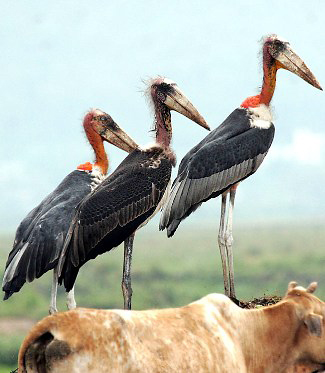
Greater Adjutants at the dump by Jon Hornbuckle.
- Guwahati City Dump one of the best places in the world for Greater Adjutant.
- Manas NP Golden Langur, Asian Elephant, Asian Water Buffalo, Bengal Florican, Red-headed Trogon and Great Hornbill.
- Kaziranga NP Indian Rhinoceros, Asian Elephant, Ganges River Dolphin, Asian Water Buffalo, Black-necked Stork, Bengal Florican, Bar-headed Goose, Kalij Pheasant, Red Junglefowl, Swamp Francolin, Spot-billed Pelican, Greater and Lesser Adjutants, Slender-billed Vulture, Pied Harrier, Grey-headed and Pallas's Fish Eagles, Great Spotted Eagle, Grey-headed Lapwing, Bronze-winged Jacana, Stork-billed Kingfisher, Chestnut-headed Bee-eater, Great Hornbill, Green Magpie, Siberian and White-tailed Rubythroats, Slender-billed Babbler, Bristled and Indian Grassbirds, and Spot-winged Starling. Also a chance of Tiger, Gaur, Dusky Eagle Owl, Brown Fish Owl and Blue-naped Pitta.
- Panbari Forest Hoolock Gibbon and Capped Langur.
- Shillong Dark-rumped Swift, Tawny-breasted Wren Babbler, Assam Laughingthrush, Grey Sibia, Rusty-capped Fulvetta and Brown Bush Warbler.
- Orang NP Swamp Francolin, Bengal Florican, Slender-billed Babbler, Bristled and Indian Grassbirds, and Indian Rhinoceros.
- Nameri NP Ibisbill, Crested Kingfisher, Asian Fairy Bluebird, Sultan Tit, Red Junglefowl, Pallas's Fish Eagle, Pied Falconet, River Lapwing, Small Pratincole, Blue-bearded and Chestnut-headed Bee-eaters, Great and Wreathed Hornbills and Green Magpie. Also a chance of White-winged Duck, Long-billed Plover, Long-tailed and Silver-breasted Broadbills, Blue-naped Pitta, Black-breasted Thrush and Spot-winged Starling.
- Eaglenest WS Best to bird near Bomphu Camp at 1900 m (6234 ft) and Lama Camp at 2300 m (7546 ft) for Rufous-necked Hornbill (Bomphu), Yellow-billed Blue Magpie, Asian Fairy Bluebird, Fire-tailed Sunbird, Long-tailed and Silver-breasted Broadbills, Sultan Tit (Bomphu), Ward's Trogon (Bomphu), Himalayan Cutia, Fire-tailed Myzornis, Beautiful Nuthatch (Bomphu), Wallcreeper, Kalij Pheasant, Grey Peacock Pheasant, Red-headed Trogon, barbets, woodpeckers, Green Magpie, Eurasian Nutcracker, warblers, parrotbills, flycatchers, niltavas, bush robins, Slaty-backed Forktail, thrushes, laughingthrushes, Bugun (Lama) and Red-faced (Crimson-faced) Liocichlas, scimitar babblers, shrike babblers, Spotted Elachura (Bomphu), Long-billed and Rufous-throated Wren Babblers, Sikkim Wedge-billed Babbler, Silver-eared Mesia, Red-billed Leiothrix, barwings, minlas including Red-tailed, fulvettas including Golden-breasted, sibias, yuhinas, Gould's and Green-tailed Sunbirds, and Gold-naped and Scarlet Finches. Also a chance of Blyth's (Bomphu) and Temminck's Tragopans, Chestnut-breasted Partridge, Hodgson's Frogmouth, Collared Treepie, Green (Bomphu) and Purple Cochoas, shortwings and Maroon-backed Accentor, and an outside chance of Red Panda.
- Sangti Valley near Dirang Ibisbill, Crested Kingfisher, Wallcreeper, Black-tailed Crake, Long-billed Plover, Brown Dipper and Slender-billed Oriole.
- Mandala Road near Dirang Ibisbill, Fire-tailed Myzornis, Long-billed Plover, warblers, Black-throated Parrotbill, Spotted Forktail, Slender-billed Scimitar Babbler, Bar-winged Wren Babbler, Golden-breasted and Ludlow's Fulvettas, and Blandford's Rosefinch. Also a chance of Temminck's Tragopan and Ward's Trogon, and an outside chance of Red Panda.
- Sela Pass above Dirang (4176 m (13,700 ft)) Himalayan Monal, Snow Partridge, Blood Pheasant, Fire-tailed Sunbird, Grandala, Fire-tailed Myzornis, Snow Pigeon, Rufous-breasted Bush Robin, White-throated Redstart, Spotted Laughingthrush, Bar-winged Wren Babbler, and Alpine and Rufous-breasted Accentors. Also a chance of Lammergeier.
- Digboi Oilfields Chestnut-backed Laughingthrush, Buff-breasted and White-hooded Babblers, and Collared Treepie. Also a chance of White-winged Duck.
- Tinsukhia area A chance of Black-tailed Crake, Blue-bearded Bee-eater, Brown Hornbill, Blue-naped Pitta, White-tailed Blue Flycatcher, Green Cochoa and Large Scimitar Babbler.
- Maguri Beel (Lake), near Tinsukhia Swamp Francolin, Bar-headed Goose and Jerdon's Babbler. Also a chance of Baikal and Falcated Ducks, and Baer's Pochard amongst many wintering waterbirds.
- Dibru-Saikhowa NP Collared Treepie, Chestnut-backed Laughingthrush, Black-breasted Parrotbill, Jerdon's and Marsh Babblers, Swamp Prinia and Smoky Warbler.
- Mishmi Hills above Roing Red-headed and Ward's Trogons, Sultan Tit, Beautiful Nuthatch, Gould’s and Rusty-bellied Shortwings, Cachar Wedge-billed Babbler, Slender-billed Scimitar Babbler, Bar-winged, Long-billed and Mishmi (Rusty-throated) Wren Babblers, Spotted Elachura, Fire-tailed Myzornis, minlas, Golden-breasted Fulvetta, sibias, yuhinas, parrotbills, Fire-tailed Sunbird, Gold-naped Finch and Hoolock Gibbon. Also a chance of Sclater's Monal, Blyth's Tragopan, Hodgson's Frogmouth, Collared Treepie, Green and Purple Cochoas, Himalayan Cutia and Spot-winged Starling.
- Namdapha NP Hoolock Gibbon, Capped Langur, White-winged Duck, White-bellied Heron, Ibisbill, Rufous-necked Hornbill, Sultan Tit, Grey Peacock Pheasant, Pied Falconet, Red-headed Trogon, Blyth's and Crested Kingfishers, Blue-bearded Bee-eater, Great Hornbill, barbets, woodpeckers including Great Slaty, Silver-breasted Broadbill, Green Magpie, warblers, parrotbills, flycatchers, niltavas, forktails, Rufous-vented Laughingthrush, Red-faced (Crimson-faced) Liocichla, Snowy-throated Babbler, scimitar, shrike and wren babblers, Silver-eared Mesia, minlas including Red-tailed, fulvettas, sibias and yuhinas. Also a chance of White-cheeked Partridge, Green Cochoa, Long-tailed Broadbill, Himalayan Cutia, Beautiful Nuthatch, Asian Paradise Flycatcher, Long-billed Plover, Hodgson's Frogmouth, Blue-naped Pitta and Collared Treepie.
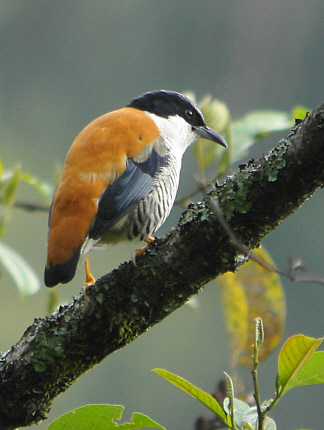
Himalayan Cutia by Ian Fulton.
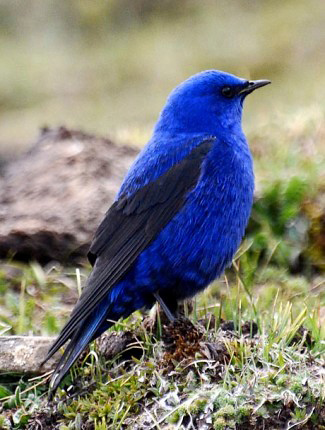
A beautiful Grandala photographed by Jon Hornbuckle.
- Off the beaten track
- Nagaland, near border with Myanmar Naga Wren Babbler, and Brown-capped, Striped and Yellow-throated Laughingthrushes. Also a chance of Black-tailed Crake, and Solitary and Wood Snipes.
Best Times for Birds and other wildlife in Northeast India
The best time to visit the lowlands is between mid-November and March, especially mid-February to the end of March, when the numbers of wintering birds from the north and high Himalayas usually reach their peak. Kaziranga NP in the lowlands does not usually open to visitors before mid-November because it is usually flooded during the monsoon, from May to October. High altitude areas, notably Sela Pass, may not be accessible until April at the earliest hence mid-April to May is arguably the best time to look for the many mountain birds, although a few wintering species and some species which pass through the mountains during the northern spring may have already left by early April at the latest.
Recommended Bird Books etc. for Northeast India
Birds of Northern India by R Grimmett and T Inskipp. Helm, 2003.
Birds of the Indian Subcontinent by R Grimmett et al. Helm, 2012.
A Field Guide to the Birds of the Indian Subcontinent by K Kazmierczak. Helm, 2008.
Pocket Guide to the Birds of the Indian Subcontinent by R Grimmett et al. Helm, 1999.
Field Guide to the Birds of Nepal by R Grimmett et al. Helm, 2016 (Second Edition).
Birds of Bhutan and the Eastern Himalayas by R Grimmett et al. Helm, 2019 (Third Edition).
Birds of South Asia: The Ripley Guide Volumes 1 and 2 by P C Rasmussen and J C Anderton. Lynx Edicions and Smithsonian Institution, 2012.
Indian Mammals: A Field Guide by V Menon. Hachette, 2014.
Field Guide to the Mammals of the Indian Subcontinent by K K Gurung and R Singh. Helm, 1998.
Apps etc.
eGuide to Birds of the Indian Subcontinent.
Where to watch birds in Asia by N Wheatley. Helm, 1996.
Don’t know which country/countries/regions to visit in Asia? Then it may be worth considering taking a look at this book, written by this website’s author. It is many years old of course but it still provides a starting point, an overview and a guiding light to the best birds and the best places to look for them in the region, and could save hours of searching for similar information on the internet. However, it is important to check more up-to-date sources for sites which have been opened up, sites and species which have been discovered, lodges that have been built etc. since the book was published.
Birding and Wildlife Trip Reports for Northeast India
Many trip reports, some for Northeastern India, are posted on the websites listed here. On some of these websites some reports are independent and some are posted by tour companies who organize tours to Northeastern India. These tour companies and others also post their own reports on their websites, which are listed under 'Some Organized Tours to Northeastern India' below.
- The best website for trip reports is CloudBirders
- but these are also worth a look
- Birdtours
- Fatbirder
- Jon Hornbuckle
- Mammal Watching
Local bird and wildlife guides in Northeast India
The costs of organized tours partly reflect the quality of the tour leaders. Some leaders are certainly better than others and many companies claim their leaders are the best but even the best rely at least to some extent on the exceptional skills of the local guides they employ. If you are travelling independently, employing such local guides will greatly increase your chances of seeing the wildlife you wish to see.
Accommodation for birders in Northeast India
Some Organized Tours for birds and other wildlife to Northeast India
There are many tour companies who organize tours to see mammals, birds, other wildlife and other natural wonders. The cost of these tours vary considerably according to such variables as the airlines used, the number of days the tours last, the number of sites visited, the number of people in the group (an important consideration if you wish to see such wildlife as rainforest mammals and birds), the number of tour leaders, the standard of accommodation and transport, and the percentage profit the company hopes to make. Generally, where the number of days tours last and the number of sites visited are similar, the cheapest tours are those that use the cheapest airlines, accommodation and local transport, that have the largest groups with the least number of leaders, and that make the least amount of profit. The most expensive tours tend to be those which are exceptionally long, use the most expensive accommodation (ridiculously lavish in some cases, even for single nights) and which make the most profit. Some tour costs partly reflect the quality of the tour leaders. Some leaders are certainly better than others and many companies claim their leaders are the best but even the best rely at least to some extent on the exceptional skills of the local guides they employ.
While tour companies organize tours with set itineraries many also organize custom tours for individuals and private groups who instead of taking a tour with a set itinerary want to follow their own itinerary to suit their own personal tastes, whether it be mammals, birds, other wildlife, other natural wonders or even man-made attractions, or a mixture of them all. Many organized tours with set itineraries are also fast-paced and target as many species as possible, whether they are mammals, birds or other wildlife or everything, which usually leaves little time to enjoy the best sites and individual species, but on a custom tour those taking part can specify the pace and the sites and species they wish to concentrate on. Custom tours also suit people who like to travel with people they already know, rather than with a group of strangers, and people with partners with different interests. Individuals and small groups will almost certainly have to pay more than the price of an organized tour with a set itinerary but a large group of friends may be able to travel for less than the price quoted for a set tour.
Tour companies who run organized tours or can arrange custom tours to Northeastern India include the following.
