
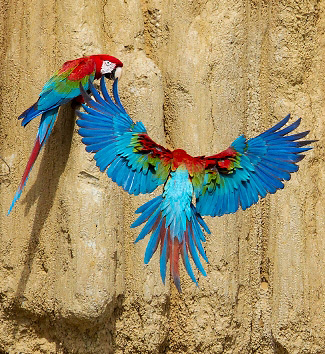
Red-and-green Macaws at a clay ick in Manu National Park by Dubi Shapiro.
SOUTHERN PERU
- The richest region for birds on Earth
- With a tenth of all the world's species, about a thousand, thanks to the combination of temperate, subtropical, foothill and especially lowland Amazonian rain forests where some locations measuring little more than ten square kilometres support over 550 species
- Including Manu National Park where 1000 species occur in just 15,000 square kilometres
- The birds include macaws and parrots, large flocks of which can be seen visiting the most spectacular clay licks in Amazonia
- As well as some of South America's and the world's other most spectacular birds including a dazzling array of hummingbirds, quetzals, jacamars, toucans, cotingas including Andean Cock-of-the-rock, manakins and multicoloured tanagers, swirling flocks of which light up the east Andean slope forests
- Butterflies also abound, Giant Otters fish the waterways and there are lots of monkeys, although they are usually less conspicuous than the birds
- All in some of the most pristine habitats left on Earth
- The previous world record for the number of birds recorded in 24 hours was set at Cocha Cashu Biological Station in Manu National Park in 1982, and it is still arguably the most impressive, because Ted Parker and Scott Robinson recorded an incredible 331 species in a square mile! The total has since been exceeded, in Kenya in 1986 when, with the aid of a light aircraft, a total of 342 species was reached (of which an incredible 333 were seen); in Northern Peru in October 2014 when a total of 354 species (of which just 232 were seen) was posted along a transect from montane forest at Abra Patricia down to lowland Amazonian forest; and, in Ecuador on 8th October 2015 when Dušan Brinkhuizen, Rudy Gelis, Mitch Lysinger and Tuomas Seimola recorded 385 species between the lowland Amazon rain forest near Tena in the east and the Quito area by dusk. The team then took a commercial flight to the Santa Elena peninsula on the Pacific coast in southern Ecuador and added many more species at roost and in their ringing nets to reach an incredible total of 425!
- Lima is the usual starting point for a trip to Manu. Birding sites near the capital city include: Pucusana fishing port where Humboldt Penguin and Peruvian Diving-petrel, as well as Guanay and Red-legged Cormorants, Peruvian Booby, Blackish Oystercatcher, Grey Gull, Inca Tern and Peruvian Seaside (Surf) Cinclodes are possible on boat trips out to a South American Sealion colony and beyond; Lomas de Lachay NR and the surrounding area, where Peruvian Thick-knee, Least Seedsnipe, Oasis Hummingbird, Peruvian Sheartail, Coastal, Greyish and Thick-billed Miners, Cactus Canastero, Collared Warbling-finch and Raimondi's Yellow-finch occur; and the nearby Laguna Paraiso on the Pacific coast, a good place for shorebirds, gulls including Belcher's and Grey, and terns including Peruvian. In addition, no trip to Peru would be complete without a pelagic boat trip out of Callao on which the range of possible seabirds includes Waved Albatross, Swallow-tailed Gull and Hornby's Storm-petrel!
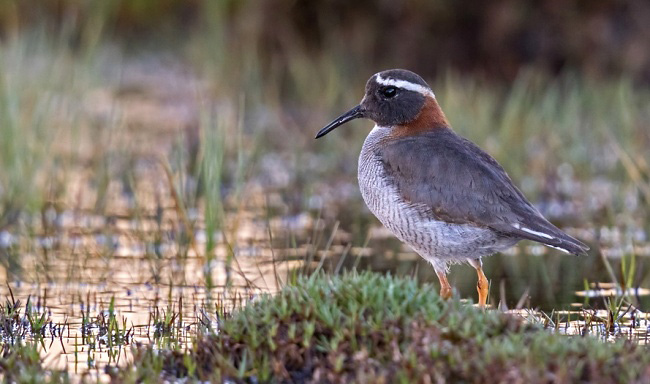
Diademed Sandpiper Plover at Marcapomacocha by Lars Petersson.
- Further afield is Central Peru where there are some spectacular birds in spectacular mountain scenery, with a chance of 50 highland endemics and many other high elevation specialities including the flightless Junin Grebe (on National Park zodiac boat trips), Orange-breasted Falcon, Junin (Black) Rail, Diademed Sandpiper Plover (Marcapomacocha), Rufous-bellied Seedsnipe, Scissor-tailed Nightjar, Oilbird (thousands in cave near Tingo Maria), Bronze-tailed Comet (Santa Eulalia Valley), Black-breasted Hillstar, Coppery (Bosque Unchog) and Fire-throated Metaltails, Olivaceous Thornbill, Blue-banded Toucanet, White-bellied Cinclodes (Marcapomacocha and Ticlio Bog/Pass), Striated Earthcreeper, Eye-ringed and White-chinned (Bosque Unchog) Thistletails, Bay, Rufous-breasted and Undulated Antpittas, tapaculos, Many-coloured Rush-tyrant (Lake Junin), Bay-vented Cotinga (Bosque Unchog), White-cheeked Cotinga (Andamarca Valley via Santa Eulalia Valley and Huascaran National Park), Band-tailed and Masked Fruiteaters (both along Paty Trail), White-eared Solitaire (Bosque Sho'llot), White-collared Jay, Golden-backed Mountain-tanager (Bosque Unchog), Golden-collared, Huallaga and Yellow-scarfed Tanagers, Rufous-browed Hemispingus (Bosque Unchog), Pardusco (Bosque Unchog), Giant Conebill, Tit-Like Dacnis, Plain-tailed and Rufous-breasted Warbling-finches, and Great and Rufous-backed Inca-finches. Not so many mammals though, probably Northern Viscacha and possibly Andean Fox, Andean Huemul and Vicuna. The best time to look for birds in this region is June-July.
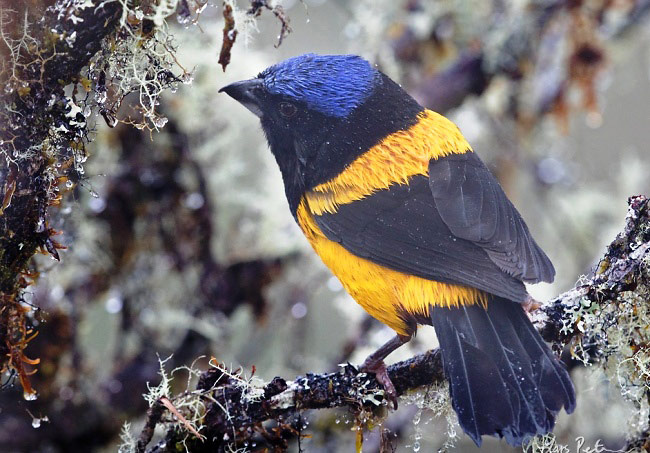
Golden-backed Mountain-tanager at Bosque Unchog by Lars Petersson.
- While in Northern Peru it is possible to see Spectacled Bear and, on the famous birding circuit, such amazing hummingbirds as Marvelous Spatuletail, as well as great rarities including White-winged Guan and maybe even Long-whiskered Owlet, while Northeastern Peru is one of the richest places for birds in Amazonia and the world with such spectacular birds as Pavonine Quetzal, Black-necked Red-cotinga and Wire-tailed Manakin, as well as Pygmy Marmoset and possibly Pink River Dolphin.
- At the other end of this long country in the far south the mirador (viewpoint) known appropriately as Cruz del Condor overlooking Colca Canyon, arguably the deepest canyon in the world, near Arequipa in far Southern Peru, is possibly the best place in the world to see Andean Condors close up, so close in fact that at times it is possible to hear the air rushing through the birds' outstretched wing feathers as they rise from their overnight roosts on the cliffs lower down in the canyon. The best time to visit the Colca Canyon is between May and December. At nearby Lago Salinas it is possible to see birds such as Andean, Chilean and occasionally James's (Puna) Flamingos, Puna Plover and Andean Avocet.
Best Birds and other wildlife in Manu - Southern Peru
Birds
Endemics
Western (Bearded) Mountaineer, Western (Bearded) Mountaineer, Koepcke’s Hermit, White-tufted sunbeam, Rufous-webbed Brilliant (recorded in Bolivia),
Green-and-white Hummingbird, Peruvian Piedtail, Coppery-naped Puffleg, White-browed Tit-spinetail, Vilcabamba Thistletail,
Apurimac, Creamy-crested and Marcapata Spinetails, Junin and Rusty-fronted Canasteros, Red-and-white Antpitta, Vilcabamba Tapaculo, Inca Flycatcher,
Black-backed Tody-flycatcher, Unstreaked Tit-tyrant, Masked Fruiteater, Cerulean-capped Manakin, Inca Wren, Parodi's Hemispingus, Chestnut-breasted
Mountain-finch, and Apurimac and Cuzco and Vilcabamba Brush-finches.
Near-endemics
Peru and Brazil 6 Fine-barred Piculet, Acre Antshrike, Manu Antbird, Black-tailed Antbird, Elusive Antpitta and Acre Tody-tyrant.
Peru, Brazil and Bolivia 38 Purus Jacamar, White-throated Jacamar, Blue-necked (-cheeked) Jacamar, Bluish-fronted Jacamar, Semi-collared Puffbird, Rufous-necked Puffbird, Fulvous-chinned Nunlet, Rufous-capped Nunlet, Black-throated (Emerald) Toucanet, Green-billed (Golden-collared) Toucanet, Brown-mandibled Aracari, Flame-throated (Lemon-throated) Barbet, Amazonian Parrotlet, Black-legged Parrot, Rose-fronted Parakeet, Black-capped Parakeet, Blue-headed Macaw, Southern Red-shouldered Macaw, Sclater’s Antwren, Ihering’s Antwren, Saturnine Antshrike, Bluish-slate Antshrike, Bamboo Antshrike, White-lined Antbird, Goeldi’s Antbird, Rufous-fronted Antthrush, Ocellated Woodcreeper, Inambri Woodcreeper, Flame-crested Manakin, Red-headed Manakin, Round-tailed Manakin, Black-faced Cotinga, Rufous Twistwing, Long-crested Pygmy-tyrant, Flammulated Bamboo-tyrant, White-cheeked Tody-flycatcher, Yellow-crested Tanager and Pearly-breasted Conebill.
Peru and Bolivia 84 (Seven hummingbirds, three cotingas and ten tanagers) Taczanowski’s Tinamou, Stripe-faced Wood-quail, Titicaca Grebe, White-browed Hermit, Olivaceous Thornbill, Scaled Metaltail, Buff-thighed Puffleg, Gould’s Inca, Huanaco (Violet-throated) Starfrontlet, Rufous-booted (Booted) Racket-tail, Cloudforest Screech-owl, Blue-banded Toucanet, Hooded Mountain-toucan, Blue-moustached (Versicoloured) Barbet, Black-crowned (Crimson-mantled) Woodpecker, Andean Parakeet (also recorded in Argentina), Black-winged Parrot, Plumero (Speckle-faced) Parrot, Yellow-rumped Antwren, Ashy Antwren, Upland Antshrike, Brownish-headed Antbird, Rufescent (Russet) Antshrike, Slaty Antshrike, Stripe-headed Antpitta, Rufous-faced Antpitta, Trilling Tapaculo, Bolivian Tapaculo, Puna Tapaculo, Diademed Tapaculo, Royal Cinclodes, Bolivian Recurvebill, Rufous-backed Treehunter, Line-fronted Canastero, Streak-throated Canastero, Puna Thistletail, Light-crowned Spinetail, Cabanis’s Spinetail, Yungas Manakin, Scarlet-breasted Fruiteater, Band-tailed Fruiteater, Scimitar-winged Piha, Hazel-fronted Pygmy-tyrant, Cinnamon-faced Tyrannulet, White-bellied (Slaty-capped) Flycatcher, Yungas Tody-tyrant, Ochraceous-breasted Flycatcher, Bolivian Tyrannulet, Yungas Tyrannulet, Ash-breasted Tit-tyrant, Unadorned Flycatcher, Kalinowski’s (Crowned) Chat-tyrant, Golden-browed Chat-tyrant, Chestnut-belted (Slaty-backed) Chat-tyrant, Taczanowski’s Ground-tyrant, Chestnut-naped (Rufous-naped) Ground-tyrant, Rufous-bellied Bush-tyrant, Olive Flycatcher, White-collared Jay, Fulvous Wren, Southern Chestnut-breasted Wren, White-eared Solitaire, Black-faced Brush-finch, Dusky-green Oropendola, Southern Mountain Cacique, Bolivian Citrine Warbler, Golden-bellied Warbler, Bolivian (Three-striped) Warbler, Slaty Tanager, Golden-bellied (Grey-hooded) Tanager, Drab Hemispingus, Orange-browed Hemispingus, Three-striped Hemispingus, White-browed Conebill, Peruvian Sierra-finch, Moustached Flowerpiercer, Golden-collared Tanager, Chestnut-bellied Mountain-tanager, Bolivian (Blue-winged) Mountain-tanager, Fire-bellied (Scarlet-bellied) Mountain-tanager, Blue-throated (Orange-eared) Tanager, Rusty-naped (Golden) Tanager, Green-capped Tanager and Spot-bellied (Blue-and-black) Tanager.
Other specialities
White-winged (Pale-winged) Trumpeter, Razor-billed Curassow, Yungas Pygmy-owl, Ocellated Poorwill, Andean Potoo, White-bellied Parrot, Green-fronted
Lancebill, Festive and Rufous-crested Coquettes, Gould’s Jewelfront, Wire-crested Thorntail, Buff-thighed Puffleg, Rufous-capped Thornbill, Many-spotted
Hummingbird, Andean Motmot, Black-streaked and (Western) Striolated Puffbirds, Curl-crested Aracari, Scarlet-hooded Barbet, Ocellated and Rufous-breasted
Piculets, Rufous-headed and White-throated Woodpeckers, Brown-rumped Foliage-gleaner, Plain Softtail, Pale-footed Swallow, Varzea Antbird, Black-spotted
Bare-eye, Amazonian Antpitta, Slaty Gnateater, Cinnamon-faced and Red-billed Tyrannulets, Johannes's and White-bellied Tody-tyrants, Dusky-tailed Flatbill,
Rufous-webbed Bush-tyrant, Band-tailed and Fiery-capped Manakins, Hauxwell's Thrush, Tawny-faced Gnatwren, Rust-and-yellow Tanager, White-browed
Hemispingus, Black-billed Seed Finch, Pale-eyed Blackbird and Casqued Oropendola. Also a chance of Bartlett's, Black-capped, Cinereous, Grey, Hooded and
Variegated Tinamous, Buckley's Forest-falcon, Rufous-breasted Wood-quail, Crested and Harpy Eagles, Uniform Crake, Golden-plumed Parakeet, Long-tailed
Potoo, White-browed Hermit, Pavonine Quetzal, Rusty-breasted and Thrush-like Antpittas, and Yellow-shouldered Grosbeak.
Others
Horned Screamer, Orinoco Goose, Muscovy and Torrent Ducks, Blue-throated Piping-guan, Fasciated Tiger-heron, Agami and Capped Herons, King Vulture,
Black-and-chestnut and (Montane) Solitary Eagles, Sunbittern, Sungrebe, Pied Plover, Andean Lapwing, Andean Gull, Yellow-billed and Large-billed Terns,
pigeons and doves, Blue-and-yellow, Red-and-green and Scarlet Macaws, parrots, Hoatzin, Sand-coloured Nighthawk, Lyre-tailed and Swallow-tailed Nightjars,
hummingbirds including Black-eared Fairy, Sword-billed, Long-tailed Sylph, Black-tailed and Green-tailed Trainbearers, Gould's Jewelfront and Giant,
trogons, Crested and Golden-headed Quetzals, all five South American kingfishers, puffbirds, jacamars, barbets, Channel-billed and White-throated Toucans,
Grey-breasted Mountain-toucan, Golden-collared Toucanet, Chestnut-eared and Ivory-billed Aracaris, woodpeckers including Crimson-bellied, foliage-gleaners,
Pearled Treerunner, Streaked Tuftedcheek, woodcreepers, many antbirds, tyrannulets, Short-tailed Pygmy-tyrant (the world's smallest passerine along with
Black-capped Pygmy-tyrant), tody-tyrants, tody-flycatchers, flycatchers, ground-tyrants, chat-tyrants, Many-coloured Rush-tyrant, Andean Cock-of-the-rock,
Screaming Piha, Plum-throated, Purple-throated and Spangled Cotingas, Bare-necked and Purple-throated Fruitcrows, tityras, jays, Musician Wren,
Black-capped Donacobius, Giant Conebill, many tanagers, Black-faced and Yellow-bellied Dacnises, honeycreepers, sierra-finches, flowerpiercers, oropendolas
and Orange-backed Troupial. Also a chance of Andean Condor, Military Macaw, Crested and Spectacled Owls, Chestnut-crested Cotinga, White-browed Purpletuft,
Tit-like Dacnis and Plushcap.
Mammals
Giant Otter, Saddleback Tamarin, and Red Howler, (Common) Woolly,
(Black-headed) Night, Common Squirrel, Black (Peruvian) Spider, Dusky Titi, Brown Capuchin and White-fronted
Capuchin Monkeys. Also a chance of Brazilian Tapir, Emperor Tamarin, Gray's Bald-faced Saki Monkey, Red Brocket Deer and Tayra,
and an outside chance of Spectacled Bear (this great rarity is now seen with some regularity in the Chaparri
Ecological Reserve near Chiclayo in Northern Peru).
Reptiles, Amphibians and Fish
Spectacled Caiman.
Invertebrates
Numerous spectacular butterflies.
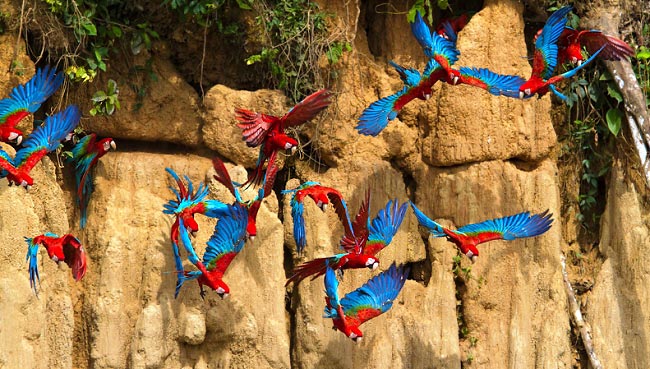
Red-and-green Macaws at a clay lick in Manu by Dubi Shapiro.
Best Sites for Birds and other wildlife in Manu - Southern Peru
- Cuzco-Machu Picchu-Abra Malaga Area
- Huacarpay Lake Bearded Mountaineer, Giant Hummingbird, Andean Lapwing, Andean Gull, Streak-fronted Thornbird, Rusty-fronted Canastero, Many-coloured Rush-tyrant and Yellow-winged Blackbird.
- Hotel Pakaritampu, Ollantaytambo Bearded Mountaineer, Black-tailed and Green-tailed Trainbearers, and Giant Hummingbird all possible in garden.
- Train Journey between Ollantaytambo and Aguas Calientes Lots of Torrent Ducks on Rio Urubamba.
- Aguas Calientes-Mandor Valley-Machu Picchu Andean Cock-of-the-rock (Pueblo Hotel), Highland Motmot (Pueblo Hotel), White-eared Solitaire (along railway line from Aguas Calientes) and Inca Wren (at the spectacular Inca site). Also a chance of Masked Fruiteater (on walk down from Machu Picchu).
- Abra Malaga (up to 4300 m/14,000 ft) Andean Condor, Sword-billed Hummingbird, Scaled Metaltail, Blue-mantled and Purple-backed Thornbills, Junin Canastero, White-browed Tit-spinetail, Rufous and Stripe-headed Antpittas, Ash-breasted and Unstreaked Tit-tyrants, Red-crested Cotinga, Inca Wren, Parodi's Hemispingus, Giant Conebill, Black-throated, Masked and Moustached Flowerpiercers, Plushcap and Cuzco Brush-finches. Also a chance of Royal Cinclodes, Marcapata Spinetail and Tit-like Dacnis.
- Andean Spirit Lodge A chance of Koepcke's Screech-owl and Buff-fronted Owl.
- Soraypampa Road White-tufted Sunbeam, Apurimac Spinetail, Vilcabamba Tapaculo, Apurimac Brush-finch and Chestnut-breasted Mountain-finch.
- The Manu Road- the route down to Amazonia
- Huacarpay to Manu Road Rusty-fronted Canastero and Streak-fronted Thornbird.
- Beginning of Manu Road via Paucartambo and a high pass Creamy-crested Spinetail, Slender-billed Miner and Puna Ground-tyrant.
- Wayqecha Biological Research Station/Upper Manu Road Area (3000 m/9800 ft) White-throated Screech-owl (below station), Rufous-banded Owl (below station), Swallow-tailed Nightjar (below station), Andean Potoo, Violet-throated Starfrontlet (above station), Chestnut-breasted Coronet (below station), Golden-headed Quetzal, Grey-breasted Mountain-toucan, Blue-banded Toucanet, Puna Thistletail (above station), Diademed Tapaculo (above station), Red-and-white and Rufous Antpittas, Inca Flycatcher, Chestnut-crested Cotinga (below station), White-collared Jay, White-eared Solitaire, Rust-and-yellow Tanager (below station), Chestnut-bellied Mountain-tanager. Also a chance of Stripe-faced Wood-quail, Rufous-bellied Bush-tyrant and Band-tailed Fruiteater.
- Wayqecha down to Cock-of-the-Rock Lodge Black-and-chestnut Eagle, Marcapata Spinetail, Red-and-white Antpitta, Black-throated Tody-tyrant, White-browed Hemispingus, Golden-collared Tanager and Plushcap. Also a chance of Chestnut-crested Cotinga.
- Cock-of-the-Rock Lodge/Mid-elevation Area (1450 m/4800 ft) Andean Cock-of-the-rock (mobile lek, usually viewable from hide), Black-and-chestnut and Solitary Eagles, Rufescent Screech-owl, Crested and Golden-headed Quetzals, Buff-thighed Puffleg, Peruvian Piedtail, Geoffroy's Wedgebill, Reddish Hermit, White-bellied Hummingbird, Wire-crested Thorntail, Violet-crowned Brilliant, Bronzy Inca, Black-streaked Puffbird, Yellow-rumped Antwren, Slaty Gnateater, Bolivian and Cinnamon-faced Tyrannulets, Inca and Unadorned Flycatchers, Cerulean-capped and Yungas Manakins, White-eared Solitaire, many tanagers, Golden-eyed Flowerpiercer and Golden-collared Honeycreeper. Also a chance of Band-bellied Owl and Lyre-tailed Nightjar.
- Cock-of-the-Rock Lodge down to Amazonia Lodge/Lower Manu Road Bluish-fronted Jacamar, Bar-breasted Piculet, Black-backed Tody-lycatcher, and Purplish and Violaceous Jays.
- Villa Carmen Biological Research Station Bamboo specialists such as Bamboo Foliage-gleaner, Goeldi's, Manu, Striated and White-lined Antbirds, Bamboo Antshrike, Dot-winged Antwren, Flammulated Bamboo-tyrant and White-cheeked Tody-tyrant, as well as Blue-headed Macaw, Reddish Hermit, Sapphire-spangled Emerald, Chestnut-capped Puffbird, Rufous-breasted Piculet, Rufous-headed Woodpecker, Red-billed Scythebill and Bluish-slate Antshrike.
- Amazonia Lodge Area (via boat trip from Atalaya along the Rio Madre de Dios) over 550 bird species recorded, including Blue-throated Piping-guan, Sungrebe, Blue-headed Macaw, Hoatzin, Koepcke's Hermit, Black-eared Fairy, Rufous-crested Coquette, Golden-tailed Sapphire, Gould's Jewelfront, Wire-crested Thorntail, Chestnut-capped Puffbird, Scarlet-hooded Barbet, Fine-barred Piculet, White-throated Woodpecker, Dusky-cheeked Foliage-gleaner, Plain Softtail, Bamboo Antshrike, Manu Antbird, Amazonian Antpitta, Flammulated Pygmy-tyrant, Ringed Antpipit, Plum-throated Cotinga, Bare-necked Fruitcrow, Band-tailed, Fiery-capped and Round-tailed (lek) Manakins, Tawny-faced Gnatwren, White-winged Shrike-tanager and Masked Crimson Tanager. Also a chance of Black-capped and Cinereous Tinamous, Razor-billed Curassow, Uniform Crake, Military Macaw and Black-banded Owl, and an outside chance of Rufous-vented Ground-cuckoo.
- Pantiacolla Lodge Area Clay lick for Blue-headed Macaw. Also a chance of White-winged Trumpeter.
- Manu Wildlife Centre Two canopy towers (including the one in nearby Tambo-Blanquillo Reserve), macaw clay lick (Ccollpa, for Blue-headed Macaw, as well as Red-and-green Macaw, Blue-headed and Orange-cheeked Parrots, and Mealy and Yellow-crowned Amazons, mostly May-Oct), mammal clay lick (Ccollpa, for Brazilian Tapir and possible Red Brocket Deer), three ox-bow lakes (cochas), Horned Screamer, Razor-billed Curassow, Blue-throated Piping-guan (tame), White-browed Hawk, Grey-breasted Crake (Cocha Blanco), Blue-and-yellow and Scarlet Macaws, Orange-cheeked and White-bellied Parrots, Tui Parakeet, Amazonian Pygmy-owl, Crested Owl, Ocellated Poorwill, Silky-tailed Nightjar, Long-tailed Potoo, Pavonine Quetzal, Needle-billed Hermit, Festive Coquette, Great and Purus Jacamars, Chestnut-capped, Collared, Semi-collared, Spotted and Striolated Puffbirds, Golden-collared Toucanet, Ivory-billed Aracari, Red-necked and Spot-breasted Woodpeckers, Cinnamon-throated, Elegant, Long-tailed and Olivaceous Woodcreepers, Buff-throated and Olive-backed Foliage-gleaners, Plain Softtail, Chestnut-winged Hookbill, Dusky-throated Antshrike, Chestnut-shouldered, Long-winged, Plain-throated, Pygmy and Sclater’s Antwrens, Manu, Silvered and Varzea Antbirds, Rufous-fronted Antthrush, Golden-crowned Spadebill, White-bellied Tody-tyrant, Dusky-tailed Flatbill, Spangled Cotinga, Bare-necked Fruitcrow, Band-tailed Manakin, Wing-barred Piprites, Musician Wren, White-winged Shrike-tanager, Yellow-bellied Dacnis, Black-billed Seed Finch, Casqued Oropendola, Pale-eyed Blackbird, and monkeys. Also a chance of Bartlett's and Variegated Tinamous, Agami Heron (Cocha Blanco), Buckley's Forest-falcon, White-winged Trumpeter, Starred Wood-quail, Rufous-sided Crake, Curl-crested Aracari, Black-faced Cotinga (Casa Machiguenga and Romero Rainforest Lodge), White-browed Purpletuft, Yellow-shouldered Grosbeak, Giant Otter, Brown-throated Three-toed Sloth, and Emperor and Saddleback Tamarins.
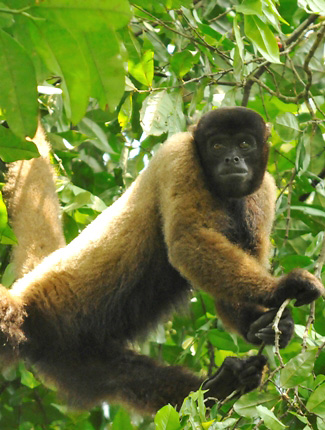
Woolly Monkey by Marie-France Grenouillet.
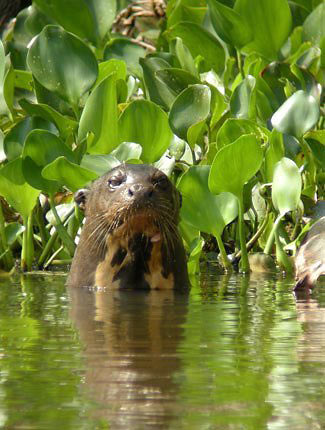
Giant Otter by Chris Townend.
- Tambopata, including Tambopata NR and Research Center (Explorers Inn), Posada Amazonas and Refugio Amazonas Not on the main circuit and virtually the same wildlife as Manu but the Rio Tambopata is arguably even richer with over 550 bird species recorded within a three-mile radius of Explorers Inn alone. A better chance of seeing Razor-billed Curassow and White-winged Trumpeter, the most spectacular clay lick in Amazonia (the Ccollpa de Guacamayos, usually at its best for most macaws and parrots May-Sep, and Jan, with Blue-and-yellow, Blue-headed, Red-and-green and Scarlet Macaws, White-bellied Parrot, Amazonian Parrotlet and Black-capped Parakeet) and an Agami Heron colony (at Cocha Coco, usually occupied Jan-Feb). Also Orinoco Goose, Sungrebe, Hoatzin, Long-tailed Potoo, Festive Coquette, Pavonine Quetzal, Great Jacamar, Semicollared and Striolated Puffbirds, White-fronted Nunbird, Ringed Antpipit, Bare-necked Fruitcrow, Band-tailed and Round-tailed Manakins, Brazilian Tapir and Giant Otter, a chance of Harpy Eagle, and an outside chance of Grey-bellied Hawk, Rufous-vented Ground-cuckoo and Short-eared Dog.
- Iberia and Tipishca around Puerto Maldonado Specialities including Black-banded Crake, Purus and White-throated Jacamars, Rufous-capped Nunlet, Rufous Twistwing, Humaita Antbird, Rufous-fronted Antthrush, Long-crested Pygmy-tyrant, White-cheeked Tody-flycatcher and Black-faced Cotinga.
- Saona Lodge near Puerto Maldonado along Tambopata River Specialities including Rufous-headed Woodpecker.
- Los Amigos Biological Station Also not on the main circuit but like Tambopata accessible from Puerto Maldonado (three hours by water taxi along Madre de Dios River) and a good site for White-browed Hawk, White-winged Trumpeter, Flammulated Tody-tyrant, Bamboo Antshrike, Peruvian Recurvebill and Round-tailed Manakin. Also a chance of Harpy and Crested Eagles, Emperor Tamarin, Black Spider Monkey and Gray's Bald-faced Saki.
- Lago Soledad Lodge – formerly Amazon Rainforest Conservation Center (ARCC) – near banks of Las Piedras River A 35-metre canopy tower, four clay-licks nearby which attract Red-and-green Macaws etc. and 619 bird species recorded in the area including White-winged Trumpeter, Black-faced and Plum-throated Cotingas, many antbirds, bamboo specialists such as Humaita Antbird, Peruvian Recurvebill and Rufous Twistwing, as well as Giant Otter.
Best Times for Birds and other wildlife in Manu - Southern Peru
The dry season usually lasts from May to October and this is the best time to visit, especially August-September when activity usually peaks at the Andean Cock-of-the-rock lek and the clay licks, which large flocks of parrots and macaws visit daily, are busy. These clay licks are usually used mostly during the dry season. During the wet season the most rain usually falls from January to March.
Recommended Bird Books etc. for Manu - Southern Peru
Birds of Peru by T S Schulenberg et al. Helm, 2010 (Second Edition).
Birds of South America: Non-Passerines by J R Roderiguez Mata et al. Harper Collins, 2006 hbk/Princeton University Press, 2006 pbk.
Birds of South America: Passerines by R S Ridgely and G Tudor. University of Texas Press/Helm, 2009 (Updated paperback edition of books listed next with 400 more illustrations).
The Birds of South America: Passerines by R S Ridgely and G Tudor. University of Texas Press, 1989 and 1994 (Two volumes).
Where to Watch Birds in Peru by T Valqui. Valqui, 2004.
Mammals of South America by R D Lord. Johns Hopkins University Press, 2007.
Monkeys of Peru: Pocket Identification Guide by R Aquino Y et al. Conservation International, 2015.
Travellers' Wildlife Guides: Peru by D Pearson and L Beletsky. Interlink Books, 2015 (Second Edition).
Bradt Wildlife Guide: Peruvian Wildlife by G Cheshire, H Lloyd and B Walker. Bradt Travel Guides, 2007.
Where to watch birds in South America by N Wheatley. Helm, 1994.
Don’t know which country/countries to visit in South America? Then it may be worth considering taking a look at this book, written by this website’s author. It is many years old of course but it still provides a starting point, an overview and a guiding light to the best birds and the best places to look for them on the continent, and could save hours of searching for similar information on the internet. However, it is important to check more up-to-date sources for sites which have been opened up, sites and species which have been discovered, lodges that have been built etc. since the book was published.
Birding and Wildlife Trip Reports for Manu - Southern Peru
Many trip reports, some for Southern Peru, are posted on the websites listed here. On some of these websites some reports are independent and some are posted by tour companies who organize tours to Southern Peru. These tour companies and others also post their own reports on their websites, which are listed under 'Some Organized Tours to Southern Peru' below.
- The best website for trip reports is CloudBirders
- but these are also worth a look
- Birdtours
- Fatbirder
- Jon Hornbuckle
- Mammal Watching
Local bird and wildlife guides in Manu - Southern Peru
The costs of organized tours partly reflect the quality of the tour leaders. Some leaders are certainly better than others and many companies claim their leaders are the best but even the best rely at least to some extent on the exceptional skills of the local guides they employ. If you are travelling independently, employing such local guides will greatly increase your chances of seeing the wildlife you wish to see.
- Peru Birding Tours
- We at Peru Birding Tours design, organize and run enjoyable and successful birding, photography and nature tours throughout Peru and South America, visiting the best places for birds and wildlife, and we look forward to welcoming and guiding you.
Accommodation for birders in Manu - Southern Peru
Some Organized Tours for birds and other wildlife to Manu - Southern Peru
There are many tour companies who organize tours to see mammals, birds, other wildlife and other natural wonders. The cost of these tours vary considerably according to such variables as the airlines used, the number of days the tours last, the number of sites visited, the number of people in the group (an important consideration if you wish to see such wildlife as rainforest mammals and birds), the number of tour leaders, the standard of accommodation and transport, and the percentage profit the company hopes to make. Generally, where the number of days tours last and the number of sites visited are similar, the cheapest tours are those that use the cheapest airlines, accommodation and local transport, that have the largest groups with the least number of leaders, and that make the least amount of profit. The most expensive tours tend to be those which are exceptionally long, use the most expensive accommodation (ridiculously lavish in some cases, even for single nights) and which make the most profit. Some tour costs partly reflect the quality of the tour leaders. Some leaders are certainly better than others and many companies claim their leaders are the best but even the best rely at least to some extent on the exceptional skills of the local guides they employ.
While tour companies organize tours with set itineraries many also organize custom tours for individuals and private groups who instead of taking a tour with a set itinerary want to follow their own itinerary to suit their own personal tastes, whether it be mammals, birds, other wildlife, other natural wonders or even man-made attractions, or a mixture of them all. Many organized tours with set itineraries are also fast-paced and target as many species as possible, whether they are mammals, birds or other wildlife or everything, which usually leaves little time to enjoy the best sites and individual species, but on a custom tour those taking part can specify the pace and the sites and species they wish to concentrate on. Custom tours also suit people who like to travel with people they already know, rather than with a group of strangers, and people with partners with different interests. Individuals and small groups will almost certainly have to pay more than the price of an organized tour with a set itinerary but a large group of friends may be able to travel for less than the price quoted for a set tour.
Tour companies who run organized tours or can arrange custom tours to Southern Peru include the following.
