
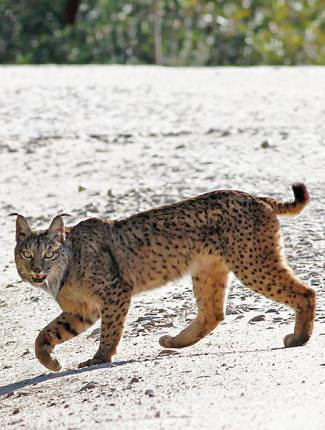
Iberian Lynx in Southern Spain by Chris Townend.
- A good chance of Iberian Lynx, one of the rarest cats in the world
- The most spectacular visible migration of storks and raptors in Europe, involving great numbers and great views of White Storks, Griffon and Egyptian Vultures, Short-toed and Booted Eagles, European Honey-buzzards and Montagu’s Harriers
- Some of Europe’s most spectacular localized birds including Marbled Teal, White-headed Duck, Black-shouldered Kite, Spanish Imperial Eagle, Western Swamphen, Audouin’s Gull and Iberian Azure-winged Magpie
- And some of Europe’s and the world’s other most spectacular birds such as
Greater Flamingo, Cinereous Vulture
and Golden Eagle - As well as a chance of Killer and Pilot Whales, and Bottlenose, Common and Striped Dolphins
- All in some superb settings, from the marismas of the Coto Donana where 127 bird species breed through rugged mountain gorges with a rich flora and numerous butterflies to the Mediterranean
- The Iberian Lynx is a small well-camouflaged cat up to about a metre long and 60 cm at the shoulder. It caan be highly elusive but there is a very good chance of seeing one in Sierra de Andujar Natural Park just two to three hours by road from Malaga or Seville. In order to stand a chance though it is best to be prepared to spend many hours scanning distant wooded, rugged, rocky slopes with binoculars and telescopes from roadside viewpoints, especially early and late in the day when it can be chilly, so warm clothing and something to sit on are recommended. 200 were released into the wild on the Iberian Peninsula between 2009 and 2017 and by the end of 2017 there were an estimated 350+ non-captive animals in Spain and Portugal.
- Other destinations in Spain include Extremadura where Spanish Ibex, Spanish Imperial Eagle, Black-shouldered Kite, and Great and Little Bustards occur; the Pyrenees of Northern Spain where high mountain birds include Lammergeier and Wallcreeper; and Northwestern Spain where Brown Bear and Wolf occur.
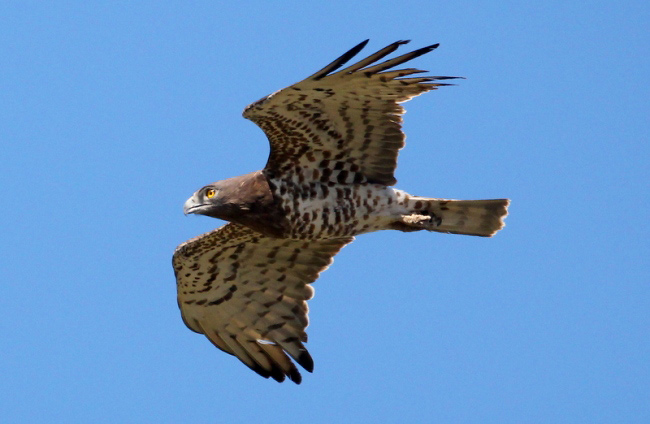
Raptors migrating across the Strait of Gibraltar can be seen at very close quarters in the Tarifa area where this Short-toed Eagle flew past Spider one spring.
Best Birds and other wildlife in Southern Spain
Birds
The birds listed here are usually present during September.
Near-endemics
Spain and Portugal 2 Spanish Imperial Eagle and Iberian Azure-winged Magpie.
Spain, Portugal and France 2 Iberian Green Woodpecker and Iberian (Southern) Grey Shrike.
Other specialities
Barbary Partridge, Marbled Teal, White-headed Duck, Greater Flamingo, Cinereous (Eurasian/Black) and Griffon Vultures,
Black-shouldered Kite, Western (Purple) Swamphen, Red-knobbed Coot, Audouin's Gull, Red-necked Nightjar, Black Wheatear,
Spotless Starling and Rock Sparrow.
Also a chance of Ruppell’s (Griffon) Vulture, Pin-tailed Sandgrouse, Little and White-rumped Swifts, and, in winter, Wallcreeper.
Others
Red-legged Partridge, Red-crested Pochard, Black-necked (Eared) Grebe, Balearic and Scopoli’s (Cory's) Shearwaters,(Northern)
Gannet, (Black-crowned) Night, Purple and Squacco Herons, Little Bittern, Glossy Ibis, Eurasian Spoonbill, White Stork, Black and
Red Kites, Egyptian Vulture, Golden, Short-toed and Booted Eagles, (European) Honey-buzzard, Montagu’s Harrier, Lesser Kestrel,
(Pied) Avocet, Black-winged Stilt, Slender-billed Gull, Black and Whiskered Terns, Little Owl, Alpine and Pallid Swifts, (European)
Bee-eater, (Eurasian) Hoopoe, Calandra, Greater Short-toed, Lesser Short-toed and Thekla Larks, (Eurasian) Crag Martin, Crested and
Penduline Tits, Firecrest, Zitting Cisticola (Fan-tailed Warbler), Sardinian Warbler, Blue Rock-thrush, Rock Bunting and Spanish
Sparrow.
Summer visitors which may have left by September include Collared Pratincole, Woodchat Shrike, Red-rumped Swallow, Rufous-tailed Scrub-robin (Rufous Bush Chat), Iberian Chiffchaff, and Western Bonelli's, Great Reed, Melodious, Western Olivaceous, Savi's and Spectacled Warblers.
Also a chance of Black Stork, Bonelli’s Eagle, Gull-billed Tern, Eurasian Eagle-owl and, in winter, Common Crane. Around Barbate on the south coast Northern Bald Ibis is being reintroduced.
Mammals
A good chance of Iberian Lynx, Killer (mostly mid-Aug to early Sep) and (Long-finned)
Pilot Whales, Bottlenose, Common and Striped Dolphins, Spanish Ibex, Wild Boar and Red Deer. Also Barbary Macaque (on Gibraltar, where possibly
introduced) and a chance of Mouflon and Egyptian Mongoose.
Reptiles, Amphibians and Fish
Mediterranean Chameleon, Moorish Gecko, Large and Spanish Psammodromuses,
and Ocellated and Spiny-footed Lizards.
Invertebrates
The many butterflies include Monarch and Two-tailed Pasha.
Plants
There are over 2300 vascular plant species in Andalucia alone and the flora is particularly
rich around Ronda where there are many orchids, narcissi, fritillaries, saxifrages and toadflaxes.
Other Natural Wonders in Southern Spain
Cueva de la Pileta
This cave near Benaojan has some superb stalactites and stalagmites, as well as some
impressive Palaeolithic cave paintings.
Best Sites for Birds and other wildlife in Southern Spain
- Sierra de Andujar Natural Park (Sierra Morena) A good chance of Iberian Lynx, Spanish Ibex (easiest to find on the almost vertical walls of the La Lancha Dam), Wild Boar, Red Deer, Spanish Imperial and Golden Eagles, Cinereous and Griffon Vultures, Iberian Azure-winged Magpie, Rock Bunting and Rock Sparrow. Also a chance of Mouflon.
- La Laguna de Fuente de la Piedra Greater Flamingo, shorebirds and Common Crane (large numbers in winter).
- Sierra de Aracena Natural Park Egyptian Mongoose, Wild Boar, White Stork, Cinereous and Griffon Vultures, and Golden Eagle. Also, in summer, a chance of Black Stork and Red-necked Nightjar.
- Coto Donana Area Greater Flamingo, White Stork, Spanish Imperial, Short-toed and Booted Eagles,
Black-shouldered Kite (Corredor de Verde), herons, Glossy Ibis, Western Swamphen, Marbled Teal,
White-headed Duck and Red-knobbed Coot.
Also a chance of Pin-tailed Sandgrouse and Lesser Short-toed Lark. - Laguna de Medina White-headed Duck and other waterbirds.
- Bonanza Saltpans Marbled Teal, Western Swamphen, Slender-billed Gull and other waterbirds including a chance of Audouin's Gull.
- Chipiona A chance of Little Swift around the harbour.
- La Janda Black-shouldered Kite, Calandra Lark and Spanish Sparrow.
- Tarifa Area Visible migration, mainly storks and raptors, and especially from Cazalla, high above the town of Tarifa where there is an information centre and Fundacion Migres carry out their counts. In westerly winds El Algarrobo may be better and if the weather is too bad for migration altogether birds often wait for better conditions in the Ojen Valley about 30 km north of Tarifa where it is also possible to see White-rumped Swift. Migrating birds include White Stork (mostly early Aug), Black Stork (mostly late Sep), Egyptian Vulture (mostly late Sep), Griffon Vulture (mostly Nov), Black Kite (mostly early Aug), European Honey-buzzard (mostly late Aug-early Sep), Booted (mostly late Sep) and Short-toed (mostly late Sep) Eagles, Lesser Kestrel (mostly late Sep) and Red Kite (mostly Oct). Also a chance of Ruppell's Vulture.
- Boat Trips out of Tarifa A chance of Killer and Pilot Whales, Bottlenose, Common and Striped Dolphins, and Balearic and Scopoli’s Shearwaters.
- Gibraltar Barbary Macaque and Barbary Partridge. Also a chance of Eurasian Eagle-owl.
- Ronda Area Spanish Ibex, Griffon Vulture, Black Wheatear, Rock Bunting and a rich flora. Also a chance of Bonelli’s Eagle.
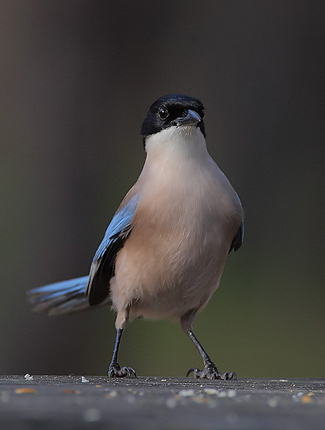
Iberian Azure-winged Magpie by Steve Fletcher, a bird now considered to be a full species by some authorities.
Best Times for Birds and other wildlife in Southern Spain
Early September is one of the best times to visit Southern Spain, because (i) the beginning of September is normally the time when the greatest numbers and variety of storks and raptors migrate over the Strait of Gibraltar; (ii) Killer Whales are most likely to occur from mid-August to early September; and (iii) it is almost as good a time as any to look for Iberian Lynx (the best being late September to March (the peak time for spring flowers), especially December-March, possibly because the breeding season usually starts in December-January and the cats are more active).
The spring migration of birds through Southern Spain usually peaks between mid-April and early May, when the Coto Donana is arguably at its best. After dry summers the marismas of this wonderful wetland may be almost dry.
Recommended Bird Books etc. for Southern Spain
Collins Bird Guide by L Svensson et al. Collins, 2010 (Second Edition).
Birds of Europe by L Jonsson. Helm, 1999.
Where to Watch Birds in Southern and Western Spain by E Garcia and A Paterson. Helm, 2019 (Fourth Edition).
Where to watch Birds in Donana by F C Moreno and J G Gutierrez. Lynx Edicions, 2006.
Where to watch Birds in Spain by J A Montero and SEO/Birdlife. Lynx Edicions, 2006.
Finding Birds in Andalucia by D Gosney. Easybirder, 2009 (book and/or DVD).
Collins Butterfly Guide by T Tolman and R Lewington. Collins, 2009 (Third Edition).
Butterflies of Britain and Europe: A Photographic Guide by H Aarnio et al. A & C Black Publishers, 2009.
Wild Flowers of the Mediterranean by M Blamey and C Grey-Wilson. A & C Black, 2004.
Mammals of Europe, North Africa and the Middle East by S Aulagnier et al. Helm, 2009.
Mammals of Britain and Europe by D McDonald and P Barrett. Collins, 2005.
Portrait of a Wilderness by G Mountfort. Hutchinson, 1958.
Apps etc.
Collins Bird Guide.
Where to watch birds in Europe & Russia by N Wheatley. Helm, 2000.
Don’t know which country/countries/regions to visit in Europe? Then it may be worth considering taking a look at this book, written by this website’s author. It is many years old of course but it still provides a starting point, an overview and a guiding light to the best birds and the best places to look for them in the region, and could save hours of searching for similar information on the internet. However, it is important to check more up-to-date sources for sites which have been opened up, sites and species which have been discovered, lodges that have been built etc. since the book was published.
Birding and Wildlife Trip Reports for Southern Spain
Many trip reports, some for Southern Spain, are posted on the websites listed here. On some of these websites some reports are independent and some are posted by tour companies who organize tours to Southern Spain. These tour companies and others also post their own reports on their websites, which are listed under 'Some Organized Tours to Southern Spain' below.
- The best website for trip reports is CloudBirders
- but these are also worth a look
- Birdtours
- Fatbirder
- Jon Hornbuckle
- Mammal Watching
Local bird and wildlife guides in Southern Spain
The costs of organized tours partly reflect the quality of the tour leaders. Some leaders are certainly better than others and many companies claim their leaders are the best but even the best rely at least to some extent on the exceptional skills of the local guides they employ. If you are travelling independently, employing such local guides will greatly increase your chances of seeing the wildlife you wish to see.
Accommodation for birders in Southern Spain
Some Organized Tours for birds and other wildlife to Southern Spain
There are many tour companies who organize tours to see mammals, birds, other wildlife and other natural wonders. The cost of these tours vary considerably according to such variables as the airlines used, the number of days the tours last, the number of sites visited, the number of people in the group (an important consideration if you wish to see such wildlife as rainforest mammals and birds), the number of tour leaders, the standard of accommodation and transport, and the percentage profit the company hopes to make. Generally, where the number of days tours last and the number of sites visited are similar, the cheapest tours are those that use the cheapest airlines, accommodation and local transport, that have the largest groups with the least number of leaders, and that make the least amount of profit. The most expensive tours tend to be those which are exceptionally long, use the most expensive accommodation (ridiculously lavish in some cases, even for single nights) and which make the most profit. Some tour costs partly reflect the quality of the tour leaders. Some leaders are certainly better than others and many companies claim their leaders are the best but even the best rely at least to some extent on the exceptional skills of the local guides they employ.
While tour companies organize tours with set itineraries many also organize custom tours for individuals and private groups who instead of taking a tour with a set itinerary want to follow their own itinerary to suit their own personal tastes, whether it be mammals, birds, other wildlife, other natural wonders or even man-made attractions, or a mixture of them all. Many organized tours with set itineraries are also fast-paced and target as many species as possible, whether they are mammals, birds or other wildlife or everything, which usually leaves little time to enjoy the best sites and individual species, but on a custom tour those taking part can specify the pace and the sites and species they wish to concentrate on. Custom tours also suit people who like to travel with people they already know, rather than with a group of strangers, and they are popular with people with partners with different interests. Individuals, partners and small groups will almost certainly have to pay more for a custom tour than an organized tour with a set itinerary but a large group of friends may be able to travel for less than the price quoted for a set tour.
Tour companies who run organized tours to Southern Spain include the following. Many of these also offer custom tours.
- Eagle-Eye Tours
- Julian Sykes Wildlife Holidays
- New Horizons
- Victor Emanuel Nature Tours
- Wildlife Travel
- Wingspan Bird Tours
- Wise Birding Holidays
- We are a small wildlife watching holiday company based in Devon (UK) specialising in birdwatching and mammal watching holidays across the world. What sets us apart from other wildlife watching companies is quite simple:
- 1 – small group sizes: (average between 4 – 8 people)
- 2 – a commitment to conservation: (donation after each tour)