
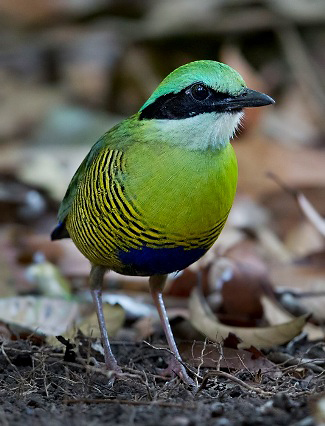
A male Bar-bellied Pitta, captured by Lars Petersson, from a hide at a 'feeding station' in Cat Tien National Park.
- Some of Asia’s and the world’s most spectacular localized birds, endemic to Vietnam and adjacent countries in Indochina, including Bar-bellied and Blue-rumped Pittas, Collared Treepie, Golden-winged and Orange-breasted Laughingthrushes, Vietnamese Cutia and Grey-crowned Crocias
- And a long list of classic fabulous South East Asian birds such as trogons, broadbills, hornbills, leafbirds, minivets and babblers
- As well as some of the most beautiful primates in the world including Buff-cheeked Gibbon, Black-shanked and Red-shanked Douc Langurs, and Delacour’s and Hatinh Langurs
- In a one thousand mile long country with scattered fragments of fine forests where the monkeys and birds live alongside flying lizards and numerous brilliant butterflies
- Some tour companies include Laos in their itineraries to Vietnam, or offer a visit there as an extension. In the beautiful karst limestone hills of the Annamite mountain range near the village of Ban Na Hin it is possible to see the endemic Bare-faced Bulbul, as well as the near-endemic Sooty Babbler, and Orange-breasted and Red-headed Trogons, Long-tailed Broadbill and Sultan Tit, and there is an outside chance of Lao Langur and even Red-collared Woodpecker. Laos is also a good place to see Jerdon’s Bushchat.
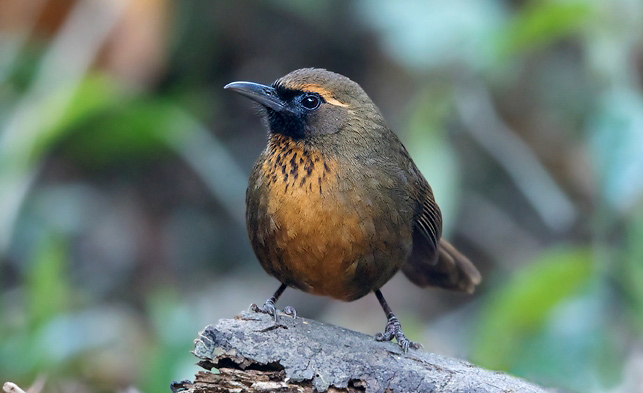
A fine image of an Orange-breasted Laughingthrush at Ta Nung by Dubi Shapiro.
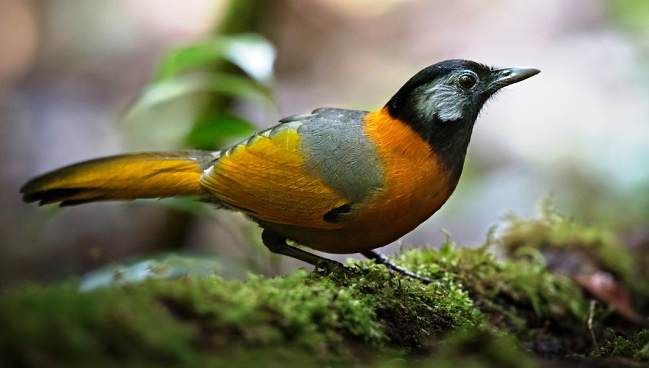
Another fine image, this time of a Collared Laughingthrush on the Da Lat Plateau by Lars Petersson.
Best Birds and other wildlife in Vietnam
Birds
The birds listed are usually present during the northern winter.
Endemics 11 Tonkin (Scaly-breasted) Partridge, Edward’s Pheasant, Annam (Brown) Prinia, Annam Grasshopper-warbler (Dalat Bush-warbler), Black-crowned (Rufous-winged) Fulvetta, White-throated (Long-billed) Wren-babbler (Fan Si Pan Mountains in northwest), Orange-breasted (Spot-breasted) Laughingthrush, Golden-winged (Chestnut-crowned) Laughingthrush, Collared Laughingthrush, Grey-crowned Crocias and Vietnamese Greenfinch.
Near-endemics
Vietnam and Cambodia 4 Orange-necked Partridge, Germain’s Peacock-pheasant, Dalat (White-browed) Shrike-babbler and Black-headed Parrotbill.
Vietnam and Laos 8 Necklaced Barbet, Indochinese Fulvetta, Sooty Babbler, Indochinese Wren-babbler (Short-tailed Scimitar-babbler), Vietnamese Cutia, Black-hooded Laughingthrush, Chestnut-eared Laughingthrush and Black-crowned Barwing.
Vietnam, Cambodia and Laos 6 Giant Ibis, Red-vented Barbet, Annam Barbet, Grey-crowned (Black-throated) Tit, Grey-faced Tit-babbler and White-cheeked Laughingthrush.
Vietnam, Laos and Malay Peninsula 1 Crested Argus.
Vietnam, Cambodia, Laos and Kalimantan (Indonesia) 1 White-shouldered Ibis.
Vietnam, Cambodia, Laos and Thailand 2 Coral-billed Ground-cuckoo and Mekong Wagtail.
Vietnam, Cambodia, Laos and China 1 Red-collared Woodpecker.
Vietnam, Cambodia, China and Myanmar 1 Chinese Grass-bird.
Vietnam, Laos, China and Mynamar 1 Black-streaked Scimitar-babbler.
Vietnam, Laos and China 7 White-winged Magpie, Limestone Leaf-warbler, David’s (Grey-cheeked) Fulvetta, Chinese Hwamei, Rufous-cheeked Laughingthrush (Hainan Island, China), Yellow-billed Nuthatch (Hainan Island, China) and Fork-tailed Sunbird.
Vietnam and China 11 White-eared Night-heron, Collared Crow, Chestnut Bulbul, Ashy-throated Parrotbill, Pale-throated Wren-babbler, Grey Laughingthrush, Eastern Moustached Laughingthrush, Masked Laughingthrush, Red-winged Laughingthrush, Streaked Barwing and Sichuan Forest (Alpine) Thrush.
Vietnam, China and Myanmar 1 White-collared Yuhina.
Vietnam, China and and Taiwan 4 Chinese (Yellow-bellied) Prinia, Collared Finchbill, Dusky Fulvetta and Red-billed Starling.
Other specialities
Green-legged (Annam) Partridge, Silver Pheasant, Siamese Fireback, Green Peafowl, Black-faced Spoonbill, White-faced Plover, Spoon-billed Sandpiper,
Saunders's Gull, Pale-capped Pigeon, Heart-spotted Woodpecker, Annam (Black-browed/Indochinese) Barbet, Bar-bellied and Blue-rumped Pittas, Ratchet-tailed
Magpie, Collared Treepie, Grey-headed Parrotbill and Red-tailed Laughingthrush. Also a chance of White-rumped Pygmy-falcon, Black-headed Woodpecker,
Blue, Blue-naped, Eared and Rusty-naped Pittas, and Green and Purple Cochoas.
Others
Red Junglefowl, Chinese Pond-heron, Lesser Adjutant, Pied Falconet, Black Baza, Black, Lesser Fish and Rufous-bellied Eagles, Grey-headed Lapwing,
green-pigeons, Vernal Hanging-parrot, Red-breasted Parakeet, Asian Emerald, Banded Bay, Violet and Whistling (Hodgson’s) Hawk Cuckoos, Green-billed
Malkoha, Collared Owlet, Great Eared-nightjar, Germain’s Swiftlet, Silver-backed Needletail, Orange-breasted and Red-headed Trogons, Banded, Pied,
Stork-billed and White-breasted (Smyrna) Kingfishers, Blue-bearded and Chestnut-headed Bee-eaters, Indochinese Roller, Great and Oriental Pied Hornbills,
Coppersmith and Green-eared Barbets, White-browed Piculet, Greater and Lesser Yellownapes, Common and Greater Flamebacks, Black-and-buff and Great Slaty
Woodpeckers, Banded, Black-and-red, Dusky, Long-tailed and Silver-breasted Broadbills, minivets including Brown-rumped and Rosy, Ashy Woodswallow,
Common and Great Ioras, Burmese Shrike, Clicking (Chestnut-fronted) and White-browed Shrike-babblers, Maroon and Slender-billed Orioles, Red-billed Blue,
Common Green and Indochinese Green Magpies, Racquet-tailed Treepie, Greater Racquet-tailed and Lesser Racquet-tailed Drongos, Asian Paradise-flycatcher,
Sultan and Yellow-cheeked Tits, Velvet-fronted Nuthatch, bulbuls, tesias, leaf-warblers, Siberian Rubythroat, Siberian Blue Robin, Slaty-backed, Spotted
and White-crowned Forktails, flycatchers including Blue-and-white, Hainan Blue and Mugimaki, Large Niltava, White-rumped Shama, Black-breasted,
Grey-backed, Japanese, Orange-headed, Siberian and White’s Thrushes, laughingthrushes including White-crested, fulvettas, Spot-necked Babbler,
scimitar-babblers, Greyish Limestone-babbler (Limestone Wren-babbler), Silver-eared Mesia, Black-headed and Rufous-backed Sibias, leafbirds, Asian
Fairy-bluebird, Golden-crested Myna, Gould's Sunbird, Little and Streaked Spiderhunters, and Red Crossbill.
Also a chance of Chinese Egret, Collared Falconet, White-browed Crake, Pheasant-tailed and Bronze-winged Jacanas, Brown Wood-owl, Blyth’s and Hodgson’s Frogmouths, Pale-headed Woodpecker, Red-tailed Minla and Asian Golden Weaver.
Mammals
Buff-cheeked and Southern White-cheeked Gibbons, Black-shanked, Grey-shanked and Red-shanked Douc Langurs,
Annamese Silvered, Delacour’s and Hatinh Langurs, Long-tailed (Crab-eating), Pig-tailed and Stump-tailed Macaques, Indian Giant Flying Squirrel,
Black Giant Squirrel, Northern Tree Shrew, Common Palm Civet, Binturong, Sambar, Lesser Mouse Deer and Indian Muntjac. Also a chance of Indo Chinese
Black Langur and Pygmy Loris, an outside chance of the very rare Tonkin Snub-nosed Monkey which occurs at a few sites in the northeast, and it may
also be possible to obtain permits for restricted areas where it is possible to see Soala, Black Muntjac and Annamite Striped Rabbit.
Reptiles
Siamese Crocodile, flying lizards and Tockay Gecko.
Invertebrates
A rich diversity of butterflies including Common and Golden Birdwings, swallowtails, swordtails and Leaf
Butterfly.
Plants
The rich flora includes a Rafflesia; Sapria himalayana.
Other Natural Wonders of Vietnam
Ha Long Bay A beautiful bay with many towering karst limestone islands.
Hang Son Doong ('Mountain River Cave') This is the world's largest cave at 200 m (656 ft) high, 150 m (492 ft) wide and at least 6.5 km (4 miles) long.
Best Sites for Birds and other wildlife in Vietnam
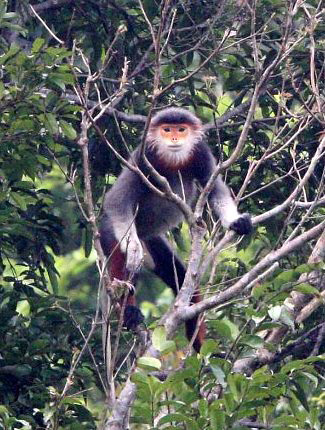
The handsome Red-shanked Douc Langur in the Son Tra Forest Reserve by Coke & Som Smith.
- Ba Be NP A chance of White-eared Night-heron.
- Tam Dao Red-headed Trogon, Long-tailed Broadbill, Chestnut Bulbul and Grey Laughingthrush. Also a chance of Blue-naped Pitta, and Green and Purple Cochoas.
- Mount Ba Vi NP Silver-breasted Broadbill, Rufous-cheeked Laughingthrush and thrushes. Also a chance of Collared Treepie and Green Cochoa.
- Van Long NR Delacour’s Langur. Also a chance of White-browed Crake and Pheasant-tailed Jacana.
- Cuc Phuong NP Pied Falconet, Silver-breasted Broadbill, Bar-bellied and Blue-rumped Pittas, Sultan Tit and Greyish Limestone-babbler. Also a chance of Silver Pheasant, Red-collared Woodpecker and Eared Pitta.
- Red River Delta including Xuan Thuy NP Black-faced Spoonbill, Spoon-billed Sandpiper, Saunders’s Gull and Red-billed Starling. Also a chance of Chinese Egret.
- Phong Nha-Ke Bang NP Bar-bellied and Blue-rumped Pittas, Sooty Babbler, Southern White-cheeked Gibbon, Hatinh Langur and Red-shanked Douc Langur. Also a chance of Indo Chinese Black Langur.
- Bach Ma NP Blue-rumped Pitta, Long-tailed Broadbill, Sultan Tit, Indochinese Wren-babbler, Buff-cheeked Gibbon and Stump-tailed Macaque. Also a chance of Crested Argus, Silver Pheasant, Hodgson’s Frogmouth and Pygmy Loris.
- Son Tra FR Red-shanked Douc Langur.
- Lang Co White-faced Plover.
- Loxo Pass and Mang Den FR Black-crowned Barwing (Loxo Pass), Yellow-billed Nuthatch, Buff-cheeked Gibbon and Grey-shanked Douc Langur. Also a chance of Crested Argus, Long-tailed Broadbill, Red-tailed Laughingthrush and Red-tailed Minla.
- Yok Don NP Mekong Wagtail, as well as a chance of White-rumped Pygmy-falcon, Collared Falconet and Black-headed Woodpecker.
- Da Lat Plateau including Mount Lang Bian (Bipoup-Nuiba NP), Ta Nung Valley and Deo Nui San Grey-crowned Crocias (Ta Nung Valley), Vietnamese Cutia, Black-hooded, Collared, Orange-breasted and White-cheeked Laughingthrushes, Long-tailed Broadbill, Slender-billed Oriole (Ho Tuyen Lam), Grey-crowned Tit, Indochinese Wren-babbler, Black-crowned Fulvetta, Black-headed Parrotbill, Gould's Sunbird and Vietnamese Greenfinch. Also a chance of Hodgson's Frogmouth, Blue Pitta and Green Cochoa.
- Cat Tien NP over 330 species of bird including Green Peafowl, Red Junglefowl, Lesser Fish-eagle, Orange-breasted Trogon, Stork-billed Kingfisher, Chestnut-headed Bee-eater, woodpeckers including Great Slaty and Heart-spotted, Great and Oriental Pied Hornbills, Banded, Black-and-red and Dusky Broadbills, Bar-bellied and Blue-rumped Pittas, Asian Fairy-bluebird, White-crested Laughingthrush and Grey-faced Tit-babbler, as well as Buff-cheeked Gibbon, Black-shanked Douc Langur, Annamese Silvered Langur, and Long-tailed and Pig-tailed Macaques. Also a chance of Germain’s Peacock-pheasant, Siamese Fireback, Lesser Adjutant, Blyth’s Frogmouth, Banded Kingfisher, Pale-headed Woodpecker and Asian Golden Weaver, as well as Pygmy Loris.
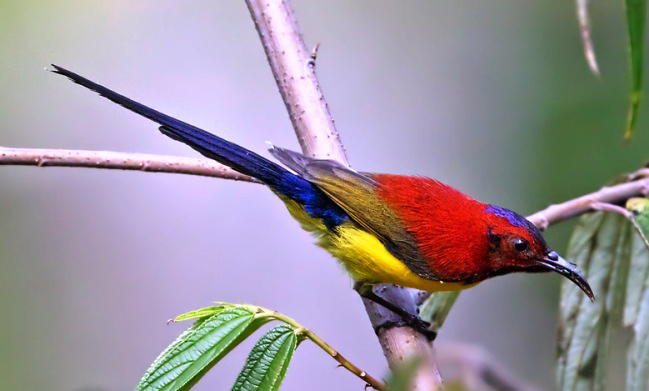
A male Gould's Sunbird on the Da Lat Plateau by Lars Petersson.
Best Times for Birds and other wildlife in Vietnam
February-March is the best time to look for birds, although some winter visitors may have already left by the end of March.
Recommended Bird Books etc. for Vietnam
Birds of South-East Asia by C Robson. Helm, 2018. (Second Edition)
Birds of South-East Asia Concise Edition by C Robson. Helm, 2015.
A Field Guide to the Mammals of South-East Asia by C M Francis. New Holland Publishers, 2008.
A Field Guide to the Reptiles of South-East Asia by I Das. Bloomsbury, 2015.
Where to watch birds in Asia by N Wheatley. Helm, 1996.
Don’t know which country/countries/regions to visit in Asia? Then it may be worth considering taking a look at this book, written by this website’s author. It is many years old of course but it still provides a starting point, an overview and a guiding light to the best birds and the best places to look for them in the region, and could save hours of searching for similar information on the internet. However, it is important to check more up-to-date sources for sites which have been opened up, sites and species which have been discovered, lodges that have been built etc. since the book was published.
Birding and Wildlife Trip Reports for Vietnam
Many trip reports, some for Vietnam, are posted on the websites listed here. On some of these websites some reports are independent and some are posted by tour companies who organize tours to Vietnam. These tour companies and others also post their own reports on their websites, which are listed under 'Some Organized Tours to Vietnam' below.
- The best website for trip reports is CloudBirders
- but these are also worth a look
- Birdtours
- Fatbirder
- Jon Hornbuckle
- Mammal Watching
Local bird and wildlife guides in Vietnam
The costs of organized tours partly reflect the quality of the tour leaders. Some leaders are certainly better than others and many companies claim their leaders are the best but even the best rely at least to some extent on the exceptional skills of the local guides they employ. If you are travelling independently, employing such local guides will greatly increase your chances of seeing the wildlife you wish to see.
Accommodation for birders in Vietnam
Some Organized Tours for birds and other wildlife to Vietnam
There are many tour companies who organize tours to see mammals, birds, other wildlife and other natural wonders. The cost of these tours vary considerably according to such variables as the airlines used, the number of days the tours last, the number of sites visited, the number of people in the group (an important consideration if you wish to see such wildlife as rainforest mammals and birds), the number of tour leaders, the standard of accommodation and transport, and the percentage profit the company hopes to make. Generally, where the number of days tours last and the number of sites visited are similar, the cheapest tours are those that use the cheapest airlines, accommodation and local transport, that have the largest groups with the least number of leaders, and that make the least amount of profit. The most expensive tours tend to be those which are exceptionally long, use the most expensive accommodation (ridiculously lavish in some cases, even for single nights) and which make the most profit. Some tour costs partly reflect the quality of the tour leaders. Some leaders are certainly better than others and many companies claim their leaders are the best but even the best rely at least to some extent on the exceptional skills of the local guides they employ.
While tour companies organize tours with set itineraries many also organize custom tours for individuals and private groups who instead of taking a tour with a set itinerary want to follow their own itinerary to suit their own personal tastes, whether it be mammals, birds, other wildlife, other natural wonders or even man-made attractions, or a mixture of them all. Many organized tours with set itineraries are also fast-paced and target as many species as possible, whether they are mammals, birds or other wildlife or everything, which usually leaves little time to enjoy the best sites and individual species, but on a custom tour those taking part can specify the pace and the sites and species they wish to concentrate on. Custom tours also suit people who like to travel with people they already know, rather than with a group of strangers, and people with partners with different interests. Individuals and small groups will almost certainly have to pay more than the price of an organized tour with a set itinerary but a large group of friends may be able to travel for less than the price quoted for a set tour.
Tour companies who are running organized tours to Vietnam in the next couple of years include the following. Many of these also offer custom tours.
