
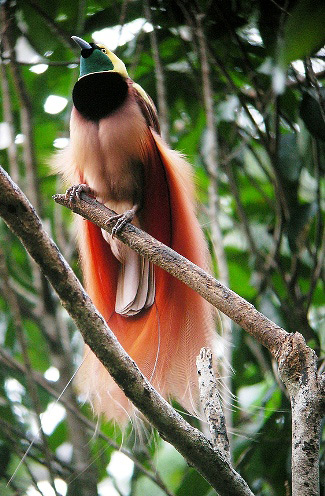
A fabulous Raggiana Bird-of-paradise in its traditional display tree at Varirata National Park, Papua New Guinea, by Mark Harper.
AUSTRALASIA and OCEANIA
The destinations listed and linked below are the ones we believe are the best in Australasia and Oceania. They have been chosen very carefully and for a multitude of reasons, but mainly based on personal experience of some of them and on dreams of visiting the rest, dreams resulting from what we have heard, read or seen.
It is our intention to update this list regularly as we add destinations and it was last updated in May 2021.
If there are any other destinations you think should be on the list below then please feel free to Email us.
The destinations are listed alphabetically with very brief summaries for those linked, in dark blue, to more detailed pages (to reach these pages click on the destination name). Those not linked to more detailed pages are described in a bit more detail here, in italics, under light blue headings.
For more information see ...
The Best (100) Birds in the World,
The Best (100) Wildlife in the World and
Best (50) Other Natural Wonders.
Destinations
The first and arguably most important destination to consider is a Local Patch, somewhere a short walk from home where it is possible to see a wide range of birds and other wildlife any day of the year.
A
American Samoa (for Western Samoa see Samoa, below)
American Samoa supports three Samoan endemics shared with (Western) Samoa; Samoan (Crimson-crowned) Fruit-dove, Samoan (Cardinal) Myzomela and Samoan
Starling, as well as Blue-crowned Lorikeet, Many-coloured Fruit-dove, Polynesian Wattled Honeyeater, the powelli race of Fiji Shrikebill on the islands of
Ta'u and Ofu-Olosega which some taxonomists believe to be a full species, and Polynesian Starling, while the many seabirds breeding on Rose Atoll NWR
include Red-tailed Tropicbird, boobies, frigatebirds, noddies, and Sooty and Common White Terns.
Australia - Eastern (Queensland)
Platypus, Koala, the Great Barrier Reef and over 50 birds endemic to eastern Australia including Albert's and Superb Lyrebirds, Rufous Scrub-bird,
Paradise and Victoria's Riflebirds, Golden, Regent and Satin Bowerbirds, and Chowchilla, as well as more widespread spectacular birds such as
Southern Cassowary.
Australia - Northern
Saltwater Crocodiles in Kakadu and nearly 30 birds endemic to north and northwest Australia including Hooded Parrot, Rainbow Pitta, Purple-crowned
Fairy-wren, White-throated Grasswren and Gouldian Finch, amongst more widespread species such as Pied Heron and Blue-winged Kookaburra.
Australia - Northwestern
Tens of thousands of wintering shorebirds at Broome including Oriental Plover, Little Curlew, Great Knot and Asian Dowitcher, and localised endemics like
Black Grasswren in the remote Kimberley.
Australia - Outback
Red Kangaroo and endemic Australian birds including Emu, Malleefowl, Letter-winged Kite, Banded Stilt, Red-necked Avocet, Inland Dotterel, Major
Mitchell’s Cockatoo, Chestnut-breasted Whiteface and several grasswrens, in some superb desert locations where at night there seems to be more stars than
sky.
Australia - Southeastern (Victoria-Tasmania)
Platypus, Koala, Tasmanian Devil, kangaroos, wombats and over 30 birds endemic to the region including 14 on Tasmania, birds such as Cape Barren Goose,
Gang-gang Cockatoo, Superb Parrot, Rufous Bristlebird, Regent Honeyeater, Pilotbird, Rockwarbler, Flame and Pink Robins, and, on Tasmania only,
Forty-spotted Pardalote.
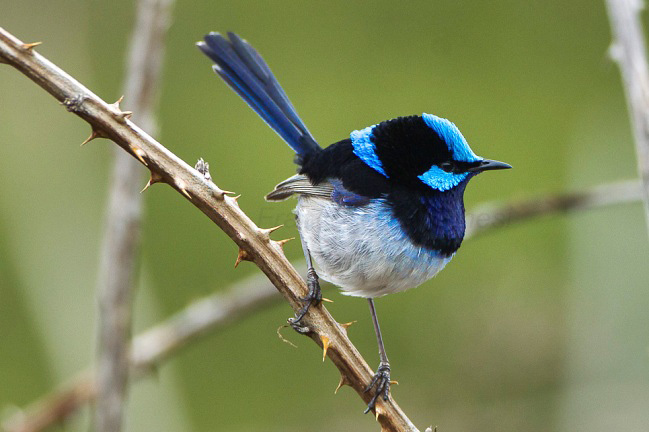
A male Superb Fairy-wren, one of several brilliant fairy-wrens in Australia, by Francesco Veronesi.
Australia - Western
Dugong, Whale Shark, Manta Ray, Numbat, Honey Possum and over 20 birds endemic to western Australia including Long-billed and Short-billed Black-cockatoos,
Noisy Scrub-bird, Blue-breasted and Red-winged Fairy-wrens, Western Bristlebird, Western Spinebill and Western Whipbird.
C
Caroline Islands
See Micronesia, below.
Chatham Islands, New Zealand
This remote archipelago about 800 km east of the main islands of New Zealand supports eight endemic birds; Chatham Pigeon, Chatham Shag, Pitt (Island)
Shag, Chatham Oystercatcher, Chatham Snipe, Chatham Parakeet, Chatham Gerygone and Black Robin, as well as Chatham (White-capped) Albatross which breeds
only on Pyramid Rock (mostly Sep-Apr), Chatham Petrel which breeds mainly on Rangatira (mostly Jan-May) and Magenta Petrel, also known as Taiko. It
is possible to see some of these birds by volunteering to help out with ongoing management and research projects on small islands such as Mangere, a strict
nature reserve where Chatham Snipe, Chatham and Red-fronted Parakeets, hybrids between the two, and Black Robin occur, as well as Shore Plover, the endemic
race of Tomtit, and Tui. Another way to see some of the birds of the Chatham Islands is to go on a cruise from New Zealand to the Subantarctic Islands of
Australia and New Zealand during which it is possible, in Zodiacs, to get close enough to Rangatira (also known as Southeast Island, where landings are not
permitted) to see Pitt Shag, Chatham Oystercatcher and Shore Plover, as well as Tomtit and Tui. On the main Chatham Island it is possible to see Chatham
Shag, Chatham Pigeon and Chatham Gerygone, as well as Little Penguin.
Christmas Island
Millions of migrating Red Crabs, giant Coconut Crabs, coral reef fish, Whale Sharks, Manta Rays, ‘golden’ White-tailed Tropicbirds, two endemic breeding
seabirds (Christmas Frigatebird and Abbott’s Booby), and four endemic landbirds; an imperial-pigeon, a swiftlet, a boobook and a white-eye.
F
Fiji
Quintessential tropical islands with fantasy fish on the coral reefs and outrageous endemic birds with some of the 35 being Golden, Orange and Whistling
Doves, Crimson, Masked and Maroon Shining-parrots, Collared Lory, Azure-crested and Chestnut-throated Flycatchers, two silktails and Fiji Parrotfinch, as
well as spectacular seabirds including Red-tailed and White-tailed Tropicbirds, Red-footed Booby and Sooty Tern.
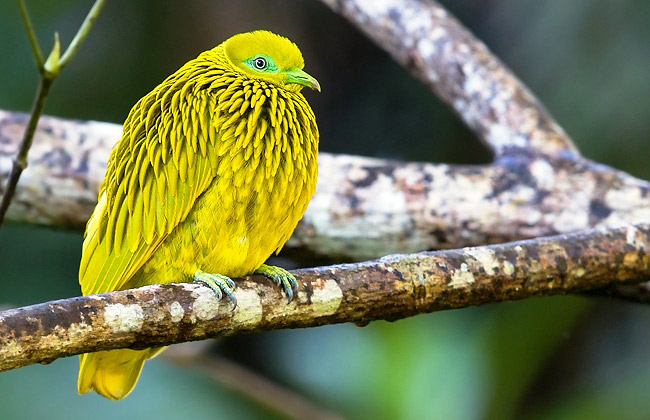
The astonishing Golden Dove is endemic to Fiji where this image was taken by Dubi Shapiro.
French Polynesia
Lots of seabirds including Polynesian Storm-petrel, Tahiti Petrel and Common White Tern, wintering Bristle-thighed Curlews, and 31 endemic birds including
Tuamotu Sandpiper, with eight on the Society Islands including Moorea and Tahiti Kingfishers, seven across the Tuamotu Archipelago also including
Polynesian Ground-dove and two fruit-doves, the 12 on the Marquesas Islands including Ultramarine Lorikeet and four monarchs, and the four on the remote
Austral (Tubuai) Islands being Rapa Fruit-dove, Rapa Shearwater, Rimatara (Kuhl’s) Lorikeet and Rimatara Reed-warbler.
H
Hawaii
About 30 endemic landbirds, 26 on the main islands, including three elepaios (small monarch flycatchers), three solitaires (Olomao, Omao and Puaiohi), and
16 'honeycreepers' (now in the finch family) which occur only on the islands of Hawaii, seabirds such as Laysan Albatross, Red-tailed and White-tailed
Tropicbirds, Great Frigatebird, Common White Tern, Red-footed Booby and Hawaiian Petrel, Bristle-thighed Curlew and the Hawaiian form of Black-necked
Stilt, Spinner Dolphins, Manta Rays, Green Turtles, coral reef fish, Humpback Whales and the chance to see rivers of molten lava pouring out of one of the
most consistently active volcanoes in the world.
I
Indonesia - West Papua
See West Papua, below.
M
Mariana Islands
See Micronesia, below.
Micronesia
About fifty endemic birds including Palau (13) and the Northern Marianas (8) with 21 on the islands of Chuuk, Kosrae, Pohnpei and Yap in actual Micronesia,
including fruit-doves, ground-doves, kingfishers, monarchs and white-eyes, along with seabirds such as Red-tailed and White-tailed Tropicbirds, Red-footed
Booby and Common White Tern, and some of the best places in the world to snorkel or scuba-dive with Manta Rays.
N
New Caledonia
Nearly 20 mainland endemic birds include some of the strangest birds in the world not least Kagu, Cloven-feathered Dove and a tool-using crow. Other
endemics include Horned Parakeet, Crow Honeyeater and Red-throated Parrotfinch, and there is the chance of some seabirds such as Great and Lesser
Frigatebirds, Red-footed Booby and Tahiti Petrel.
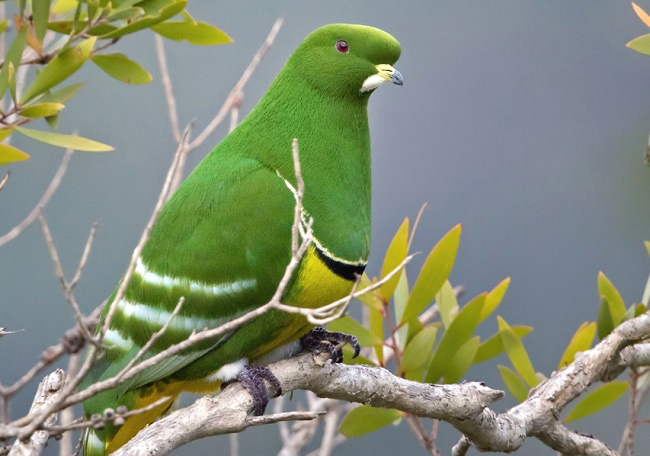
The strange Cloven-feathered Dove occurs only on the island of New Caledonia where this fine image was taken by Lars Petersson.
New Zealand
Six endemic bird families; five kiwis, three parrots, three wrens, three mohouas, four wattlebirds and Stitchbird, and 54 endemic bird species, also
including Blue Duck, Black Stilt, Wrybill, Tui, Takahe and Weka, as well as the breeding endemic, New Zealand Storm-petrel, and the islands are
just as famous for Sperm Whales and a superb selection of seabirds such as Wandering, Royal and several other albatrosses, petrels, shearwaters and
White-faced Storm Petrel, many of which can be seen at close range on boat trips.
New Zealand - Subantarctic Islands
See Subantarctic Islands, below.
P
(Western) Pacific Odyssey
See Western Pacific Odyssey, below.
Palau
See Micronesia, above.
Papua New Guinea
Nearly 500 birds are endemic to the main island of New Guinea and its offshore islands including 68 that are endemic to West Papua (the western half of the
island) and 136 that are endemic to Papua New Guinea (the eastern half) although only 33 of those are endemic to the mainland. They include Eastern, Lawes’s
and Wahnes's Parotias, Growling Riflebird, Ribbon-tailed and Stephanie’s Astrapias, Blue, Emperor and Raggiana Birds-of-paradise, and Lesser Lophornia
(Superb Bird-of-paradise), the fabulous birds-of-paradise that help make this A Top Ten Birding Destination, along with many other extraordinary creatures,
such as Palm Cockatoo, Sclater's Crowned-pigeon, Rufous-bellied and Shovel-billed Kookaburras, Red Satinbird, Flame Bowerbird, Painted Quail-thrush, four
jewel-babblers and Eastern Crested Berrypecker, to name a few. Offshore there is just as much crazy variety thanks to the fishes and other creatures living
on some of the richest coral reefs on the planet.
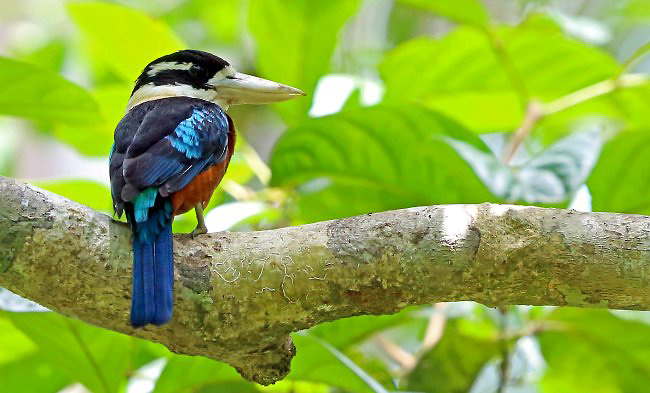
New Guinea is home to so much more than birds-of-paradise. The widespread Rufous-bellied Kookaburra for example is one of numerous spectacular endemics. Both males and females have massive white bills but males have blue tails and females rufous. This male was captured by Nigel Voaden.
Polynesia
Over 35 endemic birds including the unique Tuamotu Sandpiper, as well as lorikeets, fruit-doves, kingfishers, monarchs and reed-warblers, as well as
Bristle-thighed Curlew, lots of seabirds, including Polynesian Storm-petrel, and Common and Little White Terns, in true tropical paradises, from low-lying
atolls to high volcanic islands.
Q
Queensland (Eastern Australia)
See Australia - Eastern, above.
R
S
Samoa (Western)
Samoa consists of two large islands (Upolu and Savai’i) and eight islets and supports nine endemic bird species; Tooth-billed Pigeon (which is very rare
and unlikely to be seen), Flat-billed Kingfisher, a honeyeater known as Mao, a whistler, a triller, a fantail, a flycatcher, a white-eye and a parrotfinch,
with three more, Samoan (Crimson-crowned) Fruit-dove, Samoan (Cardinal) Myzomela and Samoan Starling, confined to (Western) Samoa and American Samoa (see
above). Samoan Moorhen is probably extinct. All surviving endemics and near-endemics except the white-eye occur on Upolu where White-tailed Tropicbirds,
Common White Terns and Brown Noddies grace the skies and other landbirds include Pacific Imperial-pigeon, Blue-crowned Lorikeet, Many-coloured Fruit-dove,
Polynesian Wattled Honeyeater, Pacific Robin and Polynesian Starling. Several endemics can be seen at the botanical gardens and in Mount Vaea Scenic
Reserve where Robert Louis Stevenson, author of Treasure Island, is buried. To see the rare white-eye it is necessary to hike high up Mount Silisili from
the village of A'opo on the island of Savai'i. All of the other endemics occur here too. Seawatching may produce Grey-backed Tern, as well as Red-footed
Booby, Great Frigatebird and Black-naped Tern. The best time to look for the endemics is July to September.
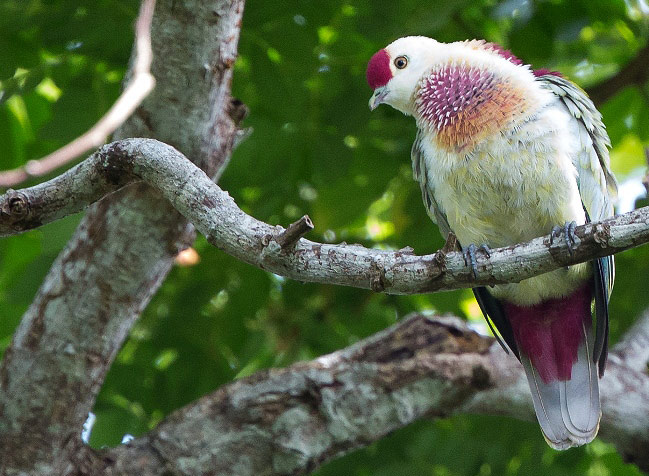
The pretty Many-coloured Fruit-dove can be seen on Samoa, Tonga and Fiji. Image by Simon Colenutt.
Solomon Islands
There are more restricted-range bird species, that is species with ranges of less than 50,000 square kilometres, in the Solomon Islands than anywhere
else on Earth. The number of endemics varies according to taxonomist but there are probably at least 70 and potentially lots more due to the presence
of many subspecies, as well as at least 20 species which otherwise occur only on other islands in Melanesia, notably Bougainville with which The Solomons
shares the likes of Fearful Owl, Sanford’s Sea-eagle, Ultramarine Kingfisher, Solomons (Ducorps’s) Cockatoo and Black-faced Pitta. To stand a chance of
seeing these and all the endemics, visitors will need to take many internal flights and be prepared to sail several times in order to visit Guadalcanal
(where the capital Honiara is situated and there are about ten single-island endemics including a rail and a moustached Kingfisher, the first male of which
was controversially 'collected' in 2015), Rennell (about eight endemics including a parrot and a shrikebill), Makira (16), Malaita (8), Santa Isabel
(an endemic rail as well as several species shared only with Bougainville), the New Georgia Islands including Kolombangara (11 including the flightless
Roviana Rail), and the Santa Cruz Islands at the southeastern end of the long archipelago (seven including Nendo Shrikebill). Three species shared only
with Vanuatu are Santa Cruz Ground-dove, Palm Lorikeet and Rusty-winged Starling. As well as birds, the Arnavon Islands to the northwest of Santa Isabel
support one of the most important rookeries in the west Pacific for Hawksbill Turtle and coral reefs surrounding many smaller islands are rich in marine
life. The best time to look for birds is July to September.
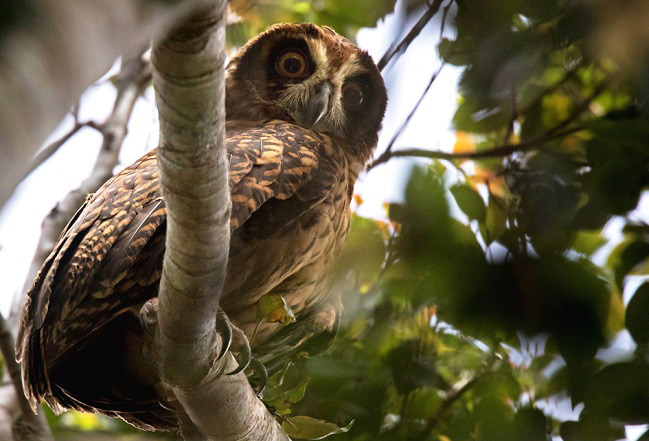
The mythical Fearful Owl on the island of Santa Isabel by Lars Petersson.
Subantarctic Islands (of New Zealand and Australia)
Millions of marine birds and mammals including King and endemic Royal Penguins, Wandering and Light-mantled Albatrosses, and elephant and fur seals, as
well as endemic ducks, shags and snipes on the Snares, Auckland, Campbell, Antipodes and Bounty Islands.
T
Tasmania
See Australia - Southeastern, above.
Tonga
Tonga is one of the few places in the world where it is possible to swim with Humpback Whales. Several operators run carefully organized tours within
the Vava'u Islands when the whales are usually present from mid-July to late October, during the dry season. The endemic Tongan Whistler occurs only
in the same island group, on A'a, 'Euakafa, Kapa, Pangaimotu, ‘Utungake and 'Uta Vava'u, as well as on the island of Late in northern Tonga. To see the
other endemic bird, Tongan (Niuafoou) Scrubfowl, it is necessary to fly to the northernmost island of all, Nuiafo'ou, where the birds can be seen at
communal nesting grounds. Neither of the two endemic birds occur on the main island, Tongatapu, but birds such as Many-coloured Fruit-dove, Polynesian
Wattled Honeyeater, Polynesian Triller and Polynesian Starling can be seen in and near the capital Nuku'alofa. From the main island it is possible to travel by ferry to the island of
'Eua where seabirds such as White-tailed Tropicbirds, Common White Terns and Grey Noddies nest. The best time to look for birds is July to
September.
V
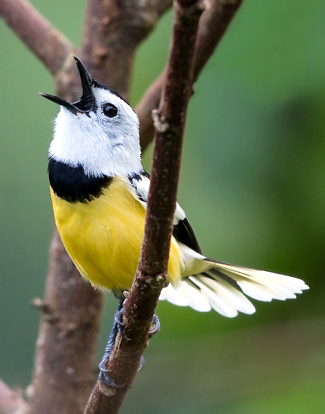
The Buff-bellied Monarch, endemic to Vanuatu, looks much better than it sounds as this superb image by Dubi Shapiro illustrates.
Vanuatu
The island of Efate is the gateway to Vanuatu but the island where all of the endemic bird species occur is Espiritu Santo. There are eleven endemics but
only five are relatively easy to see; Vanuatu Scrubfowl (especially at Palikulo Point but also in Loru Conservation Area), Vanuatu (Baker’s)
Imperial-pigeon, Tanna Fruit-dove, Vanuatu (Chestnut-bellied) Kingfisher (a difficult forest skulker), Vanuatu Honeyeater, Vanuatu Streaked Fantail,
Buff-bellied Monarch (a hyperactive forest skulker and sole member of its genus), Santo Thicketbird, Vanuatu (Yellow-fronted) White-eye, Mountain Starling
and Royal (Red-headed) Parrotfinch. The lowland forest birds are joined by Mackinlay's Cuckoo-dove, Red-bellied Fruit-dove, Pacific Imperial-pigeon, the
juliae subspecies of Pacific Kingfisher, Cardinal Myzomela, Long-tailed Triller, Melanesian (Vanuatu) Whistler and Southern Shrikebill. At the slightly
higher elevation reached via the Butmas Track the endemic imperial-pigeon and honeyeater become possible, but visitors must mount a mini-expedition with
porters and camping equipment to much higher forest to try and see the thicketbird, as well as Palm Lorikeet, Santa Cruz Ground-dove and Rusty-winged
Starling, all of which occur only in Vanuatu and the Santa Cruz Islands of the Solomon Islands. Mountain Starling is confined to the highest forests of
Espiritu Santo and Royal Parrotfinch is rare and/or nomadic on Santo but apparently more numerous on the islands of Emae and Tongoa. Two other rare birds
are the magnificens subspecies of Collared Petrel and White-necked Petrel, both of which can be seen at sea around Mota Lava and Vanua Lava in the Banks
Islands. The coral reefs around the low-lying Maskelyne Islands are some of the best for scuba-diving and snorkelling and Mt Yasur, an active volcano on
Tanna Island, is yet another natural wonder. The best time to look for the endemic birds is July to September.
W
Western Pacific Odyssey
An incredible selection of seabirds between New Zealand and Japan, from New Zealand Storm-petrel through Beck's Petrel and Heinroth's Shearwater to
Short-tailed Albatross, and many possible whales and dolphins, plus stopovers for endemic landbirds on New Caledonia and the Solomon Islands.
West Papua - Indonesia
Fantastic birds-of-paradise including Magnificent, Red, Wilson's, Western Parotia and Black Sicklebill, all displaying, mostly at close range, many other
spectacular New Guinea birds such as Palm Cockatoo, Victoria and Western Crowned-pigeons and Papuan (Blyth's) Hornbill, not forgetting some of the other
68 endemics such as Vogelkop Bowerbird, Vogelkop Lophornia (once known as Superb Bird-of-paradise), Arfak Astrapia, a chance of Long-tailed Paradigalla,
and, on offshore islands, in the richest tropical seas on Earth, Biak, Kofiau and Numfor Paradise-kingfishers.
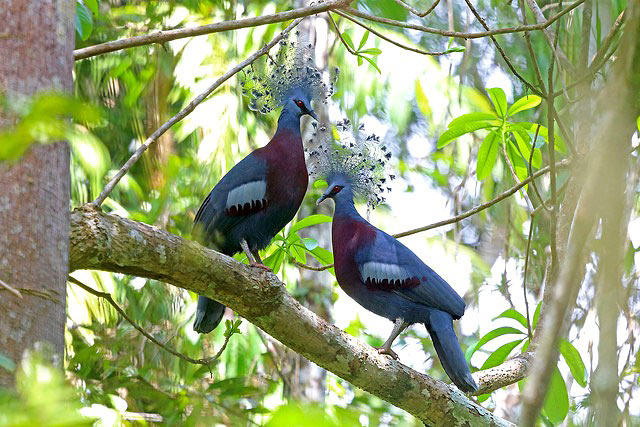
New Guinea is not all about birds-of-paradise. The numerous other spectacular endemics include three species of huge crowned-pigeons including Victoria Crowned-pigeon which inhabits the northern lowlands where this fantastic image was captured by Nigel Voaden at Nimbokrang in West Papua.
Y
Yap
See Micronesia, above.
